Emily’s Dress and Other Missing Things

“Emily Dickinson is the perfect thing to hand to a 16-year old girl,” advised fellow blogger lynchlibrarian recently. What is it about Emily? Indeed, I was 16 when I purchased my paperback copy of her complete works (at the local Borders bookstore, my idea of the cool hangout spot), and I vividly remember discussing “Success is counted sweetest” in my high school’s U.S. Literature class. Certainly I considered her words earlier and later in life, though not by much: an eager seventh grade teacher chalked “I never saw a moor” on the board for the daily quote; in my second year of college, fellow English majors and I spent the better part of a class dissecting the differences between her 1859 and 1861 versions of “Safe in their Alabaster Chambers” (the power — of a dash!).

So what is it about Emily that resonates during young adulthood? While increasingly introspective teens may be intrigued by her famously reclusive habits, it’s her words that truly inspire. At a time when teenagers feel pulled between their past and future selves, her voice simultaneously offers innocence and wisdom. As they encounter the terribly great problems of the world and personal decisions to make, her subject matter rings with the impossible brightness and darkness of life’s great questions. Through succinct, tender verses, Emily provides young people with a “nugget of pure truth” to grasp in their hands and hearts. (My Virginia Woolf obsession came later in life.)
  Feathers by Jacqueline Woodson   Emily's Dress and Other Missing Things

If young people miss out on enthusiastic teachers reading Emily’s poetry aloud, I’m happy to know they may also discover her in the pages of fiction. Jacqueline Woodson’s beloved Feathers (Putnam, 2007) perfectly pairs “‘Hope’ is the thing with feathers” with a story that examines the power of friendship over divisions and discrimination during the 1970s, a fragile, precariously hopeful time in our nation’s history. What a perfect story for a 12-year-old.

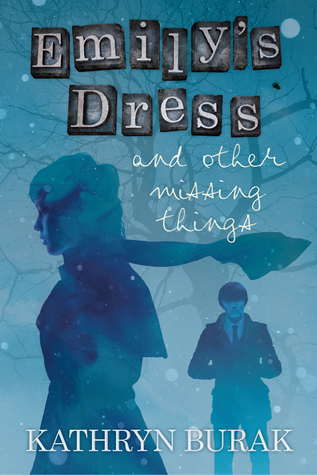
For older readers, Kathryn Burak’s novel Emily’s Dress and Other Missing Things (Roaring Book Press, 2012) explores Emily’s darker side. After experiencing personal tragedy, Claire and her father attempt to start fresh by moving to Amherst, Massachusetts, the home of Emily Dickinson. Claire is a poet herself  and finds herself drawn to Emily’s words, rich with poignant examinations of death, and to Emily’s house, now of course a museum where Emily’s personal belongings are artfully arranged for tourists to view. As if in a creative trance, she breaks in, night after night, to write while wearing Emily’s white dress — until the day the college-aged student teacher Tate discovers her. Instantly linked by this strangely intimate crime, they run, stealing the dress in the process. Burak’s poetry is the star of this novel, both in the actual verses Claire writes — the portals by which she gradually shares the tragic details of her past — and in the crisp, shimmering prose of Claire’s narration:

The smell of snow on the winter air fades. I take a deep breath. I smell paper. Here I have the cool, clean feeling of paper, too.

I am so glad to get away. To be in Emily Dickinson’s house.


With a frigate like this book, the reader will certainly agree.

Jeb

JebI adopted a dog over spring break. Jeb is an indeterminate hound, sweet, affable, and a little bit goofy. He arrived in Chicago from an informal pipeline that extends down to Oklahoma, rescuing dogs from uncertain futures. We don’t know much about Jeb. He had no people to turn him in. He has no real history. It seems as though he has lived his life on the streets; things like the indoors are something of a mystery to him. Doors are a curiosity, regular meals are a revelation, and he had no idea what to make of stairs. He didn’t know if or when I was coming back. All of these things he had to figure out on his own. I couldn’t tell him. It was all left to trust, to consistency, to promise.

And he is starting to understand.

I mention this because it reminds me of our first experiences with books and with libraries, especially when we are children. It is nice to hear pretty words about access and service and commitment. It is nice to be told that the books and stories belong to us. But whatever you tell me about who you are and who I am to you, I will know the truth of these things through my experiences. If children are to trust that we will not judge their reading choices, we must celebrate those choices. If teens are to believe that their ideas have a place in our business, we must integrate those ideas. All library users will know the library through their contact with it, but young people, above all, will take those understandings to heart.

Just like Jeb.

Oliver

Oliver by Birgitta Sif

Oliver

by Birgitta Sif

Candlewick, 2012

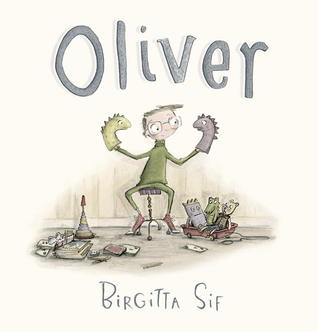
From Ferdinand to Frederick, children have wonderful (often animal) picture book role models who express the value in accepting yourself. And of course that message is all well and good. Yet in reality, the self satisfaction found in cherishing your uniqueness sometimes fails to eclipse the loneliness that so often accompanies it. Take Oliver. Here’s a young person who doesn’t seem particularly plagued by the burden of his differentness. He’s not cursing a defect or suffering from taunts; he’s not asking a parent why he is the way he is. He rather enjoys his quiet, imaginative life. His playmates are his toys, plush animals whom he carts around the library and yard. Even surrounded by his boisterous family, Oliver prefers to retreat into his own world with these soft-hearted friends.

And with these playful illustrations, the reader may retreat with him. Notice the subtle glances of otherwise button eyes, the teasing suggestion of life from what reason would inform are inanimate objects: a tiny glimpse for us into the everyday magic Oliver experiences.

Until one day, it’s not enough for Oliver. His animal friends, heaped in a pile, don’t respond like they used to. Yes, Oliver likes the way he is, and isn’t purposefully ostracized for it. There’s no doubting of self here. What Oliver lacks is someone who sees the world like he sees it; someone who can appreciate him and share his fantastical world and adventures. By the book’s end and through a fateful moment, Oliver finds his someone: a someone who’s more than plush stuffing and button eyes. And as the reader turns back to pore over the warmly detailed illustrations, she discovers that Oliver’s new friend has been with him all along, present but unseen. More magic lives on these pages, and in Oliver’s world, than first meets the eye. And as Oliver discovers, magic begs to be shared.

Bluefish

Bluefish by Pat SchmatzRecently during some pretend-play time, my two-year-old niece tucked me into bed and read me a bedtime story.

Of course she didn’t really read it to me. With each illustration, her memory triggered from the countless times Daddy read Olivier Dunrea’s Ollie aloud, and she recited each word flawlessly. A kind of decoding, it could be argued, but not true reading.

Yet for a blissful moment as I snuggled under a doll-sized blanket, I could imagine it. Reading is so commonplace, so easy for most people in my life, I could momentarily believe that this tiny person, so recently a baby, was reading me a story. It felt natural. Normal.

Yet it’s a remarkable feat, isn’t it? Gorillas can learn some basic sign, and dogs can apparently be trained to recognize words, but no other species comes close to the incredible things we can do in speaking, reading and writing. Phonemes come together to represent ideas, and then those sounds are further represented by these symbols on the page. It’s decoding that’s two abstract layers deep, yet somehow we all manage to master this skill by the time we’re still young children.

Well, most of us do.

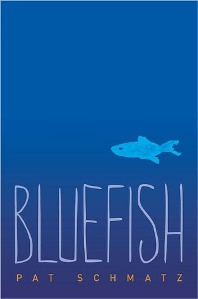
In Bluefish we meet a 14-year-old protagonist who cannot read. We aren’t aware of that information at first. Like the parents and teachers who know him marginally, we might see Travis as indifferent. Guarded. Maybe a little rebellious or even lazy. A typical teenager, no? If only he would try harder. If only he would apply himself.

But then we learn of his problem, and we think of how little we know anyone. How much we can assume. And how mountainous of a task it would be to catch up to peers ahead of you by 10 years of reading.

Thank goodness he’s not alone. One wise teacher catches on, and with pointed references to The Book Thief, he has him start circling words just as Liesel did. An eccentric classmate, Velveeta, eventually figures it out as well, and offers her help. But there’s no romantic eureka moment in this process. It’s slow, often frustrating work. Velveeta, eager to see results, makes a painful mistake after a failed tutoring attempt:

“Travis, come on. You didn’t even try.”

Try. That word torched fire-hot.

Of course he’s trying; it’s the single most important skill in society. He can’t read, but he’s not a fool.

How many of us fervent readers might ask him to try harder? How easy it seems now, our linguistic synapses established so long ago. I see myself in Velveeta, eager to help and a bit clueless how to do so. Here’s something she’s good at, something she perhaps can fix – a marked difference from her own problems hidden beneath her exuberant exterior. Though Velveeta can’t fix Travis’ reading problem, she can be his friend, with all the trust and acceptance (and, yes, mistakes) that come with the job. And he can be hers right back.