Brave Irene

brave-ireneBrave Irene

by William Steig

Farrar, Straus and Giroux, 1986

A childhood favorite of mine, this book is about one girl’s determination to help her mother in the face of trouble. When Irene’s mother, a seamstress, falls sick, there is no one to take a beautiful gown to the duchess on the day of her big ball. Irene takes on the job, and bounds through whirling snow and bitter wind that taunts Irene, telling her to GO HO—WO—WOME!” After the package flies out of Irene’s arms and the dress blows away, Irene becomes buried in snow and almost gives up. But remembering her mother’s face, she leaps out of the snow and races down the hill to the duchess’s house. She sees the beautiful dress her mom made next to a tree, and is greeted by a glowing fire, a warm meal, and cheerful faces when she knocks on the duchess’s door. William Steig’s classic illustration style—with atmospheric color, bold outlining, and sketch-like detail—shines in this heartwarming story. It is notable that the text is longer than the average picture book, and so I would only use this with a well-behaved preschool storytime group. It is also significant that the story deals with some heavy, questionable circumstances. As I child, I never wondered why Irene’s mother let her go out in the freezing snowstorm, but now I do. I never worried about the implications of young Irene staying overnight in a stranger’s home, but now I do. When Irene gets buried in the snow, she asks herself, “Why not freeze to death, and let all these troubles end?” Of course, the beauty is that she finds hope in the image of her mother’s face and keeps going, but it is definitely intense material for storytime. Yet, the theme of this picture book is hope amidst chaos, and determination in a world that wants you to give up. How can we not share a book with such poignant themes with children?
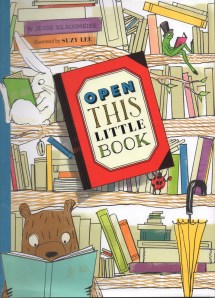
Open This Little Book

open this little bookOpen This Little Book

written by Jesse Klausmeier

illustrated by Suzy Lee

Chronicle Books, 2013

In a world where meta is everywhere, a book turning in on itself might come across as trendy or superficial. Indeed, many such books do. But the overuse of a particular approach to storytelling does not make such an approach necessarily obsolete. It does, however, raise the storytelling bar. To transcend the dangers of gimmickry, a meta picture book needs to weave together its plot, text and illustration into a tight and cohesive package, in service of a reverberant message. Fixing meta’s self reflection in some meaningful purpose grounds it, rescuing the by-definition disconnectedness of the narrative from flapping in the literary breeze. When done right, this kind of circular storytelling packs a real wallop, and such is the case with Open This Little Book.

The book is literally a number of books inside one another, each smaller than the last, each identified by a different colored cover (purple, red, green, orange, yellow, blue), each “opened” in succession by a different character (reader, ladybug, frog, rabbit, bear, giant), and then consumed and read in reverse order, arriving at the end with a compelling case for more. More books. More reading. More community. The clarity of Klausmeier’s text, clean and simple and exact, and the way she establishes and then breaks the patterned structure, shows more than tells us about the seductive sway of a well-written book. Suzy Lee’s careful illustrations begin in monochrome with the singular color of the little books’ titles. With each successive opening we have more colors in which to delight, and by the time we arrive at the final scene, with all of our friends, plus many more, luxuriating beneath and within a polychrome tree full of books, the remarkably appealing rainbow of variety stands as an immediate, resonant symbol of the endless glories of books and reading.

This is a book you need to find and experience with your own hands and eyes (and spirit). I include the book trailer below to give you a sense of the mechanics and the mood, but there is no substitute for opening this little book yourself.

A Library Lost

Seattle Public Library

Seattle Public Library

I’ve noticed an apocalyptic atmosphere has permeated the mindset of more than a few library folk pondering the future of libraries and cannot imagine it is entirely related to recent popularity surges in dystopic YA literature. Upon entering one south suburban public library recently, I felt an urge to manually shut my gaping mouth. The foyer (if you will) is stories high, endless in square footage, and enveloped with more glass than the Louvre. Stunning? Absolutely. Overkill? Of course it is; to someone who believes the mass exodus from and therefore subsequent end of the library as we know it is nigh. It seems unreasonable to spend already scarce dollars on fanciful buildings to house ill-fated manuscripts. Surely, there are more important things for society to build. Maybe a new strip mall just inches away from already abandoned ones? Did anyone say coffee shops? While no architectural expert, I would suggest that the increasing number of contemporary library spaces boasting impressive price tags speaks volumes. There’s still an outside chance that libraries are doing alright. On the other hand, to the catastrophe seeker, such spending makes for shameful waste in a time with only one apparent certainty: library mortality is imminent. The party is over.

So be it! Car per diem, or is it carpe diem? Sempre Fi? Siempre fiel? Who can say? Alas, I shall prepare for mine end. Woe to he who dares wish be in a shelf-lined fallout shelter donning a scraggly, Howard Hughes-esque beard and early Roman Empire garb (shiver). I, for one, have chosen not to ignore the copious patron masses that frequent these new library spaces. None need tell my family I love them and am hoarding countless first editions, many of which are self-help volumes to ease my transition into a loathsome, lackluster, library-less shell of a world. Perhaps a day will come when mean-spirited, torch-wielding, cyborgs with melting faux-flesh enter our sanctuaries to destroy all who read have come to champion. Nevertheless, I will not go shhhhingly into those dark stacks. Hear me, faithful library servant, I feign no shame in sharing my last crumb with the likes of Despereaux, in shedding one last tear over the quintessential relationship troubled, in breathing the last collective breath of gallant protagonists lost. No, I shall with constant vigilance continue fighting for freedom of the intellectual kind until that shiny, circuit driven, skeletal hand punches through four stories of plate glass bellowing “You are terminated!”

Image from http://www.spl.org/locations/central-library

Ed Young to visit the Butler Center!

Caldecott Medalist Ed Young is coming to the Butler Center in February for two spectacular events.

ed youngOn Friday, February 22 at 6:00pm Mr. Young will deliver the inaugural Butler Lecture “The House Baba Built” in which he will talk about his book of the same name. This beautiful and engaging piece of expressive nonfiction chronicles his childhood in Shanghai and illuminates the monumental home his father built for his family, which was both a playground for Young and his siblings, and a refuge from the dangers of the second world war for friends from around the world. The lecture is free and open to the public, but registration is required. Click here to register.

On Saturday, February 23 Mr. Young headlines The Truth About Expression, the Butler Center’s fourth annual continuing education conference. Every year we look to literature for young people as a means of pursuing and understanding some aspect of our world a little more fully. This year we investigate expression. Joining Mr. Young are Ascha Drake, Amanda Freymann and Joan Sommers, cocreators of Chuck Close: Face Book, the artist’s Boston Globe Horn Book Award winning autobiography; members of the Butler Center community; and local storytellers of international repute. Visit The Truth About Expression  page for more information and click here to register.

Oliver Jeffers

I have written before about the glories of This Moose Belongs to Me. Here’s an appealing video wherein author/illustrator Oliver Jeffers talks about his process. It’s fascinating to hear about the integration of text and image from the very beginning, and really cool to see his visual aesthetic (and effervescent sense of humor) manifest all across his life.