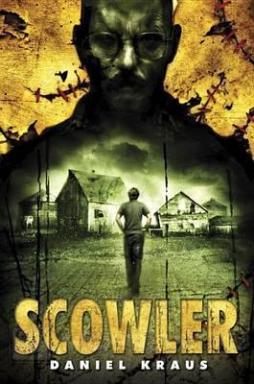
 Scowler
by Daniel Kraus
Delacorte, 2013
As always in a Daniel Kraus novel, there’s plenty going on and it’s all terrible.
In Scowler, Kraus’ latest, two monsters threaten the lives of nineteen-year-old Ry, his mother, and his younger sister. The first is Ry’s father. Abusive and cunning, he has escaped from prison with plans to slaughter his family. The second threat is Ry himself. Or rather, Ry’s hallucinations of boyhood toys, come to life, telling him what to do. (Plus, there’s a comet headed for the family’s farm.)
But with all the gruesome twists and turns of the plot, there’s one early scene that stands out to me. I can’t seem to shake it.
Ry recalls a morning after one of his parents’ violent fights. His father has left and he breaks into his parents’ locked bedroom. His mother has been sewn to the bed. Every part of her body, from her ear to each space in between her toes has been methodically threaded to the mattress. Ry gets scissors and begins the long process of removing every stitch. He recalls the details with tenderness:
“Ry felt the prim fealty of a nurse as he took up the pink fabric, shook out its crusty folds, and quartered it… He found a clean edge and swept beads of sweat from his mother’s lip and brow. Then he refolded it again and wiped the urine from her thighs and blotted what he could from the mattress. He discarded the fabric in the trash can and took up the shears. It was the most intimate thing he had ever shared with anyone.”
Daniel Kraus is masterful at confronting both his characters and readers with the meaty reality of the human body. He loves to expose our physicality and ultimately our mortality, turning our bodies into terror.
But it was the tenderness of this scene that shook me. In Ry’s response Kraus exposed a fear beyond the physical. It’s not just about losing a parent to death or violence. It’s about taking on the role of caregiver when a parent is weak and needy – losing a parent to adulthood.
The scene felt deeply familiar to me, reminding me of those moments when I was confronted with my own parents’ physical, mental, or emotional weaknesses. There is a unique blend of terror and love in those moments when a parent needs you more than you need them. And I think Daniel Kraus captured it perfectly.
I am at least ten years older than the intended audience of this book and my parents are significantly older than those of my peers. So perhaps this scene generates images and feelings for me that it would or could not for teen readers. But I suspect that for a lot of people the struggle of their teenage years is intricately tied to the loss of a parent, sometimes to death or illness, but more often to a painful recognition of their parents’ limitations. So while the scene may not feel familiar to all readers, it can still presage the inevitable consequences of adulthood.



 Butler's Pantry