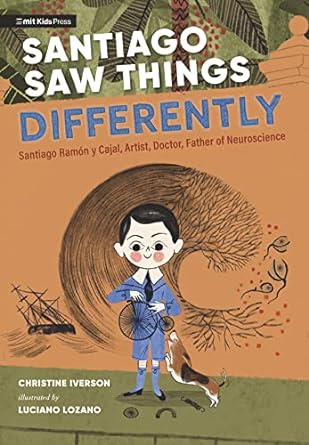
Santiago Saw Things Differently: Santiago Ramon y Cajal, Artist, Doctor, Father of Neuroscience
Christine Iverson
Illustrated by Luciano Lozano
Candlewick Press
November 14, 2023
Ages 5-9
Immerse yourself in the illuminating story of the multitalented Nobel Prize winner Santiago Cajal—the little known founder of neuroscience. Santiago discovered at the age of eight that he loved to draw using charcoal or chalk, especially on gates, doors, and blank walls in the neighborhood. The neighbors felt that the drawings were an annoyance, “but Santiago saw things differently. He was an artist and always would be” (p. 8). Santiago’s father wanted him to be a doctor, but he continued to draw and paint in secret. Santiago and his father stumbled upon human bones in an old graveyard, and he was hooked on human anatomy. “He saw the human body as a work of art” (p. 20). Santiago attended medical school and invented a way to study nerve cells more clearly under a microscope. Through his nervous system work and scientific drawings of nerve cells, he helped doctors learn about the human nervous system, enabling more people to survive and heal from disease.
Pages in this nonfiction picture book are enriched with a combination of digital illustrations and Santiago’s actual detailed scientific drawings of neural pathways. Muted blues, oranges, browns, and greens illustrate a curious young boy and later the man whose curiosity leads to his brilliant discoveries. Illustrations are positioned on sepia-toned pages giving the story an appropriate old-world feel for the backdrop of 1800’s Spain. Iverson’s bold text evokes Santiago’s pioneering spirit, passion, and perseverance. Educators and librarians may choose to share this book with children who enjoy biographies, science, and art and the themes of persistence, determination, and ambitious dreams. The afterword includes a description of the anatomy of a neuron, a self-portrait, and further reading on the personal and professional life of the “Father of Neuroscience.” Santiago Saw Things Differently shines a light on a scientist who deserves more recognition for his remarkable accomplishments.
 Butler's Pantry