Peggy Sharp comes to GSLIS

peggy sharpRespected children’s book authority Peggy Sharp has been touring the country and delighting audiences with her trademark rapid-fire, how-many-titles-can-you-talk-about-in-a-day booktalk sessions for years. This year marks the final tour (Peggy will retire at the end of 2013) and the last chance you’ll have to see and hear her work her magic. She will be at Dominican on November 1st, 2013, with her program “What’s New in Children’s Literature: A Look at the Latest Children’s Books and How to Use Them in Your Program,” jam-packed with ready-to-use-tomorrow ideas.
Preview the best new children’s books: fiction, nonfiction, picture books.

Learn about the future of children’s books and current hot topics in the world of children’s literature.

Discuss the latest technological developments in the world of children’s literature.

Earn 7 CPDU’s!

All participants will leave with extensive annotated bibliographies in a comprehensive resource handbook full of outstanding ideas.

$130 fee includes lunch, breaks and handouts

For more information and to register, visit http://gslis.dom.edu/newsevents/whatsnew2013

Questions: Call (708) 524-6054

Fifty Shades of Ambiguity

As we enter the second week of the federal government shutdown and consider the particularly polarized nature of the DC discourse itself, and the coverage of same, it is hard not to conclude that we have arrived, as a country, at some sort of cultural impasse. Our two-party system seems to have devolved into a he-said-she-said standoff full of bull-headed bravado and empty of reason. And as if the certainty of the politicians wasn’t enough, all of us in the peanut gallery, regardless of which side of the divide we’re spectating from, are equally certain about who’s right and who’s guilty. 100%.

Uh oh.

It seems that the very idea of challenging our own assumptions, wondering about our choices, even changing our minds, is an endangered species.

Part of the reason I do the work I do, in fact, a big part of the reason, has to do with raising up a generation (or 12) of critical thinkers. Kids enter the world with an incredible openness and curiosity, and it is through their cultural “education” that they let go of these possibilities in exchange for a sense of certainty. But those of us who endeavor to connect kids with stories understand the role those connections can play in keeping the wonder gates open. Meeting up with other people (and bears and vampires and cupcakes) in books allows kids to experience things they can’t or don’t experience on their own. Yet. And reading books that expose them to different sides of the same story lets them know that, usually, there is more than one side.

There are, happily, many books for young people that acknowledge, and even celebrate ambiguity. Let’s take a look at a few books about some of our founding fathers. The current debate is fraught with invocations of their fundamental perfection. And yet, there are some books out there, books for children no less, that see them as the people they really were, humanity and all.

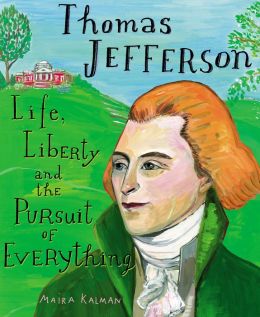
thomas jeffersonIn her upcoming picturebook biography Thomas Jefferson: Life, Liberty and the Pursuit of Everything, Maira Kalman makes the most of her brilliant, quasi-surrealist stlye, painting a portrait of the nation’s third president that expresses the dynamic breadth of his interests and the depth of the passion he brought to them in her wondrous tableaux of electric colors. We learn of diverse pursuits, the art and architecture, science, botany, etc. We learn of the care and generosity with which he ran his house and his infamous Monticello estate. We learn of his public pronouncements about the evils of slavery. And we learn about the slaves he kept himself, including one Sally Hemings, who, it is believed, bore him a number of children. In the mainstream media much has been made of Jefferson’s alleged relationship (so much, in fact, that some would say the allegations are proven) but we do not always see such admissions of guilt in books aimed at young children. But in her direct and unapologetic treatment of the whole man, Kalman ultimately paints a portrait that is more compelling for its inclusion of flaws.

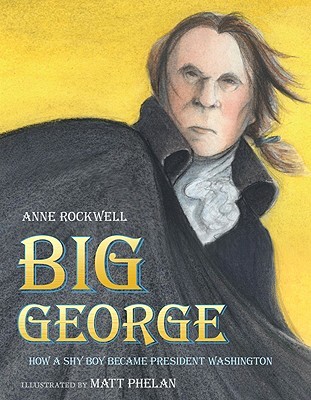
big georgeIn Big George: How a Shy Boy Became President Washington, author Anne Rockwell and illustrator Matt Phelan paint a similarly human portrait of the first of the founding fathers. Right from the start, before we even open the book, we see a different George Washington than the one we’re accustomed to, younger, sadder, and maybe, even, angry. And then we have a subtitle suggesting that he’s shy, a characterization markedly different from the man pictured. The portrait that follows is just as complex and nuanced as the cover promises. Instead of the iconic truth teller of cherry trees and wooden teeth, we meet a man of soft speech and quiet ways. We meet a man reluctant to assume the responsibilities thrust upon him but resigned to his duties. We meet a man. Throughout the book there are tensions between the text and the illustrations, which positively vibrate with the conflicts Washington experienced throughout his life. This is another portrait of an American “hero” that transcends the ordinary hero worship to offer a bigger picture actually worthy of its subject.

The thing to remember is that kids start out smart. They start out ready to think and learn and grow. They wonder. They change their minds. And the best authors and illustrators making books for them see in them the potential to stretch and grow, and challenge them accordingly. There is an inherent and profound respect in asking a lot of a child audience, setting our standards high and believing in their capacity to meet them. In my experience, kids give you what you expect of them. If you expect little, that’s what you get. If you expect everything, look out. I expect them to think and to change their minds.

Of course, I expect this of my politicians, too, and of late I have been sorely disappointed. But if we stick to our commitment to raising up the next generation with open curiosity, I have every faith that we may yet live up to our sizable ideals as a nation of thinkers.

Thomas Jefferson: Life, Liberty and the Pursuit of Everything, by Maira Kalman, Nancy Paulsen Books, 2014.

Big George: How a Shy Boy Became President Washington, by Anne Rockwell, illustrated by Matt Phelan, Houghton Mifflin Harcourt, 2009.

Adrenaline Fix

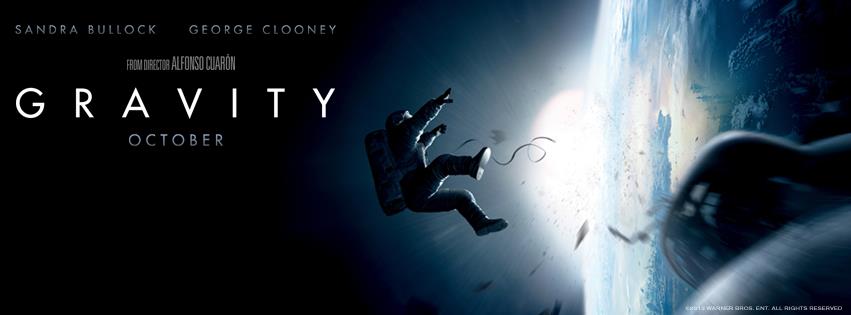
gravityI’m really not much of an adrenaline junky. Sure, I like a roller coaster as much as the next person (though I am now, sadly, too tall to ride most of them) and I’d follow Jason Bourne anywhere. But friends will tell you that all I catch of a screen thriller is what I can see between the fingers pressed firmly over my eyes. I hear even less (my thumbs are blocking my ears). And it takes a good nine hours to watch one from the comfort of my couch, what with all the pausing and walking around the living room shaking out my hands. And yet I find myself strangely addicted to the trailer for the new Alfonso Cuarón film Gravity. The first time I saw it in a theater the hair on my arms was standing up for a good five minutes, and I have worn out the various views on the YouTube (like this one and this one).

And it all has me wondering about a corollary interest in take-your-breath-away books. What are the reads that have left me gasping?

the white darkness The first thing that came to my mind is Geraldine McCaughrean’s Printz-winning The White Darkness which, quite frankly, scared the bejeezus out of me. This story of a shy girl with a hearing impairment and an historically accurate imaginary friend who accompanies her uncle on a mysterious trip to Antarctica compounds the menace of an unhinged villain with all of the terror mother nature can muster. Good night that book is scary.

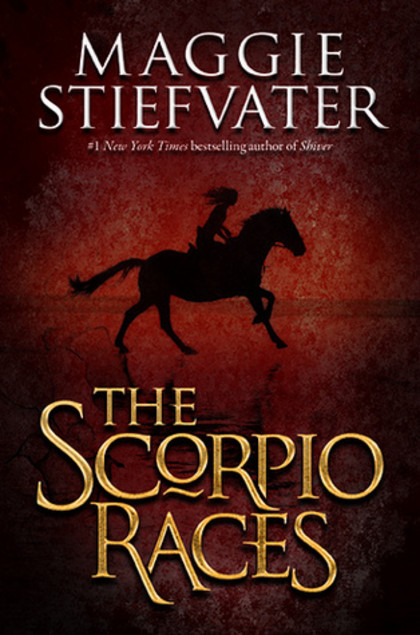
the scorpio racesThe Scorpio Races by Maggie Stiefvater raises hairs in an entirely different way. This is the story of the deadly races that happen every autumn along the shores of a Celtic Island where men capture and train capaill uisce, fierce, carnivorous horses that rise from the sea. And this time, for the first time, young Puck will be the first woman in the race. Much hangs in the balance in this taut drama, but it is Stiefvater’s evocation of the fearsome horses themselves, all teeth and muscle and blood and bone, that is so spine-chilling.

The_Great_Wide_SeaAnd then we’ve got something like The Great Wide Sea by M.H. Herlong that delivers its fright straight through the realm of possibility. Three boys set out on a year-long sail around the world with their father, broken by the recent death of their mother and clearly spinning outside the reach of responsibility. Tensions on the little craft are bad enough, but when the boys awake one morning to find the deck empty and their father gone, fear sets in. Slowly the boys’ resilience weakens as life becomes increasingly precarious and survival starts to slip from their grasp.

And what about you? What are your favorite tales of terror? Hit us up!

Kinship Project

voice from afarThe Butler Center opened in its permanent space two years ago today on September 11th, 2011, the tenth anniversary of that infamous day in world history. To commemorate that occasion we curated an exhibit called the Kinship Project, a collection of books for children and teens that speak to our human kinship. We created a catalog with notes that speak to each of the 29 books connection to the idea of kinship. I link here to the online version. We have some print copies as well (beautiful, actually) and I’d be happy to send some along to you, too. Just fill out the form below with your name and address and I’ll get them in the mail.

← Back

Thank you for your response. ✨

How about you? What do you remember of that day? What do your memories have to say to your work with books and young people? Where do you see kinship among the collections we keep?

Picture Books about Loss

myfathersarmsareaboatThe most recent Horn Book includes my article on picture books about loss in which I argue for the forced subjection of preschool children to books about death. In storytime. This gets right to my abiding belief in the importance of grounding our work in mission. Is there a purpose to storytime beyond entertainment? What might that be? And what can we do to invest our programs with deeper meaning? Read three-year-olds books about dead dogs, of course!

Seriously, though, let us remember, always, that children’s library experiences are formative. This is especially true of very young children. If I want teens to think of books and stories as an integral part of their emotional well-being (and I do want that, very much) then I had better make sure that their earliest literary experiences show them how and where books and stories fit. Young people will never know the breadth of our collections if we hide it from them. And they will never believe in their rights to all stories unless all stories share the same spotlights.

That’s what I think. What do you think?

Here’s the article: “What Makes a Good Picture Book about Loss?

When You Wander: A Search-and-Rescue Dog Story

when you wanderWhen You Wander: A Search-and-Rescue Dog Story

by Margarita Engle, illustrated by Mary Morgan

Henry Holt, 2013

“If you are lost, stay in one place. Hug a tree. Think of me.”

On paper everything about this sounds didactic and cloying, in the sort of way that might give one a headache and a toothache at the same time. A sniffing school graduate offers help to would-be lost children to keep them safe and get them found. Her first person (first canine?) exposition outlines specific procedures to be undertaken by a lost toddler matched to the dog’s skills and knowledge.

And it is sweet, make no mistake, and not without purpose.

But it is so much more than that. The language is warm and clear, presenting the instructions in an easy, friendly way, studded with details of particular meaning to a child. It is lilting and confident and happy on the tongue, broken like verse to reinforce its poetic rhythms to the reader-alouder. The toddler in question is shown in the rescue dog’s imagination, doing toddlery things that leave an indelible olfactory trail. The pictures themselves, soft and unapologetically accessible, establish a tone of security and success. And so children understand being lost in terms of the dog’s expertise, not the danger the dfficulty represents. In a final spread the roles are switched, as the child, now safe home in bed, dreams of her rescuer in a dream bubble of her own.

Above all, though, this is a story. I wouldn’t hesitate for a moment reading this aloud to a group of children, not because it contains important information that all children need to hear, but because it is purely delightful. Would that more books built on a message could be so.

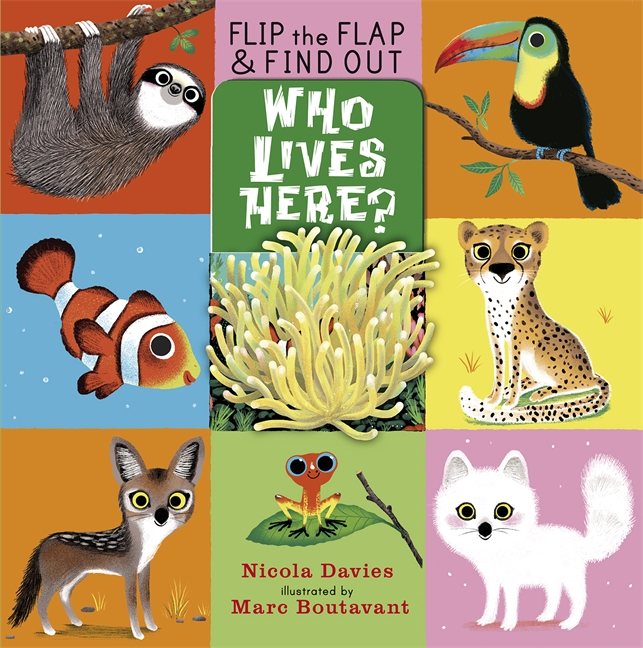
Who Lives Here?

who lives hereWho Lives Here?

by Nicola Davies, illustrated by Marc Boutavant

Candlewick, 2012

Davies employs her considerable zoological chops in service to very young children in this ingenious, elegant and especially attractive lift-the-flap matching-game. The author introduces a series of five habitats (warm, steamy jungle; still, cool pond; dry, sunny grassland; warm, clear, salty ocean; and snowy, frozen Arctic) in two two-page spreads. In the first spread, on the left is the habitat itself, with various forms of wildlife hidden about, and on the right are four quadrants, each with a flap decorated with an abstracted image representing a different habitat. Lifting each flap reveals a different animal who says where it lives, with the final (bottom right) flap exposing one animal who lives in the habitat in question. The subsequent spread shows an expanded image of the habitat, with clearer views of its many inhabitants and a few details about the one animal hidden beneath the flap on the previous page. A final spread identifies all 20 animals and invites us to match them, using their background colors as a guide.

Boutavant’s deliciously cute images, with big eyes and softened, rounded edges, recall an earlier age of children’s book illustration. Indeed, they would look right at home in the 1950s. But beyond their obvious appeal to the target audience (and to me), they conform to careful and deliberate book design pattern, adding lots of value to the entire outing. For example:

  • Each of the flaps attaches on a different axis, the first at the bottom, the second on the left, the third on the right, and the fourth at the top.
  • Each habitat image hides four animals. One of them appears under the matching habitat flap on the next page. The other three appear under the flaps for that habitat on the other pages.
  • The flaps are affixed to quadrants of contrasting colors, and the color behind the “correct” flap matches the background color of the particular habitat.
  • Text on the back of each flap offers further information about the habitat it represents and the particular animal beneath it.

And all of this pattern means that there’s lots and lots to learn from a book like this. Wildlife ecology is just the beginning. For here are lessons about how books work, and what we can and should look for as we consume them. In lots of ways, this is a book about books and reading as much as it is a book about habitat.

I love it up.

Using Caldecott Books with Older Readers

by Thom Barthelmess

1203_c75logowlrgFor 75 years the Randolph Caldecott Medal has defined illustrative excellence in American picture book publication. And for 75 years children have delighted in the narrative power of imagery. A few years ago the New York Times ran an article entitled Picture Books No Longer a Staple for Children in which reporter Julie Bosman attributed a marked decline in picture book sales to parents pushing their children to the independent reading of chapter books earlier and earlier. The response from the kidlit community was fast and furious (and occasionally indignant), on the NYT site and across social media. We proclaimed the value of picture books for pre-readers, early readers and practiced readers, citing, among other things, the visual literacy, narrative sophistication and pure joy they provide.

As librarians serving young people we have a particular responsibility to the culture of reading. Children and their families observe our attitudes and behaviors and make assessments about books and reading accordingly. Lots of libraries have systematic programs that share picture books with preschool children (AKA storytime). But how many of us do the same for older readers, regularly sharing and using picture books with the upper elementary and middle school sets? If we want kids of all ages to include picture books among their reading choices, we need to show (not tell) them that picture books belong to them.

And Caldecott books seem like a pretty darn good place to start.

Here are some ideas about categorical ways we can share Caldecott Medal and Honor books with older readers, with suggestions for particular titles in each category. What has worked for you? What are you thinking about trying? Let us know in the form below!

Read Aloud!

It’s true that the Caldecott Medal recognizes excellence in illustration, and text is, by definition, not part of the evaluation equation. But many books in the Caldecott canon read aloud beautifully. And reading them aloud does double duty; on the surface kids enjoy the experience, and underneath they understand that being read to is a normal, legitimate thing (in the presence of lots of “evidence” to the contrary).

Here are some of my favorite Caldecott read alouds that older readers might enjoy:

This Is Not My Hat by Jon Klassen (Candlewick Press – CM 2013)

Dave the Potter: Artist, Poet, Slave illustrated by Bryan Collier, written by Laban Carrick Hill (Little, Brown and Company, a division of Hachette Book Group, Inc. – CH 2011)

Red Sings from Treetops: A Year in Colors illustrated by Pamela Zagarenski, written by Joyce Sidman (Houghton Mifflin Books for Children/Houghton Mifflin Harcourt – CH 2010)

Don’t Let the Pigeon Drive the Bus by Mo Willems. (Hyperion – CH 2004)

Tar Beach by Faith Ringgold (Crown Publishers, Inc., a Random House Co. – CH 1992)

A Visit to William Blake’s Inn: Poems for Innocent and Experienced Travelers illustrated by Alice & Martin Provensen; text: Nancy Willard (Harcourt – CH 1982, also NM 1982)

Rain Makes Applesauce illustrated by Marvin Bileck; text: Julian Scheer (Holiday – CH 1965)

Explore Art – Media!

Over the years the Caldecott committee has recognized illustrations in a wide variety of media (except photography?!). Examining a few books that use a particular medium in different ways is a great way to introduce that medium to kids, and get their own creative juices flowing.

Block prints

These artists use wood or linoleum blocks to make their images. You can use potatoes!

Ella Sarah Gets Dressed by Margaret Chodos-Irvine (Harcourt, Inc. – CH 2004)

Once a Mouse retold and illustrated by Marcia Brown (Scribner – CM 1962)

The House that Jack Built: La Maison Que Jacques A Batie by Antonio Frasconi (Harcourt – CH 1959)

Watercolor

Invest in some watercolor paper. The difference will astound you!

The Lion & the Mouse by Jerry Pinkney (Little, Brown & Company – CM 2010)

Click, Clack, Moo: Cows that Type illustrated by Betsy Lewin, written by Doreen Cronin (Simon & Schuster – CH 2001)

Yo! Yes? illustrated by Chris Raschka; text: edited by Richard Jackson (Orchard – CH 1994)

Look closely

Many Caldecott honorees really blossom under close examination. Engage your kids in making with images and ideas hidden inside (OK, it’s not a medium, but I like the way it fits here).

Officer Buckle and Gloria by Peggy Rathmann (Putnam – CM 1996)

Black and White by David Macaulay (Houghton – CM 1991)

Three Jovial Huntsmen by Susan Jeffers (Bradbury – CH 1974)

Tell Your Own Story!

Many illustrators have been recognized for telling their own life story, and the range of their stylistic approaches is staggering. What style might your kids adopt to tell their stories?

Expressionism? The Wall: Growing Up Behind the Iron Curtain by Peter Sís (Farrar/Frances Foster – CH 2008)

Photography? Grandfather’s Journey by Allen Say; text: edited by Walter Lorraine (Houghton – CM 1994) (I know, they’re not photographs, but they’d be a great way to prompt kids to use photographs)

Cartoon? Bill Peet: An Autobiography by Bill Peet (Houghton – CH 1990)

STE(A)M!

There is actually quite a bit of science in the Caldecott canon. Think about beginning a STEM-oriented program or series with a picture book. It’s an interesting amalgam (get it?)!

Books about science

How might you take one of these titles and expand it into an activity?

Hot Air: The (Mostly) True Story of the First Hot-Air Balloon Ride illustrated and written by Marjorie Priceman. (An Anne Schwartz Book/Atheneum Books for Young Readers/Simon & Schuster – CH 2006)

What Do You Do with a Tail Like This? illustrated and written by Steve Jenkins and Robin Page. (Houghton Mifflin Company – CH 2004)

Castle by David Macaulay (Houghton – CH 1978)

Books about scientists

Here are some wonderful and varied looks at the lives of scientists. You could pick a single scientists and have young people choose and illustrated a single episode in her life. Or work with the kids to identify a scientist of interest and give them free illustrative reign.

Me…Jane by Patrick McDonnell (Little, Brown and Company, a division of Hachette Book Group, Inc. – CH 2012)

Snowflake Bentley illustrated by Mary Azarian, text by Jacqueline Briggs Martin (Houghton – CM 1999)

Starry Messenger by Peter Sís (Frances Foster Books/Farrar Straus Giroux – CH 1997)

The Glorious Flight: Across the Channel with Louis Bleriot by Alice & Martin Provensen (Viking – CM 1984)

Books that are science

There is a goodly amount of engineering that goes into the creation of any book. Add some holes and you’ve got a project! Take a look at these books that include the sophisticated use of die cuts and use this F&G template to have kids create an F&G folio with their own surprises.

First the Egg by Laura Vaccaro Seeger (Roaring Brook/Neal Porter – CH 2008)

Joseph Had a Little Overcoat Simms Taback (Viking – CM 2000)

Color Zoo by Lois Ehlert (Lippincott – CH 1990)

Asking Questions

With a history spanning three quarters of a century, the Caldecott canon reflects our evolving sociopolitical attitudes and perspectives. Indeed, under contemporary consideration, some recognized titles raise important questions about cultural expression and representation. By talking with kids about these kinds of issues (instead of talking to them) we expand our understandings of cultural sensitivity and literature, and offer young people some welcome agency. How might you engage kids in discussion of these titles?

The Girl Who Loved Wild Horses by Paul Goble (Bradbury – CM 1979)

Arrow to the Sun by Gerald McDermott (Viking – CM 1975)

The Mighty Hunter by Berta & Elmer Hader (Macmillan – CH 1944)

What Else?

What ideas do you have about sharing Caldecott books with older readers? Let us know!