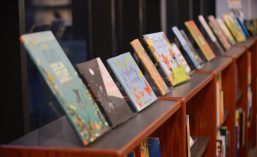
I have written before about the glories of This Moose Belongs to Me. Here’s an appealing video wherein author/illustrator Oliver Jeffers talks about his process. It’s fascinating to hear about the integration of text and image from the very beginning, and really cool to see his visual aesthetic (and effervescent sense of humor) manifest all across his life.
Author Archives: bclyp
“Rubberized” book covers?!
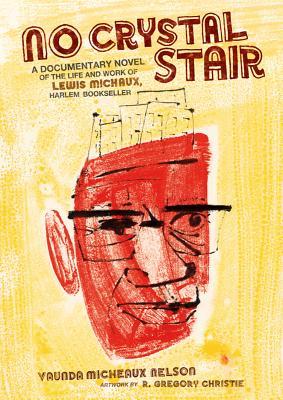
Is it just me? It seems that publishers have become really enamored of some new dust jacket treatment that adds an almost sticky texture to the paper. It feels sort of like a neoprene wetsuity material. I was on the Boston Globe Horn Book Award jury for 2012 and we recognized three pieces of fiction: No Crystal Stair by Vaunda Michaux Nelson (winner), Life: An Exploded Diagram by Mal Peet (honor book), and Code Name Verity by Elizabeth Wein (honor book). And all three have been subjected to these rubbery covers. Two of the three have dark, black backgrounds and I will admit that the matte finish of the texture adds some depth to it. But it also shows fingerprints something awful. And it’s a little tacky (duct-tape-adhesive tacky, not white-pants-after-labor-day tacky). Most libraries will put mylar covers over the jacket, simultaneously solving the problem of the unpleasant feel and compromising the benefits of the matte finish. And, really, at the end of the day, it doesn’t much matter. At all. But, still, someone is going to a lot of trouble (it must be some trouble) to take what might be perfectly fine dust jackets and make them stick.
What do you think?


For your consideration 3
Why teach an old dog new tricks when the old dog is already perfect? Our Caldecott consideration continues.
 Homer
Homer
Elisha Cooper
Greenwillow, 2012
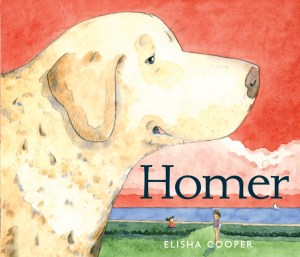
Look closely here. On the surface this is a simple, lovely story about a nice old dog (a dog who doesn’t die, by the way, for those of you worried about that kind of thing). With sensitive brush and pencil work Cooper gives us an irresistible, flesh and blood (and fur) dog in Homer. But beneath that sweet surface is an especially sophisticated piece of storytelling. Copper lays the story out across a carefully structured set of panels. One by one, the members of Homer’s family pass him on the porch, inviting him to join in one outing or another. And with each cumulative turn of the page and subsequent invitation, we see the previous family member attending to his or her pursuit. And then the whole things plays back in reverse as the family returns. A wordless denouement finds Homer leaving his post on the porch and joining the family inside, hoisting his arthritic frame into what is clearly his chair. And there is peace. Cooper’s ability to paint such full-bodied characters, human and canine, is such simple linear gestures is, on its face, a little bit amazing. That he applies that skill to a brilliant narrative arc is extraordinary. It’s hard to imagine paying more respect to a child audience.
For your consideration 2
Our Caldecott consideration continues with a fascinating book of poetry about strange habitats and their stranger inhabitants.
A Strange Place to Call Home
Marilyn Singer, illustrated by Ed Young
Chronicle, 2012
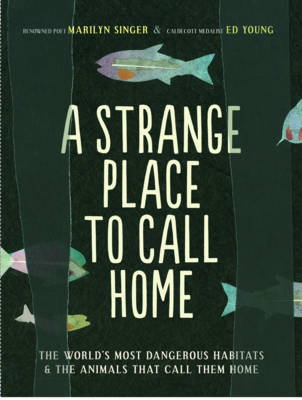
Ed Young has been on something of a stylistic tear of late. He strikes me as one of those undeterrable illustrators compelled to pursue a particular vision. Of course the Caldecott Committee is forbidden from considering a body of work. But A Strange Place to Call Home gives them plenty to consider in a single package. Singer presents fourteen different unlikely animal habitats in poems as different as their subjects. And Young goes to town (quite literally, in the case of some urban foxes). These are not the warm and fuzzy animals of petting zoos. These are peculiar and wild and just a little off-putting, and Young’s mysterious collages do them enigmatic justice. In many of the spreads the subject is not immediately identifiable, never mind recognizable. These images require attention, and reward it with curiosity. Neither the poetry nor the images explain these unfamiliar creatures, but their mysterious expression compells us to wonder and to investigate. And, really, what more can we ask than that?
For your consideration
As the days get shorter and the wind gets colder and people put Christmas lights up right after Halloween, our thoughts turn to Caldecott contenders (well, my thoughts do, anyway). So over the coming days we’ll be putting forward some books on our Caldecott radar.
 This Moose Belongs to Me
Oliver Jeffers
Philomel, 2012
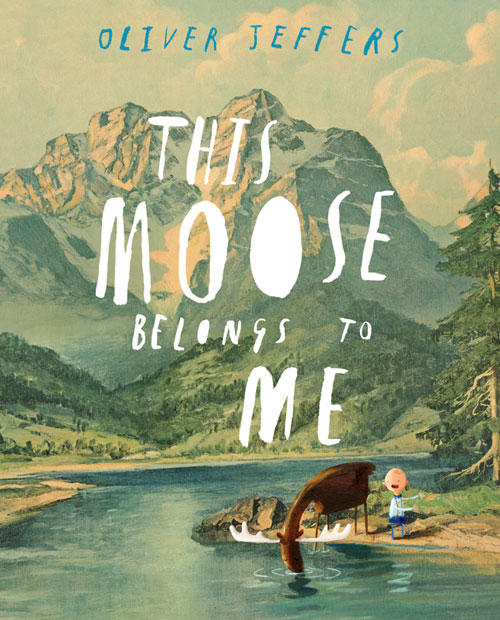
This is the story of Wilfred, a boy who finds and adopts a moose, and Marcel, the moose who will not be adopted. There is so much to love about this book: gentle humor, indelible characterizations, careful pacing. The Caldecott Medal, of course, is awarded for particular criteria, though, and “Thom loves it” didn’t make the cut. Luckily, this wonderful book excels with the actual criteria as well. Indeed, each of the wonderful elements mentioned above is achieved in the illustrations. Indeed, all of them are realized, to a high degree, in the illustrations. The incongruous background material, pixelated Romantic landscape paintings and Victorian engravings, amplifies the situational humor, giving it tone and color. Similarly, even though Wilfred’s behavior gives us the skeleton of his persona, the remarkable, gestural facial expressions take it home. Even the Moose singular apple obsession finds subtle expression in his square countenance. And the book’s design, the varied use of panels, blank backgrounds, image-filled word balloons, and even combination of typeface and handwriting, fixes a perfect pace. This is a picture book that gets better and better with multiple readings. Here’s hoping that it is being read again and again.
Gifts of Information
Our last stop on the holiday book recommendation train includes some books about real, actual people and things.
 Chuck Close: Face Book
Chuck Close
Abrams, 2012
The famous portraitist tells his remarkable story, overcoming severe dyslexia, prosoagnosia (the inability to recognize faces) and paraplegia to become one of the most celebrated artists alive in an interactive book brimming with stunning detail. A class of fifth grade students in Brooklyn asks him questions, and his candid, matter-of-fact responses give us a picture of the artist just as clear and impressive as the portraits he paints of others. Exquisite, tactile and inspirational.
 Bomb: The Race to Build–and Steal–the World’s Most Dangerous Weapon
Steve Sheinkin
Macmillan, 2012
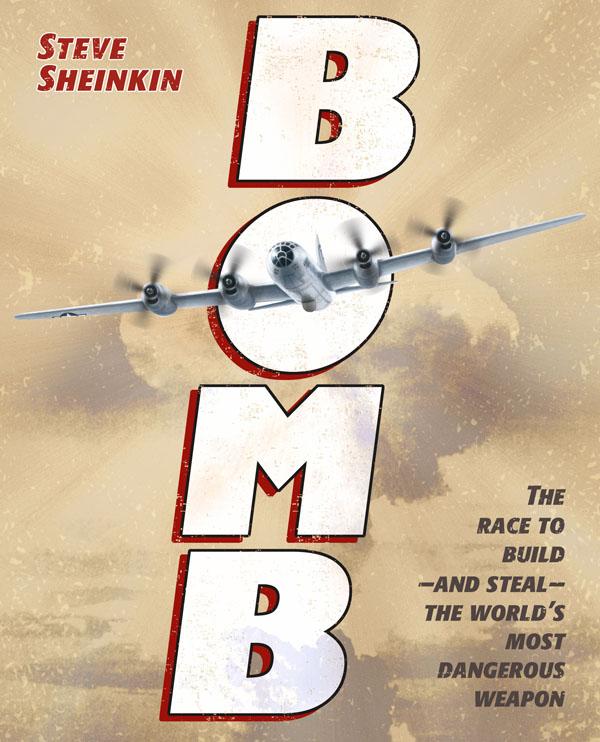
In this un-put-downable record of the Manhattan Project historian Sheinkin weaves three distinct narratives into an utterly compelling page-turner about spies, science and sabotage with abundant facts and indelible lessons. It’s always a pleasure to follow an enthusiast on a literary exploration, and the velocity of this particular journey makes it is especially exciting. Gripping, informative and scrupulous.
 Children’s Book-A-Day Almanac
Anita Silvey
Macmillan, 2012
For the children’s-book-loving adult on your list, this treasure trove by noted critic Anita Silvey makes a different recommendation for every day of the year and comes overflowing with corollary tidbits of fascination. Look for Silvey’s book-a-day for more suggestions and more fun. Erudite, expert and comprehensive.
Novel Gifts
Our holiday gift recommendations continue with a few novels we think young readers might enjoy.

The One and Only Ivan
Katherine Applegate, illustrated by Patricia Castelao
HarperCollins, 2012
Ivan the gorilla is resigned to his life in a glass enclosure at the Exit 8 Big Top Mall and Video Arcade. But when Ruby the baby elephant arrives, Ivan commits himself to winning a better life for her. Applegate crafts a natural and believable voice for Ivan, at once plain and poetic, and with it will break your heart (in the best possible way). And Castelao’s gentle gestures only add to the grace. Beautiful prose tells a beautiful story. Poignant, emotional and uplifting.
 Shark King
Kikuo R. Johnson
Candlewick, 2012
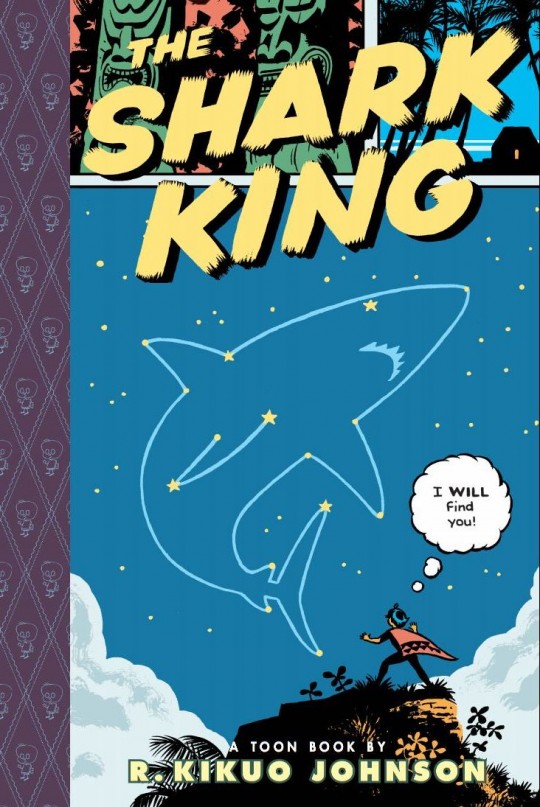
A Hawaiian legend about a shape-shifting boy who becomes a king is just the thing for a picture-perfect beginning reader with graphic illustrations, comic book panels, word-balloon dialogue and ebullient excitement! Those familiar with the tropes of the graphic novel will appreciate the care with which they are observed, and those new to the format will enjoy its immediacy and its fun. Bright, smart and ebullient.
 Code Name Verity
Elizabeth Wein
Disney-Hyperion, 2012
Shot down behind German lines during WWII, and enduring starvation and torture, Julie trades Allied secrets for prolonged safety and a few trifling comforts. Or does she? Wein’s startling novel weaves espionage, honor and indelible friendship into a gripping, revelatory package. Fierce readers will appreciate the investment required to dig through the obfuscation and retrieve a singularlygratifying literary reward. Dense, complex and thrilling.
Picture Book Gifts
Ready or not, holiday shopping season is upon us! The Butler Children’s Literature Center has your back. In a season overcome with ill-fitting sweaters and batteries-not-included gadgets, books make the perfect gift. These titles promise afternoons full of cozy, fireplace-adjacent escape, and there’s absolutely no assembly required.
Let’s start with some picture books:
 Extra Yarn
Mar Barnett, illustrated by Jon Klassen
HarperCollins, 2012
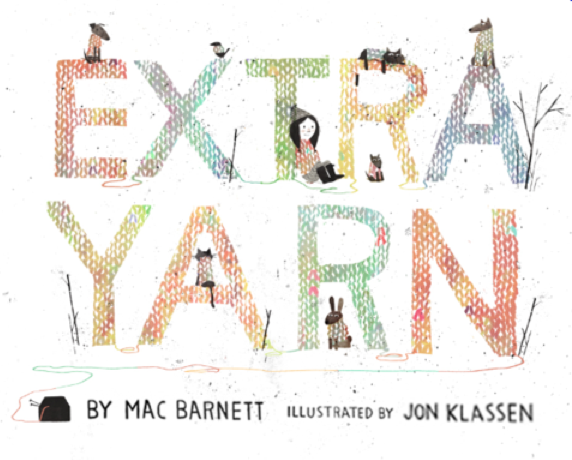
A young girl discovers a mysterious box full of a seemingly inextinguishable volume of yarm. She knits sweaters for all of the people in her coastal village, and, with yarn to spare, knits sweaters for the buildings, the trees, and everything else stationary. An evil Archduke absconds with the magical box, but the truth will out. Barnett crafts his story with care, paying special attention to the ace with which it unfolds, and Klassen yarn-bombs the entire outing with an irresistibly cozy charm. Warm, sweet and lovely.
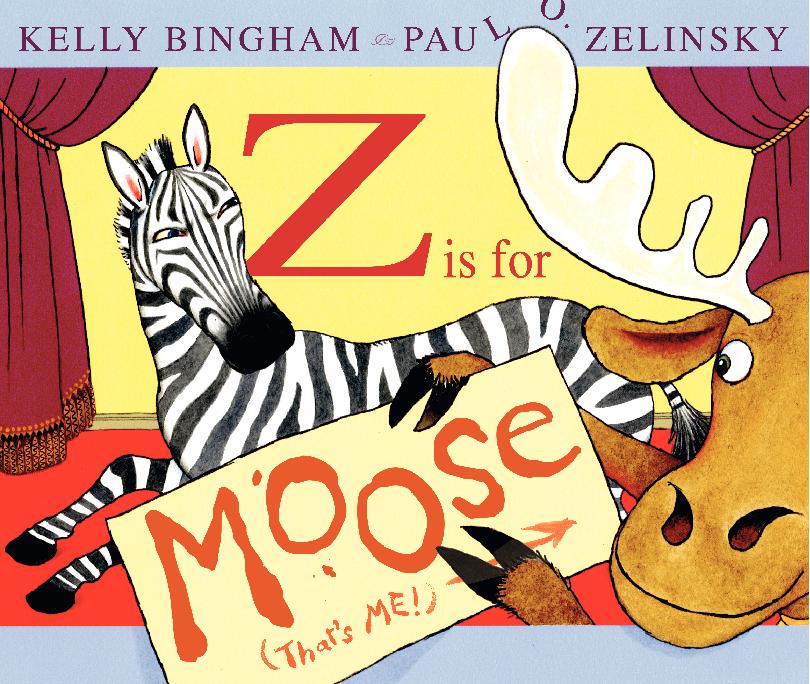 Z is for Moose
Kelly Bingham, illustrated by Paul O. Zelinsky
HarperCollins, 2012
Zebra is staging an alphabet book and is busy corralling a cast of characters to represent the different letters. When Moose’s letter is up and Mouse takes his place, bedlam ensues, with hysterical chaos leading to a heart-warming finish. Look for the (many, many) little alphabetical details happening off stage that only add to the boisterous clamor. Hilarious, irreverent and satisfying.
 Nighttime Ninja
Barbara DaCosta, illustrated by Ed Young
Little, Brown, 2012
A stealth ninja sneaks through a house at midnight in pursuit of treasure of inestimable value. Just as the prize is in his grasp, his mother flips on the lights, seizes the ice-cream and sends him back to bed. With tight formatting, sinuous prose, and a masterful match of words and pictures, this one will be requested again and again. Gorgeous, funny and irresistible.
 Butler's Pantry