During this time of year when I was a kid, my family was usually going nuts with activities. Dad was just getting back from choir tour, Mom was busy teaching music to her crazy kindergarteners, and us kids were somewhere doing speech, theatre, taekwondo, ballet, piano lessons, homework—or sometimes combinations of these things. It was hard to catch time for a dinner together or even a hello after play rehearsal. But Mom and Dad were a pretty great mom and dad, and they always managed to make all three of us kids feel special. They dyed malt-o-meal green on St. Patrick’s day, they slipped little notes in our lunchboxes, and on Easter, each of us got a basket with our favorite candy—Snickers for Josh, Reeses Peanut Butter Cups for Rachel, and Jelly Belly jelly beans for me. Sometimes there would be a little trail of jellybeans from the door to my bed, as if the Easter Bunny had accidentally dropped them on his way (even when I was sixteen).
Now, I’m not home anymore. I’m still their kid, but now I have a job and a school twelve hours away from them, and they aren’t by my side to make me feel special anymore. They still do, of course, it it just over the phone or in cardboard package, but it doesn’t have the same immediacy. So I find ways of discovering what’s special now on my own—through friends, through art, through music, and also, of course, through books.
The following three picturebooks are all published in 2012, and they all have something to say about being special. Sometimes specialness is far away and you have to find it. Sometimes, it’s right next to you and you don’t see it. Sometimes, it’s in an animal or in a friend or in a mysterious something that might surprise you or take a while to understand. Sometimes, it is lost or forgotten.
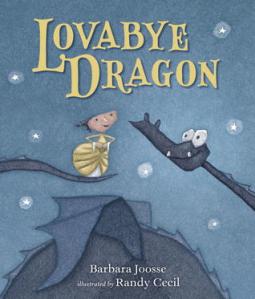 In Lovabye Dragon, by Barbara Joosse and illustrated by Randy Cecil, a little girl longs for a dragon friend, and a dragon longs for a little girl friend. They dream about finding each other, but the poor girl becomes so sad that she cries silver tears all the way to the dragon’s cave. When the dragon follows the tears, he finds the girl in her castle, and the double-page spread is filled with light and celebration of their union. Cecil’s lovely oil paintings use diverse shades of blue to express the rich, atmospheric tone of the book, and Joosse’s sensitive text celebrates the friendship of two creatures that in every way are different, but together build something special. Though this story could be taken as fantasy, fairy tale, or some version of destiny, I take from it a sense of hope and beauty. You can be alone. You can be sad. You can be alone and sad for a long time. But sometime, somewhere, someone might find you and call you special, or you might be led down a path to find someone special. In the meantime, there’s no harm in calling yourself special. Because it’s true.
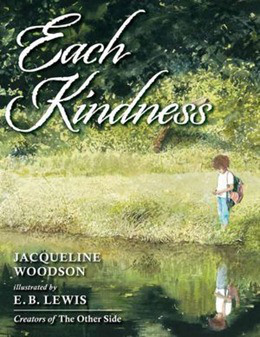
 Each Kindness, written by Jacqueline Woodson and illustrated by E.B. Lewis, has a more deliberate message about treating others with respect. Written in the first-person, it tells the story of a new girl coming to school. The narrator character and her friends ignore the new girl—they whisper secrets, laugh, make fun of the girl’s clothing, and refuse to play with her. Lewis’s realistic watercolor illustrations captivate the eye and change perspectives drastically on every page, as if they are begging the narrator to change her own perspective. She doesn’t, though—not until it is too late and the girl has moved away. The book ends with the young protagonist watching the water ripples come and fade, wishing she would have made the new girl feel special.
Don’t we all wish we could go back and change something we did, or make someone feel special when we didn’t? I remember being the bystander in a few instances in elementary school—not teasing, but not standing up for anyone either. My feelings of guilt were strong and palpable—I can still feel them now. So palpable, in fact, that I became a “Peer Mediator” in upper elementary school and was determined to calm fights and extinguish any bullying I saw. Now, it’s easy to see someone’s uniqueness—we are adults. It’s easy to forget the “rules” of being cool in school, and seeing people’s “special qualities” certainly wasn’t part of the being cool plan. I wish we could change that.
 Finally, a lovely interplay of humor and heart-warming charm harmonize in Boy + Bot, written by Ame Dyckman and illustrated by Dan Yaccarino. A young boy and a red robot meet each other in the forest one day, and instantly become friends. Trouble ensues when the two friends roll down a hill and Bot’s power switch turns off. The boy tries everything he knows to help—feeds him applesauce, reads him a story, and tucks him in to sleep. But then, when the bedroom door opens, Bot’s power switch turns on and he is frightened to see that Boy cannot be awakened! He tries everything he knows to help—bring him to his home (a mysterious tower), gives him oil, and brings in a spare battery. Bot’s inventor discovers him, the boy awakens, and the two friends are reunited. Bright colors and artistic vignettes bring out both the boldness and softness in this book, and it’s pretty fabulous to see two characters with an honest connection in just thirty-two pages. But it happens with little kids, right? Kids (I’m talking before school starts) can meet each other and instantly hold hands, then go off and play Legos. They make each other feel special all the time.
Okay, maybe by now you’re screaming at your computer—enough with the cheesiness, the sugary clichés, the specialness!
But I still dream about the green Malt-o-Meal, and I’m 28. I still love the Easter Basket with the trail of Jelly Bellys. And I still want hugs and phone calls and everything else that makes me feel special.
Because I am. And so are you. So spread it, what else is there to do?
 Brave Irene


 Butler's Pantry