Fifty Shades of Ambiguity

As we enter the second week of the federal government shutdown and consider the particularly polarized nature of the DC discourse itself, and the coverage of same, it is hard not to conclude that we have arrived, as a country, at some sort of cultural impasse. Our two-party system seems to have devolved into a he-said-she-said standoff full of bull-headed bravado and empty of reason. And as if the certainty of the politicians wasn’t enough, all of us in the peanut gallery, regardless of which side of the divide we’re spectating from, are equally certain about who’s right and who’s guilty. 100%.

Uh oh.

It seems that the very idea of challenging our own assumptions, wondering about our choices, even changing our minds, is an endangered species.

Part of the reason I do the work I do, in fact, a big part of the reason, has to do with raising up a generation (or 12) of critical thinkers. Kids enter the world with an incredible openness and curiosity, and it is through their cultural “education” that they let go of these possibilities in exchange for a sense of certainty. But those of us who endeavor to connect kids with stories understand the role those connections can play in keeping the wonder gates open. Meeting up with other people (and bears and vampires and cupcakes) in books allows kids to experience things they can’t or don’t experience on their own. Yet. And reading books that expose them to different sides of the same story lets them know that, usually, there is more than one side.

There are, happily, many books for young people that acknowledge, and even celebrate ambiguity. Let’s take a look at a few books about some of our founding fathers. The current debate is fraught with invocations of their fundamental perfection. And yet, there are some books out there, books for children no less, that see them as the people they really were, humanity and all.
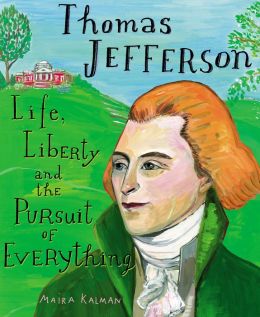
thomas jeffersonIn her upcoming picturebook biography Thomas Jefferson: Life, Liberty and the Pursuit of Everything, Maira Kalman makes the most of her brilliant, quasi-surrealist stlye, painting a portrait of the nation’s third president that expresses the dynamic breadth of his interests and the depth of the passion he brought to them in her wondrous tableaux of electric colors. We learn of diverse pursuits, the art and architecture, science, botany, etc. We learn of the care and generosity with which he ran his house and his infamous Monticello estate. We learn of his public pronouncements about the evils of slavery. And we learn about the slaves he kept himself, including one Sally Hemings, who, it is believed, bore him a number of children. In the mainstream media much has been made of Jefferson’s alleged relationship (so much, in fact, that some would say the allegations are proven) but we do not always see such admissions of guilt in books aimed at young children. But in her direct and unapologetic treatment of the whole man, Kalman ultimately paints a portrait that is more compelling for its inclusion of flaws.
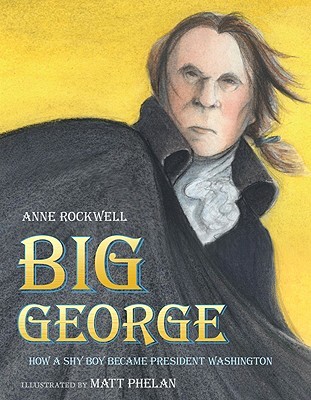
big georgeIn Big George: How a Shy Boy Became President Washington, author Anne Rockwell and illustrator Matt Phelan paint a similarly human portrait of the first of the founding fathers. Right from the start, before we even open the book, we see a different George Washington than the one we’re accustomed to, younger, sadder, and maybe, even, angry. And then we have a subtitle suggesting that he’s shy, a characterization markedly different from the man pictured. The portrait that follows is just as complex and nuanced as the cover promises. Instead of the iconic truth teller of cherry trees and wooden teeth, we meet a man of soft speech and quiet ways. We meet a man reluctant to assume the responsibilities thrust upon him but resigned to his duties. We meet a man. Throughout the book there are tensions between the text and the illustrations, which positively vibrate with the conflicts Washington experienced throughout his life. This is another portrait of an American “hero” that transcends the ordinary hero worship to offer a bigger picture actually worthy of its subject.

The thing to remember is that kids start out smart. They start out ready to think and learn and grow. They wonder. They change their minds. And the best authors and illustrators making books for them see in them the potential to stretch and grow, and challenge them accordingly. There is an inherent and profound respect in asking a lot of a child audience, setting our standards high and believing in their capacity to meet them. In my experience, kids give you what you expect of them. If you expect little, that’s what you get. If you expect everything, look out. I expect them to think and to change their minds.

Of course, I expect this of my politicians, too, and of late I have been sorely disappointed. But if we stick to our commitment to raising up the next generation with open curiosity, I have every faith that we may yet live up to our sizable ideals as a nation of thinkers.

Thomas Jefferson: Life, Liberty and the Pursuit of Everything, by Maira Kalman, Nancy Paulsen Books, 2014.

Big George: How a Shy Boy Became President Washington, by Anne Rockwell, illustrated by Matt Phelan, Houghton Mifflin Harcourt, 2009.

Kinship Project

voice from afarThe Butler Center opened in its permanent space two years ago today on September 11th, 2011, the tenth anniversary of that infamous day in world history. To commemorate that occasion we curated an exhibit called the Kinship Project, a collection of books for children and teens that speak to our human kinship. We created a catalog with notes that speak to each of the 29 books connection to the idea of kinship. I link here to the online version. We have some print copies as well (beautiful, actually) and I’d be happy to send some along to you, too. Just fill out the form below with your name and address and I’ll get them in the mail.

← Back

Thank you for your response. ✨

How about you? What do you remember of that day? What do your memories have to say to your work with books and young people? Where do you see kinship among the collections we keep?

if you want to see a whale.

if you want to see a whaleif you want to see a whale.

Written by Julie Fogliano, illustrated by Erin E. Stead.

A Neal Porter Book, Roaring Brook Press, 2013. ISBN 978-1-59643-731-9

Quiet and lyrical, this picturebook (created by the same team as And Then It’s Spring) celebrates childhood in its playful energy and its deep contemplation. Fogliano’s minimalist poetry flows off the page like maple syrup; yet, the text is not without structure. Fogliano uses assonance and alliteration effectively and intelligently throughout the story, using fun phrases such as “whales won’t wait for watching” and delicate ones such as “ship that is sailing” and “flag that is flapping.” Stead’s signature illustration style of muted pastels and purposeful negative space compliment and extend Fogliano’s artful text. As I experienced this story, I couldn’t help but put myself into the young character’s shoes, imagining, remembering and creating images in my head about my own childhood journeys.

I was left with many thoughts and feelings after I finished this book, but the most significant was a personal meditation on patience and discovery. After a first read, it might be easy to think that seeing a whale is the most important thing for this young boy. After all, it is the title of the book. Yet, I think the text and image are purposefully juxtaposed here. Yes, the text states, “You’ll have to just ignore the roses,” and “Don’t look way out and over there to the ship that is sailing.” But, the boy doesn’t ignore the roses, and he does look way out and over there. During the majority of the book, the boy isn’t seeing a whale. Rather, he is exercising patience for the future and truly experiencing the beautiful things of every day. Most days aren’t monumental, right? Most days, we don’t have promotions, our babies aren’t born, our books aren’t published, and the love of our life doesn’t knock on our door with 1,000 yellow daises. Rather, we write emails and cook dinner and help with homework and come home to chaos or maybe empty apartments. The days of actually “seeing the whale” are fabulous and memorable and obviously grand. But we have to be patient to discover them. Maybe Fogliano and Stead are saying that the whale has always been there all along, hanging out in our minds and hearts. We just have to open our eyes to the every day to finally see it.

On a side note, I adore the dog in this picturebook. I love the tilt of its head, the way its back arches when it smells roses, and the way it follows the boy around in every spread, just like dogs do.

And the book trailer is awesome.

When You Wander: A Search-and-Rescue Dog Story

when you wanderWhen You Wander: A Search-and-Rescue Dog Story

by Margarita Engle, illustrated by Mary Morgan

Henry Holt, 2013

“If you are lost, stay in one place. Hug a tree. Think of me.”

On paper everything about this sounds didactic and cloying, in the sort of way that might give one a headache and a toothache at the same time. A sniffing school graduate offers help to would-be lost children to keep them safe and get them found. Her first person (first canine?) exposition outlines specific procedures to be undertaken by a lost toddler matched to the dog’s skills and knowledge.

And it is sweet, make no mistake, and not without purpose.

But it is so much more than that. The language is warm and clear, presenting the instructions in an easy, friendly way, studded with details of particular meaning to a child. It is lilting and confident and happy on the tongue, broken like verse to reinforce its poetic rhythms to the reader-alouder. The toddler in question is shown in the rescue dog’s imagination, doing toddlery things that leave an indelible olfactory trail. The pictures themselves, soft and unapologetically accessible, establish a tone of security and success. And so children understand being lost in terms of the dog’s expertise, not the danger the dfficulty represents. In a final spread the roles are switched, as the child, now safe home in bed, dreams of her rescuer in a dream bubble of her own.

Above all, though, this is a story. I wouldn’t hesitate for a moment reading this aloud to a group of children, not because it contains important information that all children need to hear, but because it is purely delightful. Would that more books built on a message could be so.

On a Beam of Light

on a beam of lightOn a Beam of Light

by Jennifer Berne, illustrated by Vladimir Radunsky

Chronicle, 2013

I fancy myself a scaredy dad. My son, who has been with us now for approximately 750ish days, has managed to instill a deep rooted paranoia within me concerning every possible aspect of the human condition. “Is he choking or just laughing really hard?” “What was that, a poop or a toot” (please just be a toot!)? And something I’m certain every parent can relate to: “Why isn’t he deciphering complex algebraic proofs yet?” Unreasonable? Absolutely! Whereas I can look past perceived mathematical deficiencies, I worry away over words and speech.

Believe it or not, other parents have shared concerns for their child’s development. Case in point; THE EINSTEINS! Turns out, even the most (arguably) brilliant scientist ever took a while to blossom. Jennifer Berne’s book On a Beam of Light reveals a quiet, curious baby Albert who barely spoke at the age of three. He sort of took his time checking things out. Upon receiving a compass from his father, young Albert became mesmerized by the consistency of its northward pointing needle. This revelation developed a thirst for knowledge within him that would span a lifetime. Far more inquisitive than his classmates, some teachers believed he would be an utter failure in life. Unperturbed, he searched for answers in books on science and math. Tireless thinking and daydreaming led him to discover some of the most important concepts in scientific history.

Berne takes an interesting approach to Einstein’s story by focusing on his difficulties fitting in, his curious nature, and a love of simple pleasures. In a word: his normalcy. For all practical purposes this seemingly super-natural man was little more than a thoughtful boy who loved music, riding his bicycle, eating ice cream, and wearing shoes with no socks. The author’s clever references to activities children adore make Albert all the more appealing to young readers and listeners. Particularly keen observations and significant moments in Albert’s story are written in large, red ink to emphasize their meaning.

Vladimir Radunsky creates a whimsical mood with static pen drawings which are often colored with ink and gouache paints. Some of Albert’s thoughts and questions are drawn as word bubbles. Particularly effective are the freckled, parchment-like pages which are soft on the reader’s eyes. Images frequently portray Albert in a pensive pose. Depictions of his thoughts and dreams bounce across pages as if they were darting through his mind. One particular spread illustrating a scene made of atoms accompanies Albert’s understanding of nature’s building blocks. In another, mathematical formulas and sheet music spew from a violin played by the passionate genius.

On a Beam of Light is a unique middle grade picture book that allows young readers to indulge their inner mathematician and/or scientist without feeling compelled to learn. It feels complete in many ways. The exquisite, diverse artwork complements the energizing text creating broad appeal for a topic some young readers may consider bland. It even gives fretful parents food for thought. I take comfort in the realization that my boy is WAY smarter than Einstein was at his age. Fellow scaredy dads, there’s hope for us all.

Boot & Shoe

boot & shoeBoot & Shoe

by Marla Frazee

Beach Lane Books, 2012.

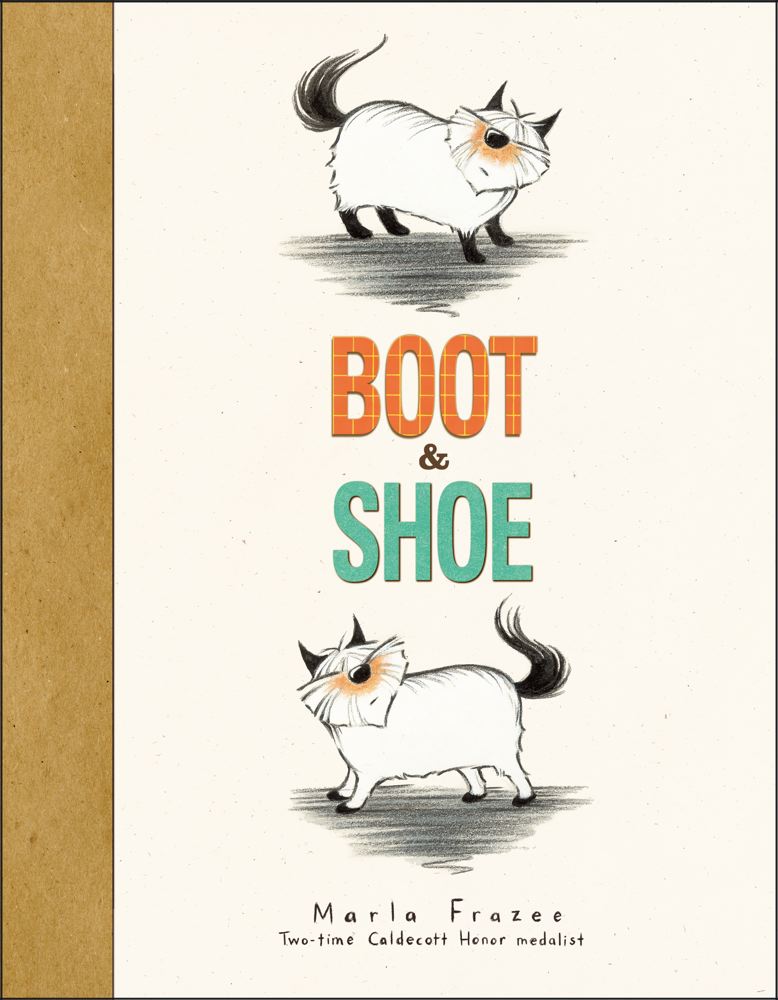
There is no denying that Marla Frazee has made her mark on children’s literature. Her signature illustration style has delighted children and award committees with titles such as Stars, All the World, and A Couple of Boys Have the Best Week Ever.

Boot & Shoe, Frazee’s 2012 gem, stands out for me among her work. I know this is partially because I’m a dog person—I even have two dogs who are brother and sister, similar to Boot and Shoe. But this book is much more for me than just being part of a target audience. It is rich with humor, artistry, and honesty.

Boot and Shoe come from the same litter, and they do everything together—eat, sleep, and even pee. But, Boot likes the back porch and Shoe likes the front porch. Frazee uses soft lines of black Primsacolor pencil and textures and details every page with gouche paint to bring out a wide variety of moods. Significant white space is used throughout the book to highlight vignettes, half-page spreads, and energetic scenes. The crisis of the book—when the dogs can’t find each other—instantly changes Frazee’s artistic style. In nighttime, sad scenes, Frazee uses harsher, straighter lines and deep colors of black and blue pencil. One of my favorite spreads is when the sun comes up, and both Boot and Shoe begin to cry.

So, the book changes. I read this book in a storytime, and kids were laughing and giggling and pointing at the beginning. But when the dogs couldn’t find each other, there was real fear in the room. When Boot and Shoe cried, the room was silent. While I was reading, I kept thinking, “Wow, this is a dynamic book.” Yes, it’s about dogs and friendship. But it’s also about loss; it’s telling children that it’s okay to cry when you feel sad, and it’s doing it with an honest intention and a comforting approach. Rather than books that are only charming and funny (which are great at times, too), Boot and Shoe really spans a variety of moods and emotions, just like we all feel every day. How great to have such authentic, conscientious storytelling for children.

And I gotta say it: If you have dogs or love dogs, this is a book for you. I grew up with one dog, and when she passed away my parents decided to get two—a brother and sister, Jem and Scout. Since getting to know these cuddly dudes, I’m telling you, I’ve never seen such friendship. Besides the fact that Jem would eat all of Scout’s food if he could and Scout bites Jem’s ears constantly, these two dogs are BFFs. Just like Boot and Shoe, they sleep together, eat together, play together. But they are individuals, too. Seeing how much they love each other just makes me want to love more, and to treat each person I meet the way they treat each other—with an open heart, a forgiving soul, and always a shoulder (or back or stomach) to lie on.

Thanks, Marla Frazee. You rule.

Check out Scout and Jem’s friendship throughout their lives below.

IMG_0067  IMG_0258 IMG_0305

IMG_0665 IMG_0746_2

Who Lives Here?

who lives hereWho Lives Here?

by Nicola Davies, illustrated by Marc Boutavant

Candlewick, 2012

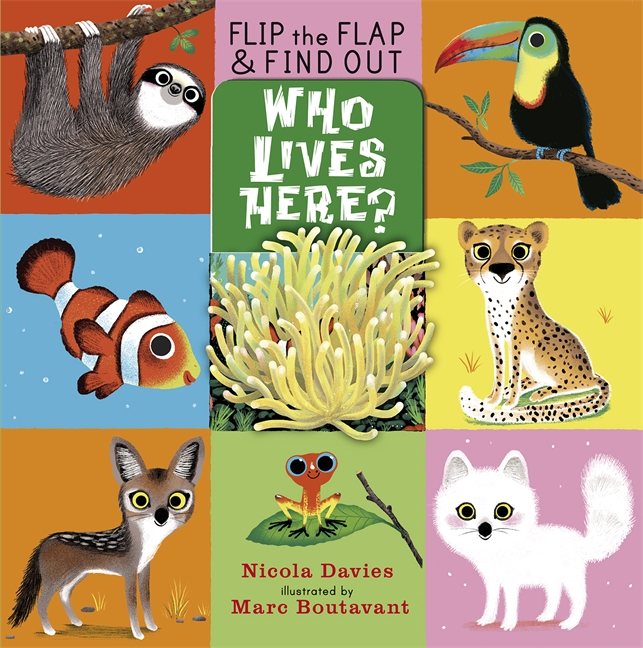
Davies employs her considerable zoological chops in service to very young children in this ingenious, elegant and especially attractive lift-the-flap matching-game. The author introduces a series of five habitats (warm, steamy jungle; still, cool pond; dry, sunny grassland; warm, clear, salty ocean; and snowy, frozen Arctic) in two two-page spreads. In the first spread, on the left is the habitat itself, with various forms of wildlife hidden about, and on the right are four quadrants, each with a flap decorated with an abstracted image representing a different habitat. Lifting each flap reveals a different animal who says where it lives, with the final (bottom right) flap exposing one animal who lives in the habitat in question. The subsequent spread shows an expanded image of the habitat, with clearer views of its many inhabitants and a few details about the one animal hidden beneath the flap on the previous page. A final spread identifies all 20 animals and invites us to match them, using their background colors as a guide.

Boutavant’s deliciously cute images, with big eyes and softened, rounded edges, recall an earlier age of children’s book illustration. Indeed, they would look right at home in the 1950s. But beyond their obvious appeal to the target audience (and to me), they conform to careful and deliberate book design pattern, adding lots of value to the entire outing. For example:

  • Each of the flaps attaches on a different axis, the first at the bottom, the second on the left, the third on the right, and the fourth at the top.
  • Each habitat image hides four animals. One of them appears under the matching habitat flap on the next page. The other three appear under the flaps for that habitat on the other pages.
  • The flaps are affixed to quadrants of contrasting colors, and the color behind the “correct” flap matches the background color of the particular habitat.
  • Text on the back of each flap offers further information about the habitat it represents and the particular animal beneath it.

And all of this pattern means that there’s lots and lots to learn from a book like this. Wildlife ecology is just the beginning. For here are lessons about how books work, and what we can and should look for as we consume them. In lots of ways, this is a book about books and reading as much as it is a book about habitat.

I love it up.

Caldecott 2014 continued some more

There are two more spring books that have caught my Caldecotty attention:

round is a tortillaRound is a Tortilla: A Book of Shapes

written by Roseanne Greenfield Thong

illustrated by John Parra

Chronicle, 2013

To begin with, this book is supremely lovely. Of course, lots of books are lovely, and loveliness is not a particular criterion for Caldecott consideration. But let’s just put that out there. Parra’s figure work is warm and personal, simultaneously accessible and specific. His largely symmetrical composition affords the imagery some organizational clarity, making it especially easy on the eye (and enhancing the shape identification, to boot). But there is much to admire beyond the simple beauty. The color work is extraordinary. Parra sets vibrant reds and oranges against grayed-out blues and greens. The unexpected result, with its dramatic sense of light and shadow, enhances the sense of place. It feels like a hot day in the Mexican shade. The treatment of shapes is suitably sophisticated. Rhyming verse calls attention to one shape at a time, and while many of the shape in question are present for searching and finding, there are other shapes represented, too.

And if ever there was a book jacket optimized to accept a golden circle sticker, this is it. I mean, really.

henris scissorsHenri’s Scissors

written and illustrated by Jeanette Winter

Simon and Schuster, 2013

Illustrating a picture book about a famous artist is no small thing. How does the illustrator capture the essence of the artist’s style without resorting to mimicry, expressing without copying? Jeanette Winter makes it look easy. In this simple picture book biography of Henri Matisse she employs color to set Matisse’s artwork apart from its contextual environs, replicating the vibrant artwork with rich, saturated color and using a more reserved, pastel palette for the artist and his surroundings. She structures the story carefully, covering the first 70 years of his life in the first few pages and dedicating the balance of the book to the paper-cutting for which he is most celebrated today. Matisse made the technical discovery while recovering from a severe, debilitating illness, and Winter reflects its transformational power with a major compositional shift. The exposition unfolds with images in small, tight squares on a clean, buff ground. At the pivotal moment of discovery, when the artist finds his way to creation again, the images break across the entire spread, reaching beyond the edge of the page in expressive freedom. Most picture books contribute to the storytelling with representative imagery. Using the art itself to tell the story, in its structural design, adds layers of meaning to an already illuminating story. I’d call that excellence of pictorial interpretation of story, theme, or concept.

Anyone out there excited about any 2013 American picture books?

Such Soft, Snuggly, Sleepy, Sloths

Lucy Cooke celebrates the otherwise underappreciated sloth in her book a little book of SLOTH. Few children’s books begin with an author’s note confessing “I love sloths. I always have.” Of course, to my knowledge, there are just not many books entirely dedicated to the beloved sloth and shame on publishing for that. Books about soft, fuzzy kittens and playful puppies enjoy rampant popularity. To be sure, if mice were paid for their abundance of stories they would have started their own colony on the moon (after all it is made of cheese, right?) far from those mean kittens. Who knows why authors love them so. No offense against rodents but even I jump when one scampers across the living room floor. The world’s largest rodent, the capybara, happens to be my favorite but how many books were published about the capybara last year (seriously, if there were any, let me know)?

slothMy apologies…this is neither about my empathy for the under-sloth as it were nor my anxiety from excessive dog/cat/mouse lit.

Slothville shelters well over a hundred sloths that have been hurt or found parentless in the wild. Founded by Judy Arroyo in Costa Rica, the sanctuary cares for the curious, grinning creatures which are lanky in appearance and leisurely in motion. In reference to a sloth named Mateo who is particularly protective of his stuffed cow Moo, Cooke jests, “If any of the other baby sloths tries to sneak a Moo hug, a fight breaks out – a very, very slow fight, in which the winner is the last sloth to stay awake.” Each page of the colorful photo album contains a single image or multiple images of the animals in cute poses a la Anne Geddes, hanging from tree limbs, or snuggling with stuffed toys, blankets, and fellow sloths. Alongside images the author relays interesting tidbits with clever quips on the animal’s behavior. The sloth’s unique behavior and bizarre characteristics will fascinate parents and children alike while the round eyed, stumpy nosed babies in their hand-crafted onesies are absolutely adorable. Besides, with a little imagination they sort of look like mice, too. Envision a rainy evening, scoop up your little one, and snuggle up to a little book of SLOTH.

A Little Book of Sloth

by Lucy Cooke

Margaret K. McElderry Books, 2013

Mike Mulligan and his Steam Shovel

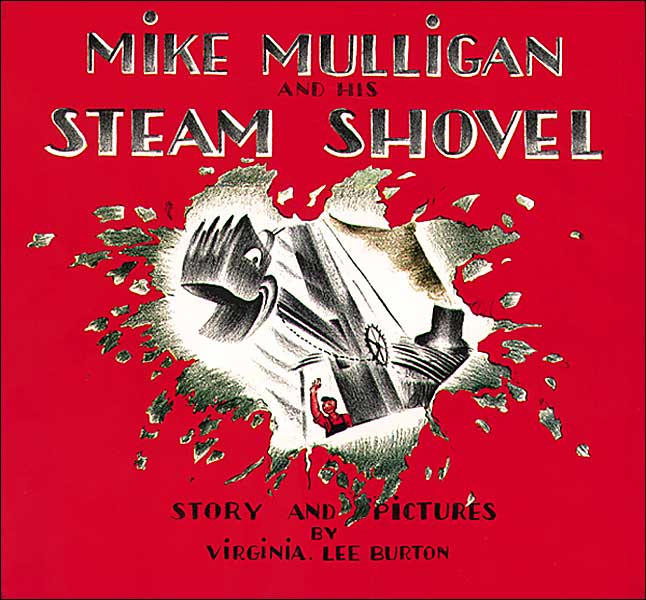
Mike-Mulligan-and-his-Steam-Shovel-Book-CoverRecently, I had a chance to look at Virginia Lee Burton’s classic for the first time since I was a child. My memories of the story, though fond, consisted of fast paced machinery digging stuff. As a 39 year old child, I’ve come to realize much more.Burton begins her story with a proud Mike Mulligan showing off Mary Ann (his steam shovel both named and personified with ever-grinning face – I love it!) on a hilltop, rays of light surrounding her; tah dah! The story follows their rise to stardom as key members in the architectural development of our country and the subsequent takeover of more efficient machines. While other steam shovels find their way to the junkyards, Mike can’t bear to leave Mary Ann to such a dismal end and looks for work outside of the busy city.

Throughout the story, Mike remains confident in Mary Ann and proves her worth with a final dig of Popperville’s town hall cellar. Whereas the new and improved technology is taking over in the cities, the steam shovels are still efficient, viable, and even exciting for folks in rural areas. Mary Ann proves to be the newest and fastest digging machine the townspeople have ever seen. In a sense, the story on its face seems to suggest that newer and faster is better. Mary Ann and Mike are nudged aside by better technology and in turn replace “a hundred men” digging the new town hall cellar. However, Burton proposes a clever quandary when Mary Ann literally digs herself too deep with no way out. An insightful little boy’s suggests building the town hall around the machine and the citizens, as well as Mike and Mary Ann of course, agree. Mary Ann retires with pride as the town hall’s heating system and Mike finds a less strenuous position as the building’s janitor; happily ever after. In the end, the town hall doubles as a museum to the old steam shovel and serves as a nostalgic salute to Mike and his contemporaries.

Today, technological advancement (especially as it relates to speed) is nearly constant. It’s hard to deny the improvements in efficiency and perhaps quality of life for those able to take advantage of new technology. Just as challenging is remembering how we got here and realizing that older and slower still have an important role to play in the world. Mike Mulligan and his Steam Shovel almost seems an answer to a child’s question, “What happens to the older (fill in the blank) when the new ones come along?” Though perhaps somewhat idealistic, Burton’s nod to the past and progress is a wonderful book for children brimming with morality and opportunity for meaningful discussion.