Open This Little Book

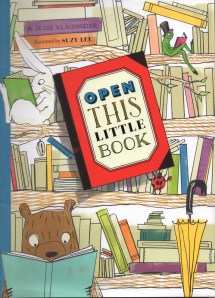
open this little bookOpen This Little Book

written by Jesse Klausmeier

illustrated by Suzy Lee

Chronicle Books, 2013

In a world where meta is everywhere, a book turning in on itself might come across as trendy or superficial. Indeed, many such books do. But the overuse of a particular approach to storytelling does not make such an approach necessarily obsolete. It does, however, raise the storytelling bar. To transcend the dangers of gimmickry, a meta picture book needs to weave together its plot, text and illustration into a tight and cohesive package, in service of a reverberant message. Fixing meta’s self reflection in some meaningful purpose grounds it, rescuing the by-definition disconnectedness of the narrative from flapping in the literary breeze. When done right, this kind of circular storytelling packs a real wallop, and such is the case with Open This Little Book.

The book is literally a number of books inside one another, each smaller than the last, each identified by a different colored cover (purple, red, green, orange, yellow, blue), each “opened” in succession by a different character (reader, ladybug, frog, rabbit, bear, giant), and then consumed and read in reverse order, arriving at the end with a compelling case for more. More books. More reading. More community. The clarity of Klausmeier’s text, clean and simple and exact, and the way she establishes and then breaks the patterned structure, shows more than tells us about the seductive sway of a well-written book. Suzy Lee’s careful illustrations begin in monochrome with the singular color of the little books’ titles. With each successive opening we have more colors in which to delight, and by the time we arrive at the final scene, with all of our friends, plus many more, luxuriating beneath and within a polychrome tree full of books, the remarkably appealing rainbow of variety stands as an immediate, resonant symbol of the endless glories of books and reading.

This is a book you need to find and experience with your own hands and eyes (and spirit). I include the book trailer below to give you a sense of the mechanics and the mood, but there is no substitute for opening this little book yourself.

The Brother’s Grimm: Popular Folk Tales

brothers grimmThe Brothers Grimm: Popular Folk Tales

Newly translated by Brian Alderson, illustrated by Michael Foreman

Doubleday, 1978

This rich collection of thirty-one Grimm’s tales combines familiar stories, such as “Hansel and Gretel,” “Rapunzel,” and “Rumpelstiltskin,” with lesser-known tales like the haunting “Fitcher’s Bird” and “King Throstlebeard.” While the anthology contains no formal introduction, internal notes or citations, there is a table of contents and a list of color illustrations in the front matter. Alderson also includes detailed “Afterward” and “Notes” sections in the back matter, in which he affirms his mission for the book. He states that many English translations of Grimm, though accurate, “miss the spirit of the tales” (188), and his objective for this collection is to translate the German tales “not from the scholar’s study but from a storyteller talking to his listeners” (188). He succeeds in this goal, as the translations are clear, concise, and readable—yet they still contain anecdotes of humor, gruesome description, and evocative imagery. Alderson notes that the Brothers Grimm stories “exist in a number of forms,” and his translation “is largely based on texts which had reached [the] final form, the ninth edition of the ‘Grosse Ausgabe’” (189). When he uses previous versions of the tales in his translations, he does not make a specific source note in the internal text, but he does mention it in the “Notes”, which are a thorough three pages long. Alderson comments that himself, his illustrator, and his publisher chose the specific tales to be included, and notes that the order of arranging the tales is intentional. He states, “It was hoped that the sequence of stories would have a naturalness about it that would make it comfortable for readers to work through, if they wished, from one end to the other” (189). Michael Foreman’s dynamic illustrations enhance the collection, as each tale begins with a black-and-white thumbnail sketch and twenty-six full-color, vibrant, watercolor illustrations are scattered throughout the book. Foreman captures the tone of each tale, using muted and dark colors, shadow, and thin lines in the mysterious tales and luminous color, imaginative details, and softer lines in the lighter tales. The collection’s most remarkable feature is its potential diversity of audience. Because of the collection’s comprehensible translation, it is a great resource for the oral storyteller, but it is also a worthy selection for upper-elementary children, as the illustrations bring out the pathos of each story. Translated and illustrated by two qualified, experienced experts in children’s literature, this collection is a significant addition to the canon of folklore for children.

For your consideration 2

Our Caldecott consideration continues with a fascinating book of poetry about strange habitats and their stranger inhabitants.

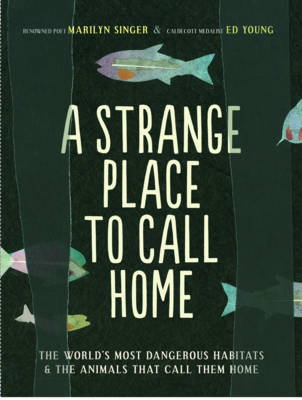
A Strange Place to Call Home

Marilyn Singer, illustrated by Ed Young

Chronicle, 2012

Ed Young has been on something of a stylistic tear of late. He strikes me as one of those undeterrable illustrators compelled to pursue a particular vision. Of course the Caldecott Committee is forbidden from considering a body of work. But A Strange Place to Call Home gives them plenty to consider in a single package. Singer presents fourteen different unlikely animal habitats in poems as different as their subjects. And Young goes to town (quite literally, in the case of some urban foxes). These are not the warm and fuzzy animals of petting zoos. These are peculiar and wild and just a little off-putting, and Young’s mysterious collages do them enigmatic justice. In many of the spreads the subject is not immediately identifiable, never mind recognizable. These images require attention, and reward it with curiosity. Neither the poetry nor the images explain these unfamiliar creatures, but their mysterious expression compells us to wonder and to investigate. And, really, what more can we ask than that?

Novel Gifts

Our holiday gift recommendations continue with a few novels we think young readers might enjoy.

The One and Only Ivan

Katherine Applegate, illustrated by Patricia Castelao

HarperCollins, 2012

Ivan the gorilla is resigned to his life in a glass enclosure at the Exit 8 Big Top Mall and Video Arcade. But when Ruby the baby elephant arrives, Ivan commits himself to winning a better life for her. Applegate crafts a natural and believable voice for Ivan, at once plain and poetic, and with it will break your heart (in the best possible way). And Castelao’s gentle gestures only add to the grace. Beautiful prose tells a beautiful story. Poignant, emotional and uplifting.

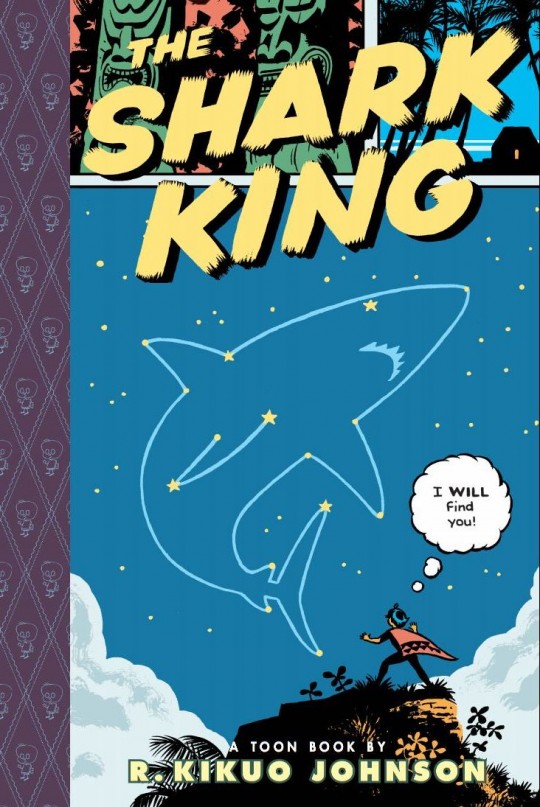
Shark King

Kikuo R. Johnson

Candlewick, 2012

A Hawaiian legend about a shape-shifting boy who becomes a king is just the thing for a picture-perfect beginning reader with graphic illustrations, comic book panels, word-balloon dialogue and ebullient excitement! Those familiar with the tropes of the graphic novel will appreciate the care with which they are observed, and those new to the format will enjoy its immediacy and its fun. Bright, smart and ebullient.

Code Name Verity

Elizabeth Wein

Disney-Hyperion, 2012

Shot down behind German lines during WWII, and enduring starvation and torture, Julie trades Allied secrets for prolonged safety and a few trifling comforts. Or does she? Wein’s startling novel weaves espionage, honor and indelible friendship into a gripping, revelatory package. Fierce readers will appreciate the investment required to dig through the obfuscation and retrieve a singularlygratifying literary reward. Dense, complex and thrilling.