Such Soft, Snuggly, Sleepy, Sloths

Lucy Cooke celebrates the otherwise underappreciated sloth in her book a little book of SLOTH. Few children’s books begin with an author’s note confessing “I love sloths. I always have.” Of course, to my knowledge, there are just not many books entirely dedicated to the beloved sloth and shame on publishing for that. Books about soft, fuzzy kittens and playful puppies enjoy rampant popularity. To be sure, if mice were paid for their abundance of stories they would have started their own colony on the moon (after all it is made of cheese, right?) far from those mean kittens. Who knows why authors love them so. No offense against rodents but even I jump when one scampers across the living room floor. The world’s largest rodent, the capybara, happens to be my favorite but how many books were published about the capybara last year (seriously, if there were any, let me know)?

slothMy apologies…this is neither about my empathy for the under-sloth as it were nor my anxiety from excessive dog/cat/mouse lit.

Slothville shelters well over a hundred sloths that have been hurt or found parentless in the wild. Founded by Judy Arroyo in Costa Rica, the sanctuary cares for the curious, grinning creatures which are lanky in appearance and leisurely in motion. In reference to a sloth named Mateo who is particularly protective of his stuffed cow Moo, Cooke jests, “If any of the other baby sloths tries to sneak a Moo hug, a fight breaks out – a very, very slow fight, in which the winner is the last sloth to stay awake.” Each page of the colorful photo album contains a single image or multiple images of the animals in cute poses a la Anne Geddes, hanging from tree limbs, or snuggling with stuffed toys, blankets, and fellow sloths. Alongside images the author relays interesting tidbits with clever quips on the animal’s behavior. The sloth’s unique behavior and bizarre characteristics will fascinate parents and children alike while the round eyed, stumpy nosed babies in their hand-crafted onesies are absolutely adorable. Besides, with a little imagination they sort of look like mice, too. Envision a rainy evening, scoop up your little one, and snuggle up to a little book of SLOTH.

A Little Book of Sloth

by Lucy Cooke

Margaret K. McElderry Books, 2013

Summer and Bird

ImageSummer and Bird

by Catherine Catmull

Dutton, 2012

This book is a book to write about.

I first picked it up on Thom Barthelmess’s (curator of The Butler) recommendation, but was also instantly attracted to the beauty of the cover. A cream background contrasted with eerie, sharp bare tree branches echoes the themes of light and dark in the text. A giant swan opens its wings at the top of the cover, inviting you to look at the beautifully embossed, maroon, shiny cursive-like font of the title. The stark white of the back cover seems stripped of feeling, except for the back of two girls walking away, close in physical space but looking in different directions. Ingenious design here.

The text itself is lyrical, insightful, and entirely imaginative. Like Shannon Hale, Catmull pulls you slowly into her world, and in order to follow, you have to surrender your skepticism and let yourself be taken over by the lush phrases and astonishing world building. As with Neil Gaiman or Kathi Appelt, you must relinquish control let the author lead you through a story that will surely be magical, and maybe will even change you.

The plot centers on two very different sisters, Summer and Bird, who wake up one day to find their parents missing in their forest home. Softspoken, warm Summer and the young, spunky, but selfish Bird are overwhelmed with confusion, rejection, and mystery, but decide to follow a cryptic note from their mother and are drawn to the woods in search of their parents. Much like Narnia or The Looking Glass, the sisters enter into the fantasy world of Down, where they take separate, parallel journeys as they try to find their parents. Through their own experiences—Bird falling under the power of The Puppeteer, a manipulative bird who has stolen her mother’s crown, and Summer finding herself stuck in a nest high in the sky with nothing but a small egg—they find that maybe what they were searching for wasn’t necessarily their parents, but themselves. Touching on complex themes of jealousy, desire for power, betrayal, guilt, anger, the dynamic nature of family relationships, courage, inner strength, hope, and freedom, this book is mesmerizing and thought provoking. I admit that as I was reading it, I went through cycles of emotion—anger, fear, irritation, hope, joy, catharsis, and a type of tender sorrow that reaches down deep where I can feel my chest sting a bit with wonder.

Catmull writes in a third-person omniscient perspective, one that is difficult to write in and hard to keep your reader involved in, because the narrator knows every character, and can write from each of their viewpoints. Catmull, however, uses the perspective to add layer and layer upon the story, sometimes jumping in time, sometimes giving the reader secret information that Summer and Bird do not know. Abundant with the mythology of birds and elements of fairy tale, Catmull entwines sections of her story like a skilled weaver, leaving her reader with a one-of-a-kind, extraordinary piece of art.

An eloquent, magical, unsettling, brave debut novel, this is one you want to read.

“All their lives, Bird had been the difficult one, the unmanageable child, and Summer the good girl who could always be relied on. But Summer could see that Bird had always found her own story and chosen to follow it, and Summer envied that. Most of all, she envied the magnetic bird-soul that had told Bird what to do.”

~from the text

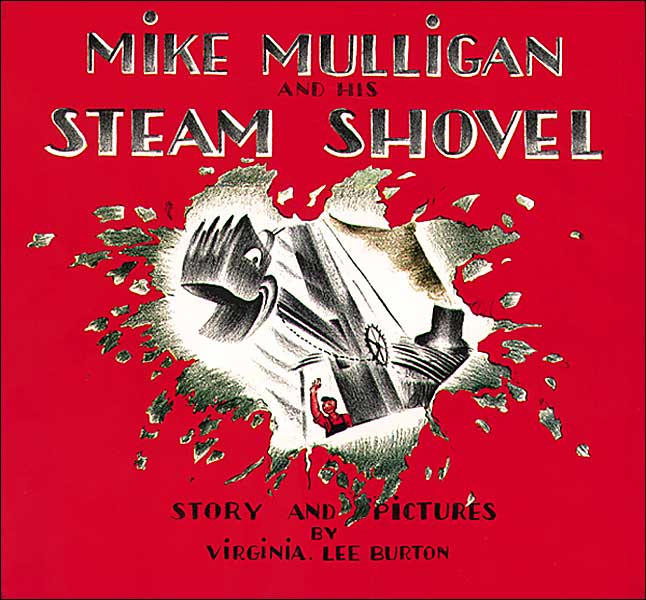
Mike Mulligan and his Steam Shovel

Mike-Mulligan-and-his-Steam-Shovel-Book-CoverRecently, I had a chance to look at Virginia Lee Burton’s classic for the first time since I was a child. My memories of the story, though fond, consisted of fast paced machinery digging stuff. As a 39 year old child, I’ve come to realize much more.Burton begins her story with a proud Mike Mulligan showing off Mary Ann (his steam shovel both named and personified with ever-grinning face – I love it!) on a hilltop, rays of light surrounding her; tah dah! The story follows their rise to stardom as key members in the architectural development of our country and the subsequent takeover of more efficient machines. While other steam shovels find their way to the junkyards, Mike can’t bear to leave Mary Ann to such a dismal end and looks for work outside of the busy city.

Throughout the story, Mike remains confident in Mary Ann and proves her worth with a final dig of Popperville’s town hall cellar. Whereas the new and improved technology is taking over in the cities, the steam shovels are still efficient, viable, and even exciting for folks in rural areas. Mary Ann proves to be the newest and fastest digging machine the townspeople have ever seen. In a sense, the story on its face seems to suggest that newer and faster is better. Mary Ann and Mike are nudged aside by better technology and in turn replace “a hundred men” digging the new town hall cellar. However, Burton proposes a clever quandary when Mary Ann literally digs herself too deep with no way out. An insightful little boy’s suggests building the town hall around the machine and the citizens, as well as Mike and Mary Ann of course, agree. Mary Ann retires with pride as the town hall’s heating system and Mike finds a less strenuous position as the building’s janitor; happily ever after. In the end, the town hall doubles as a museum to the old steam shovel and serves as a nostalgic salute to Mike and his contemporaries.

Today, technological advancement (especially as it relates to speed) is nearly constant. It’s hard to deny the improvements in efficiency and perhaps quality of life for those able to take advantage of new technology. Just as challenging is remembering how we got here and realizing that older and slower still have an important role to play in the world. Mike Mulligan and his Steam Shovel almost seems an answer to a child’s question, “What happens to the older (fill in the blank) when the new ones come along?” Though perhaps somewhat idealistic, Burton’s nod to the past and progress is a wonderful book for children brimming with morality and opportunity for meaningful discussion.

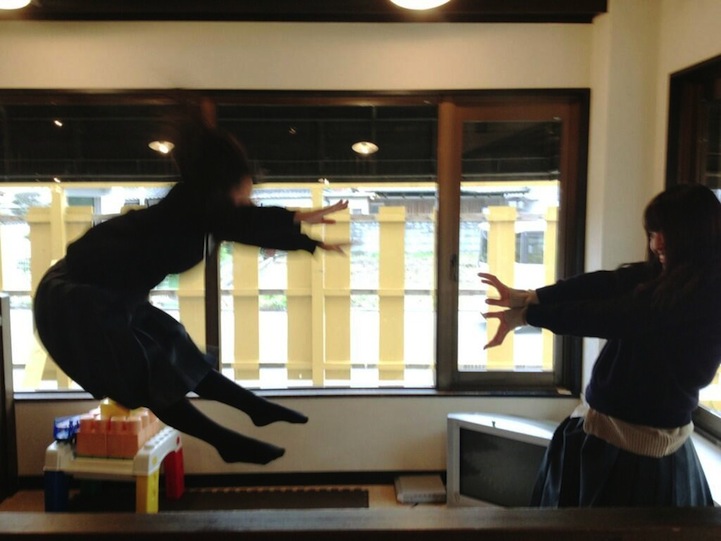
Makankosappo Kamehameha

dragonballz6My friend Heath alerted me to this trend of Japanese young people sharing photographic interpretations of manga/anime energy cannons. I love so much about it: the appropriation of the theme and its translation to a new medium, the ironic juxtaposition of prim, restrained school uniforms and dynamic, energetic composition, and the contagious fun. Just look. For all of their serious machinations, they can’t help but grin. It’s no surprise that it’s catching on quick. It’s like planking only interesting.

My favorite thing, though, is its expressive process of story. All of this began with books, books that made a mark on the cultural consciousness that these kids feel the need to explore and share. In 2013, in a world suffused with gadgetry, this is how stories perpetuate themselves. We get so distracted by sensational arguments about the end of publishing and fling ourselves on the funeral pyre of the printed book, and miss the truth staring us in the face. Stories are there. Right in front of us, telling us something about ourselves, just like they always have. We just have to remember to look.

Brave Irene

brave-ireneBrave Irene

by William Steig

Farrar, Straus and Giroux, 1986

A childhood favorite of mine, this book is about one girl’s determination to help her mother in the face of trouble. When Irene’s mother, a seamstress, falls sick, there is no one to take a beautiful gown to the duchess on the day of her big ball. Irene takes on the job, and bounds through whirling snow and bitter wind that taunts Irene, telling her to GO HO—WO—WOME!” After the package flies out of Irene’s arms and the dress blows away, Irene becomes buried in snow and almost gives up. But remembering her mother’s face, she leaps out of the snow and races down the hill to the duchess’s house. She sees the beautiful dress her mom made next to a tree, and is greeted by a glowing fire, a warm meal, and cheerful faces when she knocks on the duchess’s door. William Steig’s classic illustration style—with atmospheric color, bold outlining, and sketch-like detail—shines in this heartwarming story. It is notable that the text is longer than the average picture book, and so I would only use this with a well-behaved preschool storytime group. It is also significant that the story deals with some heavy, questionable circumstances. As I child, I never wondered why Irene’s mother let her go out in the freezing snowstorm, but now I do. I never worried about the implications of young Irene staying overnight in a stranger’s home, but now I do. When Irene gets buried in the snow, she asks herself, “Why not freeze to death, and let all these troubles end?” Of course, the beauty is that she finds hope in the image of her mother’s face and keeps going, but it is definitely intense material for storytime. Yet, the theme of this picture book is hope amidst chaos, and determination in a world that wants you to give up. How can we not share a book with such poignant themes with children?

Bbbbbbbbbbbbbbbbbbb!

elephantMy wife and I recently brought our 22 month old son to his first pajama storytime. Unwise in the ways of toddler aging, I would prefer, “He is almost two year old.” He in his onesie, me in my version of pjs, and Mom the only mature, pajama-less one of us set out for an adventurous evening at our library. I suppose I should mention here my disappointment that adult onesies are not widely fashionable. When they are, as my dreams foretell, I shall forever wear them.

As I was saying, we planned to arrive at the library a bit early so B could explore. Unfortunately, a significant aspect of his exploratory process includes climbing stairs at the speed of molasses. Against his wishes, we decided to carry him up for fear of missing the program entirely. Librarians have organized short, picture book stacks in rows overlooking a play area and glass-walled activity room. My eager little guy scurried through the aisles pointing, oohing, and ahhing almost exactly the way I envisioned he would. For B, nearly every audible thing on earth; cars, elephants, trains, cows, trains with car driving cows and elephants, produce an enthusiastic ‘Bbbbbbbbbbbb!’ sound. Naturally, when he noticed the dozens of stuffed animal characters on top of each book stack, the once quiet library was transformed into a bustling circus train yard. I was smitten.

B has little previous contact with other children beyond our nuclear family. Toddler storytime at the library proved an excellent way to introduce him to other people his age. Although he looked to be the youngest of the bunch, he interacted with other children through play, crafting, and dancing while learning to share, communicate, and listen. Not bad for a 30 minute library program. The theme was spring and although librarian shared only two books (for the life of me, I can’t remember them…I was too busy being a proud father; bad librarian!), the group was ready to graduate to building a paper plate mask with lion and lamb on either side. Afterward, we scurried out to the play area for some block building and car ‘bbbbbb’ing.

As we left the library I reflected on the last hour (should I have said sixty minutes?) feeling happy and eager to enjoy our next visit. Strapping B into his car seat, I realized that the chances of him remembering his first storytime when he was say 96 months old were remote. Fortunately, I knew that I would never forget it.

Image from Microsoft Word Clip Art

Babies!

What’s little and round and needs to be read to every day?

A baby, that’s what. Thankfully, there is no shortage of wonderful, baby-friendly reading material out there. Here are a few recent titles that caught our attention:

now im bigNow I’m Big!

by Karen Katz

McElderry Boos, 2013

Karen Katz has dozens of bright, ebullient, irresistible board and picture books to her credit, all populated with her unmistakably round baby figures, in vivid, technicolor glory. This time around a collection of toddlers reminisce about their long-ago infancy. Each spread has a baby on the left suffering some baby indignity (When I was a baby I had to wear diapers) followed by the grown-up toddler celebrating new found preschool prowess (NOW I’M BIG! I can wear underpants and poo in the toilet). The final situation has a little girl welcoming a new baby to the family, offering a litany of all the ways she can help, now that she’s big. While toddlers will love feeling all grown-up, the bright colors, expressive faces and simple illustrative style make this a winner for the brand-newest little ones, too.

faces for babyFaces for Baby

curated by Yana Peel

Templar Books, 2013

In 2009 Templar Books created an exquisite board book of black and white fine art reproductions specially selected for babies’ taste for bold, high-contrast imagery. This follow up taps in to babies’ interest in faces, offering twelve modern depictions of the human face in varying styles. The composition is uncluttered, with nothing but the image, with the artist’s name and date of the work printed unobtrusively below. Brief biographical information of the artists represented appears on the verso and a circular mirror on the final page stands apart from the series of rectangular pieces, distinguishing baby’s face from the others. A luxe and lovely package.

you are my baby farmYou Are My Baby: Farm

by Lorena Siminovich

Chronicle, 2013

This charming, ingenious board book takes advantage of a deceptively simple die-cut process, making a matching game of farm animal parents and their young. On each large page a grown-up farm animal describes her baby, complete with a color reference (You have a curly pink tail) and on the smaller pages the baby is pictured, identified by name, and the animal sound is communicated (You are my baby, little piglet. Oink! Oink!). The large and small pages turn independent of one another, though careful use of backgrounds that contrast in color and texture facilitates easy matching. With all sorts of developmental concepts at play (colors, patterns, animal names and sounds, matching, motor skills) this winning volume and it’s sister volume You Are My Baby: Safari fire on all baby cylinders.

What are your favorite books for baby?

Green Malt-O-Meal and Specialness, Among Other Things

During this time of year when I was a kid, my family was usually going nuts with activities. Dad was just getting back from choir tour, Mom was busy teaching music to her crazy kindergarteners, and us kids were somewhere doing speech, theatre, taekwondo, ballet, piano lessons, homework—or sometimes combinations of these things. It was hard to catch time for a dinner together or even a hello after play rehearsal. But Mom and Dad were a pretty great mom and dad, and they always managed to make all three of us kids feel special. They dyed malt-o-meal green on St. Patrick’s day, they slipped little notes in our lunchboxes, and on Easter, each of us got a basket with our favorite candy—Snickers for Josh, Reeses Peanut Butter Cups for Rachel, and Jelly Belly jelly beans for me. Sometimes there would be a little trail of jellybeans from the door to my bed, as if the Easter Bunny had accidentally dropped them on his way (even when I was sixteen).

Now, I’m not home anymore. I’m still their kid, but now I have a job and a school twelve hours away from them, and they aren’t by my side to make me feel special anymore. They still do, of course, it it just over the phone or in cardboard package, but it doesn’t have the same immediacy. So I find ways of discovering what’s special now on my own—through friends, through art, through music, and also, of course, through books.

The following three picturebooks are all published in 2012, and they all have something to say about being special. Sometimes specialness is far away and you have to find it. Sometimes, it’s right next to you and you don’t see it. Sometimes, it’s in an animal or in a friend or in a mysterious something that might surprise you or take a while to understand. Sometimes, it is lost or forgotten.
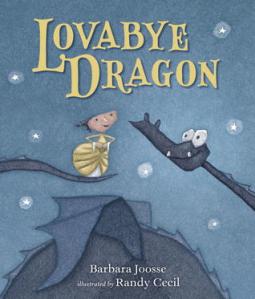
13414866In Lovabye Dragon, by Barbara Joosse and illustrated by Randy Cecil, a little girl longs for a dragon friend, and a dragon longs for a little girl friend. They dream about finding each other, but the poor girl becomes so sad that she cries silver tears all the way to the dragon’s cave. When the dragon follows the tears, he finds the girl in her castle, and the double-page spread is filled with light and celebration of their union. Cecil’s lovely oil paintings use diverse shades of blue to express the rich, atmospheric tone of the book, and Joosse’s sensitive text celebrates the friendship of two creatures that in every way are different, but together build something special. Though this story could be taken as fantasy, fairy tale, or some version of destiny, I take from it a sense of hope and beauty. You can be alone. You can be sad. You can be alone and sad for a long time. But sometime, somewhere, someone might find you and call you special, or you might be led down a path to find someone special. In the meantime, there’s no harm in calling yourself special. Because it’s true.

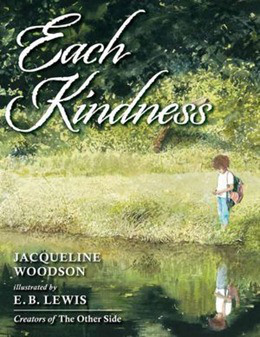
ImageEach Kindness, written by Jacqueline Woodson and illustrated by E.B. Lewis, has a more deliberate message about treating others with respect. Written in the first-person, it tells the story of a new girl coming to school. The narrator character and her friends ignore the new girl—they whisper secrets, laugh, make fun of the girl’s clothing, and refuse to play with her. Lewis’s realistic watercolor illustrations captivate the eye and change perspectives drastically on every page, as if they are begging the narrator to change her own perspective. She doesn’t, though—not until it is too late and the girl has moved away. The book ends with the young protagonist watching the water ripples come and fade, wishing she would have made the new girl feel special.

Don’t we all wish we could go back and change something we did, or make someone feel special when we didn’t? I remember being the bystander in a few instances in elementary school—not teasing, but not standing up for anyone either. My feelings of guilt were strong and palpable—I can still feel them now. So palpable, in fact, that I became a “Peer Mediator” in upper elementary school and was determined to calm fights and extinguish any bullying I saw. Now, it’s easy to see someone’s uniqueness—we are adults. It’s easy to forget the “rules” of being cool in school, and seeing people’s “special qualities” certainly wasn’t part of the being cool plan. I wish we could change that.

ImageFinally, a lovely interplay of humor and heart-warming charm harmonize in Boy + Bot, written by Ame Dyckman and illustrated by Dan Yaccarino. A young boy and a red robot meet each other in the forest one day, and instantly become friends. Trouble ensues when the two friends roll down a hill and Bot’s power switch turns off. The boy tries everything he knows to help—feeds him applesauce, reads him a story, and tucks him in to sleep. But then, when the bedroom door opens, Bot’s power switch turns on and he is frightened to see that Boy cannot be awakened! He tries everything he knows to help—bring him to his home (a mysterious tower), gives him oil, and brings in a spare battery. Bot’s inventor discovers him, the boy awakens, and the two friends are reunited. Bright colors and artistic vignettes bring out both the boldness and softness in this book, and it’s pretty fabulous to see two characters with an honest connection in just thirty-two pages. But it happens with little kids, right? Kids (I’m talking before school starts) can meet each other and instantly hold hands, then go off and play Legos. They make each other feel special all the time.

Okay, maybe by now you’re screaming at your computer—enough with the cheesiness, the sugary clichés, the specialness!

But I still dream about the green Malt-o-Meal, and I’m 28. I still love the Easter Basket with the trail of Jelly Bellys. And I still want hugs and phone calls and everything else that makes me feel special.

Because I am. And so are you. So spread it, what else is there to do?
Three Times Lucky

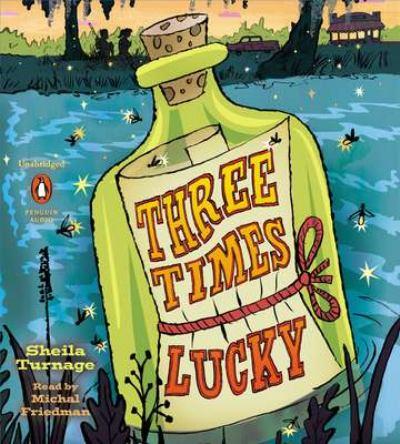
three-times-luckyThree Times Lucky

by Sheila Turnage

read by Michal Friedman

Penguin Audio, 2012

My colleague Luke recently posted about Marcelo in the Real World, 2010 Schneider Award winner, paying particular attention to the audio version. I, too, am busy listening to award-winning titles, and find myself charmed by Michal Friedman’s reading of Three Times Lucky by Sheila Turnage.

Audiobook evaluation can be a tricky business, and this title makes for a nice case study. One of the stickier wickets has to do with separating the quality of the reading and the production from the quality of the source material. As far as the quality of the source material here, we have the endorsement of the 2013 Newbery Committee, who chose Three Times Lucky as one of their Honor Books (and I’m more than happy to throw my enthusiastic appreciation into the pot).

Then there’s the question of artistic interpretation. Set in fictional  Tupelo Landing, NC, the book features a cast of honest, sometimes quixotic characters, drawn with the thick outline of bigger-than-life eccentricity. Turnage is a native of North Carolina herself. She chronicles the outlandish, small-town behavior of the inhabitants of Tupelo Landing with a generous, colorful twang and Friedman captures the cadence of the language and the integrity of the characters in her spirited reading.

The story features a few mysteries playing out on different levels: Mo and her friend Dale are “assisting” the police with a murder investigation; Mo is searching for her own mother, who left her drifting down a river in a basket (Mo is short for Moses); and the reader is busy puzzling out the truth about Mo’s adopted family, The Colonel and Miss Lana, and their own mysterious behavior. Friedman’s narration manages a sharp intensity that maintains all of that suspense without ever puncturing the delicate humor.

As far as the production values, there is much to celebrate here. The source material comes easily divided into chapters of manageable size, and are broken into tracks accordingly. The sound is crisp, clean and consistent, without any audible hissing, muddiness, or variations in the voice reproduction. There is nothing to notice here, and that’s just as it should be.

My one quibble would be with the application of southern accents. While Turnage’s language feels authentic, Friedman’s North Carolina drawl has a few consistency issues. I can’t speak to the authenticity of the North Carolina accent in general, but I don’t think it unreasonable to expect one character to pronounce another character’s name consistently throughout. The cadence feels genuine, though, and beautifully captures the essential nature of the characters. And Mo’s first person narrative, even with the pronunciation lapses, is remarkably and genuinely childlike, in a refreshing and indelible way. So, my quibble is just that, and nothing more.

At the end of the day I look for an audiobook that adds something to the experience that I can’t bring to it myself, reading in my head, and in that regard this one scores right off the charts. Give it a listen and tell me what you think!

Thank you, Mr. Stork

Marcelo-in-the-Real-WorldMarcelo in the Real World

by Francisco X. Stork

Arthur A. Levine, 2009

Late to this literary shindig, I often find myself running (speed walking?) to keep up with my fellow bibliophiles. Better said, I’m discovering pots of gold that have long ago been plundered by my colleagues, but finding them nonetheless. Such is the case with Marcelo in the Real World. Content with studying at Paterson High School, (a special school for students with Asperger’s Syndrome) caring for horses and living in his own tree house, seventeen year old Marcelo Sandoval is challenged by his father to accept a summer job at his law firm. Marcelo reluctantly accepts and begins to feel and express emotions that he has never before recognized. As he learns to cope with this new world, what Marcelo once saw as clear lines between right and wrong, good and bad, and the like become fuzzy. The competitive nature and opposing viewpoints of this ‘real world’ create a far more challenging, often confusing reality for Marcelo.

As with many books of late, I experienced Marcelo as an audio book. Fellow listeners can attest to the utter deflation of a good book brought on by poor audio production. The audio starts off slow and I admit hovering my finger over the eject button on my CD player. Fortunately, I remained patient and soon the reader’s (Lincoln Hoppe) deliberately slow pace and hushed, deep tone became harmonious with Marcelo’s unique and wonderful thought processes. Though I have never had the occasion to read a book after listening to it, I most assuredly will do so with Marcelo. Indeed, not since The Miraculous Journey of Edward Tulane (Thank you, Ms. DiCamillo) has there been a creation I wished I had written. For those who have not yet read it, try listening to it. To those who have, I offer the same advice.