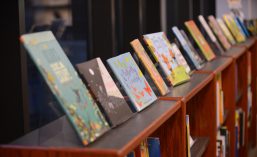
The Brother’s Grimm: Popular Folk Tales

brothers grimmThe Brothers Grimm: Popular Folk Tales

Newly translated by Brian Alderson, illustrated by Michael Foreman

Doubleday, 1978

This rich collection of thirty-one Grimm’s tales combines familiar stories, such as “Hansel and Gretel,” “Rapunzel,” and “Rumpelstiltskin,” with lesser-known tales like the haunting “Fitcher’s Bird” and “King Throstlebeard.” While the anthology contains no formal introduction, internal notes or citations, there is a table of contents and a list of color illustrations in the front matter. Alderson also includes detailed “Afterward” and “Notes” sections in the back matter, in which he affirms his mission for the book. He states that many English translations of Grimm, though accurate, “miss the spirit of the tales” (188), and his objective for this collection is to translate the German tales “not from the scholar’s study but from a storyteller talking to his listeners” (188). He succeeds in this goal, as the translations are clear, concise, and readable—yet they still contain anecdotes of humor, gruesome description, and evocative imagery. Alderson notes that the Brothers Grimm stories “exist in a number of forms,” and his translation “is largely based on texts which had reached [the] final form, the ninth edition of the ‘Grosse Ausgabe’” (189). When he uses previous versions of the tales in his translations, he does not make a specific source note in the internal text, but he does mention it in the “Notes”, which are a thorough three pages long. Alderson comments that himself, his illustrator, and his publisher chose the specific tales to be included, and notes that the order of arranging the tales is intentional. He states, “It was hoped that the sequence of stories would have a naturalness about it that would make it comfortable for readers to work through, if they wished, from one end to the other” (189). Michael Foreman’s dynamic illustrations enhance the collection, as each tale begins with a black-and-white thumbnail sketch and twenty-six full-color, vibrant, watercolor illustrations are scattered throughout the book. Foreman captures the tone of each tale, using muted and dark colors, shadow, and thin lines in the mysterious tales and luminous color, imaginative details, and softer lines in the lighter tales. The collection’s most remarkable feature is its potential diversity of audience. Because of the collection’s comprehensible translation, it is a great resource for the oral storyteller, but it is also a worthy selection for upper-elementary children, as the illustrations bring out the pathos of each story. Translated and illustrated by two qualified, experienced experts in children’s literature, this collection is a significant addition to the canon of folklore for children.

Ed Young to visit the Butler Center!

Caldecott Medalist Ed Young is coming to the Butler Center in February for two spectacular events.

ed youngOn Friday, February 22 at 6:00pm Mr. Young will deliver the inaugural Butler Lecture “The House Baba Built” in which he will talk about his book of the same name. This beautiful and engaging piece of expressive nonfiction chronicles his childhood in Shanghai and illuminates the monumental home his father built for his family, which was both a playground for Young and his siblings, and a refuge from the dangers of the second world war for friends from around the world. The lecture is free and open to the public, but registration is required. Click here to register.

On Saturday, February 23 Mr. Young headlines The Truth About Expression, the Butler Center’s fourth annual continuing education conference. Every year we look to literature for young people as a means of pursuing and understanding some aspect of our world a little more fully. This year we investigate expression. Joining Mr. Young are Ascha Drake, Amanda Freymann and Joan Sommers, cocreators of Chuck Close: Face Book, the artist’s Boston Globe Horn Book Award winning autobiography; members of the Butler Center community; and local storytellers of international repute. Visit The Truth About Expression  page for more information and click here to register.

Oliver Jeffers

I have written before about the glories of This Moose Belongs to Me. Here’s an appealing video wherein author/illustrator Oliver Jeffers talks about his process. It’s fascinating to hear about the integration of text and image from the very beginning, and really cool to see his visual aesthetic (and effervescent sense of humor) manifest all across his life.

“Rubberized” book covers?!

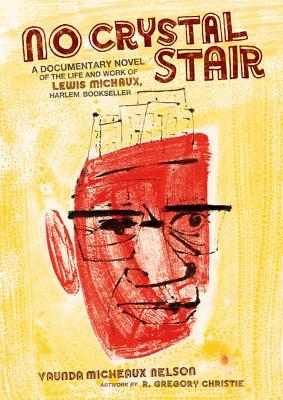
Is it just me? It seems that publishers have become really enamored of some new dust jacket treatment that adds an almost sticky texture to the paper. It feels sort of like a neoprene wetsuity material. I was on the Boston Globe Horn Book Award jury for 2012 and we recognized three pieces of fiction: No Crystal Stair by Vaunda Michaux Nelson (winner), Life: An Exploded Diagram by Mal Peet (honor book), and Code Name Verity by Elizabeth Wein (honor book). And all three have been subjected to these rubbery covers. Two of the three have dark, black backgrounds and I will admit that the matte finish of the texture adds some depth to it. But it also shows fingerprints something awful. And it’s a little tacky (duct-tape-adhesive tacky, not white-pants-after-labor-day tacky). Most libraries will put mylar covers over the jacket, simultaneously solving the problem of the unpleasant feel and compromising the benefits of the matte finish. And, really, at the end of the day, it doesn’t much matter. At all. But, still, someone is going to a lot of trouble (it must be some trouble) to take what might be perfectly fine dust jackets and make them stick.

What do you think?

no crystal stairlife an exploded diagramverity

For your consideration 3

Why teach an old dog new tricks when the old dog is already perfect? Our Caldecott consideration continues.

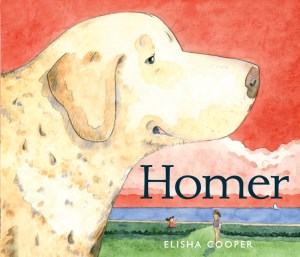
homerHomer

Elisha Cooper

Greenwillow, 2012

Look closely here. On the surface this is a simple, lovely story about a nice old dog (a dog who doesn’t die, by the way, for those of you worried about that kind of thing). With sensitive brush and pencil work Cooper gives us an irresistible, flesh and blood (and fur) dog in Homer. But beneath that sweet surface is an especially sophisticated piece of storytelling. Copper lays the story out across a carefully structured set of panels. One by one, the members of Homer’s family pass him on the porch, inviting him to join in one outing or another. And with each cumulative turn of the page and subsequent invitation, we see the previous family member attending to his or her pursuit. And then the whole things plays back in reverse as the family returns. A wordless denouement finds Homer leaving his post on the porch and joining the family inside, hoisting his arthritic frame into what is clearly his chair. And there is peace. Cooper’s ability to paint such full-bodied characters, human and canine, is such simple linear gestures is, on its face, a little bit amazing. That he applies that skill to a brilliant narrative arc is extraordinary. It’s hard to imagine paying more respect to a child audience.

For your consideration 2

Our Caldecott consideration continues with a fascinating book of poetry about strange habitats and their stranger inhabitants.

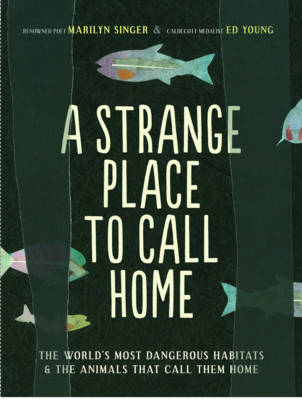
A Strange Place to Call Home

Marilyn Singer, illustrated by Ed Young

Chronicle, 2012

Ed Young has been on something of a stylistic tear of late. He strikes me as one of those undeterrable illustrators compelled to pursue a particular vision. Of course the Caldecott Committee is forbidden from considering a body of work. But A Strange Place to Call Home gives them plenty to consider in a single package. Singer presents fourteen different unlikely animal habitats in poems as different as their subjects. And Young goes to town (quite literally, in the case of some urban foxes). These are not the warm and fuzzy animals of petting zoos. These are peculiar and wild and just a little off-putting, and Young’s mysterious collages do them enigmatic justice. In many of the spreads the subject is not immediately identifiable, never mind recognizable. These images require attention, and reward it with curiosity. Neither the poetry nor the images explain these unfamiliar creatures, but their mysterious expression compells us to wonder and to investigate. And, really, what more can we ask than that?

Bluefish

Bluefish by Pat SchmatzRecently during some pretend-play time, my two-year-old niece tucked me into bed and read me a bedtime story.

Of course she didn’t really read it to me. With each illustration, her memory triggered from the countless times Daddy read Olivier Dunrea’s Ollie aloud, and she recited each word flawlessly. A kind of decoding, it could be argued, but not true reading.

Yet for a blissful moment as I snuggled under a doll-sized blanket, I could imagine it. Reading is so commonplace, so easy for most people in my life, I could momentarily believe that this tiny person, so recently a baby, was reading me a story. It felt natural. Normal.

Yet it’s a remarkable feat, isn’t it? Gorillas can learn some basic sign, and dogs can apparently be trained to recognize words, but no other species comes close to the incredible things we can do in speaking, reading and writing. Phonemes come together to represent ideas, and then those sounds are further represented by these symbols on the page. It’s decoding that’s two abstract layers deep, yet somehow we all manage to master this skill by the time we’re still young children.

Well, most of us do.

In Bluefish we meet a 14-year-old protagonist who cannot read. We aren’t aware of that information at first. Like the parents and teachers who know him marginally, we might see Travis as indifferent. Guarded. Maybe a little rebellious or even lazy. A typical teenager, no? If only he would try harder. If only he would apply himself.

But then we learn of his problem, and we think of how little we know anyone. How much we can assume. And how mountainous of a task it would be to catch up to peers ahead of you by 10 years of reading.

Thank goodness he’s not alone. One wise teacher catches on, and with pointed references to The Book Thief, he has him start circling words just as Liesel did. An eccentric classmate, Velveeta, eventually figures it out as well, and offers her help. But there’s no romantic eureka moment in this process. It’s slow, often frustrating work. Velveeta, eager to see results, makes a painful mistake after a failed tutoring attempt:

“Travis, come on. You didn’t even try.”

Try. That word torched fire-hot.

Of course he’s trying; it’s the single most important skill in society. He can’t read, but he’s not a fool.

How many of us fervent readers might ask him to try harder? How easy it seems now, our linguistic synapses established so long ago. I see myself in Velveeta, eager to help and a bit clueless how to do so. Here’s something she’s good at, something she perhaps can fix – a marked difference from her own problems hidden beneath her exuberant exterior. Though Velveeta can’t fix Travis’ reading problem, she can be his friend, with all the trust and acceptance (and, yes, mistakes) that come with the job. And he can be hers right back.

For your consideration

As the days get shorter and the wind gets colder and people put Christmas lights up right after Halloween, our thoughts turn to Caldecott contenders (well, my thoughts do, anyway). So over the coming days we’ll be putting forward some books on our Caldecott radar.

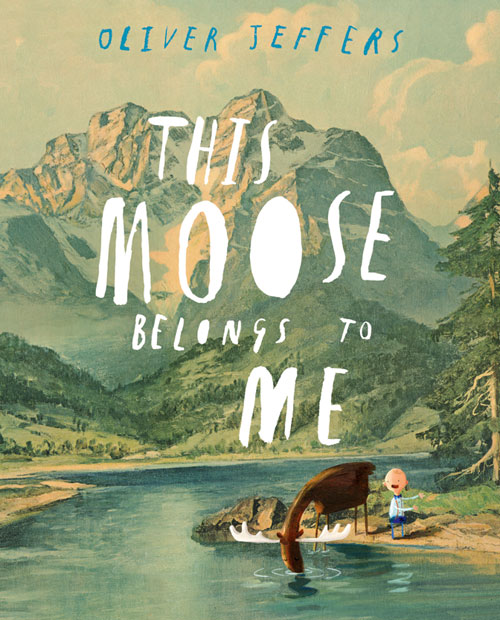
This Moose Belongs to Me

Oliver Jeffers

Philomel, 2012

This is the story of Wilfred, a boy who finds and adopts a moose, and Marcel, the moose who will not be adopted. There is so much to love about this book: gentle humor, indelible characterizations, careful pacing. The Caldecott Medal, of course, is awarded for particular criteria, though, and “Thom loves it” didn’t make the cut. Luckily, this wonderful book excels with the actual criteria as well. Indeed, each of the wonderful elements mentioned above is achieved in the illustrations. Indeed, all of them are realized, to a high degree, in the illustrations. The incongruous background material, pixelated Romantic landscape paintings and Victorian engravings, amplifies the situational humor, giving it tone and color. Similarly, even though Wilfred’s behavior gives us the skeleton of his persona, the remarkable, gestural facial expressions take it home. Even the Moose singular apple obsession finds subtle expression in his square countenance. And the book’s design, the varied use of panels, blank backgrounds, image-filled word balloons, and even combination of typeface and handwriting, fixes a perfect pace. This is a picture book that gets better and better with multiple readings. Here’s hoping that it is being read again and again.

The List

the-list-siobhan-vivianWhen I was in middle school, I wrote a story that was printed in the school lit magazine.  It was about a girl that is so obsessed with the upcoming dance and what’s she’s going to wear that she forgets to look both ways crossing the street and is fatally injured in a car crash. Yes, I was an angry teenager. It was this kind of juvenile catharsis that I expected from The List by Siobhan Vivian. I gleaned from the cover flap that the story revolves around an actual list of the prettiest and ugliest girls in each grade. Apparently it comes out every year right before homecoming and somehow no one knows who makes it and the school administration does absolutely nothing about it. I imagined “pretty girls” and “ugly girls” discovering they had more in common than they thought. I saw an eating disorder somewhere in there. And I hoped for at least one pretty girl getting blood dumped on her or being horribly disfigured in an accident. Entertaining, maybe. But I’ve (almost) moved on from all the bitterness and insecurity of my teenage years. As a mature and confident adult I find reading about these kinds of stories shallow and boring.

I was wrong. And right. This is undeniably a book about body image and identity. There is, indeed, a girl with an eating disorder. But that’s just a hook. Vivian uses the list and the inevitable drama it creates as a way to drop a bomb into the lives of girls who are fully realized characters all on their own. They are worried their boyfriend is ashamed of them. They hate their mothers. They lost their virginity and aren’t ready for the emotional consequences. They just don’t want to be friends anymore. With alternating chapters from the voice of each girl on the list, readers can dip in and out of these girls’ lives drawing the larger thematic connections where they want. I have to hand it to Vivian for holding the plot together across eight different points of view. By the end, I not only felt I really knew each girl, but I really wanted to know who wrote the list. And then I remembered that I’m a mature and confident adult…and stopped judging books by their cover.

Wonder Show

Wonder-ShowSince reading Wonder Show I’ve had the chance to tell a lot of people about it. Every time, I find myself outlining the plot for them. There’s a girl, I say, who is abandoned by her family and sent to a home with a sadistic head master. She’s mistreated, I tell them, but also possibly guilty of a terrible crime. And so she escapes to a traveling freak show, which is when the story really begins. Oh, they say, cool. And after they have politely smiled and nodded their head, I realize that I have failed. They think this is just another novel. I could go into more detail, sure. I could point out what a relief it is to read a book written for young adults that is not entirely in the first person. I could talk about how Barnaby weaves together the omniscient voice of the narrator, pieces of diary entries, letters, lists, and chapters from the viewpoint of tertiary characters. I might explain just how rich those characters are, that they are not just a quirky backdrop for the adventures of the protagonist, but are on journeys of their own deeply woven into the larger narrative. I could talk about how the book is really about the power of storytelling and how we define, burden, and limit ourselves with the stories we tell ourselves about who we are.  But who would listen? I’m not the storyteller that Barnaby is and even if I was, most people don’t want to hear about anything but the plot. They want the coming attractions that show exactly what is going to happen and reveal all the best jokes. But sometimes, the story is all in the telling. And Wonder Show is that kind of story.