PCP Two of Spades: Born in the Wild

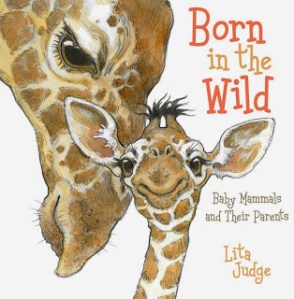
born in the wildBorn in the Wild: Baby Mammals and Their Parents

by Lita Judge

Roaring Brook Press, 2014

This bright, instructive exploration of different mammal families offers lots of concrete information about what mammal babies need and how mammal parents meet those needs. Sections feature a brief identification of a particular need on a single spread, followed by a few pages with specific examples of different species attention to it. The text is full of fascinating explicatory zoological detail about everything from food to shelter. But the star of this charming outing is Judge’s open, inviting portraiture that finds a perfect balance of natural authenticity and friendly accessibility. The informative text provides the facts and figures, delineating our common place in the natural world, and the warm, soulful imagery makes good on that promise, allowing the reader to feel the connection as well as understand it. In a world where growing up can feel like a daunting endeavor, how comforting it is to know that we’re all in it together.

PCP Two of Hearts: The Thing About Luck

the thing about luckThe Thing About Luck

by Cynthia Kadohata, with illustrations by Julia Kuo

Atheneum, 2013

I am a huge fan of Cynthia Kadohata’s work. Huge. I was on the committee that selected Kira-Kira, her first book for children, as the 2005 Newbery Medal winner, and I have loved every subsequent book. There is a quiet, raw honesty that runs through her writing, a transparency of language that sneaks up on you and, out of events that seem mundane, delivers something exquisite and profound. It’s like magic.

The Thing About Luck tells the story of a Japanese American farming family toiling amidst a flurry of bad luck. Sunny’s parents have been called away to Japan on emergency family business, leaving Sunny and her little brother Jaz in the care of her grandparents Obaachan and Jiichan, saddled with the back-breaking work of itinerant, contract wheat harvesting. Kadohata paints the circumstances in vivid, albeit plainspoken detail: Sunny’s fear of mosquitoes (she had malaria once); Jaz’s difficulty connecting; Obaachan’s strict, traditional ways; Jiichan’s tireless effort; and an impossibly thorough explanation farm machinery. And somehow, in the spaces between these definitions and explanations, she offers a tender, immediate, indelible portrait of family that is as touching as it is unique. These are people who love one another deeply, and Kadohata’s ability to show us that love, in the conflicts and struggles that would threaten it, is simply staggering.

LeUyen Pham to deliver the Butler Lecture!

LeUyenPham

Award-winning and best-selling author/illustrator/graphic novelist LeUyen Pham will deliver her lecture “Wandering Wonderland: An Immigrant’s Story Told Through Books,” on Thursday, March 5, 2015. Pham’s work includes a delightful variety of picture books, from the Orbis Pictus honor The Boy Who Loved Math by Deborah Heiligman and the Freckleface Strawberry books by Julianne Moore to her own stories Big Sister, Little Sister and A Piece of Cake; illustrations for the New York Times best-seller The Princess in Black by Shannon and Dean Hale and the Scott O’Dell Award winner Bo at Ballard Creek by Kirkpatrick Hill; and a range of graphic novels with Jordan Mechner and Alex Puvilland, including Prince of Persia, Solomon’s Thieves, and Templar. For this, the third annual Butler Lecture, Pham is literally “drawing” on her own childhood, producing a series of comic panels that explore her earliest experiences with particular books for children.

The lecture will take place at 6 p.m., followed by a reception with refreshments and a book sale and signing; it is free and open to the public, though registration is required. This an evening not to be missed.

To register, please visit: http://gslis.dom.edu/newsevents/butler-lecture-2015-featuring-leuyen-pham

For more information, please contact me at tbarthelmess@dom.edu.

The Butler Lecture is generously underwritten by the Butler Family Foundation.

PCP Two of Diamonds: My Book of Life By Angel

my book of life by angelMy Book of Life By Angel

by Martine Leavitt

Farrar Strauss Giroux, 2012

The grief surrounding her mother’s death and the havoc it wreaks on her family pushes Angel to breaking. She slips onto the streets, and soon is in thrall to charming, malevolent Call and his “candy.” At first she’s doing favors for his friends, but in short order she finds herself working a corner to support herself and her habit. She is broken and resigned, until Call shows up one evening with eleven-year-old Melli in tow. Angel searches her soul to find an untapped store of resilience and resolve, and sets out to rescue Melli, and maybe, herself.

Leavitt writes in stunning, atmospheric free verse, and somehow manages to craft crystalline beauty from brutal, harrowing circumstances. Angel’s first-person narrative swings between blunt resignation and fierce defiance, beautifully articulating the confused despair of her gradual destitution and the clambering strength of her willful climb back up. It’s a staggering piece of writing–searing and evocative–and leaves the young reader with a profound understanding of the complex circumstances some teens face, full of empathy and free from judgment.

YMA thoughts

There were lots of surprises at the ALA Youth Media Awards this past Monday morning (you can read about all of the winners here) and they have already been much celebrated, dissected, and critiqued. I have my own thoughts (don’t we all) which I offer as a list, because I fear if I started writing something long form I’d be here until April. And I have some snow to shovel.

So, in no particular order, here’s what I think:

1) Diversity won the day. Everywhere. The Newbery medal and both honor books. The Wilder (ALSC lifetime contribution) and Edwards (YALSA lifetime contribution) awards. The Caldecott medal and three of the six honor books. The Arbuthnot lecturer. Three of the five Sibert honor books. The Geisel award author. Not to mention the slates from the Belpré, the Coretta Scott King, the Schneider Family, and the Stonewall, all of which are diverse by nature. Everywhere!

2) Back in December, in a comment on the Calling Caldecott blog, I suggested that it was entirely possible for This One Summer be recognized by both the Caldecott and Printz committees. Nobody was buying it. This is me, gloating.

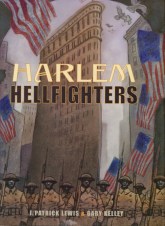
3) Some of my favorites were overlooked. Harlem Hellfighters, The Misadventures of the Family Fletcher, The Turtle of Oman. But I still get to love and champion those books, and now I get to (re)acquaint myself with other books that other folks find to be extraordinary. It’s hard to think of that as a problem, really.

4) Some things I really don’t like were recognized, too. And that’s a terrific opportunity to remember that people see books differently from how I do, and people see the awards differently from how I do. And, ultimately, that the greater the variety of taste and appreciation we have among our ranks, the better able we are to meet the many different literary needs of the young people we serve. Win win, as it were.

5) What did you think?

harlem hellfighters Levy_Front_final 91xfx6cxaRL._SL1500_


PCP Two of Clubs: Denied Detained Deported

denied detained deportedDenied Detained Deported: Stories from the Dark Side of American Immigration

by Ann Bausum

National Geographic, 2009

Negative space is an artistic construct that looks at the visual space around or between subjects as a place in an image where meaning can exist and communicate itself: objects can be defined by their own outlines, or by the outlines of adjacent objects. The construct has application in the study of literature, too, as we consider how an idea is shaped not only by its own definition but also by the definitions of related concepts. As we seek to understand “belonging” in books for young people, then, let us look not only at books that celebrate someone’s place in a particular community, but books that consider the refusal of such membership, too.

Ann Bausum applies such an approach to American history in Denied Detained Deported: Stories from the Dark Side of American Immigration, seeking to understand how people came to this country, by looking deeply and carefully at a number of situations where that arrival was thwarted. She begins with the familiar Emma Lazurus poem that appears on the plaque at the base of the Statue of Liberty, followed by a contemporary poem by Naomi Shihab Nye that offers a decidedly less welcoming vision of the US border. From there Bausum investigates a number of historical events, each titled with a different form of alienation. “Excluded” looks at the Chinese Exclusion Act of 1882 which left Chinese immigrants ineligible for citizenship until 1943. “Denied” tells the story of the St. Louis, a ship carrying hundreds of German Jewish refugees that the US turned away in 1939. The author captures the events with arresting clarity, engaging the reader’s empathy and outrage with her precise language and documentary research. And on top of the harrowing stories Bausum posits questions about our contemporary treatment of those newest to our country, often subjected to xenophobic mistreatment and persecution.

By exacting the nature of fearsome, systematized alienation, Denied Detained Deported delivers a powerful picture of how important it is to belong.

PCP Ace of Spades: The Disenchantments

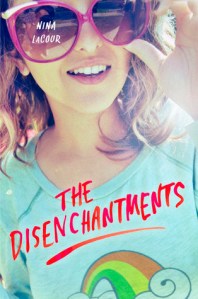
11699055The Disenchantments

by Nina LaCour

Dutton, 2012

Colby and Bev have been saving for years (and years) for their year-long-backpack-around-Europe-before-college-trip. It’s going to be the best. They’re best friends, after all, and, well, Colby is pretty much in love with Bev. Except Bev isn’t going. She’s going to college instead. She applied ages ago. Sorry.

To make matters worse (or not quite so bad), Colby will be spending the summer before he’s not going to college traveling around with Bev and Meg and Alexa, The Disenchantments, managing their Pacific Northwest tour from his Uncle Pete’s VW van. There is some road-trip revelry here, and a goodly amount of deep adolescent angst, that keep things moving and give us plenty to think about along the way. But the novel’s real genius comes from profound clarity and resonance with which LaCour paints Colby’s circumstances. To be sure, not many of us have experienced this particular turn of events, but she makes something universal of the skittish confusion and achy disorientation that come when the dependability of high school gives way to the unknown of what comes next. It’s no easy path to tread, and Colby’s way through is thrilling and sad and powerfully affecting. By getting the trauma just right, LaCour makes the resultant growth immediately recognizable and especially gratifying.

PCP Ace of Hearts: When the Beat was Born: DJ Kool Herc and the Creation of Hip Hop

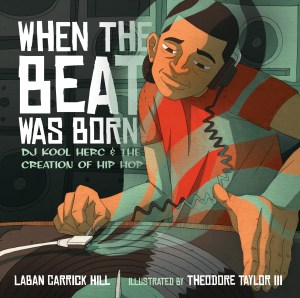
when the beat was bornWhen the Beat was Born: DJ Kool Herc and the Creation of Hip Hop

by Laban Carrick Hill, illustrated by Theodore Taylor III

Roaring Brook, 2013

“Clive loved music.” So begins this spirited, affirmative biography of the inventor of Hip Hop, and right from the start we are primed for an exposition of how that love would manifest itself, on Sedgwick Avenue in the Bronx, and around the world. The story offers a straightforward, linear account of DJ Kool Herc’s childhood in Jamaica, move to NYC, and self-propelled rise to prominence as DJ and legend, noting such innovations as inviting rapper friends to “MC” his parties, using dual turntables to extend the “break” between songs, and encouraging break dancing, calling out the b-boys and doing play-by-play of their acrobatic moves. The color quality of the illustrations is decidedly dark, with a predominance of murky grays,greens and browns, and strong, definitive shadows. Yet the book itself is remarkably positive and bright. On court, in line, and around the park, smiles abound. Indeed, everything we learn about DJ Kool Herc, from his devotion to his little sister and party partner, to the way his friendships played such a central role in his music, gives us a picture of an artist excited to share his world, replacing fighting with dancing, and loneliness with community. Ultimately, this is an affectionate portrait of an affectionate man, someone who loves his music and loves his people, all at once.

CaldeNott Results!

Yesterday evening twelve dutiful children’s book discussers met to consider a selection of picture books of international provenance, applying the Caldecott Medal terms and criteria to picture books ineligible for the actual award, in hopes of learning about some wonderful books, and the Caldecott Medal itself, in the process. We began with 18 very different books (you can find our complete discussion list here) and ended up with one winner and three honor books.

Our honor books are:

tiny creaturesTiny Creatures: The World of Microbes

illustrated by Emily Sutton (England)

written by Nicola Davies (Wales),

Candlewick Press, 2014

A scientific exploration of microbes explains their natural existence and celebrates the intricacies of their ecological function. Our committee appreciated Sutton’s use of scale, visually explaining the size and amount of the microbes around us; the friendly, approachable tone of her watercolor paintings, reinforcing the book’s even, almost enthusiastic approach to its subject; and the repeated presence of two children, not mentioned in the text, who, in their constant dress and curious attitude, serve as a ready point of access for the young reader.

at the same moment around the worldAt the Same Moment Around the World

illustrated and written by Clotilde Perrin (France)

Chronicle, 2014

This magical book circles the globe, exploring different children’s experiences at a single moment in time. We begin at 6:00am in Senegal, and travel east across time zones, to France, to Bulgaria, to Iraq, as kids of all stripes work, play, eat and dream. Each spread moves from one country to the next, connecting otherwise disparate locales and delivering a powerful message of human continuity. We appreciated the tall trim size, reflecting the longitudinal time zones; the attention to detail, with watery endpapers suggesting the surrounding oceans; and the indelible warmth of the culturally specific depictions. The final, fold-out map, that names the children and fixes them on the globe, adds concrete understanding to the sensitive expression of community.

rules of summerRules of Summer

illustrated and written by Shaun Tan (Australia)

Scholastic, 2014.

Two brothers offer fantastical, superstitious interpretations of a collection of seemingly pedestrian rules, brought to bigger-than-life through Tan’s edgy, immersive, dreamlike paintings. While each of the rules comes to individual life in its own spread, Tan links them together in an emotional arc that traces a bumpy, competitive, and ultimately tender relationship between two brothers who appear together, at the story’s end, surrounded by drawings of their imaginative adventures. We appreciated the painterly precision of the drama; the powerfully depicted relationship; the curious, sometimes impenetrable symbolism of birds and crowns; and the way the sinister undercurrent of the imaginings resolves into dependable comfort.

And our CaldeNott Medal goes to:
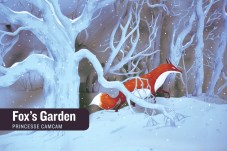
foxs gardenFox’s Garden

illustrated by Princess Camcam (Germany)

Enchanted Lion, 2014

A fox seeks shelter for herself and her babies and, when chased from a house on a wintry night, takes refuge in the nearby greenhouse. The house’s boy delivers a basket of sustenance, and the fox repays the kindness, decorating his bedroom with flowers as he sleeps. Princess Camcam creates her illustrations in three dimensions, photographing dioramas of intricately cut and painted paper, carefully arranged and lit. The effect is intimate and tranquil, with hushed colors, soft shadows, and an immediate sense of place. The artist’s careful use of sharp and cloudy focus pulls the viewer into the images, and her supreme command of light conveys the chill of the air, the stillness of the snow, and the arrival of the morning. Simply breathtaking.

It was noted that ours is not a “mock” endeavor but is instead, as the only one of its kind, the CaldeNott. Boom. It was also noted that we have chosen a book about a fox two years in a row. Make of that what you will.

This fall we’ll (re)turn our attention to international picture books, to do this all over again in 2016. Feel free to send any candidate titles my way. In the meantime, I’ll be off to the Bologna International Children’s Book Fair with a group of students in March, in search of our own. We’ll keep you posted.
PCP Ace of Diamonds: Roller Derby Rivals

roller derby rivalsRoller Derby Rivals

by Sue Macy, illustrated by Matt Collins

Holiday House, 2014

I love a book that looks at yesterday and makes me think hard about today. This is one of those books, a rowdy, rock-em-sock-em snapshot of a bygone rivalry that positively hums with contemporary resonance. Macy and Collins set their sights on the roller derby, in its day a hugely popular sport built of speed and spectacle, profiling two incandescent women and their fierce, secretly friendly competition. Gerry Murray is beauty, Midge “Toughie” Brasuhn is brawn, and their fabricated opposition reflected the shifting cultural conventions of post WWII America. Their battle unfolded on television, indeed roller derby itself gets some credit for helping to cement the medium’s popularity, and the orchestration of the conflict makes for an eerie predictor of what we now call reality television. Unlike so much of that contemporary entertainment, however, this was a valiant fight between worthy opponents (despite contrivances to the contrary) and the book follows suit, offering up an account built on respect and honor. Diamonds are our cards of strength, and there is so much of it expressed here, from the physical strength necessary to perform feats of derring-do (while whizzing around a track) to the more spiritual fortitude required to bypass cultural expectation and chart a different course. These were some strong women, and strength like that is just as admirable, and just as crucial, today as it ever was.

Boom.

To learn more about the Playing Card Project (PCP), visit our first entry, here.