There’s no more fun time of the year than the END of the year, when “best of” lists come out; everyone’s mock award results are announced, and we need to buy presents for all the young readers in our lives (and/or hunker down in the cold with some great reads for ourselves)!
This list isn’t a “best of,” nor is it the result of any structured decisionmaking process (stay tuned for our Mock Caldecott results next week). What this list IS, is a brief list of Butler Center staff favorites from 2015 that would make great gift choices, or for personal reading, on a variety of topics.
Happy holidays, and happy reading!
PICTURE BOOKS (suggested by Diane Foote, Butler Center Curator)
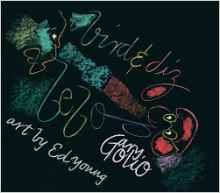
Bird & Diz by Gary Golio, illus. by Ed Young (Candlewick)
This book’s remarkable design and construction sets it apart from all other books on the topic of jazz music…it unfolds (literally) as the melody and harmony unfold, or it can be read more traditionally by turning the folded pages. Read and listen along with some of Charlie Parker’s and Dizzy Gillespie’s compositions for the most complete and fulfilling experience.
Last Stop on Market Street by Matt de la Pena, illus. by Christian Robinson (Putnam)
This brightly colorful picture books hits numerous high notes: it’s an intergenerational story; it portrays a nicely diverse neighborhood of folks; and conveys a gentle yet powerful message about grace and appreciation, as CJ and his Nana travel across town on the bus to work at a soup kitchen.
Night Animals by Gianna Marino (Viking)
The nervous-looking possum on the cover gives a hint of the hilarity inside; one by one the forest animals, portrayed in shiny gray and white against a black nighttime background, get terrified in turn by whatever “night animal” is following them. The joke is on everyone when kids camping in a tent and the bevy of creatures all scatter, each yelling RUN!
Wolfie the Bunny by Ame Dyckman, illus. by Zachariah Ohora (Little, Brown)
A wolf in bunny’s clothing stars in this cheerful story about overcoming perceptions. Baby Wolfie is left on the Bunny family’s doorstep, and when they take him in big sister Dot has to get used to her scary-at-first little brother. In the tradition of great new sibling stories (Julius, I’m looking at you), Wolfie and Dot find common cause against an outside threat and the rest is history.
CHILDREN’S FICTION (suggested by Alena Rivers, MLIS student and Butler Center graduate assistant)
Dolls of Hope by Shirley Parenteau (Candlewick)
Dolls of Hope is a follow up story to Ship of Dolls. Both novels were inspired by the Friendship Doll exchange of 1926 between the U.S. and Japan as an act to prevent future wars. Dolls of Hope tells the story of an 11-year-old Japanese girl, Chiyo Tamura, who has been asked to help create one of the dolls for Japan and keep it safe until it is sent to America. ‘Tis the season for an inspiring story of peace and friendship!
Gone Crazy in Alabama by Rita Williams-Garcia (HarperCollins/Amistad)
I can’t wait to read this follow up to Rita Williams-Garcia’s One Crazy Summer and P.S. Be Eleven! Why not spend my winter break reading a story set during the summer of 1969 in Alabama? Delphine, Vonetta and Fern are back! This time the three sisters are sent from Brooklyn, NY to stay with family in Alabama. Ma Charles and her half sister Miss Trotter aren’t on speaking terms. Delphine and her sisters discover there is more to their family’s history than they knew and they learn the importance of family ties.
The Maloneys’ Magical Weatherbox by Nigel Quinlan (Roaring Brook)
A magical phone booth that siblings Liz and Neil call the Weatherbox rings only to signal the changing of the seasons. The keeper of the Weatherbox is their father; when the Weatherbox fails to ring and signal autumn’s arrival, Liz and Neil suspect their neighbor Mrs. Fitzgerald has something to do with it. They must work quickly to discover Mrs. Fitzgerald’s secret and restore the Weatherbox so the seasons continue to change.
Ms. Rapscott’s Girls by Elise Primavera (Dial)
I am intrigued by the idea of girls attending a boarding school called “Great Rapscott School for the Daughters of Busy Parents.” The headmistress has an exceptional way of teaching the girls lessons on bravery and friendship through the likes of adventures the girls would never imagine! I consider myself a busy parent but, thankfully, not quite so busy that my children need a special boarding school!
The Toymaker’s Apprentice by Sherri L. Smith (Putnam)
I can’t pass up an opportunity to read a book inspired by one of my favorite holiday stories, The Nutcracker! My family just saw the ballet performance and I’m excited to read a new tale featuring Stefan Drosselmeyer, the son and apprentice of a toymaker who has been kidnapped. Stefan and his cousin Christian must find Stefan’s father and, along the way, their adventures include saving a princess and battling the Mouse Queen’s seven headed Prince of Mice.
INFORMATIONAL BOOKS (suggested by Diane Foote, Butler Center Curator)
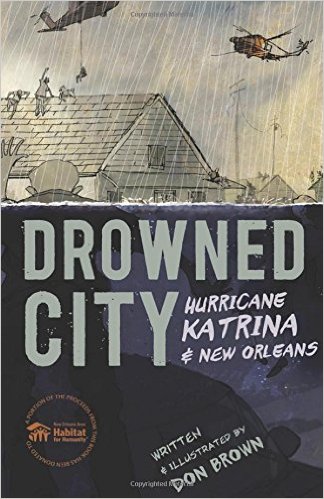
Drowned City by Don Brown (Houghton Mifflin Harcourt)
The latest entry in Brown’s collection of graphic nonfiction brings the disaster of Hurricane Katrina to life for a contemporary audience, many of whom may have been too young at the time to fully comprehend the horror and scale of the tragedy.
Hello, I’m Johnny Cash by G. Neri, illus. by A. G. Ford (Candlewick)
At the author’s note states, Cash’s popularity surged in the 1980s after a period in the doldrums. That means parents today, as well as grandparents who remember hearing Cash’s music when it was first released, will be eager to share this success story with their own kids and grandkids. Painterly illustrations and a design that recalls an album cover with liner notes add to the appeal.
Water Is Water by Miranda Paul, illus. by Jason Chin (Roaring Brook)
The water cycle is of course an essential element of all life on earth, and there are several outstanding books for kids on the topic, including A Drop of Water by Walter Wick. Even so, this one stands out for its clever embedding of a friendship story that unfolds only in the illustrations. Clever!
TEEN FICTION (suggested by Hal Patnott, GSLIS student and Butler Center grad assistant)
Alex As Well by Alyssa Brugman (Holt)
Alex is she. Alex is he. Gender is not as simple as “boy” or “girl” for Alex, because Alex is both at once. This important, coming-of-age story explores the struggles of defining your own identity when the world around you is trying to tell you who you have to be.
Carry On by Rainbow Rowell (St. Martin’s Griffin)
Simon Snow may be the Chosen One, but he struggles with school like any teen. I fell in love with Simon Snow and his evil roommate Baz the vampire when they first appeared in Rainbow Rowell’s 2013 novel Fangirl. Now they’re back, but this time in their own adventure full of magic, mystery, and romance.
The Ghosts of Heaven by Marcus Sedgwick (Roaring Brook)
Sedgwick links together four stories across centuries with the image of a spiral. Each narrative takes a different form, mixing poetry, prose, and points of view. The concept reminds me of Cloud Atlas by David Mitchell, one of my favorite books. I am excited to experience each character’s struggle for survival.
Lizard Radio by Pat Schmatz (Candlewick)
Fifteen-year-old Kivali doesn’t believe it when her guardian Sheila, a nonconforming artist, decides to send her off to CropCamp, a program for indoctrination into their government-controlled society. I look forward to reading Kivali’s adventure, because it’s not just another dystopian fantasy. Along the way to finding herself, Kivali wrestles with gender identity, first love, and friendship.
Nimona by Noelle Stevenson (HarperTeen)
I can’t resist an epic, fantasy adventure. Nimona is the story of a plucky and impulsive shapeshifter who teams up with a super villain to expose the fraud of a so-called legion of heroes. Full of dragons, battles, mischief, and humor, this National Book Award finalist subverts the traditional tropes of fantasy. Originally published as a webcomic, Nimona is Noelle Stevenson’s debut graphic novel.
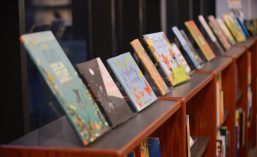

 The 2016 GSLIS Mock Caldecott Medal for the most distinguished picture book is awarded to Kadir Nelson for If You Plant a Seed, published by Balzer + Bray, an imprint of HarperCollins Publishers. If You Plant a Seed is an uplifting tale of a rabbit and mouse. When their garden becomes threatened by ravenous birds, rabbit and mouse learn to sow the seeds of kindness.
 Bird & Diz, written by Gary Golio and illustrated by Ed Young, published by Candlewick. Pastels, gouache, and sumi ink in an accordion frieze format capture the essence of the improvisational style of jazz through Dizzy Gillespie and Charlie Parker’s “Salt Peanuts” performance. Using abstraction and vibrant colors, Young presents a visual experience readers can see, hear and feel.
 Float, written and illustrated by Daniel Miyares, published by Simon & Schuster Books for Young Readers. Venturing outdoors on a rainy day, a young boy with his newspaper boat experiences the wonder of play. Pops of bright color contrasted against a monochromatic gray background effectively direct readers’ attention to the movement of the boy, the boat, and the water. Panoramic views and distinctive, digitally rendered images successfully convey the meaning of the story without the use of words.
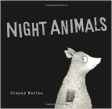 Night Animals, written and illustrated by Gianna Marino, published by Viking, an imprint of Penguin Group (USA). While hiding from scary night-time sounds, possum and skunk encounter other frightened “night animals.” Rendered in gouache and ink, Marino’s illustrations capture a humorous nighttime escapade. On an ink-black background, the night animals’ realistic fur and cartoon eyes combine with speech bubble narration to provide an unexpectedly hilarious adventure.