Get well Tim Curry

News is emerging that actor Tim Curry is recovering from a stroke. Initial reports suggested that he had collapsed yesterday following a massive episode. More recent reports say that, while he collapsed in his LA home yesterday, the stroke occurred last July, and he has been recovering (well) ever since. In any event, I wish him very well.

rocky horrorWhen I was in High School I went to midnight showings of the Rocky Horror Picture Show week after week (after week) at the Coventry Cinema in Cleveland Heights. I think its fair to say that the experience had a profound effect on my adolescence, offering an indelible, albeit particular, affirmation of different ways of being. Watching and eventually joining the participatory irreverence, throwing toast, spritzing rain, singing and dancing along, offered me a kind of community I really needed at the time. Who knew musical theater could be like that?!

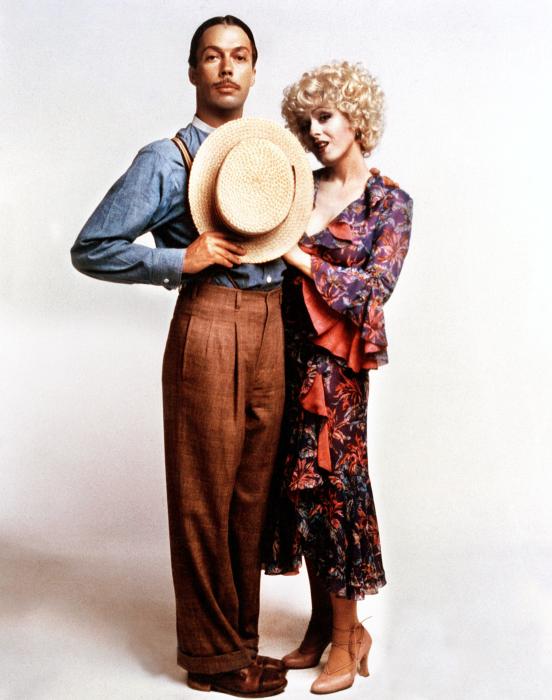
annieSpeaking of musical theater, I refuse to apologize for the fact that I love all things Annie. I just do. Ask me about Kristen Vigard’s casting as the original red-mopped orphan and her replacement with Andrea McArdle after previews in Conecticutt. Heck, watch the Julie Stevens documentary, Life After Tomorrow (SJP!) if you want to know more about it. Anyhow, Curry plays Rooster in the 1982 movie version. There’s lots to love about the film, if you’re me, at least, including his sneaky, sinister performance. He’s brilliant. And, thinking back, it’s a little striking how much Carol Burnett, as Miss Hannigam. looks like Frank N. Furter. Huh.

But today I remember Tim Curry as an extraordinary narrator of audiobooks. My introduction to audiobooks came with my very first ALSC evaluation committee experience as a member of Notable Recordings for Children. Back then each of us was assigned a sampling of eligible recordings (cassette tapes!), based on the first letter of the title. I was assigned A-C, and received, relatively early in the year, the first of  Lemony Snicket’s Series of Unfortunate Events, The Bad Beginning. So charming. Curry’s arch, over-the-top narration makes the most of the tongue-in-cheek prose, honoring its playful irony and milking the humor. It’s just a little irresistible.

AbhorsenBut my favorite audiobook performance of all time must be his stunning readings of Garth Nix’s Abhorsen trilogy. It was such an interesting choice, casting a man to read these menacing novels about a family of necromancers in a centuries-old battle against conspiring evil, as all of the protagonists are young women. But once you hear Curry’s contemptuous reading of Mogget the familiar, and the positively dripping malevolence of Orannis, the baddest of the many baddies, you know the choice was just perfect. I have listened to all three, in sequence, at least five times, stem to stern, and they never disappoint. I recommend them all the time, and do so again today, to you.

So, here’s wishing Tim Curry a continued speedy recovery, with hopes that he finds his way back to the recording booth soon.

Caldecott 2014 continued some more

There are two more spring books that have caught my Caldecotty attention:

round is a tortillaRound is a Tortilla: A Book of Shapes

written by Roseanne Greenfield Thong

illustrated by John Parra

Chronicle, 2013

To begin with, this book is supremely lovely. Of course, lots of books are lovely, and loveliness is not a particular criterion for Caldecott consideration. But let’s just put that out there. Parra’s figure work is warm and personal, simultaneously accessible and specific. His largely symmetrical composition affords the imagery some organizational clarity, making it especially easy on the eye (and enhancing the shape identification, to boot). But there is much to admire beyond the simple beauty. The color work is extraordinary. Parra sets vibrant reds and oranges against grayed-out blues and greens. The unexpected result, with its dramatic sense of light and shadow, enhances the sense of place. It feels like a hot day in the Mexican shade. The treatment of shapes is suitably sophisticated. Rhyming verse calls attention to one shape at a time, and while many of the shape in question are present for searching and finding, there are other shapes represented, too.

And if ever there was a book jacket optimized to accept a golden circle sticker, this is it. I mean, really.

henris scissorsHenri’s Scissors

written and illustrated by Jeanette Winter

Simon and Schuster, 2013

Illustrating a picture book about a famous artist is no small thing. How does the illustrator capture the essence of the artist’s style without resorting to mimicry, expressing without copying? Jeanette Winter makes it look easy. In this simple picture book biography of Henri Matisse she employs color to set Matisse’s artwork apart from its contextual environs, replicating the vibrant artwork with rich, saturated color and using a more reserved, pastel palette for the artist and his surroundings. She structures the story carefully, covering the first 70 years of his life in the first few pages and dedicating the balance of the book to the paper-cutting for which he is most celebrated today. Matisse made the technical discovery while recovering from a severe, debilitating illness, and Winter reflects its transformational power with a major compositional shift. The exposition unfolds with images in small, tight squares on a clean, buff ground. At the pivotal moment of discovery, when the artist finds his way to creation again, the images break across the entire spread, reaching beyond the edge of the page in expressive freedom. Most picture books contribute to the storytelling with representative imagery. Using the art itself to tell the story, in its structural design, adds layers of meaning to an already illuminating story. I’d call that excellence of pictorial interpretation of story, theme, or concept.

Anyone out there excited about any 2013 American picture books?

Oklahoma relief

moore tornadoI have long admired Kate Messner, for lots of reasons. She is a sensitive and versatile writer. She is a committed teacher, and her annual letter to parents about connecting kids with books sits at the heart of my own MLIS classroom considerations of intellectual freedom, as it galvanizes the great value of a proactive, affirmative, respectful approach. Now she is leading an(other) effort to rally authors and illustrators of books for young people to raise money for folks in dire need, this time those affected by the recent tornadoes in Oklahoma. You can enter to win signed books by donating $10 to the American Red Cross. Specific instructions are here. I shouldn’t be surprised when folks who offer so much of themselves on the page are so generous in real life. So I won’t be. I’ll just be grateful.

Thanks, Kate.kate messner

Emily’s Dress and Other Missing Things

“Emily Dickinson is the perfect thing to hand to a 16-year old girl,” advised fellow blogger lynchlibrarian recently. What is it about Emily? Indeed, I was 16 when I purchased my paperback copy of her complete works (at the local Borders bookstore, my idea of the cool hangout spot), and I vividly remember discussing “Success is counted sweetest” in my high school’s U.S. Literature class. Certainly I considered her words earlier and later in life, though not by much: an eager seventh grade teacher chalked “I never saw a moor” on the board for the daily quote; in my second year of college, fellow English majors and I spent the better part of a class dissecting the differences between her 1859 and 1861 versions of “Safe in their Alabaster Chambers” (the power — of a dash!).

So what is it about Emily that resonates during young adulthood? While increasingly introspective teens may be intrigued by her famously reclusive habits, it’s her words that truly inspire. At a time when teenagers feel pulled between their past and future selves, her voice simultaneously offers innocence and wisdom. As they encounter the terribly great problems of the world and personal decisions to make, her subject matter rings with the impossible brightness and darkness of life’s great questions. Through succinct, tender verses, Emily provides young people with a “nugget of pure truth” to grasp in their hands and hearts. (My Virginia Woolf obsession came later in life.)

  Feathers by Jacqueline Woodson   Emily's Dress and Other Missing Things

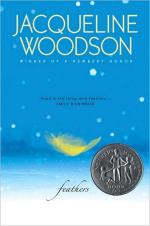
If young people miss out on enthusiastic teachers reading Emily’s poetry aloud, I’m happy to know they may also discover her in the pages of fiction. Jacqueline Woodson’s beloved Feathers (Putnam, 2007) perfectly pairs “‘Hope’ is the thing with feathers” with a story that examines the power of friendship over divisions and discrimination during the 1970s, a fragile, precariously hopeful time in our nation’s history. What a perfect story for a 12-year-old.

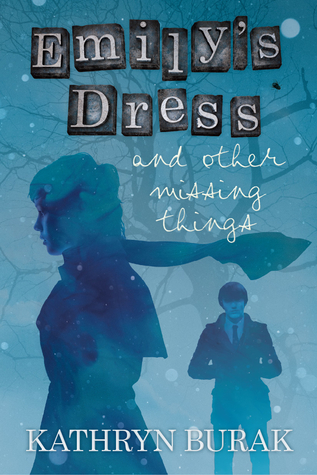
For older readers, Kathryn Burak’s novel Emily’s Dress and Other Missing Things (Roaring Book Press, 2012) explores Emily’s darker side. After experiencing personal tragedy, Claire and her father attempt to start fresh by moving to Amherst, Massachusetts, the home of Emily Dickinson. Claire is a poet herself  and finds herself drawn to Emily’s words, rich with poignant examinations of death, and to Emily’s house, now of course a museum where Emily’s personal belongings are artfully arranged for tourists to view. As if in a creative trance, she breaks in, night after night, to write while wearing Emily’s white dress — until the day the college-aged student teacher Tate discovers her. Instantly linked by this strangely intimate crime, they run, stealing the dress in the process. Burak’s poetry is the star of this novel, both in the actual verses Claire writes — the portals by which she gradually shares the tragic details of her past — and in the crisp, shimmering prose of Claire’s narration:

The smell of snow on the winter air fades. I take a deep breath. I smell paper. Here I have the cool, clean feeling of paper, too.

I am so glad to get away. To be in Emily Dickinson’s house.


With a frigate like this book, the reader will certainly agree.

Caldecott 2014 continued

We left off with three women whose 2013 work merits some Caldecott consideration. Here are a few men whose illustrations we want to look at, too (remember, I’m going alphabetically by author – the gender breakdown is purely accidental):

boy and the airplaneThe Boy and the Airplane

illustrated by Mark Pett

Simon and Schuster, 2013

This wordless picture book is awash in poignant, sepia-toned nostalgia, so you know I’ll love it. A little boy receives a package (from an unidentified stranger – look carefully) and opens it to discover a red toy airplane. He plays and plays and plays, until the plane accidentally lands up on the roof, beyond his reach. Try as he might, he can’t get it down. So, he plants a seed. Year by year a great tree grows. The boy grows, too, becoming a young man and, eventually, an old, Santa-Claus-looking one. At last, he climbs the tree and finds the plane, just as he left it. Instead of playing, though, he wraps it up and pays it forward. I can already anticipate heated arguments about whether or not this is really a book for kids (nostalgia has that effect on us) but expect consensus with respect to the subtle art with which the story is told. The pages themselves are a succession of varied drab grays, fixing a somber tone that persists, even in the happier moments. And the wistful facial expressions, so simply realized, are somehow simultaneously round and piercing, all at once. We are left with a tender cycle of loss and reconciliation, but the melancholic tone establishes the losing, not the finding, as the predominant thematic emotion. We can go back and forth as much as we like about the need for a poignant picture book about the inevitability of loss. But taking the theme as a given, it’s hard to argue with its artistic execution.

the darkThe Dark

written by Lemony Snicket, illustrated by Jon Klassen

Little Brown, 2013

In 2013 Jon Klassen became the first illustrator to win both the Medal and an Honor since Leonard Weisgard did it in 1947. Can he be the first repeat winner since the Dillons did it in 1976 and 1977? With a book like The Dark in contention there’s no denying the possibility. A little boy fears the Dark, and so he confronts it. Snicket personifies the Dark in his almost elegaic text, and though our young hero Laszlo fears him, he is more a mystery than a real threat. Klassen sets the action in a huge, ramshackle house, full of the sort of staircases, closets, and corners that invite worry. But what’s especially striking about this book is not so much what Klassen build into the illustrations but what he leaves out. There is no furniture to speak of, save Laszlo’s bed, and a dresser in the basement with curious import. And there are no adults, either. Klassen has really tapped into the insecurities of childhood and manifests them on the page in stark resonance. It’s easy to celebrate an artist’s exquisite hand, fine line, sense of shape, manipulation of color, etc. It’s not so easy to recognize what the artist excludes. This book gives us the rare opportunity.

bluebirdBluebird

illustrated by Bob Staake

Schwarz and Wade, 2013

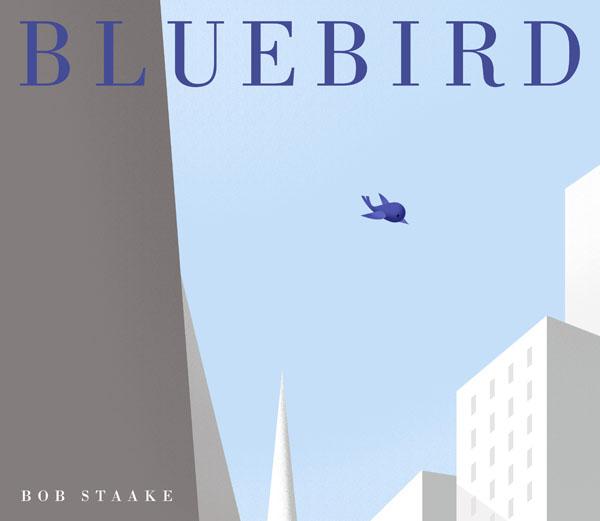
A little boy is bullied, rather mercilessly. Friendless, he roams the city streets alone. He is adopted by a little blue bird, who becomes his trusted companion. The bullies persist, though, and in a particularly brutal attack, his little blue bird is struck by a stick and killed. Other birds arrive, and the boy and his bird are flown to the sky where the little blue bird is released. The Caldecott tends not to love purely digital work; somehow art is supposed to be made by hand. But it is only a matter of time before we recognize the computer as just another medium, no different from pens or brushes or woodblocks. And this could be the time. Staake, known more for a style of chaotic, somewhat irreverent ebullience, really reins things in here, working in a restrained palette with simple lines and straightforward composition. By getting out of the story’s way, he makes it all the more powerful. I have already read some musings about the inappropriateness of such a stark treatment of difficult subject matter. But to my eyes, by expressing the truth just as he sees it, Staake pays extraordinary respect to his young readers. And there’s a lot to say about the value of that kind of respect, at least when we’re talking about the most distinguished picture book for children.

Caldecott 2014

It may be early to begin handicapping the 2014 Caldecott Medal (the committee won’t meet for its first round of deliberations until the end of next month), but this is already proving to be a strong year in picture books. I have  encountered some extraordinary titles that are, each in its own way, individually distinct. Let’s take a look, shall we? I’ll start with three today, and add some more in the coming days.

In alphabetical order by author (I am a librarian, remember):

dream friendsDream Friends

written and illustrated by You Byun

Nancy Paulsen Books, 2013

A shy little girl develops a deep friendship with a ginormous white cat, though their relationship exists only in her dreams. Those dreams become the foundation for a real life friendship, though, which soon blossoms into playgrounds-full of playpals and one flesh-and-blood BFF. The story is a sweet one, sometimes a little too sweet, but the digitally manipulated pen and ink illustrations are magnificent. Byun has a glorious sense of color, which she manages carefully to distinguish between the lands of life and dreaming. She engages her unfettered imagination in the depiction of the dream world, peppering the fantastical landscapes with flying origami cranes, pendulant upside-down clock towers,  bedroom forests festooned with bonnets, and confectionary firework displays. The artist spent her childhood in Japan and Korea, and the recognizable element of kawaii to her drawings only adds to the charm. But beyond the beauty of the images, it is Byun’s ability to establish mood, communicate emotion, and define relationships with shape and color that really distinguish this elegant outing.

flora and the flamingoFlora and the Flamingo

illustrated by Molly Idle

Chronicle Books, 2013

This interactive wordless book introduces Flora, dressed in a pink bathing costume and yellow swim cap, to a similarly pink flamingo, and the two engage in a sort of mirrored dance. The flamingo engages in a gorgeous display, extending legs and draping wings in elegant expression. Flora tries to follow along but her clumsy positions are not entirely successful. Seeing her despair, the flamingo offers assistance, and soon the two have achieved a perfect compromise. Idle is artful with the “toy-and-movable” component. Individual flaps expose individual poses, as Flora struggles to match the flamingo’s grace. When the two really join forces, a single flap perfectly expresses their combination, and their dance takes flight. A final, irresistible double-gatefold completes the lesson, as Flora takes over the instruction and the flamingo follows in her exuberant footsteps. I don’t know if the Caldecott Committee has ever recognized a book with an interactive element, but given its ingenious application here, it’s hard to imagine that they won’t be looking carefully.

nino wrestles the worldNiño Wrestles the World

written and illustrated by Yuyi Morales

Roaring Brook Press, 2013

Niño is a pint-sized luchador who takes on all manner of pretend opponents in his living-room lucha libre ring. Each of his foes is imagined from pieces of Mexican culture, from Olmec Head to the Weeping Woman. Ultimately it is LAS HERMANITAS who prove to be the worthiest adversaries. But he clearly loves those little sisters, and the three become LOS TRES HERMANOS, establishing themselves as the team to beat. Morales works in digital collage, rearranging her handcrafted watercolors and woodblock images, inserting pieces of photography here and there. The typography is suitable exclamatory, and feels like part of Niño’s vivid imagination. As irresistible as the images are, to me the book’s standout element is the fact that it explores a quintessential childhood experience–imaginative play–in a way that is simultaneously culturally specific and universal. The Caldecott terms and criteria being what they are, the Committee will need to process that value in terms of its distinguished illustrations. I’d be happy to make the case.

Publisher Preview

Please join us on Saturday, May 11 at 1:00pm for our annual Fall Publisher Preview (yes, it’s spring, but they’re previewing their fall lists). Representatives from Albert Whitman, Capstone Press, Norwood House and Sourcebooks will be on hand to show us what they have coming down the publishing pipeline, discuss trends in the industry, and answer any questions we might have. They tend to be pretty generous, and offer lovely, book-laden goody bags as well. Not to be missed!

We meet in Springer Suites, on the bottom level of the Rebecca Crown Library on Dominican’s main campus. Go here to RSVP.

We hope to see you there!

albert whitmancapstonenorwood housesourcebooks

Dynamic Bibliography: Eight Keys and Relish

Every month at the Butler Center, we have an open discussion group in which we consider three books with something in common, called Butler Book Banter. The purpose of this meeting—to discuss books in the context of others—resonates with part of Thom Barthelmess’s mission for the Butler Center: what he calls Dynamic Bibliography.

I personally think Dynamic Bibliography should be added to the Oxford English Dictionary. The concept rests in the idea that while it is important to look at an individual book, the real truth, discovery, beauty, essence, and energy of a work resides in intertextuality. How do books talk to each other? What are common themes, or how do themes resist each other or argue? What is between the lines, between the pages, between the covers of a list of books? How does a book change when you discuss it in context with different books? When we put two, or three, or four books next to each other, they certainly say something different than one that stands alone.

What’s fabulous is that what the books say is all up to the reader.

Today, I am going to attempt this concept of discussion through Dynamic Bibliography with two books, both published within the last two years. They are:

Eight Keys by Suzanne LaFleur. Published by Wendy Lamb Books, 2011.

Relish: My Life in the Kitchen by Lucy Knisley. Published by First Second, 2013.

ImageEight Keys tells the story of middle grader Elise, who is struggling between her childhood self and her impending adolescence. With a best friend who she believes to be childish, a locker partner who smashes her lunch, and two parents who died before she was three, Elise doesn’t have it easy. Then, Elise discovers a key that has her name on it in her uncle’s barn, and she enters a mystery that might finally help her come to terms with her past, her situation, and herself.

Relish: My Life in the Kitchen is a graphic novel that is not just about food, but about finding deliciousness in every aspect of life. In this memoir, Lucy tells her life story through interaction of text and illustration, and she tells it in the context of sautéed garlic mushrooms, sushi, gourmet cheese, and much more. She tells of her life as a child of divorce, her travels abroad, her time in college, and her work life, her artistic core, and her relationships. It is refreshing to read a novel about a young woman who loves food, who enjoys it, and who has a healthy relationship with it.


Now, at first glance, these books don’t really have much to do with each other. One is a middle grade piece of fiction, one a graphic novel memoir. One’s focus is on mystery and school life, one is on food. One is written in linear prose, the other through childhood flashbacks and illustration.


But, let’s take a deeper look…what do both of these books say? What do they say to each other?


1.)    Family. Both of these girls’ lives are connected with their families, and both in unconventional ways. Elise is raised by her aunt and uncle, and Lucy spends time going back and forth between her mom’s house in the country and her dad’s city apartment. Yet, both girls cherish their families, get upset with their families, and forgive their families. And they both need their families.


“I walked over to her, climbed into her lap. I’m much too big for that; hadn’t done it in years and years, couldn’t even remember doing it, really. But I sat sideways with my legs on the couch. I put my arms around her neck and rested by head on her shoulder. She slipped her arms around me and held on.”
–
Eight Keys


“After almost eight years of living in Chicago, I realized: I’m homesick…And I missed my mom’s cooking.”


-Relish


2.)    Friends. Elise’s friendship stories play a more significant role in the plot than Lucy’s, but several of Lucy’s vignettes include friendship as a central piece of her own development. Elise’s best friend Franklin is so kind and giving that when Elise ditches his babyish ways, my goes out to him. The antithesis of friendship—bullying—is also present in Eight Keys. Maybe it’s just the bullied kid in me (I have such white skin; kids called me “Albino” and “Alien” because you could see veins in my arms), but I was surprised that bullying wasn’t part of Lucy’s story. What does the absence of bullying say about Lucy’s story? That it didn’t happen, or that it wasn’t significant?


“Once we got on the bus, it was totally like usual—just me and Franklin on our own, in our own seat, having our own conversation. That was how the whole school day always used to go. We didn’t really need to get to know the other kids because we had each other.”


-Eight Keys


“We ate [sweet corn on a stick] while sitting on the dusty curb, with cold grapefruit soda, making a mess of our clothes and faces.”


-Relish


3.)    Leaving Childhood behind. Adolescence was a hard, sad time for me, which is probably why coming-of-age novels are always my favorite. I see myself in them. Both of these girls struggle with questions—why is middle school so much harder than elementary? Why am I getting bad grades? Why is my dad so dang hard to get along with? Why doesn’t my family understand me? Lucy tells her story as an adult reflecting back on childhood, so her maturity bleeds through, while Elise is right in the middle of her struggle and doesn’t apologize for it. While each of these girls grow in different ways, they both find their way through the muck and become strong along the way.


“No one likes me because I’m friends with that dweebus Franklin. He makes me look like a baby.”


-Eight Keys


“We fought. The truth is, my dad and I are sometimes too similar—too finicky and stubborn and easily wounded—to get along all the time.”


-Relish


4.)    Self-Discovery: This is the big one. Through overcoming obstacles, reconciling the past, and facing the future with an open heart, both of these girls discover who they are. Lucy uses food as a way to illustrate her self-discovery, and this makes sense because food is all about the senses—feeling, seeing, smelling, sensing, wanting, touching, tasting. Isn’t that what adolescence is about? Dipping our fingers into adulthood, trying certain dishes and finding out that some are delicious and some are disgusting? Elise discovers herself through a gift from her father, and sees that instead of waiting to live her life until after she grows up, realizes that she’s already living it, and has been her whole life.  


“It could be whatever I needed it to be, whatever I wanted it to be. And the truth, I suddenly understood, was that so could I.”


-Eight Keys


“Like me, still a young woman, learning about what moves me, what I want. What I love. And doing these things with excitement, curiosity, and relish.”


-Relish


These girls are both lovable, both smart, and both grow into themselves in their respective books. I think if they were to magically appear in front of me, they would be friends. They would argue because they are both strong-headed, and they would both be protective of their own hearts.


But I can also see them planting a garden, Elise telling Lucy the way they do it on her farm, and Lucy returning with memories from her mother’s garden in the country.

And they’d share a tomato.
B3 suspended for April 18, 2013

rain spoiled my bookDue to the extraordinarily excessive and perpetual rainfall, Dominican has closed campus today and suspended all events. So, our last Butler Book Banter of the season will have to wait for another day. Check back soon for dates and titles for our fall B3 series. And don’t be a stranger!

Love, Thom

Maggot Moon

maggot moon

Maggot Moon

by Sally Gardner

Candlewick/Brilliance Audio, 2013

There is so much I want to say about this book. So much. But each and every element or facet or consequence I might mention would rob you of the opportunity to experience it yourself, thereby diminishing your encounter. Even saying that much feels like something of a spoiler.

So I’ll make just these few short comments:

1) Every now and again you read something that feels actually new. This is one of those stories.

2) For a good while you will feel disoriented. Stick it out. It’s worth it.

3) There are some powerful, interactive spot illustrations in the print book that contribute to the mood. The audiobook is sharp and reserved and extraordinary. Take your pick.

4) Please read this book as soon as you can, then find me so we can talk about it.