Resolve for Art: A Review of Light, Letters, and Love: How Jo van Gogh Saved Vincent’s Paintings for the World

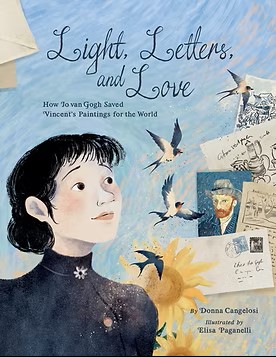
Light, Letters, and Love: How Jo van Gogh Saved Vincent’s Paintings for the World
By Donna Cangelosi
Illustrated by Elisa Paganelli
Sleeping Bear Press, an imprint of Cherry Lake Publishing Group
Ages 4+
Available: March 16, 2027

Meet Jo van Gogh, the woman who saved Vincent van Gogh’s paintings from destruction and obscurity. She met and fell in love with Theo van Gogh, Vincent’s brother and art dealer, in Amsterdam. After their untimely deaths, Vincent’s paintings are given to Jo. She was the only one to see value in the paintings, with her family and art critics going so far as to tell her to throw them away. After reading and translating Vincent’s letters, she gets renewed confidence to present Vincent’s paintings again. When an art critic reads the letters and sees the paintings, he feels compelled to feature Vincent’s “unusual” artwork, and the rest is history. Cangelosi’s prose is gentle and emotionally driven. After tragically losing Vincent and Theo in a short period, being surrounded by Vincent’s artwork brings Jo hope and comfort in a dark time in her life. Vincent’s insightful quotes about life and beauty paired with his unique art motifs wonderfully exude that consolation. Paganelli’s digital illustrations mimic van Gogh’s swirly and vibrant oil paintings. Her background colors are muted and not overly bright, which makes Vincent’s reverberant artwork stand out. There is an author’s note, a timeline, and four books featured in the book’s backmatter. Three of the four books were published after 2020, making the information relevant. Light, Letters, and Love: How Jo van Gogh Saved Vincent’s Paintings for the World is a down-to-earth narrative nonfiction picture book that introduces readers to a previously unknown hero of art history.

what i came to tell you

what i came to tell youwhat i came to tell you

by Tommy Hays

Egmont, 2013

Grover and Sudie have recently lost their mother, killed when she was hit by a car, crossing the street. Their father, director of the local Thomas Wolfe House, buries himself in his work. Sudie disintegrates into tears. And Grover retreats to the cane break in the vacant lot beside their home, weaving intricate tapestries of branches and leaves between the wild bamboo shoots growing there. As time passes these tapestries take on meaning for Grover, and for the community, and when a developer threatens to raze them, Grover fears the loss of much more than the pieces of art themselves. Hays is careful and artful as he draws back the curtain, slowly revealing circumstances surrounding the accident and the burdens associated with them. A cast of original, winning characters helps and bumbles and threatens and loves. There is so much sweet spirit here, and it shines just right.

This is a book cut of a standard middle grade cloth. We have seen many books about the death of a parent, wherein a child struggles to make peace and move forward, and this, surely, won’t be the last. But this book is special, if not because of its theme, then because of its approach to it. For in Grover we meet a particular, individual child, the likes of which we don’t see in literature every day. Grover is a sensitive boy.

For decades arms of the children’s literature establishment have fought against female gender expectations, filling shelves with plucky, resolute heroines who defy stereotypes and take no prisoners. By no means do I mean to suggest that we’re done–girls are still bombarded with images and messages that define their lives in unfortunate and dangerous ways–but we can find more and more positive role models on the pages of books, girls who take responsibility for their own lives, ignoring princes and taking on dragons themselves.

But where are the boys who sidestep societal expectations? Have we become so consumed with getting boys to read, chasing their attention with action and adventure and testosterone-fueled explosions, that we are inadvertently doing some stereotyping of our own? I admire what i came to tell you for its warm prose, metaphorical landscape, and astute characterizations. It is, all by itself, a lovely and resonant story. But I am thankful for its contribution to the canon. It offers us a model of a boy who looks to art as a doorway, who processes his pain with nimble fingers and a beating heart, a boy who feels. It shows us that there are lots of different ways to meet the challenges life has in store for us, and that tenderness is not a liability but an asset. It delivers the power of art, in its theme and its execution.

Thanks.