Finding the Words: A Review of A Voice in the Storm 

A Voice in the Storm 
Written and illustrated by Karl James Mountford 
Candlewick Press/Candlewick Studio 
Ages 3-7 
Available November 5, 2024 

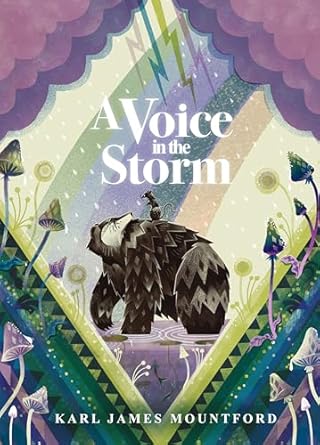
Sometimes, it’s hard not to feel like there is a storm raging inside. In Karl James Mountford’s A Voice in the Storm, Rat struggles with her own emotional storm and how to open up to her friends about her feelings. When a storm starts outside, she runs away from her friends, Jackdaw and Hedgehog. As lightning flashes and thunder cracks, Rat has a frightening experience with Snake, almost stepping into his mouth when he offers to shelter her. Afterwards, she runs into Bear, who teaches her that the storm outside “‘needs time to free its voice’” (p. 22). With Bear’s advice and support, Rat learns how to open up to her friends and give a voice to the storm happening inside her. 

Mountford’s stunning artwork and poignant prose come together to create a touching story that discusses depression and helps guide readers in figuring out how to express themselves. Mountford uses digitally created, geometric illustrations with a color palette of purples, greens, blacks, and grays to draw the eye of the reader and show the intensity of Rat’s emotions. His animals are expressive, showing Rat’s sadness, Jackdaw’s worry, and Bear’s kindness. Mountford’s use of storms as a metaphor aptly describes mental health struggles in a way that’s easy for young readers to understand and relate to. Additionally, the dialogue between characters, especially Rat and Bear, introduces readers to ways they can articulate their own feelings: Bear tells Rat that “‘all voices [are] just noise until someone listens’” (p. 22). When Rat opens up to Bear, she tells him that she “‘[cares] about everything all at once, and yet, [she doesn’t] feel anything at the same time’” (p. 25). This conversation gives readers an opportunity to learn how they can ask for support when they need it. While the publisher recommends this book for preschool-early elementary school readers, this emotionally moving story can serve as a thoughtful conversation starter for all ages participating in discussions about mental health. 

In His Fins: A Review of Narwhal: Unicorn of the Arctic 

Narwhal: Unicorn of the Arctic 
Written by Candace Fleming 
Illustrated by Deena So’oteh 
Anne Schwartz Books 
Ages 4-8 
Available October 22, 2024 

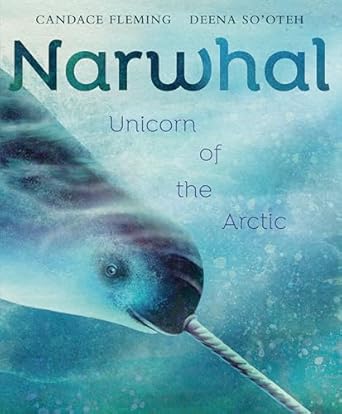
Have you ever wondered what it’s like to be a narwhal? Candace Fleming’s Narwhal: Unicorn of the Arctic, illustrated by Deena So’oteh, answers that question by taking readers through a year in the life of a male narwhal. The narrative starts in December, showing how male narwhals joust with their tusks. Important moments include finding cracks in the ice, called leads, to breathe through, and hunting for food deep in the ocean using echolocation. As summer arrives and the ice melts, the narwhal migrates with his pod.  When they reach their destination, the hunting grounds are scarce, but with their blubber from the winter, they can survive. They must also protect themselves from dangerous orcas and polar bears. As summer ends and the ice grows back, the narwhal migrates back to his winter home, ready to start the cycle all over again. 

Candace Fleming expertly puts readers in the perspective of a narwhal to show the routines he follows, including his eating habits, the predators he keeps watch for, and the migration path he follows with his pod. Fleming uses poetic language and onomatopoeias, like “tik-tik-tik-tik” (15-16) to imitate echolocation, to describe the sights and sounds of a narwhal’s world. Deena So’oteh’s realistic, digital illustrations bring the beautiful world of narwhals to life. The main color palette consists of blues, greens, and blacks, but So’oteh carefully changes the color scheme to emphasize the tone of the story during different events; for example, when the narwhals are threatened by predators, the colors become darker and muted to emphasize the danger and fear the narwhals feel. Fleming includes back matter detailing conservation efforts that support narwhals and a list of fun facts, as well as a bibliography. Although Fleming herself is not a narwhal scientist, it is clear she put care and effort into researching narwhals. Both educational and beautifully illustrated, this nonfiction picture book is sure to captivate young readers curious about the unicorns living in the Arctic.  

Winter Teamwork: A Review of In the Winter Woods by Daniela Kulot 

In the Winter Woods 
Written and illustrated by Daniela Kulot 
Translated by Elisabeth Lauffer 
Charlesbridge 
Ages 3-7 
Available October 15, 2024 

It’s the middle of a cold winter, and Fox, Mouse, and Crow are all hungry, but they can’t find even a morsel to eat. Squirrel is hungry, too, but he has a secret stash of snacks hidden away that he can’t wait to enjoy. When Fox, Mouse, and Crow ask Squirrel to share, he says no. After hours of searching, he realizes that he forgot where his stash was hidden. He asks Fox, Mouse, and Crow for help in exchange for sharing his food. Soon, they find Squirrel’s food and feast together! 

With these woodland creatures, Kulot tells a story of friendship and community, showing the importance of working together and sharing with others. Although the message has been repeated before, Kulot brings charm to the basic “sharing is caring” theme with her woodland creatures and winter landscape. The illustrations are done in digital media, and the animals have a cute, slightly cartoonish look with beautiful backdrops of winter in the countryside. Kulot uses muted blues, browns, oranges, and greens to create the cold, barren atmosphere. These delightful illustrations complement the text, where Kulot uses devices like alliteration and rhyming to add a sing-song-like quality, bringing levity to what could otherwise be a dire situation. With its beautiful art and thoughtful message, In the Winter Woods would be a great addition to libraries and classrooms looking to do a program or lesson on winter or social-emotional learning.  

The Strength in Being Seen: A Review of Deer Run Home by Ann Clare LeZotte 

Deer Run Home 
Written by Ann Clare LeZotte 
Scholastic Inc/Scholastic Press 
Ages 10-14 
Available October 1, 2024  

Effie Pappas is Deaf and linguistically isolated from her family, who don’t speak American Sign Language. Effie and her sister, Deja, are sent to live with their father at the end of the summer. When school starts, Effie’s ASL interpreter, Miss Kathy, begins to suspect that something is wrong with Effie’s home life. After Miss Kathy visits Effie’s home and sees the neglect, she is awarded temporary custody of Effie. Now that she finally has a safe home and a budding friendship with a new girl at school named Cait, Effie starts to open up about her experiences with her family. Miss Kathy eventually petitions for and wins permanent custody of Effie, giving her the security and family she never had. 

Ann Clare LeZotte’s Deer Run Home is a touching story that exposes the reality that d/Deaf children can experience growing up in hearing families without ASL. LeZotte draws on the real-life court case this novel is inspired by to thoughtfully depict the neglect that Effie experiences because her family won’t learn her language, as well as the difficulty Effie has with speaking up about the sexual abuse she endures at the hands of her stepfather. The sexual abuse happens before the novel begins and is thoughtfully described only once, but it serves as one of the obstacles Effie is able to overcome when she finds kindness and support from Miss Kathy and other adults at school. LeZotte takes advantage of the verse format to mirror ASL grammar and storytelling styles at some points. The verse is poignant and moving, and every word is intentional. Readers are drawn to Effie’s character, feeling every bit of her joy, sadness, fear, and loneliness. LeZotte also ties in a plotline of habitat loss for the local deer population, drawing parallels between the displaced deer and Effie’s feelings of loneliness and being lost. At once heartbreaking and empowering, Deer Run Home shows the healing and growth that comes with discovering your voice. 

Guest Reviewer Edition: A Review of Kindling

Kindling
Chee, Traci
HarperCollins
February 27, 2024
Grades 9-up

Magical elite soldiers must confront their own traumas and identities while banding together to defend a town besieged by raiders. Inspired by Seven Samurai, Chee weaves together the stories of seven kindlings who are desperate for stability and purpose in a world that no longer needs them. Raised from the age of six to be elite weapons in a war of expansion, these kindlings now wander the countryside, but are soon gathered for a mission by one of their own. Initially, each kindling views the defense of Camas—the mountain village terrorized by raiders—as just a job. But as time passes and the soldiers’ lives and pasts show their impact, the group finds solace in one another and grows close. “That’s what home is. The people you love. The people you fight for.” (p. 417) Despite coming from similar backgrounds, each character has their own unique voice, characteristics, vices, fears and desires. One character is nonbinary; the rest are female. Even if they don’t bear the same scars, every kindling recognizes a bit of themselves in their comrades. Though all seven kindlings have point-of-view chapters, the book is written in second-person, which forces the reader to empathize with their harsh reality. These vignettes of grief, trauma and the effects of war are devastating and intensely realistic; Chee paints an unflinching depiction of violence and its effect on children. Interweaving these moments with lighter ones like romance and village camaraderie keeps the book from being bogged down by heavy topics. Action scenes towards the climax of the story are fast-paced and thrilling, but easy to follow. Despite a macabre tone throughout and bittersweet climax, the story ends on a note of newfound hope and optimism. Kindling puts the desperation of existing without guidance, and the challenge of living one’s life for oneself, on display in a way any reader can empathize with.


Guest reviewer Katie Steffensen, is a Dominican University MLIS candidate and works in youth services at a library in the North Chicago suburbs. She loves working with tweens and teens.

Cracking the Code of Middle School: A Review of Talia’s Codebook for Mathletes

Talia’s Codebook for Mathletes
Marissa Moss
Walker Books
June 13, 2023
Ages 8 to 12

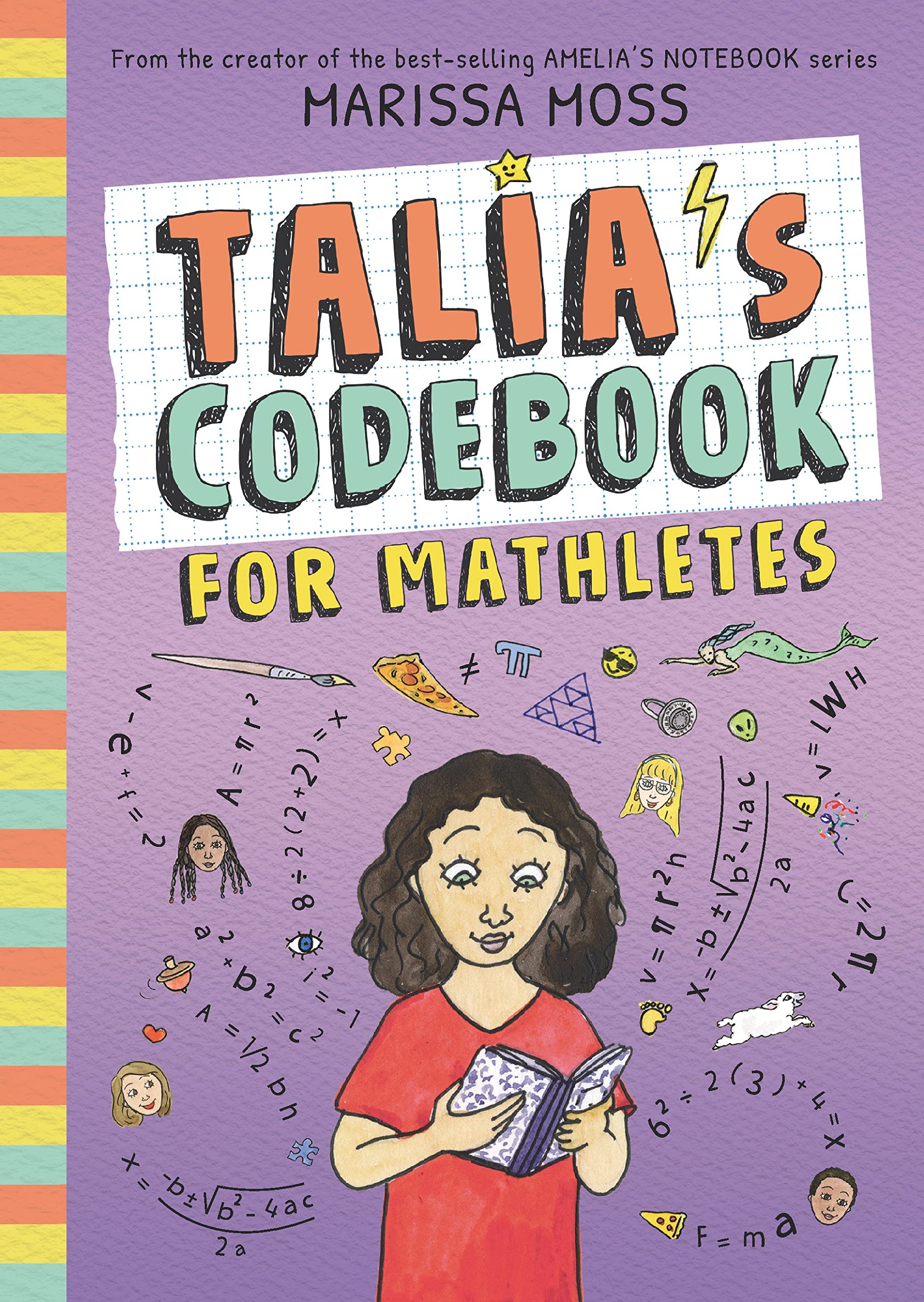
Talia loves cracking codes and doing math, but can’t seem to solve the puzzle that is middle school. Joining the mathlete team was supposed to help with her transition, but as the only girl on the team, the boys make her the outcast. When her mathlete best friend, Dash, gets too embarrassed to be best friends with a girl, and wants to hide their friendship, there’s only one thing Talia can do—make her own all-girls mathlete team! With her new friends by her side, Talia becomes determined to bring their team to victory, get her friend back, and figure out the social rules of middle school.

The comic diary form gives a personal touch to the feelings, actions, and reactions Talia has to daily life as a middle school student. The book is broken down into observations, deductions, quizzes, and puzzles, which act as chapters. With this style, readers get a fast-paced book with no breaks in the plot. The illustrations are meant to look like doodles in a diary but are still expressive with the use of postures and facial expressions. The colors are bright with the use of watercolors and gouache with ink to give definitions to characters and objects. The overarching themes of friendship, discovering a sense of self, and finding the courage to do something outside the norm make this book perfect for readers entering middle school. Talia evolves in her social development, starting as self-centered and refusing to see her friend’s perspectives then becoming conscious of her actions and how they affect other people’s feelings. Talia’s friends and family don’t have major character developments during the book, but they do support and encourage her on her journey through middle school. Talia’s Codebook for Mathletes is a STEM-oriented book that teaches young readers, especially girls interested in math or science, to be courageous and forge their own unique path in middle school.

How to Survive Sixth Grade with Glasses: A Review of Four Eyes

Four Eyes
Rex Ogle
Illustrated by Dave Valeza
Graphix
Ages 8 to 12
May 2nd, 2023

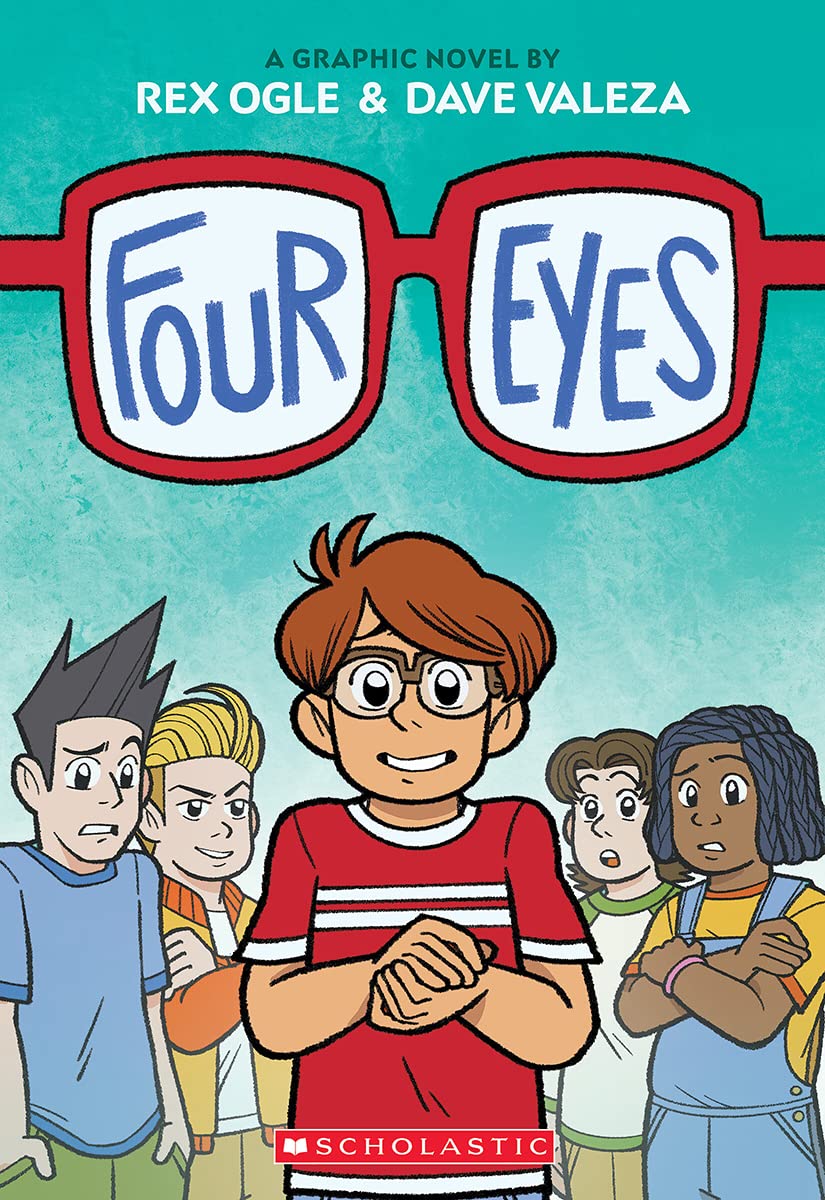
Rex thought sixth grade was going to be exciting, with new teachers, a fancy locker, and his best friend by his side. He was going to conquer the year with flying colors. Then his best friend starts hanging out with the popular crowd who don’t like the comics and who start bullying Rex for being short. Rex’s year can’t get any worse—until he finds out he needs glasses. Now, Rex has to deal with wearing glasses and being bullied for it, while navigating sixth grade, having no friends, and a family who don’t understand him.

The pencil-drawn illustrations express detailed features like the emotional facial expressions of each character and objects in the background. The warmer-hued colors distinguish the characters and the scene and give energy to the novel, matching the fast-pace of the story. The author and illustrator express an encouraging tone when themes of growing up and trying to figure out a place in school are brought up in Rex’s life. As Rex matures into his own person, he learns that everyone needs help sometimes, even adults. A major emotional moment in the story explores the difficulty of living in a low-income household, and although his family can’t afford the fancy pair of glasses for him or the nice clothes, Rex learns that having a loving family, a safe place to sleep, and the things you need are more important than what you might want. Middle school may be hard to figure out, but Rex finds his place by making new friends, and with their support, stands up to the bullies that his friend is hanging out with. Eventually, he also understands that becoming your own person means it’s okay to let go of old friends and accepts that glasses don’t change who you are. Four Eyes is a coming-of-age story for readers who are trying to navigate the intricate balance of middle school and what it means to grow up.

Jane Austen Meet Cutes Shakespeare: A Rosewood: A Midsummer Meet Cute Review

Rosewood: A Midsummer Meet Cute
Sayantani Dasgupta
Scholastic Press
March 7, 2023
Age: 12+

Eila Das, a Bengali American teen who prefers Shakespeare to Jane Austen, is known by her family and peers as the “sensible one.” Though she has a passion for acting, she pushes that away when her father dies to focus on what she thinks will be a more profitable career. Eila compares her love of acting and Shakespeare to how her father loved Shakespearean theater but indicates how he chose a career as an engineer to help support his family. Eila wants to become a lawyer and likes it that way, so she can help support her sister and her mother now that her father is gone. Her plans to pursue law are derailed when she agrees to attend a theater camp with her sister, Mallika, who submitted applications for both of them without Eila’s permission.

Much to Eila’s annoyance, the theater camp is no longer focused on Shakespeare but is instead hosting a casting competition for Rosewood, Mallika’s favorite regency era romance TV show. Eila reluctantly attends the new camp with her sister and ends up with the opportunity to be cast on Rosewood, but only as a minor character, due to that being the only option at the time for people of color.

The supporting cast of characters in this story complement Eila well, with one essential supporting character being Mallika, who is the opposite of the “sensible one.” She is a beautiful, free-spirited, emotional being who is obsessed with theater, drama, and romance. Mallika would be the obvious choice to be cast as the main love interest on a popular TV show because of her superstar looks and her lively personality, but she does not outshine the usually shy and rigid Eila. Instead, Mallika is a support system for Eila as they both process losing their father and as Eila learns to embrace her love of theater again as her priorities shift.

Eila blossoms out of her normal reserved nature as she begins to think more with her heart than her head and she even makes the casting team rethink who they want to see as one of the lead love interests on the TV show. Swept into a meet cute of her own, Eila begins to fall for Rahul Lee, a Bangladeshi Chinese Singaporean British boy who loves both Shakespeare and Jane Austen. With a budding new romance and a streak of rebelling against expectations on her mind, Eila becomes the new “it” girl when she lands the role of the love interest on Rosewood.

This face-paced, multicultural, young adult romance is a refreshing take on regency era love stories like Sense and Sensibility and comes with the dramatic tension of the well-loved book series and TV show Bridgerton. Rosewood: A Midsummer Meet Cute is a must-read for theater kids and the hopeless romantics who love an empowering story about a young woman of color who defies expectations, paired with the sweetest meet cute and an exciting conclusion that leaves you wanting more stories that challenge genre stereotypes for characters of color.

Little Seeds Saving the Planet: A Book Review of Big Tree

Big Tree
Brian Selznick
Scholastic Press
Ages 7 and up
April 4, 2023

Louise and Merwin, two Sycamore seeds, have always assumed they would live with their Mama for a long time before setting down their roots. However, when the mysterious voice of the Old One whispers of impending danger to Louise, and strange incidents start happening in the forest, Louise and Merwin are thrust into an unknown world away from their Mama. Forced to explore the changing and dangerous world around them, the siblings face dinosaurs, meteors, and volcanoes to find a safe place to grow. When the voice of the Old One becomes louder to Louise, she realizes that they may have a higher purpose—to save the world.

Pros and illustrations make this a non-traditional children’s fiction book as it uses both as an integral part of the story; with pages switching from pros, illustrations, and to a combination of both. The black and white charcoal illustrations bring another layer to the story while giving a changing perspective shift from microscopic to galactic view of the world and its creatures. The illustrations are ordered to show the motion of objects, animals, and plants giving life to the story, especially when whole pages portray the walk of a dinosaur past the forest (Pgs. 70-81). Through great changes, Merwin and Louise must change their perspective to adapt to the world around them. Merwin becomes pragmatic and protective of Louise, who is being guided to safety by the Old One, and mostly leads them astray of the Old One’s plan. Louise basks in the new sensations of the world and delves more into trusting and listening to the world around them. Eventually, learning to trust in one another, they both listen to the Old One and prepare for the chance to save the world. In this adventure, Selznick gives a voice to the world by using the Old One as a wise and protective being that wishes to help all its children, while also teaching them that death is just one part of the Cycle of Life. Selznick includes backmatter on the original idea of this book, the science behind key characters, and an acknowledgment of all the scientists and specialists that have helped him research in preparation for this book. As Louise guides Merwin, Big Tree will guide readers to listen to the sound of the world and care for our fragile planet before it’s too late.


All in a Days Work: A Review of Stillwater and Koo Save the World

Stillwater and Koo Save the World (A Stillwater and Friends Book)
Jon J. Muth
Scholastic Press
Ages 4 to 8
February 7, 2023

Koo, a young giant panda, wakes up inspired to change the world and enlists his thoughtful Uncle Stillwater to help fix it all—today. As they go about their day, Koo proceeds to have giant expectations of what he would like to do, but Stillwater teaches him that making small changes in the environment, and helping the community, can be their own meaningful way to change the world.

Told using a variety of animals, humans, and anthropomorphic pandas, the diverse characters reflect the diversity of the world and all the characters that might need kindness. Pandas as symbols of peace and friendship in Asian countries, are the main character in this story as they try to bring small improvements to the world around them. The pace of the story changes from rapid excitement as Koo suddenly wakes up one day and instantly ropes his uncle into the expectations of wanting to save the whole world, then slows only when Stillwater speaks to Koo about making small differences in the world around him. As the pace changes, the tone of the story changes to one of acceptance and encouragement of his personal efforts Encouraged by his uncle, Koo begins to bring joy to those around him through small but meaningful actions, such as cleaning his room and making a cake for the neighbors. These realistic everyday chores and acts of thoughtfulness offer young readers clear examples of how their actions impact the world around them. Drawn with pencil and granulated watercolors, the airy but vivid illustrations exemplify the beauty in the world around Stillwater and Koo and why they want to help save it. Stillwater and Koo Save the World is an uplifting story about wanting to make giant differences in the world by doing something small, inspiring readers to make meaningful changes in the world regardless of age.