Story of Survival: A Review of The Rebel Girls of Rome

The Rebel Girls of Rome 
Written by Jordyn Taylor 
Published by HarperCollins Publishers/Harper 
Ages 14-18 
Available July 8, 2025  

Nineteen-year-old Lilah just finished her first year of college and is still trying to figure out how to survive after her mother’s death. When she receives a mysterious message about a lost family heirloom, she feels excited about the idea of learning more about her family’s history. Lilah grew up thinking that her grandfather, Ralph, was the only member of his family who survived when the Nazis invaded Rome. Now, Lilah has an opportunity to discover if his sister, Bruna, might have survived, too. Despite Ralph’s refusal to speak about his family and childhood, Lilah convinces him to travel to Italy with the hope of discovering what happened to Bruna. Alternating chapters between Lilah’s perspective in the present day and Bruna’s in the 1940s, this story of rebellion and resistance highlights the strength necessary for survival and the importance of telling your story. 

Jordyn Taylor seamlessly weaves together two perspectives separated by 80 years and two generations to create an emotional and touching story of survival and forgiveness. She explores themes of grief, guilt, and generational trauma through Lilah’s grief for her mother and the survivor’s guilt that Ralph and Bruna struggle with for their whole lives. Bruna’s story is compelling and heartbreaking, detailing the reality of living in occupied Rome. Taylor adds an uplifting layer through Ralph and Bruna’s heartfelt reunion and Lilah’s relationship with her grandfather deepening as she learns more about him. She also incorporates aspects of LGBTQ+ history and women’s history in Italy, both showcasing the multi-layered oppression Bruna faced and commenting on the progress that still needs to be made today. In the author’s note, Taylor explains how much of the novel is based on facts, like the missions carried out by resistance groups, and how much is fiction. Both captivating and touching, The Rebel Girls of Rome showcases the power that love has to help people survive and bring people back together, even after 80 years. 
Creating the Change: A Review of Saving Savannah

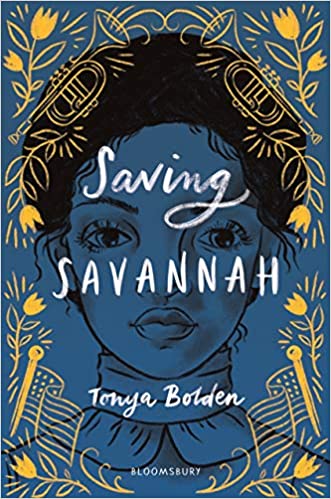
Saving Savannah cover art

Saving Savannah
Tonya Bolden

Bloomsbury
January 14, 2020
Ages 14-18

It’s 1919—the Great War just ended, the Spanish Flu still rages, and women nation-wide are demanding the vote. Against this tumultuous backdrop, Savannah Riddle lives a life of luxury amidst the affluent African American community in Washington, DC. But she is beginning to chafe at the vapidity of her set and speculate about the poverty and struggle just outside her bubble. Making new friends and seeking out new experiences opens Savannah’s eyes to the world around her and challenges her to find ways to make a difference in her community.

Fans of Bolden’s earlier YA (Crossing Ebenezer Creek, 2017; Inventing Victoria, 2019) will be familiar with Savannah’s family tree, but this elegant story also works as a stand-alone novel. As pandemic, racial inequality, and social unrest are once again—and still—front and center in our consciousness, Savannah’s fear, bravery, and determination to effect change feel both modern and timeless. Bolden sets a brisk pace with the narrative that is well-matched to the book’s chaotic events and prevents the difficult themes for getting too weighty. While Savannah is clearly the central and most dynamic figure, the supporting characters (including many real-life historic figures) are well-drawn and provide a strong counterpoint to her journey from debutante to social justice advocate. History lovers will appreciate Bolden’s thorough research and documentation. The extensive author’s note offers a look at the historical inspiration for many of the characters and events. Also included are background notes on many of the historical references, citations for newspaper headlines, photo credits, and a bibliography of selected resources.

Back to School with Historical Fiction: A Review of Finding Langston

Finding Langston by Lesa Cline-Ransome

Finding Langston
Lesa Cline-Ransome
Holiday House, August 2018

Langston doesn’t like much about his new life in Chicago – not the small apartment he shares with his father, or the noisy streets and sidewalks, and definitely not his new school, where classmates call him “country boy” and make fun of how he speaks. Langston misses Alabama, where his mother died and where his Grandma still lives, though his father sends her part of his paycheck each week in the hopes of helping her move up north with them. It’s only when Langston discovers George Cleveland Hall Library, open to all Chicago residents, that he starts to feel at home.

In the safety of the library, Langston also discovers his namesake, a poet who seems to have inspired a few of the love letters written by young Langston’s mother to his father. Reading the poetry of Hughes helps Langston work through his grief at losing his mother, but it’s a new friend who recognizes that reading poetry “is a way of putting all the things you feel inside on the outside” (p 99).

Cline-Ransome mixes poetry and history in this slim fiction novel for elementary and middle school children. The post World War II era of the Great Migration is explored through the story of one family, and Langston (the character) also learns a great deal about Langston Hughes and other African American poets and writers of the time. Chicago’s Bronzeville neighborhood and Chicago Public Library’s Hall Branch are both highlighted and given extra detail in an Author’s Note at the end of the book. Told with heart and thoughtfulness, Finding Langston belongs in personal libraries and on classroom shelves alike.