Mock Newbery Results

I spent this past weekend immersed in deep, insightful book discussion with fourteen other astute, committed individuals, in search of “the most distinguished contribution to American literature for children” published in 2014. This was the culmination of a semester’s worth of reading, nominating, and more reading. By dedicating the time and energy of an entire course to the endeavor we were able to really dig into the Newbery process, replicating not just the book discussion, but the nominations, introductions, and balloting. In the end we spent 15 hours over two days discussing and voting on a list of 29 titles, arriving at a winner and two honor books. I’ll talk a bit more about our lists in a bit, but let me now get to our results:

The committee chose two honor books:
the art of secretsThe Art of Secrets by James Klise, published by Algonquin Young Readers, 2014

When arsonists torch Saba Khan’s apartment, tensions are high. Is this a hate crime, targeting Saba’s Pakistani immigrant family? Was is staged? Who is responsible? The community at her independent school steps up, raising funds to help the family, but when one of the items collected for auction turns out to be the work of Chicago outsider artist Henry Darger, valued at half a million dollars, things get bona fide complicated. Klise exposes the truths, and misdirections, through a series of blindered e-mails, texts, journal entries, phone conversations, and other exchanges between a diverse cast of players, threading the compelling mystery with obfuscation and intrigue. Taut plotting, masterful characterization, and nuanced exposition combine in a satisfying, surprising novel.

bad bye good bye

Bad Bye, Good Bye by Deborah Underwood, illustrated by Jonathan Bean, published by HMH Books for Young Readers, 2014

A little boy travels with his family from their old home to their new one, lamenting their losses, considering their transitions, and hoping for their future. Underwood composes 57 discrete single-syllable words into forty rhyming couplets, with every couplet being an adjective/noun pairing (with the exception of one critical turning point). Within this structured framework she achieves a staggering range of emotion and experience, equally resonant to the lap-based toddler, the emerging reader, or budding poet. Simple words take on layers of meaning that shift and grow in their careful sequence, drawing the reader or listener along the journey’s immediate, indelible arc. While Bean’s energetic, substantial images add atmosphere to the outing, establishing meaningful context and reinforcing the emotional tug, Underwood’s spare, rhythmic, verse has its own unmistakable, dramatic power.

And the committee chose, as winner of our 2015 Mock Newbery:
RevolutionRevolution by Deborah Wiles, published by Scholastic Press, 2014.

The town of Greenwood, Mississippi becomes the battleground for a nation in turmoil during the freedom summer of 1964. “Agitators” from the north descend to establish and protect black voters’ rights while the local communities erupt at the challenge to the status quo. Wiles tells the story in two first-person narratives, of twelve-year-old Sunny, whose eyes are opening to habituated racism she couldn’t see, and fourteen-year-old Raymond, who experiences that racism first-hand. Wiles embellishes and interrupts those two distinct voices with a jarring battery of primary documents, submerging the reader in a cultural context that includes everything from frothy invocations of pop-culture to noxious expressions of hatred, all of them documented and real. The resulting combination makes for a piercing, illuminating, and especially human exploration of a tumultuous episode in our country’s history.

A note about our lists:

We began our reading with a list of 15 titles selected by me (as instructor for the course) in July, which included both published and anticipated books. Unlike the “real” committee, that short list was curated to represent a wide range of style, tone, format, and reading level, as well as a balance of cultural diversity. In addition to those titles we all read widely from an ever-growing list of suggested titles from which each student nominated one. And in the end we arrived at our final 29. We can never know how well our final list might compare to the books the “real” committee is looking at this year. Indeed, in many ways our purposes are different. But we have great confidence in the depth and precision of the investigation we undertook, and great pride in the results.
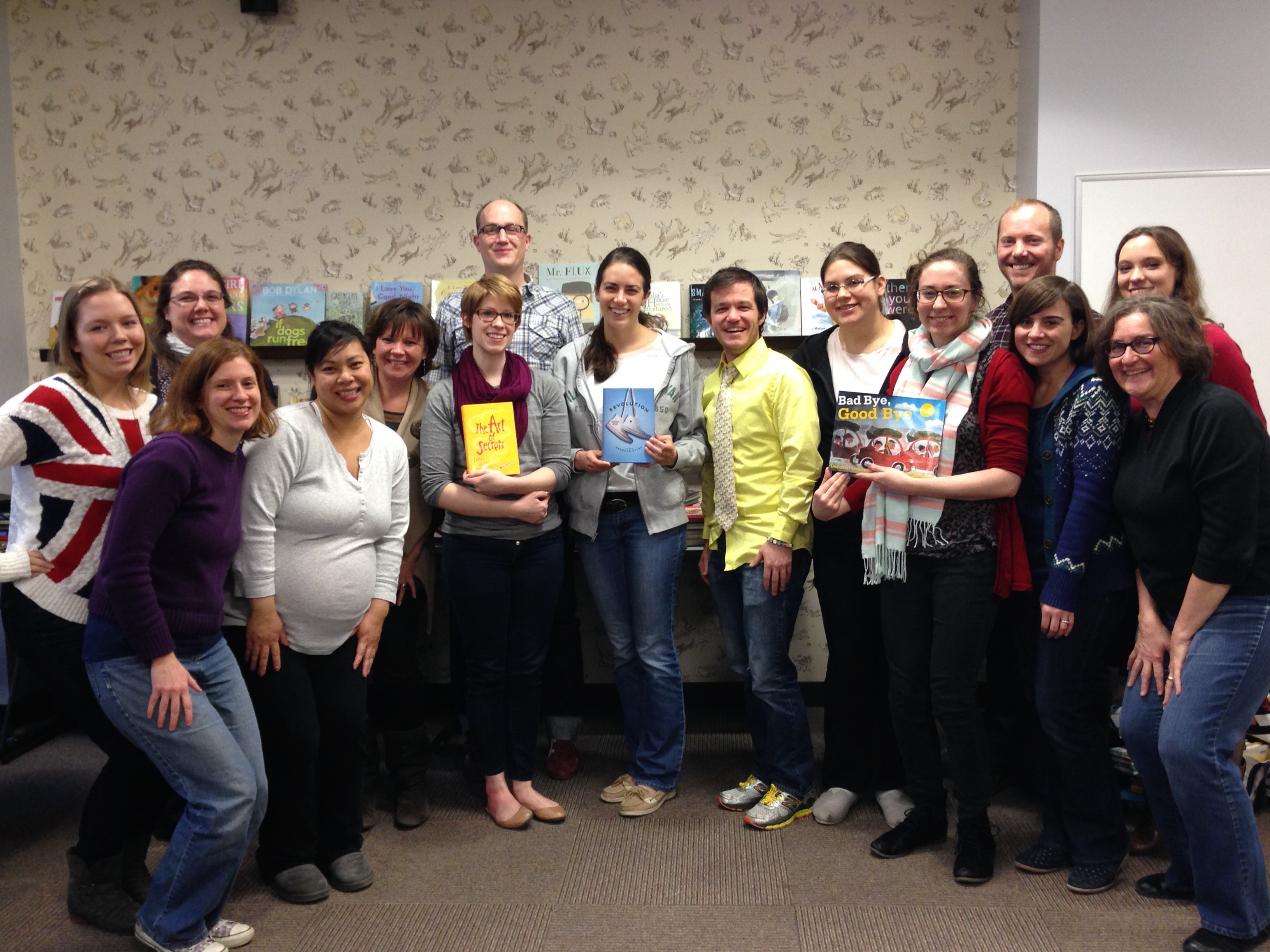
mock newbery committee

whole round earth

In my children’s literature class I like to introduce different frameworks for our weekly book discussions. Some weeks we consider books through a lens of readers’ advisory service. Sometimes we think about popularity or esoterica. Sometimes we think about separating our personal responses from our professional ones. A week or so ago we engaged in a creative activity as we undertook our discussions. The books on the table were biographies, and the activity was one a recycling craft. It’s an activity I have connected to different books, in different ways. This time around we had a couple of biographies of artists, and we thought about it as an extension of those tests.

Here’s how it works:

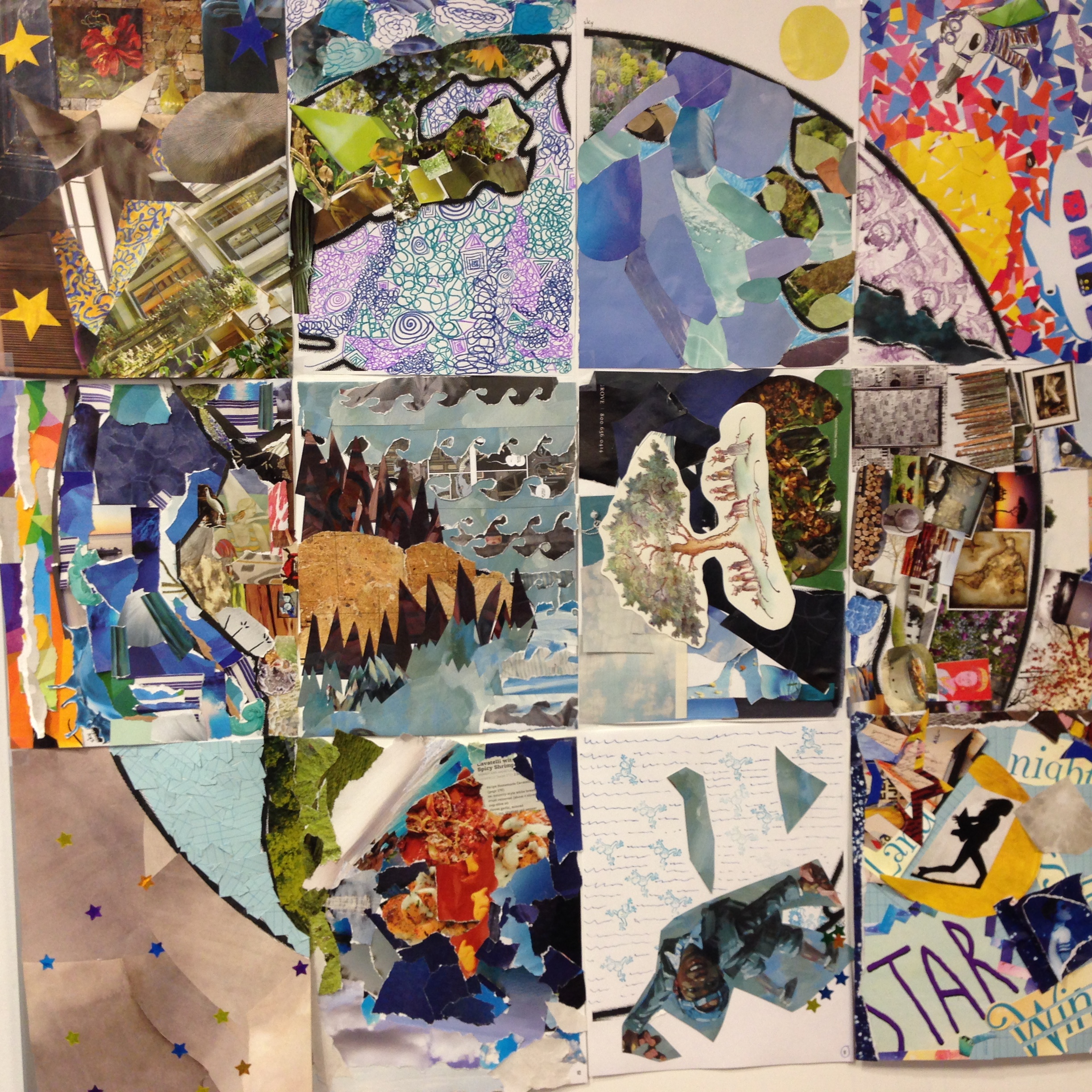
I have a big blown-up line drawing of the globe broken down onto 12 pieces of letter-sized paper which tile together, four-across and three-high, to form a complete image. Each page has markings indicating which parts of the image are air, which are land, and which are water. Then we all fill in the blanks, using whatever we like. I put out a bunch of scissors and glue sticks and old magazines, posters, catalogs, and other paper goods (books that have been withdrawn for condition might be great!), markers and pens, rubber stamps and ink pads, old stickers, felt remnants, leftover foam shapes, etc. The whole idea is that we use or reuse stuff that’s already around, instead of buying lots of stuff special.

And when the individual pieces are done, we assemble them, and magic happens.

To begin with, the assemblies are beautiful. Every time. There’s something about the juxtapositions of all of the different approaches that tickles me no end.

There are metaphorical resonances, too, that are really powerful. The finished product is identifiable as our planet, and as we look at it we understand, deeply, that its beauty comes from its diversity and authenticity. It’s almost as if the planet is only whole when each of us does our part. And then there’s the transformation of what might be considered waste into communicative artwork. It’s just really good.

Here’s a picture of the one we made this semester, and I’ve pasted below a link to the pdf template, in case you’d like to try it yourself!

whole round earth

whole round earth template


Thom’s Rules of Order: Ten Tips for Good Book Discussion

butler center mock newbery discussionHere’s a recent piece I did for the Horn Book about open, inquisitive book discussion. In many ways I’m anti-rule; prescription tends to rub me the wrong way. Still, book discussion benefits from a common framework, and even someone as enamored of the mixture of florals and plaids as I am can probably follow these rules. What are your tricks for staying on topic (and off of nerves)?

pictured: Members of the GSLIS Mock Newbery course discussing books in the Butler Center.

The results are in

As part of the fifth annual Dominican University Caritas Veritas Symposium the Butler Center staged a Book Identity Project through which we solicited from members of the university community a book (or six) from childhood that contributed to their identity. Participants were given an old-school check-out card asking for the book and we lined the front door and window of the center with old-school check-out card pockets to receive them. We had a tremendous response, with 101 books listed on 86 different cards.

identity cardsThe submissions are fascinating, with a surprising variety. To be sure, the collection includes some well-loved, to be expected titles. Where the Wild Things Are gets three mentions, and Dr. Seuss shows up six times, twice for The Cat in the Hat, twice for Green Eggs and Ham, and once each for Oh, the Places You’ll Go! and One Fish, Two Fish, Red Fish, Blue Fish. I’m not surprised to see Louisa May Alcott or A.A. Milne, C.S. Lewis or Lewis Carroll (or Robert Louis Stevenson) in the mix. The single most-cited title is Shel Silverstein’s The Giving Tree, with four mentions, which is something of a surprise, not because it’s a book I don’t care for (indeed, I don’t care for it) but because it seems to have the sort of nostalgic perspective that I never thought spoke strongly to children. Consider me schooled. I was somewhat surprised, too, to find books outside the children’s canon, by the likes of Hemingway and Steinbeck and Dwight D. Eisenhower. We didn’t specify that the book needed to be a book written expressly for children, just that it resonated in the participant’s childhood, so it makes perfect sense that books like these would show up. It’s a great reminder of my own myopia, that I automatically understand young people’s reading through my deep engagement with the body of literature I study. Schooled again!

Quite a few series made the cut, including Nancy Drew, The Boxcar Children, The Chronicles of Narnia, and, of course, Harry Potter (I was 32 when Harry Potter and the Sorcerer’s Stone was published, and it’s just a little sobering to realize how many of our students read it as children). Alexander and the Terrible, Horrible, No Good, Very Bad Day got two mentions (I wonder if those folks saw the movie) as did The Runaway Bunny. Andrew Clements’ Things Not Seen, published in 2004, is the youngest book mentioned, and the oldest is Henry Wadsworth Longfellow’s Song of Hiawatha, first published in 1855.

Here’s the complete list. Check it out. Are you surprised by what you see? And while you’re at it, let us know if you can identify the authors of any of the first few books listed, unfamiliar to us.

stephan and karaHere are Butler Center Student Assistant Kara Pauley and LISSA President Stephan Licitra collecting entires (and passing out candy). It sure is great to have such friendly, diligent assistance.


Oh, and for the record, my choice was Spectacles, by Ellen Raskin. It’s a great book. You should check it out.spectacles

Here is the World: A Year of Jewish Holidays

here is the worldHere is the World: A Year of Jewish Holidays
written by Lesléa Newman

illustrated by Susan Gal

Abrams, 2014

Sometimes I love a book on sight. It’s not fair, I know, or smart, really, to offer up my affection before I have really gotten to know the book a little, but sometimes I can’t help it. I had just such a reaction to this book. And I’m happy to report that deeper study and familiarity prove that my instincts were right. It’s splendid. And this, Rosh Hashanah, the beginning of the Jewish year, seems the perfect day to sing its praises.

My affection began with the images. They are bright and cheerful and immediately arresting, but that basic appeal is just the beginning of their wonder. Susan Gal is a master of composition and shape. Every spread exhibits ordered balance and movement, reinforcing the sense of celebration with steady energy. And her figure work is just exquisite, with impeccable proportion and individual consistency. This seems a small thing, perhaps, but I can think of plenty of illustrators, some of them household names, who don’t approach the skillful grace of this warm, vital portraiture.

The color work enjoys the same sense of energy and balance, with rich, saturated jewel tones humming beside one another, glowing with naturalistic light. Indeed, whether lit by sunlight or stars, every spread elicits a sense of presence, so immediate is the setting.

And Gal employs all of this skill and style to a cumulative visual story that threads the family’s experience through the year. These holidays are not abstract, isolated festivities, but the real and meaningful celebrations of a close family.

For her part, Newman’s rhythmic verse scans beautifully (would that all rhyming text scan this well!), inviting, even imploring to be read aloud. But, just like the pictures, there’s substance behind the style, with family as the central theme.

This wonderful book will find its way to many libraries because of its useful and  accessible treatment of important cultural information, but I sure hope it has a chance to extend beyond its simple utility and has a chance to delight with its profound and handsome charms.

Shanah tovah.

PicWits!

picwits instructionsThis week we wrapped up our consideration of picture books in the Children’s Literature course I’m teaching, and we began class with a rousing game of PicWits! Do you know PicWits!? It’s a party game, much like Apples to Apples, that has players matching cards in their hand to a single phrase, with individuals taking turns choosing which card best represents the phrase in question. What’s unique about PicWits! is that the phrase is a “caption” and the cards in people’s hands are all photographs. You earn points when the chooser chooses the picture you matched to the caption. So, the game’s central point is the visual interpretation of the text. See where I’m going with this?

To begin with, the game is lots of fun. The images themselves represent a huge variety of theme and execution, and are often bizarre, leading to plentiful opportunities for provocative, sometimes outrageous pairings. But beyond the hilarity, our experience gave rise to some really interesting and illuminating thoughts about how picture books function, and what we can and should make of the symbiotic relationships between words and text. Here are some of our ideas:

Possibilities are endless. No matter how clearly you see and understand a phrase, others will see and understand it differently. Even given the limitations of having only a few cards to match from at any given time, there’s still remarkable variety in the relationships established between the single caption and the many visual interpretations offered. Indeed, no matter what picture you match with a phrase, there will be some relationship, even if it is one of tension or discord. Picture book illustrations can take advantage of that same infinite possibility, affecting just as many different responses.

Know your audience. We learned pretty rapidly that different people respond differently to different images. Martina* likes pictures of cute kids. Lynne* hates squirrels (HATES). before too long one learns to play to the chooser, making the match accordingly. We saw a direct parallel between that sort of play, and an illustrator’s attention to audience/age range.

Some pictures are just cute. Some pictures are just cute, and will be chosen, regardless of their interpretation of the caption in question. It’s the way of the world. Similarly, some picture books will find a broad audience due to their visual appeal, irrespective of how well they do (or do not) interpret the text in question or deliver any other literary element. That’s OK. It doesn’t make those bad books. But it is something to remember as we examine large numbers of picture books and parse their success.

The pairing that works is the pairing that works. It can be difficult to predict which pairing is going to capture someone’s attention. Literal is not necessarily best, but neither is ironic. So much depends upon the context, and the players. In terms of connections to picture book evaluation, this reminded us that the only thing we have to judge is the picture book in front of us, and that gives us plenty to talk about!

picwitsHere are a few students going to PicWits! town.

*names have been changed to protect the innocent.

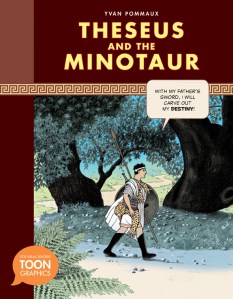
Theseus and the Minotaur

theseus and the minotaurTheseus and the Minotaur

by Yvan Pommaux

Toon, 2014

I grew up with ancient mythology. My parents met in graduate school, themselves 1/2 of the first cohort of Classics PhD students at the University of Washington (three men and one woman–my mom used to joke that my dad “won” the contest) and our childhoods were steeped in the stories of ancient Greece and Rome. Indeed, the ancient world was everywhere, in the pictures on the walls, the statues on the tabletops, the books on the shelves, even the secretive Latin conversations at the dinner table. And the myths were our bedtime stories. Think about that for a minute. I remember being five years old and feeling plainly terrified that if I looked my mother square in the face I’d be turned to stone. I got past it, of course, but these stories will always feel very close to me.

I also remember struggling with the definition of mythology as organic, adaptive story that grows and mutates in different cultural iterations. I wanted to know the real, official account of Medea, and resented my father’s challenging assertion that all of the versions are equally valid, right up to the contemporary reimaginings (perhaps my students, themselves occasionally frustrated by my refusal to offer a straight answer to anything, now know whom to blame). But I have come to love the idea that these ancient stories represent deeply resonant foundations on which all manner of human interaction can be explored. And I am always on the lookout for new contemporary volumes to add to the canon.

This one does not disappoint.

Like all Toon books, the comic format relies on careful reading of the images to digest the story. Word balloons, and, in this case, some general narrative, further the account, but the large spreads and small detail images constitute the heart of the story. Pommaux’s simple pencil line drawings are easy to follow, yet display remarkable sophistication in their style and execution. Small details, like the family resemblance between King Aegeus and his son Theseus reinforce the bountiful mythology. The artist superimposes crisp, flat figures on smudged, sketchy grounds, establishing a sort of cinematic energy that propels the story along. Pommaux plays with the organization of the (often unframed) panels as well, stretching them across the top and/or bottom of both pages, effectively playing with the tropes of the comic canon in the same way bards and playwrights played with the stories themselves. There’s some terrific front and back matter here, too, including endpaper maps, character sketches for principle players, shorter definitions of people, places and things in a longer index, and suggestions for further investigation.

It’s easy to imagine kids reading these words and pictures, over and over. With any luck we can look forward to Perseus and the Gorgon coming up next!

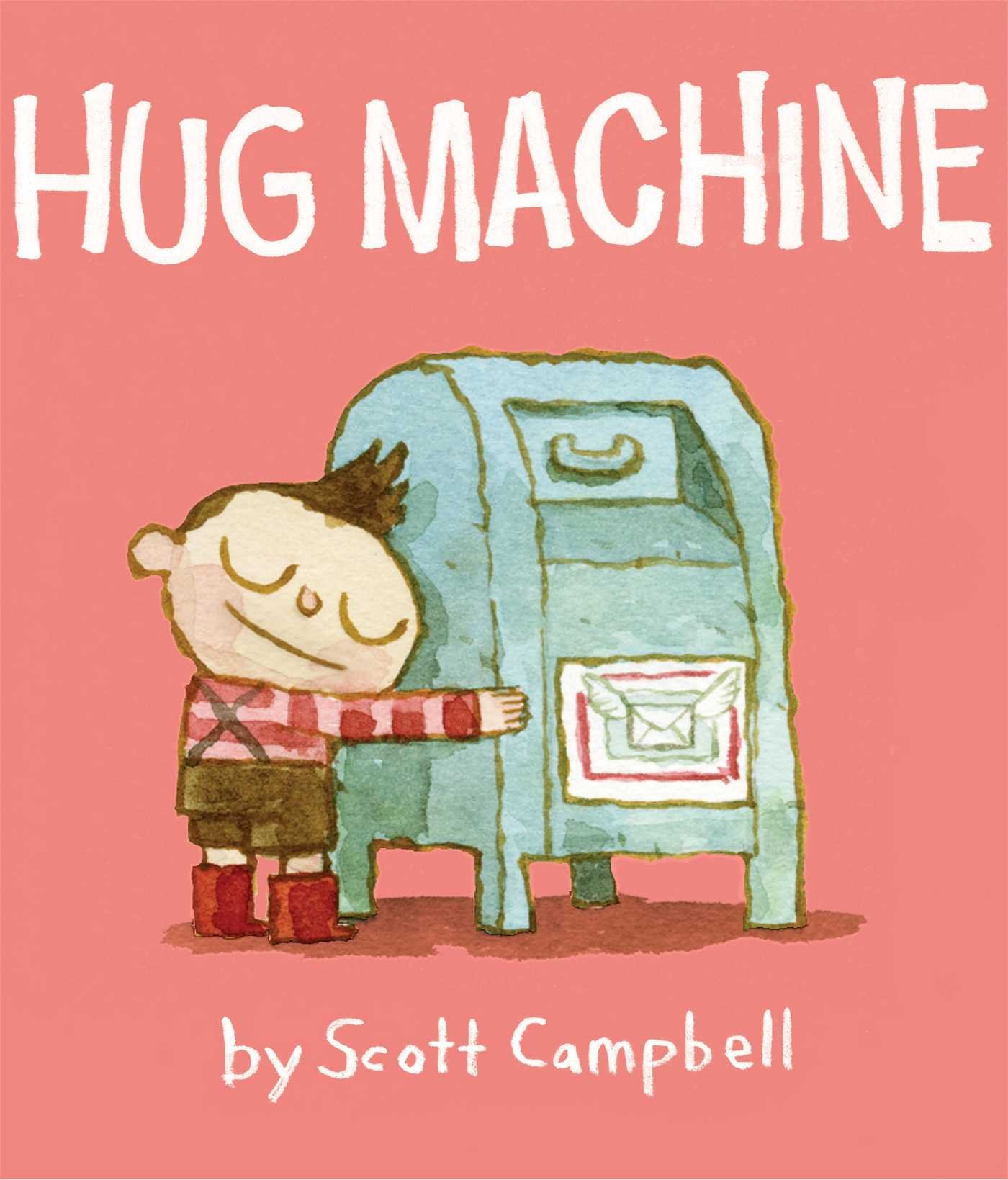
Hug Machine

hug machine

Hug Machine

by Scott Campbell

Atheneum, 2014

I love this book. I love it up. Indeed, here is a place where one is glad one is blogging, and can set aside the more formal trappings of professional writing and just gush with abandon.

Ready? Here is a list of my impromptu enthusiasms:

1) The faces. Campbell does some good faces. His style is particularly loose and sketchy, but boy, howdy, he can capture emotion and attitude in a few watercolor gestures. From the resolute purpose of the hugger, expressed in his firm mouth and closed eyes, to the variety of surprise among those being hugged (catch the look on his dad’s face, and that turtle?! shut up!), the priceless range of emotion adds meaning and depth to what might have been one note mawkish.

2) The composition. Some spreads are open, and some are crowded. But whether it’s the ominous space between the hug machine and his intended porcupine, or the busy, serial hugging along the dotted line (a la Family Circus), the composition is never accidental and always effective.

3) The font. Everything is hand painted, with the same easy watercolors as the pictures, reinforcing the child-perspective and adding to the insouciance.

4) The arc. It’s not uncommon to happen upon a picture book whose words and images match its listeners. But I can’t remember the last time I encountered a book whose story arc was so well calibrated to its audience. The pagination, the pacing, the implicit pauses and inflections. Here is a book that will blossom when read aloud, over and over (and over).

5) The details. They got everything right here. The buff heavy stock feels delicious under your fingertips. The endpapers, with their empty and completed checklists, even the author flap of the dust jacket (with our hero hugging a fire hydrant while a curious dog looks on), all of it contributes to a cohesive, thorough, and endlessly appealing experience.

6) The edge. I’m not exactly allergic to sincerity, but I do like my earnest cut with a healthy dose of dry. This is an undeniably sweet outing, but between the bodacious humor and the appreciable astringency, it is anything but cloying.

7) The timing. Hug Machine did not come out in February (see above).

8) The gender expression. This is a book all about warmth, doused in pink and glowing with ardor, and the bearer of all of that fervent affection is a little boy. Boom.

I leave you with an instructional video on 90-second hugs by the author himself. I suggest you put in some practice, and then go out and get your hug on.

p.s. September 6-14, 2014 appears to be Hug a Book Week, so if you’re looking for a recipient, you might start at your local library.

Animals at war

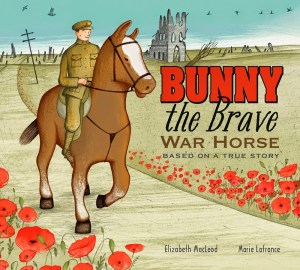
Bunny the BraBunny the Brave War Horseve War Horse: Based on a True Story

by Elizabeth McLeod, illustrated by Marie Lafrance

Kids Can Press, 2014

Bunny, a magnificent horse, and two brothers, Bud and Tom, ship out to Europe in 1914 among a group of police horses and officers sent to fight on the battlefields of WWI. Bunny is initially assigned to Bud, and when he is killed he becomes Tom’s horse. The two form a close bond, and survive the conflict together, performing acts of heroism and sacrifice along the way. At war’s end, however, the two are separated; Tom returns to Canada, and Bunny is sold to a Flemish farmer. McLeod tells Bunny’s story with a combination of poetic license and narrative restraint. Her straightforward prose tells Bunny’s story simply, without drama or sentiment. We experience the hardships of war–the hunger and danger and death–but the matter-of-fact tone with which they are expressed establishes Bunny’s and Tom’s resolute, impenetrable bravery. Lafrance’s folk-like illustrations reinforce this sense of plain strength. Spread across double pages, the images are a bleak amalgam of murky greens and greys, setting a desperate tone broken only by the brilliant poppies immortalized in Dr. John McCrae’s poem “In Flanders Fields.” McLeod includes an author’s note in which she explains just how much isn’t known about Bunny’s story (even “Bud,” the name given Tom’s brother, is an invention), and confirms the heartbreaking conclusion. The Library and Archives Canada Cataloguing in Publication assigns fiction subject headings to this title, and I’m inclined to agree. This is a fiction with roots in fact. But it is no less a powerful and touching evocation of the perpetual price of waging war.

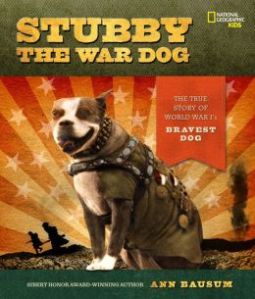
stubby the war dogStubby the War Dog: The True Story of World War I’s Bravest Dog

by Ann Bausum

National Geographic, 2014

In stark contrast to Bunny, Stubby the War Dog is a presentation of a bodacious collection of scrupulously documented facts surrounding one formidable dog. Sergeant Stubby, as he was known, was a dog with a personality as outsized as his antics. He presented himself as a stray to the 102nd Infantry, training at Yale University in 1917, and so endeared himself to the soldiers that one Corporal Robert Conroy smuggled him onto their ship bound for the theater in Europe. From there Stubby’s infamy grew and grew. Bausum offers a series of almost unbelievable anecdotes–Stubby saluting the officer who discovers him as a stowaway, Stubby rescuing a French toddler from oncoming traffic, Stubby recovering from grievous injury sustained on the battlefield–which establish his irrepressible persona. She also surrounds Stubby’s own story with rich and extensive context, offering lots of information about the greater war and its impact on everyone it touched. The narrative follows Stubby back to the United States after the war, where he travels, parades, and generally contributes to the post-war effort, and even chronicles his story after death, and the eventual inclusion of his remains at the Smithsonian Institution. What is most striking about this masterful exposition, to me, is the journalistic integrity of Bausum’s language. She makes it crystal clear, at every juncture, what she knows and what she wonders, and how she knows the difference. At no time does the reader question the veracity of the facts being presented, yet the narrative’s careful precision never intrudes on the accessible flow of the story. It’s easy to imagine kids enthralled with Stubby’s bigger-than-life life. And it’s just as easy to imagine them fascinated by the curiosity that prompted the investigation and the research that followed. I consumed the story through the Recorded Books audiobook version, narrated by Andrea Gallo, and even the experience without a single image was riveting.

These two books differ from one another in interesting ways. One uses snippets of history as a foundation for a largely fictionalized story while the other offers a detailed account sourced from the (admittedly much more plentiful) historical record. Yet, almost counterintuitively, it is Stubby’s “true” story that brims with outlandish, colorful flourishes, while Bunny’s “imagined” account offers a much more reserved and stoic vision of the animals-at-war experience. And this juxtaposition, in a nutshell, is what I love so much about the work of librarianship for the young. It is not ours to determine which is the better, truer, more legitimate approach, We get to put these books on the self, together, and invite kids (metaphorically, or directly, too, if we want) to ponder them both.

William Wegman board books

321circus early rider3…2…1…Circus and Early Rider

by William Wegman

Dial Books for Young Readers, 2014

When I was in Library School (that’s what we called it back then) fine-art photographer William Wegman began exploring the world of picture books as a medium for sharing his doctored photographs of his weimaraner dogs. He staged fantabulous vignettes with his dogs acting out famous fairy tales (like Red Riding Hood, pictured, from his book Little Red Riding Hood) or engaged in everyday activities (like harvesting, also pictured, from his book Farm Days). The results were weird and fascinating and beautifully child-centered; while some adults found them creepy, kids were captivated.

red riding hoodwegman tractorWegman’s children’s literature output has been spottier of late, though experiments with a new style, inserting digital images of the dogs into scribbly, painterly paintings, have produced some recent charmers, including two board books out this month. 3…2…1…Circus! sees the dogs in all manner of circus scenarios, beginning with ten and counting down to a literal, lone puppy blast-off. Early Rider sets the puppies to get about in all manner of transportation, from pogo stick to hot-air balloon, described in rhyming couplets. The production values here are pleasantly rough, with sketchy objects on even sketchier backgrounds, offering a pronounced contrast to the digital clarity of the puppy pics. And Wegman’s ability to interpret the puppies’ playful positions, painting them into cockpits and clown suits, adds lots of dynamic energy.

A successful board book speaks to its infant audience with color, content, and imagery. All too often we see popular picture books reformatted on board pages, to take advantage of some sort of classic status, forgetting that babies have special (literary) appetites. This pair does a great job combining raucous color, meaningful concepts, and adorable puppies into a chewable package just right for babies to devour.

Here are a few book trailers from Wegman’s YouTube channel, because puppies.