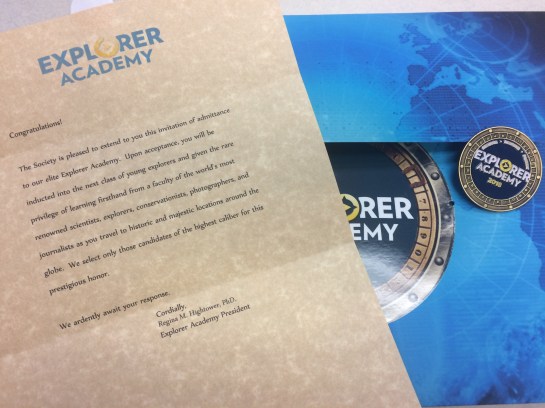
We’ve been accepted to the Explorer Academy!

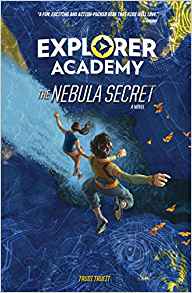
nebula secret coverI was fortunate to spend my Wednesday afternoon with a lovely group of fellow book-lovers; professors, lit experts, book-sellers, and publishing industry insiders (oh, my!) at the lunch and launch of the new National Geographic Kids series Explorer Academy. The series will include seven fact-based fiction adventures for middle-grade readers that are inspired by the real scientists and explorers at the National Geographic Society. The first title in the series, The Nebula Secret, follows 12-year old Cruz Coronado and his fellow students as they travel the globe to become the next generation of explorers and possibly solve the mysterious death of Cruz’s mother. The blend of adventure, STEM topics, and world cultures is sure to appeal to a wide audience.

exp acceptance 2

trueitTrudi Trueit, the series author, is a weather forecaster turned writer that couldn’t help sharing her love for science with young readers. In our brief conversation, she proved to be a passionate advocate for readers, libraries, and scientists! She has tapped the knowledge of National Geographic Explorers (they are like the rock stars of the National Geographic Society) for the series to bring their real life discoveries, research, and innovations into the action-packed plots. Nizar Ibrahim, paleontologist and National Geographic Explorer, joined us to share his experiences with the NGS and a top-secret (sorry!) hint at some new discoveries.

Stop by the BCLC to check out the ARC in our signed books collection (as soon as I finish reading it) and keep your eye out for publication this fall by Under the Stars, the new fiction imprint of National Geographic.

2018 Picture Book Poetry

April is National Poetry Month – celebrate with us by checking out new collections and illustrated poems. You can find these titles, novels in verse for older readers, and other lyrical picture books for children here at Butler Children’s Literature Center!

blackgirlmagic

Black Girl Magic (Macmillan/Roaring Brook Press, January 2018)
Written by Mahogany Browne
Illustrated by Jess X. Snow

With a dedication stating “This book is for you,” this spirited poem of strength and finding beauty in yourself despite what the world expects of you lifts up black women, acknowledging their accomplishments and struggles, and gives young black girls an anthem of support. The text is accompanied by striking black, white, and red illustrations that amplify the empowering message of the poem.


In the Past (Candlewick Press, March 2018)
inthepastWritten by David Elliott
Illustrated by Matthew Trueman

This collection of poems about ancient creatures ranges from the humble Trilobite to the mighty Quetzacoatlus and proves that anything can be poetic. Perfect for dinosaur fans of any age, In the Past includes a geologic timeline and notes for each ancient creature along with realistic mixed media images. The poetry is light-hearted and informative and plays on the illustrations on each page.


martinrisingMartin Rising: Requiem for a King (Scholastic Press, January 2018)
Written by Andrea Davis Pinkney
Illustrated by Brian Pinkney

In this collection of “docu-poems,” author Andrea Davis Pinkney presents the final months of Dr. King’s life. With a musicality of language and along with Brian Pinkney’s illuminating and spiritual paintings, each poem carries a different emotional tone and honors multiple facets of King’s life – his work, his family, and his ministry. This selection works on its own as a memorial of Dr. King’s life, but would also be a powerful read aloud in a classroom or theater setting, or as a part of a larger program for students at any age.


The Horse’s Haiku (Candlewick Press, March 2018)horseshaiku
Written by Michael J. Rosen
Illustrated by Stan Fellows

This collection of haiku about horses is organized into three sections: In the Field, At the Barn, and Under Saddle. Watercolor illustrations on each page allow the reader’s eye to graze while the mind contemplates the sparse verse. A note on haiku concludes the collection and teaches the reader how to enjoy haiku in everyday life. The Horse’s Haiku would be suitable for a read aloud for younger children, or as a read along as part of a larger poetry unit for older elementary students.


withmyhandsWith My Hands: Poems About Making Things (HMH/Clarion Books, March 2018)
Written by Amy Ludwig VanDerwater
Illustrated by Lou Fancher & Steve Johnson

This collection celebrates the “joy of making” with over 20 poems about different creative activities, each written in unique styles. The illustrations are also varied, ranging from crayon and colored pencil sketches to mixed media collages and paintings. With My Hands would pair well with an arts and crafts session, or as inspiration for creative pursuits of all types.


Earth Verse: Haiku from the Ground Up (Candlewick Press, February 2018)earthverse
Written by Sally M. Walker
Illustrated by William Grill

Geographical concepts and natural events like minerals, fossils, earthquakes, and volcanoes are explored in this collection of haiku, accompanied by impressionistic and muted colored pencil illustrations. Each concept is explained in further detail at the end of the book, and a suggested reading list is also included, making this a perfect poetic tie-in or an added “layer” of a geology curriculum.


didyouhear

Did You Hear What I Heard? Poems About School (Penguin Random House/Dial Books, February 2018)
Written by Kay Winters
Illustrated by Patrice Barton

Over 30 poems fill this colorful collection – all about bus rides, fire drills, recess, field trips, tests, and teachers. Stylistically, the poems range from structured stanzas to free verse to singsong rhymes. Bright and playful illustrations make this collection suitable for younger students and perfect for classroom read-alouds or as a starting point for students to write their own school-themed poems.
A Review of The Peculiar Incident on Shady Street by Lindsay Currie

Just in time for the changing season and upcoming Halloween celebrations comes Lindsay Currie’s first book for middle grades.

peculiar incident

Tessa Woodward is less than thrilled about her family’s move from Florida to Chicago, and their house doesn’t seem to be too pleased either, based on the moving items, flickering lights, and eerie drawings appearing in Tessa’s sketchbook. When Tessa reveals to her classmates that her house is haunted on her first day at her new school, she is afraid her social life is over, but a group of unlikely friends decides to help Tessa solve the mystery of who used to live in her house – and who is making it difficult for the Woodwards to live there now.

Lindsay Currie’s in-depth research on the haunted settings and ghost stories featured in The Peculiar Incident on Shady Street shows in the details of this mystery, and makes for a satisfying read. Tessa is a smart, sensitive, and curious protagonist, and her relationship with her parents and younger brother is genuine. Readers will want to cheer her on as she works to solve her own problems, with the help of her peers, who are proud to explore their interests. The pacing adds to the spook-factor without being too dramatic and makes you want to keep reading (preferably with the lights on!).

A Review of Silent Days, Silent Dreams by Allen Say

This is one of the most remarkably affecting books I have ever read. When a baby is born, he or she doesn’t know s/he is deaf, autistic, or any different from anyone else; it is positively heartbreaking to read about this one’s introduction to a world that was almost unfailingly cruel.

Born in in 1899 in rural Idaho, James Castle was deaf, unable to speak, and autistic. Through straightforward narration, his nephew attempts to show the world through baby James’ eyes: “James opened his eyes to the world and saw things that moved and things that were still. Anything that moved seemed to scare him. He cried as his parents bobbed around him with darting eyes and flapping mouths. But James couldn’t hear himself shrieking. For him the world would always be silent.” It is truly the stuff of nightmares, interpreted hauntingly by Say’s mixed-media art, some in smudgy grayscale and some in color. Images of young James engaged by various scraps of paper, charcoal, and other “found” art materials are almost peaceful; they are juxtaposed by harrowing scenes of him holding his arms around his ears while other children scream taunts at him.

SilentDaysSilentDreams

Silent Days, Silent Dreams by Allen Say (Scholastic/Arthur A. Levine, 2017)

James’ own parents were no doubt as terrified and perplexed by their son as he was by the world; unfortunately, they were ill-equipped, or unable or unwilling, to figure out how best to rear him. At first, they gave him old paper or other throwaway items, since those things seemed to keep him entertained or at least occupied. They sent him to a school where he appears to have found some level of engagement: looking books and printed materials in the library, although he could not read; watching teachers sew books together; and doing “well in shoe repair class.” But the school considered him a failure because he could not learn to speak. There is no judgement made explicit in the text on the principal who advised James’ parents “…not to give James and drawing materials at home. He said James should learn to read and write and not waste time on drawings.” Readers will come to their own conclusions about the humanity, or lack thereof, in this approach.

As an adult, James became extremely isolated, essentially living in a barn where he had his “studio” and a mattress on the floor. Continually tormented by kids stealing his artwork, and called names such as “Dummy” and “Crazy Jimmy,” he nonetheless persisted in doing the only thing that seemed to give him any pleasure: using whatever he could find (soot with spit, charred sticks, and the like) to create art. Say’s portrayal of the type of illustrations James was creating at this time show eerie pictures of people with boxes or blank circles where faces should be, as well as quotidian images of small wooden houses and little puppets of dolls, farm animals and birds. We’ll never really know, but it’s possible James was expressing his wishes, desires, and silent dreams for home and companionship in the only way he knew how.

There is some redemption to James’ story with an art show organized by his nephew’s teacher in art school, and an eventual trailer in which he could live that was a big step up from the shacks he’d inhabited for most of his life. Nowadays, “found” or “naïve” art is a recognized genre, and James Castle is a respected contributor to it. Say’s closing portrait shows James as an adult, standing in front of his “Dream House,” with what might be a hint of a smile. The text reads “I think he was happy.”

An author’s note, bibliography, and photos of some of the found materials Say used to create the art round out this haunting picture book biography for older readers.

April B3: Immigration Stories

These days, it’s more important than ever for us to share stories about immigration with the young readers we serve; both for the sake of immigrant kids in our communities, and to encourage understanding among others of these kids’ experiences.

Join us on April 5, 2017 in the Butler Center from 5:30-7:00 (books & snacks out at 5:30; discussion from 6-7) to discuss the following list of recently published books with an immigration theme, from picture books to children’s fiction to teen fiction. We’re focusing on fiction this time; we know there are lots of excellent informational books too. You may remember the Butler Center’s “Big Read” bibliography from last year; this month’s list complements the selections recommended there.

PICTURE BOOKS

CallingtheWaterDrum
Calling the Water Drum
by LaTisha Redding, illus. by Aaron Boyd (Lee & Low, 2016)

PieceofHome
A Piece of Home
by Jeri Watts, illus. by Hyewon Yum (Candlewick, 2016)

CHILDREN’S FICTION

LongPitchHome
A Long Pitch Home
by Natalie Dias Lorenzi (Charlesbridge, 2016)

OnlyRoad.jpeg
The Only Road
by Alexandra Diaz (Simon & Schuster/Paula Wiseman, 2016)

TEEN FICTION

GirlMansUp.jpeg
Girl Mans Up
by M-E Girard (HarperTeen, 2016)

Watched
Watched
by Marina Budhos (Random/Wendy Lamb, 2016)

PCP Three of Diamonds: Separate is Never Equal

separate is never equalSeparate is Never Equal: Sylvia Mendez and Her Family’s Fight for Desegregation
by Duncan Tonatiuh

Abrams, 2014

In 1943, Sylvia Mendez, her two brothers, and three cousins all go to the local 17th Street Elementary School to register. Sylvia’s light-skinned cousins are accepted, and she and her brothers are told they’ll need to enroll at the inferior Mexican school, father from their home. Sylvia’s parents aren’t having it, and push back, filing file suit, undertaking multiple appeals, and ultimately prevailing. Tonatiuh’s account details the family’s many struggles, from the complexities of the legal process to the personal attacks Sylvia experiences. After rigorous research, and interviews with Sylvia herself, Tonatiuh delivers a story that is both compelling and inspiring. And his archetypal artwork, with its Pre-Columbian influences, connects the contemporary fight with its formidable ancestry. The strong lines, simplified postures, and fixed profiles convey the family’s resolute determination; theirs is a victory that comes from strength, and a strength that comes from family.

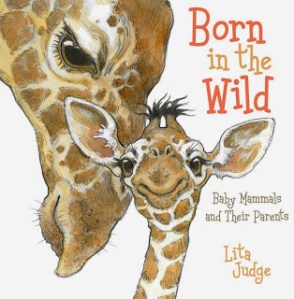
PCP Two of Spades: Born in the Wild

born in the wildBorn in the Wild: Baby Mammals and Their Parents

by Lita Judge

Roaring Brook Press, 2014

This bright, instructive exploration of different mammal families offers lots of concrete information about what mammal babies need and how mammal parents meet those needs. Sections feature a brief identification of a particular need on a single spread, followed by a few pages with specific examples of different species attention to it. The text is full of fascinating explicatory zoological detail about everything from food to shelter. But the star of this charming outing is Judge’s open, inviting portraiture that finds a perfect balance of natural authenticity and friendly accessibility. The informative text provides the facts and figures, delineating our common place in the natural world, and the warm, soulful imagery makes good on that promise, allowing the reader to feel the connection as well as understand it. In a world where growing up can feel like a daunting endeavor, how comforting it is to know that we’re all in it together.

LeUyen Pham to deliver the Butler Lecture!

LeUyenPham

Award-winning and best-selling author/illustrator/graphic novelist LeUyen Pham will deliver her lecture “Wandering Wonderland: An Immigrant’s Story Told Through Books,” on Thursday, March 5, 2015. Pham’s work includes a delightful variety of picture books, from the Orbis Pictus honor The Boy Who Loved Math by Deborah Heiligman and the Freckleface Strawberry books by Julianne Moore to her own stories Big Sister, Little Sister and A Piece of Cake; illustrations for the New York Times best-seller The Princess in Black by Shannon and Dean Hale and the Scott O’Dell Award winner Bo at Ballard Creek by Kirkpatrick Hill; and a range of graphic novels with Jordan Mechner and Alex Puvilland, including Prince of Persia, Solomon’s Thieves, and Templar. For this, the third annual Butler Lecture, Pham is literally “drawing” on her own childhood, producing a series of comic panels that explore her earliest experiences with particular books for children.

The lecture will take place at 6 p.m., followed by a reception with refreshments and a book sale and signing; it is free and open to the public, though registration is required. This an evening not to be missed.

To register, please visit: http://gslis.dom.edu/newsevents/butler-lecture-2015-featuring-leuyen-pham

For more information, please contact me at tbarthelmess@dom.edu.

The Butler Lecture is generously underwritten by the Butler Family Foundation.

YMA thoughts

There were lots of surprises at the ALA Youth Media Awards this past Monday morning (you can read about all of the winners here) and they have already been much celebrated, dissected, and critiqued. I have my own thoughts (don’t we all) which I offer as a list, because I fear if I started writing something long form I’d be here until April. And I have some snow to shovel.

So, in no particular order, here’s what I think:

1) Diversity won the day. Everywhere. The Newbery medal and both honor books. The Wilder (ALSC lifetime contribution) and Edwards (YALSA lifetime contribution) awards. The Caldecott medal and three of the six honor books. The Arbuthnot lecturer. Three of the five Sibert honor books. The Geisel award author. Not to mention the slates from the Belpré, the Coretta Scott King, the Schneider Family, and the Stonewall, all of which are diverse by nature. Everywhere!

2) Back in December, in a comment on the Calling Caldecott blog, I suggested that it was entirely possible for This One Summer be recognized by both the Caldecott and Printz committees. Nobody was buying it. This is me, gloating.

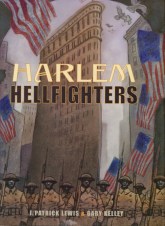
3) Some of my favorites were overlooked. Harlem Hellfighters, The Misadventures of the Family Fletcher, The Turtle of Oman. But I still get to love and champion those books, and now I get to (re)acquaint myself with other books that other folks find to be extraordinary. It’s hard to think of that as a problem, really.

4) Some things I really don’t like were recognized, too. And that’s a terrific opportunity to remember that people see books differently from how I do, and people see the awards differently from how I do. And, ultimately, that the greater the variety of taste and appreciation we have among our ranks, the better able we are to meet the many different literary needs of the young people we serve. Win win, as it were.

5) What did you think?

harlem hellfighters Levy_Front_final 91xfx6cxaRL._SL1500_


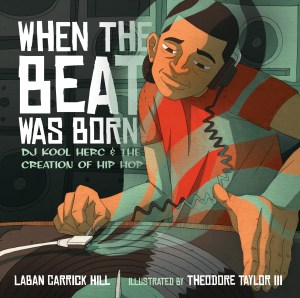
PCP Ace of Hearts: When the Beat was Born: DJ Kool Herc and the Creation of Hip Hop

when the beat was bornWhen the Beat was Born: DJ Kool Herc and the Creation of Hip Hop

by Laban Carrick Hill, illustrated by Theodore Taylor III

Roaring Brook, 2013

“Clive loved music.” So begins this spirited, affirmative biography of the inventor of Hip Hop, and right from the start we are primed for an exposition of how that love would manifest itself, on Sedgwick Avenue in the Bronx, and around the world. The story offers a straightforward, linear account of DJ Kool Herc’s childhood in Jamaica, move to NYC, and self-propelled rise to prominence as DJ and legend, noting such innovations as inviting rapper friends to “MC” his parties, using dual turntables to extend the “break” between songs, and encouraging break dancing, calling out the b-boys and doing play-by-play of their acrobatic moves. The color quality of the illustrations is decidedly dark, with a predominance of murky grays,greens and browns, and strong, definitive shadows. Yet the book itself is remarkably positive and bright. On court, in line, and around the park, smiles abound. Indeed, everything we learn about DJ Kool Herc, from his devotion to his little sister and party partner, to the way his friendships played such a central role in his music, gives us a picture of an artist excited to share his world, replacing fighting with dancing, and loneliness with community. Ultimately, this is an affectionate portrait of an affectionate man, someone who loves his music and loves his people, all at once.