Animals at war

Bunny the BraBunny the Brave War Horseve War Horse: Based on a True Story

by Elizabeth McLeod, illustrated by Marie Lafrance

Kids Can Press, 2014

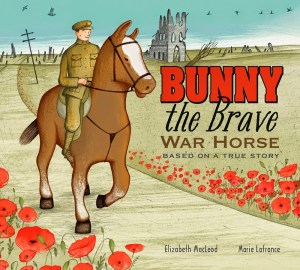
Bunny, a magnificent horse, and two brothers, Bud and Tom, ship out to Europe in 1914 among a group of police horses and officers sent to fight on the battlefields of WWI. Bunny is initially assigned to Bud, and when he is killed he becomes Tom’s horse. The two form a close bond, and survive the conflict together, performing acts of heroism and sacrifice along the way. At war’s end, however, the two are separated; Tom returns to Canada, and Bunny is sold to a Flemish farmer. McLeod tells Bunny’s story with a combination of poetic license and narrative restraint. Her straightforward prose tells Bunny’s story simply, without drama or sentiment. We experience the hardships of war–the hunger and danger and death–but the matter-of-fact tone with which they are expressed establishes Bunny’s and Tom’s resolute, impenetrable bravery. Lafrance’s folk-like illustrations reinforce this sense of plain strength. Spread across double pages, the images are a bleak amalgam of murky greens and greys, setting a desperate tone broken only by the brilliant poppies immortalized in Dr. John McCrae’s poem “In Flanders Fields.” McLeod includes an author’s note in which she explains just how much isn’t known about Bunny’s story (even “Bud,” the name given Tom’s brother, is an invention), and confirms the heartbreaking conclusion. The Library and Archives Canada Cataloguing in Publication assigns fiction subject headings to this title, and I’m inclined to agree. This is a fiction with roots in fact. But it is no less a powerful and touching evocation of the perpetual price of waging war.
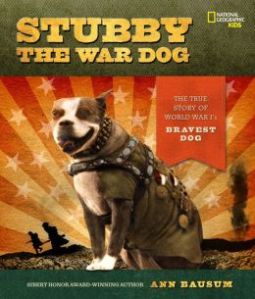
stubby the war dogStubby the War Dog: The True Story of World War I’s Bravest Dog

by Ann Bausum

National Geographic, 2014

In stark contrast to Bunny, Stubby the War Dog is a presentation of a bodacious collection of scrupulously documented facts surrounding one formidable dog. Sergeant Stubby, as he was known, was a dog with a personality as outsized as his antics. He presented himself as a stray to the 102nd Infantry, training at Yale University in 1917, and so endeared himself to the soldiers that one Corporal Robert Conroy smuggled him onto their ship bound for the theater in Europe. From there Stubby’s infamy grew and grew. Bausum offers a series of almost unbelievable anecdotes–Stubby saluting the officer who discovers him as a stowaway, Stubby rescuing a French toddler from oncoming traffic, Stubby recovering from grievous injury sustained on the battlefield–which establish his irrepressible persona. She also surrounds Stubby’s own story with rich and extensive context, offering lots of information about the greater war and its impact on everyone it touched. The narrative follows Stubby back to the United States after the war, where he travels, parades, and generally contributes to the post-war effort, and even chronicles his story after death, and the eventual inclusion of his remains at the Smithsonian Institution. What is most striking about this masterful exposition, to me, is the journalistic integrity of Bausum’s language. She makes it crystal clear, at every juncture, what she knows and what she wonders, and how she knows the difference. At no time does the reader question the veracity of the facts being presented, yet the narrative’s careful precision never intrudes on the accessible flow of the story. It’s easy to imagine kids enthralled with Stubby’s bigger-than-life life. And it’s just as easy to imagine them fascinated by the curiosity that prompted the investigation and the research that followed. I consumed the story through the Recorded Books audiobook version, narrated by Andrea Gallo, and even the experience without a single image was riveting.

These two books differ from one another in interesting ways. One uses snippets of history as a foundation for a largely fictionalized story while the other offers a detailed account sourced from the (admittedly much more plentiful) historical record. Yet, almost counterintuitively, it is Stubby’s “true” story that brims with outlandish, colorful flourishes, while Bunny’s “imagined” account offers a much more reserved and stoic vision of the animals-at-war experience. And this juxtaposition, in a nutshell, is what I love so much about the work of librarianship for the young. It is not ours to determine which is the better, truer, more legitimate approach, We get to put these books on the self, together, and invite kids (metaphorically, or directly, too, if we want) to ponder them both.

The Caldecott measuring stick

measuring stickThe Caldecott terms and criteria constitute a particular, prescriptive lens through which to look at picture book illustration. The Caldecott Medal is arguably the most prestigious prize a picture book can win, and as such the specific elements and attributes it recognizes have a particular role to play as we examine and evaluate books in the canon. To be sure, the Caldecott terms and criteria are not the only measure we can apply. Indeed, in our day to day work with children, other things–iconic characterization, accessibility, suitability for a group read aloud–can be much more significant. Still, measuring picture books with the Caldecott measuring stick allows us to delve deeply into the quality of the illustration, and gives us meaningful information about the application and legacy of the Medal itself.

And so, for our final project in my intensive picture book course this semester, we are putting the books we’ve looked at through the Caldecott paces. From the 80 titles we’ve looked at the students have nominated 12 for our Mock Caldecott (stipulating that all are eligible, regardless of date or place of publication, or nationality of creator). It is fascinating too see which titles stand out in a Caldecotty sort of way, and which have announced to us their qualities in that respect. Here they are:

  • Michael Rosen’s Sad Book, illustrated by Quentin Blake, written by Michael Rosen
  • Mr. Tiger Goes Wild, by Peter Brown
  • Knock Knock: My Dad’s Dream for Me, illustrated by Bryan Collier, written by Daniel Beaty
  • Locomotive, by Brian Floca
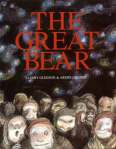
  • The Great Bear, illustrated by Armin Greder, written by Libby Gleeson
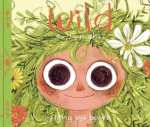
  • Wild, by Emily Hughes
  • Flora and the Flamingo, by Molly Idle
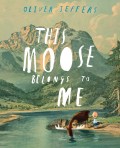
  • This Moose Belongs to Me, by Oliver Jeffers
  • Waiting for the Biblioburro, illustrated by John Parra, written by Monica Brown
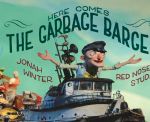
  • Here Comes the Garbage Barge, by Red Nose Studio
  • John, Paul, George and Ben, by Lane Smith
  • And Then it’s Spring, illustrated by Erin Stead, written by Julie Fogliano

michael rosen's sad bookmr tiger goes wildknock knocklocomotivegreat bearwildflora and the flamingothis moose belongs to mewaiting for the biblioburrohere comes the garbage bargejohn paul george and benand then it's spring

USBBY’s 2014 Outstanding International Books List

Here at the Butler Center we’re proud to host the USBBY Outstanding International Books Committee for their year-end deliberations. And, given our recent trip to the Bologna Children’s Book Fair, we’re especially interested in their choices.

Here’s the 2014 list. I see some favorites. How about you? What international books for children and teens are on your radar for next year’s list?

SLJ1402w_FT-USSBY_Image1

Paying it forward

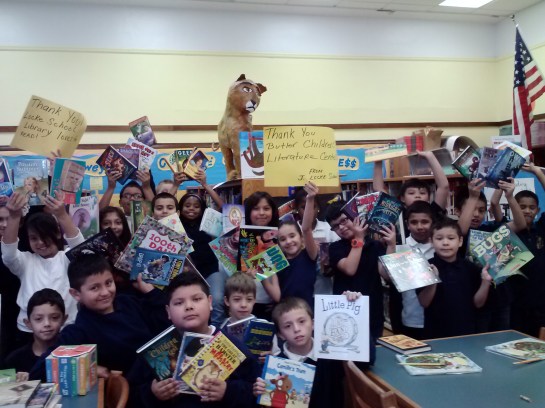
locke kidsThe buzz leading up to the ALA Youth Media Awards announcements Monday morning, full of predictions and premonitions, rightly focuses on the books themselves. The criteria for the big awards are all different, but they share a stalwart dismissal of the definition of popularity as inherently valuable. We look for literary and/or illustrative excellence, knowing that the best way to build a population of curious and voracious readers is to purposefully challenge them with excellent excellence. But it’s too easy to let that focus distract us from the very real work of matching kids and books, which sits at the heart of youth librarianship (at least as far as I’m concerned).

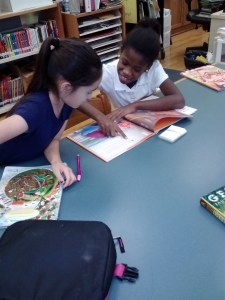
And today I have the great pleasure of having my attention diverted to such happy togetherness of kids and books with these pictures, sent to us from the Josephine Locke School, the most recent recipient of a grant of new books from the Butler Center. The Locke Librarian, Sabrena Wetzel, is a longtime friend of the Butler Center, and we enjoyed working with her to distribute books to the library there.

Each year the Butler Center receives new books from our friends in publishing, and each year we pull the previous year’s books, to make room for the next. We work with local libraries, schools, and other agencies to place those books where they’ll do the most good, and boy, howdy, they appear to be doing some good at Josephine Locke!

If you’d like to be considered for a book grant, drop us a line. We’d love to meet you!

shared reading

kids reading

Mock CaldeNott Results!

This time of year we enjoy handicapping the big children’s and young adult book awards as much as the next literature center. But rather than trying to anticipate the 2014 committees, we decided to go a different way in our own engagement with the process. We used the Caldecott lens to examine some outstanding examples of picture book making from around the world. Yesterday evening a hale and inquisitive group of 22 gathered in the Butler Center to consider extraordinary picture books ineligible for the actual Caldecott Medal due to their international provenance. We pulled out the official Caldecott terms and criteria (leaving behind the bits about the illustrator being American and the book being first published in America) and focused them on a butler’s dozen (that’s 13) of terrific ineligible picture books. It was stimulating and edifying, and, as is always the case with Butler Center book discussions, a real blast. In the end we chose one winner and one honor book. Look at us!

jane the fox and meFor our winner we selected Jane, the Fox & Me by Fanny Britt, illustrated by Isabelle Arsenault (Groundwood Books). A young girl, bullied and friendless, finds strength and comfort in the pages of a favorite novel, buoyed by its familiar message and strengthened enough, eventually, to trust someone and take a chance. We were especially taken with Arsenault’s sophisticated use of color to paint an emotional landscape; the distinct styles she used to differentiate the adolescent world of the protagonist and the imaginary world of Jane Eyre into which she retreats; and the illustrations’ almost childlike essence that really enhanced the raw vulnerability of the first-person voice.

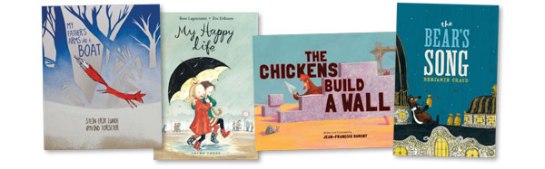
my father's arms are a boatOur honor book is My Father’s Arms Are a Boat by Stein Erik Lunde, illustrated by Øyvind Torseter (Enchanted Lion Books). A boy who recently lost his mother steps into the night with his father to process grief, look for comfort, and reconnect with the world that still holds possibility. Here we appreciated the untethered compositions, expressing the amorphous, rudderless nature of grief; the gradual relief that comes with the return of regular boundaries; and the expression of life’s fragility in the delicate three-dimensional paper-work dioramas.

But this was no easy choice. The debate was spirited, intense, and full of insight. And just look at the other distinguished titles we had on the table!:

The Line by Paula Bossio (Kids Can Press)

The Bear’s Song by Benjamin Chaud (Chronicle Books)

A Little Book of Sloth by Lucy Cooke (Margaret K. McElderry Books)

Herman and Rosie by Gus Gordon (Roaring Brook Press)

Opposites by Xavier Deneux (Chronicle Books)

Here I Am by Patti Kim, illustrated by Sonya Sanchez (Capstone)

The Big Wet Balloon by Liniers (Toon Books)

The Tiny King by Taro Miura (Candlewick Press)

Maps by Aleksandra Mizielinska and Daniel Mizielinski (Big Picture Press)

The Voyage by Veronica Salinas, illustrated by Camilla Engman (Groundwood Books)

Nasreddine by Odile Weulersse, illustrated by Rbecca Dautremer (Eerdmans Books for Young Readers)

It was a lot of fun. You should try it.

Commonalities, Not Competition: Newbery 2014

It gets to be this time of the year in the children’s publishing world and my anxiety starts to bubble to the surface of my being. Blogs are buzzing with reviews of novels, analysis of illustrations, and comparison of genres. Librarians ask each other, “What are your favorites this year?” Patrons ask, “So who do you think is going to win?” And while I love love love the ALSC awards, I want to take a step back and reflect upon what a few of these buzzing books have in common, rather than the spirit of competition that my air bubble is currently filled with. This perfectly fits with The Butler Center’s mission to encourage imagination and wonder through literature.

I generated the following list of books randomly from several sources. This is simply for observation’s sake, so if a book isn’t included, there is no intention or reason behind it (and I have had a chance to READ THESE!) Let’s check out some of the books:

  • Counting by 7s by Holly Goldberg Sloan
  • One Came Home by Amy Timberlake
  • The Thing About Luck by Cynthia Kadohata
  • Flora and Ulysses: The Illuminated Adventures by Kate DiCamillo
  • The Center of Everything by Linda Urban
  •  A Tangle of Knots by Lisa Graff
  • Far Far Away by Tom McNeal

Okay, so let’s the get obvious ones out of the way– most of these authors are women and they are all fiction choices. But this says more about me as a reader than about the Newbery contenders this year.

But let’s look at what’s underneath. When I take a close look, this is what I see:

1) They all ask important questions. Why are we here? How do I discover my own voice? What is the best way to make decisions? Where do I fit in? Can I change my own destiny, or is it just up to luck? Whether it is Georgie who is trying to navigate her own world amidst feelings of loss and coming-of-age discoveries or Flora going on adventures with a magic squirrel, these characters search, seek, and only sometimes find the answer. In other words, they make us think.

2) They are filled with important relationships. I think we know that humans instinctually want to connect with others, but each of these books explores friendship and family relationships with distinguished and dynamic depth. Cady searches for her long-lost parent. Willow loses everything she has and then finds family in a patchwork quilt of interesting human beings. The ghost of Jacob Grimm protects young Jacob Johnson Johnson, forming a kind of intimate bond between male characters. This level of authenticity is, in my opinion, rare in middle grade/YA novels.

3) They leave us with more questions, rather than answers. These books don’t tell us the way to live. There is no black and white, right or wrong. They explore questions along the way, but they leave the answers up to the reader. And isn’t that what great books are all about? Some of the best books I’ve read, I’ve finished the last page and thought, “Hmmm,” or “….huh….?” But then I think. I talk to other readers. I wait for it to sink in. And all of these books have sunk in because they don’t “fix” or “solve” anything. They explore, ignite, and wonder.

What Newbery buzz books are you excited about this year? What do they have in common with each other? How do the books inform each other when you compare them in the aggregate rather than in direct competition with each other?

Mock CaldeNott!

the bear's songOn Thursday, January 16, our regular Butler Center book discussion group, B3, resumes with a bang. This time out we’re conducting a Mock Caldenott Award. Yes, you read that right. CaldeNott. We’ll be using the official Caldecott terms and criteria to evaluate picture books ineligible for the actual award, due to their foreign provenance, and pick a winner.
I am as likely as the next person to get swept up in the drama and intrigue of the ALA Youth Media Awards. I attend the press conference where the winners are announced to the world without fail, and had the great honor of presiding over the festivities in 2010 (the year we announced The Lion and the Mouse as Caldecott winner). And I love all of the handicapping and arm-chair quarterbacking that goes on. But there’s a little part of me (OK, a big part) that feels bad about the incredible books that don’t get their due. We spend so much time searching for the most distinguished American books of the year that books from other countries get lost in the shuffle. And some of those books are fan-freaking-tastic.

mapsSo, we have a short list of a butler’s dozen (that’s 13) extraordinary picture books vying for the Caldenott crown. You can find the titles here. Hey, why don’t you join us?!

As always, we meet on the third Thursday of the month in the Butler Center at 7:00. This time we’re opening up a few hours early. From 5:00-7:00 you’re welcome to drop into the center, enjoy a sandwich and a snack, review the books on the table, and consider the terms and criteria that will guide our discussion. If you can come only be with us for part of the evening, that’s fine. If you haven’t seen any of the books yet, that’s fine. The point is, you should come.

It would be great if you’d RSVP in the form below (but do still please come, even if you don’t get around to it).

the big wet balloonHope to see you there!

← Back

Thank you for your response. ✨

Warning
Warning

Warning.

Fifty Shades of Ambiguity

As we enter the second week of the federal government shutdown and consider the particularly polarized nature of the DC discourse itself, and the coverage of same, it is hard not to conclude that we have arrived, as a country, at some sort of cultural impasse. Our two-party system seems to have devolved into a he-said-she-said standoff full of bull-headed bravado and empty of reason. And as if the certainty of the politicians wasn’t enough, all of us in the peanut gallery, regardless of which side of the divide we’re spectating from, are equally certain about who’s right and who’s guilty. 100%.

Uh oh.

It seems that the very idea of challenging our own assumptions, wondering about our choices, even changing our minds, is an endangered species.

Part of the reason I do the work I do, in fact, a big part of the reason, has to do with raising up a generation (or 12) of critical thinkers. Kids enter the world with an incredible openness and curiosity, and it is through their cultural “education” that they let go of these possibilities in exchange for a sense of certainty. But those of us who endeavor to connect kids with stories understand the role those connections can play in keeping the wonder gates open. Meeting up with other people (and bears and vampires and cupcakes) in books allows kids to experience things they can’t or don’t experience on their own. Yet. And reading books that expose them to different sides of the same story lets them know that, usually, there is more than one side.

There are, happily, many books for young people that acknowledge, and even celebrate ambiguity. Let’s take a look at a few books about some of our founding fathers. The current debate is fraught with invocations of their fundamental perfection. And yet, there are some books out there, books for children no less, that see them as the people they really were, humanity and all.

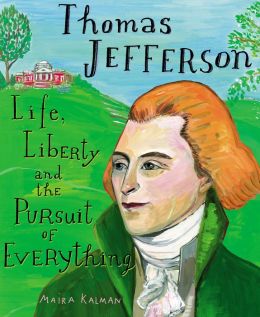
thomas jeffersonIn her upcoming picturebook biography Thomas Jefferson: Life, Liberty and the Pursuit of Everything, Maira Kalman makes the most of her brilliant, quasi-surrealist stlye, painting a portrait of the nation’s third president that expresses the dynamic breadth of his interests and the depth of the passion he brought to them in her wondrous tableaux of electric colors. We learn of diverse pursuits, the art and architecture, science, botany, etc. We learn of the care and generosity with which he ran his house and his infamous Monticello estate. We learn of his public pronouncements about the evils of slavery. And we learn about the slaves he kept himself, including one Sally Hemings, who, it is believed, bore him a number of children. In the mainstream media much has been made of Jefferson’s alleged relationship (so much, in fact, that some would say the allegations are proven) but we do not always see such admissions of guilt in books aimed at young children. But in her direct and unapologetic treatment of the whole man, Kalman ultimately paints a portrait that is more compelling for its inclusion of flaws.

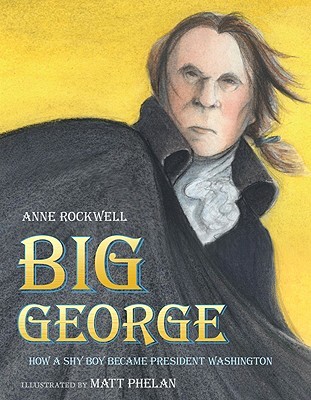
big georgeIn Big George: How a Shy Boy Became President Washington, author Anne Rockwell and illustrator Matt Phelan paint a similarly human portrait of the first of the founding fathers. Right from the start, before we even open the book, we see a different George Washington than the one we’re accustomed to, younger, sadder, and maybe, even, angry. And then we have a subtitle suggesting that he’s shy, a characterization markedly different from the man pictured. The portrait that follows is just as complex and nuanced as the cover promises. Instead of the iconic truth teller of cherry trees and wooden teeth, we meet a man of soft speech and quiet ways. We meet a man reluctant to assume the responsibilities thrust upon him but resigned to his duties. We meet a man. Throughout the book there are tensions between the text and the illustrations, which positively vibrate with the conflicts Washington experienced throughout his life. This is another portrait of an American “hero” that transcends the ordinary hero worship to offer a bigger picture actually worthy of its subject.

The thing to remember is that kids start out smart. They start out ready to think and learn and grow. They wonder. They change their minds. And the best authors and illustrators making books for them see in them the potential to stretch and grow, and challenge them accordingly. There is an inherent and profound respect in asking a lot of a child audience, setting our standards high and believing in their capacity to meet them. In my experience, kids give you what you expect of them. If you expect little, that’s what you get. If you expect everything, look out. I expect them to think and to change their minds.

Of course, I expect this of my politicians, too, and of late I have been sorely disappointed. But if we stick to our commitment to raising up the next generation with open curiosity, I have every faith that we may yet live up to our sizable ideals as a nation of thinkers.

Thomas Jefferson: Life, Liberty and the Pursuit of Everything, by Maira Kalman, Nancy Paulsen Books, 2014.

Big George: How a Shy Boy Became President Washington, by Anne Rockwell, illustrated by Matt Phelan, Houghton Mifflin Harcourt, 2009.

Odd Duck

Odd DuckOdd Duck
by Cecil Castellucci & Sara Varon
First Second, 2013

The phrase feels like a relic from an older generation, like bee’s knees. Indeed, when I occasionally say it, I can feel the echo of my parents’ voices in my lungs. “She’s a bit of an odd duck, isn’t she?” It’s almost – almost – an endearing phrase – not quite as nice as “marches to the beat of a different drummer” but a similar notion. Just enough of a raised-eyebrow judgment to acknowledge a differentness in another.

The title’s slightly nostalgic phrase makes me not at all surprised its artist is the quirky, kooky Sara Varon, whose Bake Sale was a deliciously different cookie of a book as well. In Odd Duck, she brings her signature omnisciently-bemused labeling to the endearing details of Cecil Castellucci’s story and character, including duck-protagonist Theodora’s morning rituals (“Quaking exercises, for perfect pitch and tone”), her occasional unorthodox shopping choices (“Duck food, just like all the other ducks…but also…mango salsa! Huh!”), and her eventual disapproval of the new neighbor Chad (“Feathers ASKEW!” and “Violent dancing!”). Details including rotary phones and Theodora’s lavender cloche-like bonnet (complete with a decorative, metaphorically-foreshadowing bee) insist the story is set in some bygone era. The ducks’ wide-eyed expressions and wiggly, spaghetti-like limbs (again, “Violent dancing!”) call to mind the Steamboat Willie days of early cartooning, or perhaps today’s decidedly-retro hit “Adventure Time” on Cartoon Network.

Early in the story, Theodora wishes on a star “that nothing in her happy life would ever change.” She is clearly as sentimental and vintage as her artist’s style suggests. And of course the new neighbor throws a bit of a wrench (nearly literally, as he is a builder of strange modern sculpture) into her life. She is initially offended by his unrefined mannerisms and disheveled appearance until they find some common ground on the ground: both decide not to fly south for winter. Bonded by this quiet rebellion against the birds-of-a-feather rule – a glimmer of the uncompromising nature of each of their odd-duck-ness to be fully revealed and reveled in by the book’s end – Theodora and Chad become fast not-so-fair-weather friends.

The odd-duck odd-couple’s charm lies in their utter contentment with themselves. Up until a critical plot point in which they overhear a stranger’s comments, it never occurs to either party that he or she holds the title of oddest duck. Their mostly unencumbered sense of self and gentle stubbornness to be anything else is such a delightful match to Castellucci’s story and Varon’s artwork. It’s a reading experience so well done and delightful it’s sure to inspire its readers to embrace the odd in themselves.

Kinship Project

voice from afarThe Butler Center opened in its permanent space two years ago today on September 11th, 2011, the tenth anniversary of that infamous day in world history. To commemorate that occasion we curated an exhibit called the Kinship Project, a collection of books for children and teens that speak to our human kinship. We created a catalog with notes that speak to each of the 29 books connection to the idea of kinship. I link here to the online version. We have some print copies as well (beautiful, actually) and I’d be happy to send some along to you, too. Just fill out the form below with your name and address and I’ll get them in the mail.

← Back

Thank you for your response. ✨

Warning
Warning
Warning

Warning.

How about you? What do you remember of that day? What do your memories have to say to your work with books and young people? Where do you see kinship among the collections we keep?