The Strength in Being Seen: A Review of Deer Run Home by Ann Clare LeZotte 

Deer Run Home 
Written by Ann Clare LeZotte 
Scholastic Inc/Scholastic Press 
Ages 10-14 
Available October 1, 2024  

Effie Pappas is Deaf and linguistically isolated from her family, who don’t speak American Sign Language. Effie and her sister, Deja, are sent to live with their father at the end of the summer. When school starts, Effie’s ASL interpreter, Miss Kathy, begins to suspect that something is wrong with Effie’s home life. After Miss Kathy visits Effie’s home and sees the neglect, she is awarded temporary custody of Effie. Now that she finally has a safe home and a budding friendship with a new girl at school named Cait, Effie starts to open up about her experiences with her family. Miss Kathy eventually petitions for and wins permanent custody of Effie, giving her the security and family she never had. 

Ann Clare LeZotte’s Deer Run Home is a touching story that exposes the reality that d/Deaf children can experience growing up in hearing families without ASL. LeZotte draws on the real-life court case this novel is inspired by to thoughtfully depict the neglect that Effie experiences because her family won’t learn her language, as well as the difficulty Effie has with speaking up about the sexual abuse she endures at the hands of her stepfather. The sexual abuse happens before the novel begins and is thoughtfully described only once, but it serves as one of the obstacles Effie is able to overcome when she finds kindness and support from Miss Kathy and other adults at school. LeZotte takes advantage of the verse format to mirror ASL grammar and storytelling styles at some points. The verse is poignant and moving, and every word is intentional. Readers are drawn to Effie’s character, feeling every bit of her joy, sadness, fear, and loneliness. LeZotte also ties in a plotline of habitat loss for the local deer population, drawing parallels between the displaced deer and Effie’s feelings of loneliness and being lost. At once heartbreaking and empowering, Deer Run Home shows the healing and growth that comes with discovering your voice. 

Butler Bookshelf

Now that school has started, so has the lesson planning! Whether you want to keep the lessons going at home or you’re looking for books to add to your classroom, we have a lot of new nonfiction books to share, including Wild Brunch: Poems About How Creatures Eat by David L. Harrison and illustrated by Giles Laroche. Harrison uses fun poems to explain how different animals across the world eat their food every day. He covers a wide range of animal species, from sea creatures, like narwhals, to land animals, like aardvarks; he also features a variety of flying animals, like turkey vultures, Mexican free-tailed bats, and houseflies. Harrison even includes a poem about mayflies, who only live for one day and don’t eat at all! Harrison includes a back matter that goes into more detail about each animal he writes about and their eating habits, sharing sources for where readers can learn more. Accompanied by Laroche’s detailed collages, Wild Brunch is sure to delight and educate any animal enthusiast!

Check out more of our nonfiction collection below!

50 True Tales From Our Great National Parks
Written by Stephanie Pearson
Illustrated by Madeline Kloepper
Published by Wide Eyed Editions
Available now

Evidence!: How Dr. John Snow Solved the Mystery of Cholera
Written by Deborah Hopkinson
Illustrated by Nik Henderson
Published by Knopf Books for Young Readers
Available now

Radar and the Raft: A True Story About a Scientific Marvel, the Lives it Saved, and the World it Changed
Written by Jeff Lantos
Published by Charlesbridge
Available September 24th, 2024

The Shape of Things: How Mapmakers Picture Our World
Written by Dean Robbins
Illustrated by Matt Tavares
Published by Knopf Books for Young Readers
Available now

Wild Brunch: Poems About How Creatures Eat
Written by David L. Harrison
Illustrated by Giles Laroche
Published by Charlesbridge
Available now

Guest Reviewer Edition: A Review of Kindling

Kindling
Chee, Traci
HarperCollins
February 27, 2024
Grades 9-up

Magical elite soldiers must confront their own traumas and identities while banding together to defend a town besieged by raiders. Inspired by Seven Samurai, Chee weaves together the stories of seven kindlings who are desperate for stability and purpose in a world that no longer needs them. Raised from the age of six to be elite weapons in a war of expansion, these kindlings now wander the countryside, but are soon gathered for a mission by one of their own. Initially, each kindling views the defense of Camas—the mountain village terrorized by raiders—as just a job. But as time passes and the soldiers’ lives and pasts show their impact, the group finds solace in one another and grows close. “That’s what home is. The people you love. The people you fight for.” (p. 417) Despite coming from similar backgrounds, each character has their own unique voice, characteristics, vices, fears and desires. One character is nonbinary; the rest are female. Even if they don’t bear the same scars, every kindling recognizes a bit of themselves in their comrades. Though all seven kindlings have point-of-view chapters, the book is written in second-person, which forces the reader to empathize with their harsh reality. These vignettes of grief, trauma and the effects of war are devastating and intensely realistic; Chee paints an unflinching depiction of violence and its effect on children. Interweaving these moments with lighter ones like romance and village camaraderie keeps the book from being bogged down by heavy topics. Action scenes towards the climax of the story are fast-paced and thrilling, but easy to follow. Despite a macabre tone throughout and bittersweet climax, the story ends on a note of newfound hope and optimism. Kindling puts the desperation of existing without guidance, and the challenge of living one’s life for oneself, on display in a way any reader can empathize with.


Guest reviewer Katie Steffensen, is a Dominican University MLIS candidate and works in youth services at a library in the North Chicago suburbs. She loves working with tweens and teens.

Forgive Me?: A Review of The Dubious Pranks of Shaindy Goodman

The Dubious Pranks of Shaindy Goodman
By Mari Lowe
Levine Querdio
Published November 7, 2023
Age 10-14

Awkward and excluded, 12-year-old Shaindy Goodman just wants to fit in with the girls at Bais Yaakov Middle School. When she’s invited by Gayil, the queen bee next door, to help with a series of pranks, she shrugs off her misgivings in favor of acceptance. Helping out with some harmless jokes, even if it means breaking into school, may be her chance to find friendship. Shaindy quickly realizes the pranks are more mean-spirited than high-spirited, and that only certain classmates are being targeted. Naïve to Gayil’s manipulation, she feels guilty but hopes for the best until the mischief and hard feelings are all pinned on her. As she finally understands Gayil’s acts of revenge for an unintended slight, she lets go of her own anger for lessons of penance, forgiveness, and taking responsibility for her actions.

Lowe uses the period of the Jewish High Holidays of Rosh Hashanah and Yom Kippur, as well as their lessons, as a frame for this middle grade drama of judgement and atonement. She crafts a well-rounded and sympathetic character in Shaindy, expressing a universal need for friendship and belonging, and the way tweens and teens often make poor decisions in search of them. The plot and pace of the title move quickly through the season, mirroring the way bad choices can often lead to snowballing consequences. Moments of lightness, Shaindy’s struggle with roller blades, and final closeness with her sister help temper more serious content and lead to a satisfying conclusion. In the penultimate scene, a classroom of girls offers each other silent acknowledgment of wrongs and forgiveness for them. The wise words of a teacher, “The hardest thing many of you will do in your lives… is admit you were wrong,” (p 155) is a life lesson for those of all ages and religious backgrounds.

Enchanted by Ella Enchanted? Follow it to more great reads.

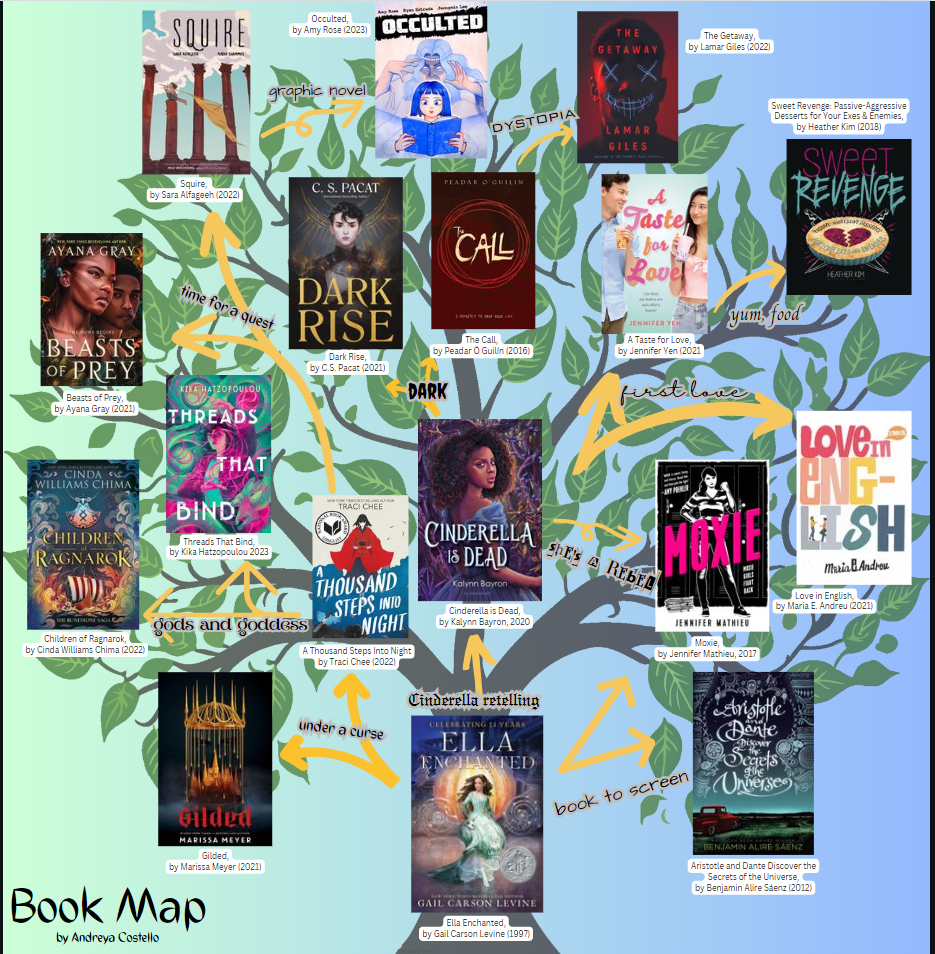
Did you know that Gail Carson Levine’s inspiration for the Newbery Honor book Ella Enchanted was part love for the Cinderella story and part annoyance—“She’s so disgustingly good! And why does she take orders from her horrible stepmother and stepsisters?” (Levine). Well, we might not all be able to create award-winning alternatives to our favorite books, but we sure can find some amazing options for taking our own favorite stories in new directions.

Butler Youth Services Scholar Andreya Costello took inspiration from Julia Smith’s reader’s advisory book map from Booklist Online centering Amari and the Night Brothers by B.B. Alston. Starting the map with Ella Enchanted by Gail Carson Levine, a beloved book from her childhood, Costello attempted to connect it with more recent and diverse works written for a teen audience to take the story in new directions. Readers can follow the paths connecting each book by genre, theme, mood and more.

Link to the full project with path rationales.


About the Scholarship

The Butler Youth Services Scholarship for Underrepresented Groups in the Field of Library and Information Science is awarded each year to a student seeking to earn an MLIS with a focus in children’s services for public or school libraries with the goal of increasing diversity in the profession. Preference will be given to graduates of a Dominican University undergraduate program who are from a background underrepresented in the field of library science. This competitive award considers merit, academic excellence, leadership qualities, and the desire and disposition to work with young people as part of the applicant selection process. The project above was created in association with the scholarship award. More information on the award and application process can be found HERE.


*Gail Carson Levine. “Gail Said: Ella Enchanted.” Gail Carson Levine, https://www.gailcarsonlevine.com/ella.html. September 12, 2023.

Elementary!: A review of The Improbable Tales of Baskerville Hall

The Improbable Tales of Baskerville Hall
Ali Standish
Harper Collins Children’s Books
Age 8-12
Available September 12, 2023

In a middle-grade twist on the Sherlock Holmes stories, a brilliant young Arthur Conan Doyle accepts a full scholarship to a mysterious school for exceptional students. In the hopes of providing a better life for his family, Arthur devotes himself to school, including the friendships, mysteries, and mayhem that one would expect of a 19th century English boarding school—eccentric students and professors, secret societies, magical clocks, and even a baby dinosaur. But when it comes time to submit to the questionable ethics of the secret society, and their promises of wealth and power, or do the right thing at the possible expense of his future, Arthur shows integrity to the end.

Standish borrows liberally from the Holmes novels with characters, like Dr. Watson, Jamie Moriarty, and Sherlock Holmes himself, named for many of the original Doyle’s most famous characters. Arthur himself is drawn as one would imagine a young Sherlock. These details, however, may be lost on young readers. The swiftly plotted and intricately detailed mystery can stand alone though, using its quirky characters and darkly atmospheric setting to draw the reader into its world and to rooting for the cast of diverse and well-crafted characters. Themes of friendship, integrity, and problem-solving run heavily through the novel and help to ground some of the more outlandish plot devices, like time travel and dinosaur hatching. And with a parting “the game is afoot” (p. 310), Standish sets the stage for a series of future adventures that junior sleuths will be sure to love.

Claiming Her Place: A Review of We Still Belong

We Still Belong
Christine Day
HarperCollins Children’s Books
Age 8-12
August 1, 2023

Excitement, anxiety, disappointment, and hope—over the course of one emotional day, Wesley Wilder explores all the feeling middle school has to offer. As the early riser in her close-knit, multi-generational, indigenous household, Wesley battles nerves over the big day she’s planned. She’s written a heartfelt poem for the school newspaper in celebration of Indigenous People’s Day. She’s planning to use the same newspaper issue to ask her kind, funny, gamer-boy, crush to the school dance. And will cap off the day celebrating at the intertribal powwow planned in her Seattle area community.

As the title implies, themes of belonging, community, family, and friendship drive the fast-paced plot of this middle grade novel. Wesley is a thoroughly sympathetic character, full of all the uncertainty, eagerness, and budding confidence of adolescence, while exhibiting a strong connection to her single mother, grandfather, and extended family (a well-crafted network of supportive adult characters). Her thoughtful voice, and desire for community, come through in care for her best friend, Hanan, and her efforts to reach out to those around her in need of a friend. And even when things around Wesley seem to unravel, like her crush already having a date or her aunt’s family’s potential move, she grounds herself in gratefulness, showing a mindfulness uncommon to most middle grade characters. Day (Upper Skagit) handles incidences of discrimination toward indigenous people and causes with a gentle touch, weaving them into the narrative in a way that explains and exemplifies Wesley’s kindness. A day in the life of a soft-hearted girl growing into her voice.

With a Twist: A Review of What a Desi Girl Wants

What a Desi Girl Wants
Sabina Khan
Scholastic
July 18, 2023
Age 12+

Induced by curiosity, guilt, and a very persuasive Dadi, Mehar flies from her boring home in Kansas to her family’s nawabi palace in Agra, India, for her father’s lavish wedding festivities. In a South Asian and LGBTQ twist on What a Girl Wants (Warner Bros., 2003), which is itself an adaptation of the 1955 play The Reluctant Debutante by William Douglas-Home, Mehar attempts to reconnect with a distant father, undermine her social-climbing future step-mother and step-sister, and foster a blossoming relationship with her Dadi’s lovely and shy personal assistant, Sufiya. As she bonds with her father, gets to know Naz and Aleena (the future steps), and grows closer to Sufiya, her original motivations come into question and she discovers both stronger relationships and humility through the journey.

Complex family dynamics drive the plot of this emotionally charged YA dramady. Mehar doesn’t fully understand her parents’ relationship and the reasons they split. She makes assumptions about the way Naz and Aleena are using her father. And she underestimates the family obligations and social restrictions that drive Sufiya’s reluctance to out herself. Khan writes Mehar as confident and clueless in turn, ruled by her desires and goals in a way that conflicts with Indian cultural expectations. She is a flawed, yet likable protagonist that stands out against the less developed secondary characters. The juxtaposition of her t-shirts and jeans against the lavish palace, wedding finery, and luscious foods adds to the sense of her straddling cultures with varying degrees of success. As Mehar settles in and struggles less, she grows in maturity, owning up to her mistakes and mending fences to get what she really wants—connection.

Control Your Own Destiny: A Review of The Queens of New York

The Queens of New York
E.L. Shen
HarperCollins, Quill Tree Books
June 23, 2023
Age 13+

Yours, mine, theirs—unrealistic expectations will get you every time. Jia is an aspiring manga artist with dreams bigger than running her parents’ Chinatown dumpling restaurant. Ariel is a genius, headed for a parent-approved STEM program and early admission to college, but all she really wants is closure after her sister’s death. Everett is bound for Broadway and determined to make it, even if it means fighting through the undisguised racism she sees in her theater program. Over one summer, the girls support each other through hard decisions and horrible situations no matter if they’re sitting together wrapping dumplings or separately traveling the world.

Shen sets teenage dreams and goals against the expectations of Asian American families, community, and culture in steamy, summertime Flushing, Queens. Weaving themes of racism, loss, guilt, and bravery through the narrative, she crafts a story of friends that will be there through it all, near or far. Each of the young women face a test of their ambition—Jia shows her parents she deserves to go to college, Ariel leaves for South Korea to find the answers her parents are keeping from her, Everett must stand up to the mockery and racism she sees in her theater world—and each knows she can lean on the others for strength to do what’s needed. Chapters alternate between the narration and story of each of the main characters, divided by text and email communications that showcase their extraordinary friendship. Thoughtfully written and deeply nuanced characters will have readers cheering for their satisfying wrap ups. An ode to growth and bravery, and the friends that make it all less scary.

Cracking the Code of Middle School: A Review of Talia’s Codebook for Mathletes

Talia’s Codebook for Mathletes
Marissa Moss
Walker Books
June 13, 2023
Ages 8 to 12

Talia loves cracking codes and doing math, but can’t seem to solve the puzzle that is middle school. Joining the mathlete team was supposed to help with her transition, but as the only girl on the team, the boys make her the outcast. When her mathlete best friend, Dash, gets too embarrassed to be best friends with a girl, and wants to hide their friendship, there’s only one thing Talia can do—make her own all-girls mathlete team! With her new friends by her side, Talia becomes determined to bring their team to victory, get her friend back, and figure out the social rules of middle school.

The comic diary form gives a personal touch to the feelings, actions, and reactions Talia has to daily life as a middle school student. The book is broken down into observations, deductions, quizzes, and puzzles, which act as chapters. With this style, readers get a fast-paced book with no breaks in the plot. The illustrations are meant to look like doodles in a diary but are still expressive with the use of postures and facial expressions. The colors are bright with the use of watercolors and gouache with ink to give definitions to characters and objects. The overarching themes of friendship, discovering a sense of self, and finding the courage to do something outside the norm make this book perfect for readers entering middle school. Talia evolves in her social development, starting as self-centered and refusing to see her friend’s perspectives then becoming conscious of her actions and how they affect other people’s feelings. Talia’s friends and family don’t have major character developments during the book, but they do support and encourage her on her journey through middle school. Talia’s Codebook for Mathletes is a STEM-oriented book that teaches young readers, especially girls interested in math or science, to be courageous and forge their own unique path in middle school.