Playing Card Project (PCP) Ace of Clubs

Welcome to the first post in the Playing Card Project, a year-long series for 2015 through which we’ll build a deck of playing cards, one Tuesday at a time. We’ve established four suit-based themes and will investigate each theme in terms of how it is expressed in 13 different books for children and teens. 52 weeks, 52 cards, 52 books. Get it?

Our suit themes are as follows:

♣ Clubs – stories of belonging

♦ Diamonds – stories of strength

♥ Hearts – stories of affection

♠ Spades – stories of growth

And, yes, we will produce a physical deck of cards at year’s end, to be distributed widely, and free of charge, to anyone who is a friend of the Butler Center (so now would be a good time to start following this blog, btw).

I think things will make sense as we go, so let’s get to it!

For our first entry, the Ace of Clubs, I present

cradle meCradle Me

by Debby Slier

Starbright Books, 2012

This book is so full of charms it is hard to know where to begin, so I’ll begin with the babies. Each board page features a different baby ensconced on a cradle board, with a single word describing the baby’s disposition (peeking, crying, yawning, etc.). Individual babies represent different Native American tribes, with a color-coded key in the back (the background color on the baby page matches a decorative frame on the key page) to identify each nation. We know how much babies like looking at other babies (they LOVE it) and a board book built around that fascination is well-conceived. Add to that the exquisite photography, the easily manipulable trim-size, and the especially appropriate dispositional content, and this makes for a winning baby book.

We consider it here, though, not for its infantile excellence but because of its powerful message of belonging. On the surface, we see each individual baby, with specific dress and cradle board construction, as belonging to his or her nation. But in their universally recognizable circumstances and expressions we see that the babies belong to one another, too. And they belong to us, and we to them. Indeed, this is a book that proclaims our universal belonging, in the simple juxtaposition of eleven beautiful babies whose distinct identities serve, mostly, to demonstrate their community, and invite us right in.

One down, 51 to go. See you next Tuesday.

Mock CaldeNott – January 15, 2015

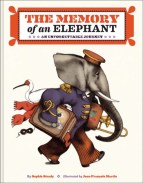
memory of an elephantJoin us for our second annual Mock CaldeNott discussion on Thursday, January 15, 2015! Once again we’ll investigate a collection of extraordinary picture books from the previous year, using the Caldecott terms and criteria as our guide to illustrative excellence. The special component of our experience is that we’re looking at books that are ineligible for the actual Caldecott Medal due to their international provenance. It’s extra-informative and super-fun. You should really come.

Beginning at 5:00pm we’ll have an opportunity to review the picture books in contention (with light refreshments). Indeed, all of the books are currently available for preview in the Butler Center at any time (any time we’re open, anyway).

Our formal deliberations will begin at 7:00pm. Woohoo.

Here are the books we’re looking at:

Two Tough Crocs by David Bedford, illustrated by Tom Jellett, Holiday House, 2014

Fox’s Garden by Princesse Camcam, Enchanted Lion, 2014

Tiny Creatures: The World of Microbes by Nicola Davies, illustrated by Emily Sutton, Candlewick, 2014

Shh! We Have a Plan by Chris Haughton, Candlewick, 2014

Anna’s Heaven by Stian Hole, Eerdmans, 2014

Fall Leaves by Loretta Holland, illustrated by Elly MacKay, HMH, 2014

The Dinner that Cooked Itself by J.C. Hsyu and Kenard Pak, Flying Eye Books, 2014

Mr. Brown’s Fantastic Hat by Ayano Imai, minedition, 2014

Midnight Library by Kazuno Kahara, Roaring Brook Press, 2014

Moví la mano / I Moved My Hand by Jorge Luján, illustrated by Mandana Sadat, Groundwood Books, 2014

Children Growing Up in War by Jenny Matthews, Candlewick, 2014

At the Same Moment Around the World by Clotilde Perrin, Chronicle, 2014

Jim Curious by Matthias Picard, Abrams, 2014

The Mouse Mansion by Karina Schaapman, Dial, 2014

The Memory of an Elephant by Sophie Strady, illustrated by Jean-François Martin, Chronicle, 2014

Rules of Summer by Sean Tan, Scholastic, 2015

Goal! by Sean Taylor, illustrated by Caio Vilela, Henry Holt, 2014

The Big Book of Slumber by Giovanna Zoboli, illustrated by Simona Mulazzani, Eerdmans, 2014

children growing up with warRSVP/Questions in the form below!

← Back

Thank you for your response. ✨

Warning
Warning
Warning

Warning.

Mock Newbery Results

I spent this past weekend immersed in deep, insightful book discussion with fourteen other astute, committed individuals, in search of “the most distinguished contribution to American literature for children” published in 2014. This was the culmination of a semester’s worth of reading, nominating, and more reading. By dedicating the time and energy of an entire course to the endeavor we were able to really dig into the Newbery process, replicating not just the book discussion, but the nominations, introductions, and balloting. In the end we spent 15 hours over two days discussing and voting on a list of 29 titles, arriving at a winner and two honor books. I’ll talk a bit more about our lists in a bit, but let me now get to our results:

The committee chose two honor books:

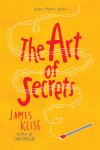
the art of secretsThe Art of Secrets by James Klise, published by Algonquin Young Readers, 2014
When arsonists torch Saba Khan’s apartment, tensions are high. Is this a hate crime, targeting Saba’s Pakistani immigrant family? Was is staged? Who is responsible? The community at her independent school steps up, raising funds to help the family, but when one of the items collected for auction turns out to be the work of Chicago outsider artist Henry Darger, valued at half a million dollars, things get bona fide complicated. Klise exposes the truths, and misdirections, through a series of blindered e-mails, texts, journal entries, phone conversations, and other exchanges between a diverse cast of players, threading the compelling mystery with obfuscation and intrigue. Taut plotting, masterful characterization, and nuanced exposition combine in a satisfying, surprising novel.

bad bye good bye

Bad Bye, Good Bye by Deborah Underwood, illustrated by Jonathan Bean, published by HMH Books for Young Readers, 2014

A little boy travels with his family from their old home to their new one, lamenting their losses, considering their transitions, and hoping for their future. Underwood composes 57 discrete single-syllable words into forty rhyming couplets, with every couplet being an adjective/noun pairing (with the exception of one critical turning point). Within this structured framework she achieves a staggering range of emotion and experience, equally resonant to the lap-based toddler, the emerging reader, or budding poet. Simple words take on layers of meaning that shift and grow in their careful sequence, drawing the reader or listener along the journey’s immediate, indelible arc. While Bean’s energetic, substantial images add atmosphere to the outing, establishing meaningful context and reinforcing the emotional tug, Underwood’s spare, rhythmic, verse has its own unmistakable, dramatic power.

And the committee chose, as winner of our 2015 Mock Newbery:

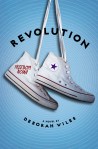
RevolutionRevolution by Deborah Wiles, published by Scholastic Press, 2014.
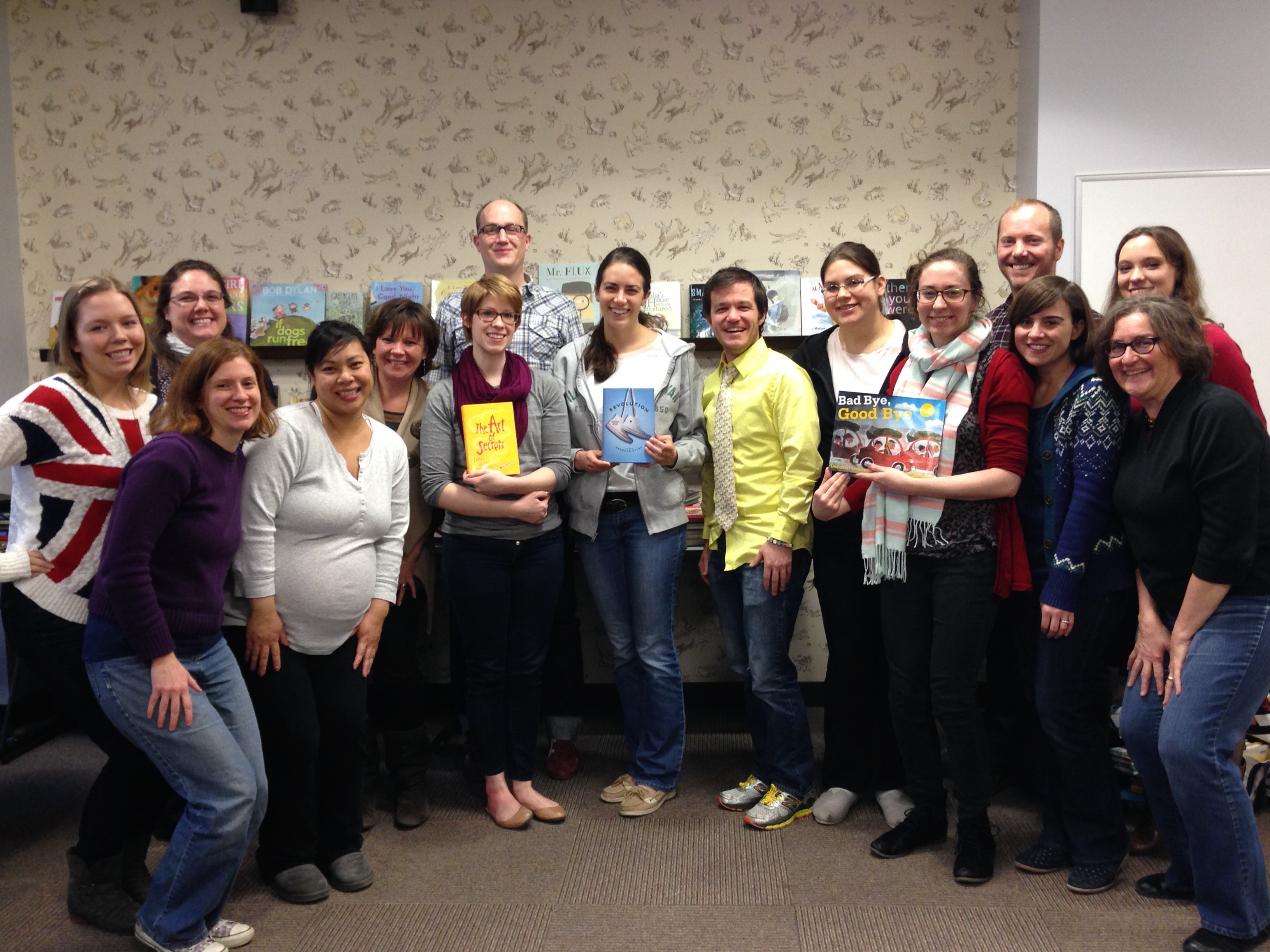
The town of Greenwood, Mississippi becomes the battleground for a nation in turmoil during the freedom summer of 1964. “Agitators” from the north descend to establish and protect black voters’ rights while the local communities erupt at the challenge to the status quo. Wiles tells the story in two first-person narratives, of twelve-year-old Sunny, whose eyes are opening to habituated racism she couldn’t see, and fourteen-year-old Raymond, who experiences that racism first-hand. Wiles embellishes and interrupts those two distinct voices with a jarring battery of primary documents, submerging the reader in a cultural context that includes everything from frothy invocations of pop-culture to noxious expressions of hatred, all of them documented and real. The resulting combination makes for a piercing, illuminating, and especially human exploration of a tumultuous episode in our country’s history.

A note about our lists:

We began our reading with a list of 15 titles selected by me (as instructor for the course) in July, which included both published and anticipated books. Unlike the “real” committee, that short list was curated to represent a wide range of style, tone, format, and reading level, as well as a balance of cultural diversity. In addition to those titles we all read widely from an ever-growing list of suggested titles from which each student nominated one. And in the end we arrived at our final 29. We can never know how well our final list might compare to the books the “real” committee is looking at this year. Indeed, in many ways our purposes are different. But we have great confidence in the depth and precision of the investigation we undertook, and great pride in the results.

mock newbery committee

whole round earth

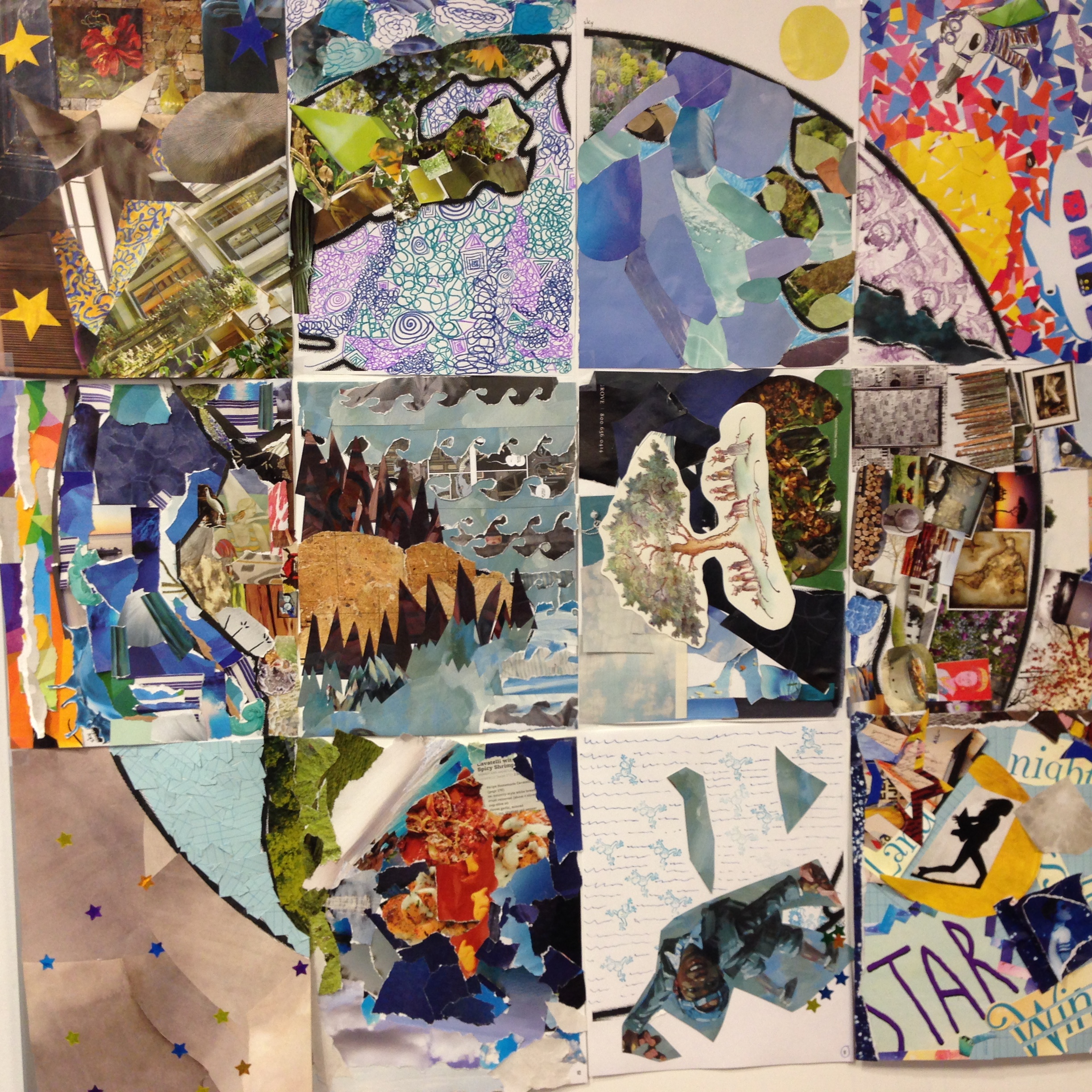
In my children’s literature class I like to introduce different frameworks for our weekly book discussions. Some weeks we consider books through a lens of readers’ advisory service. Sometimes we think about popularity or esoterica. Sometimes we think about separating our personal responses from our professional ones. A week or so ago we engaged in a creative activity as we undertook our discussions. The books on the table were biographies, and the activity was one a recycling craft. It’s an activity I have connected to different books, in different ways. This time around we had a couple of biographies of artists, and we thought about it as an extension of those tests.

Here’s how it works:

I have a big blown-up line drawing of the globe broken down onto 12 pieces of letter-sized paper which tile together, four-across and three-high, to form a complete image. Each page has markings indicating which parts of the image are air, which are land, and which are water. Then we all fill in the blanks, using whatever we like. I put out a bunch of scissors and glue sticks and old magazines, posters, catalogs, and other paper goods (books that have been withdrawn for condition might be great!), markers and pens, rubber stamps and ink pads, old stickers, felt remnants, leftover foam shapes, etc. The whole idea is that we use or reuse stuff that’s already around, instead of buying lots of stuff special.

And when the individual pieces are done, we assemble them, and magic happens.

To begin with, the assemblies are beautiful. Every time. There’s something about the juxtapositions of all of the different approaches that tickles me no end.

There are metaphorical resonances, too, that are really powerful. The finished product is identifiable as our planet, and as we look at it we understand, deeply, that its beauty comes from its diversity and authenticity. It’s almost as if the planet is only whole when each of us does our part. And then there’s the transformation of what might be considered waste into communicative artwork. It’s just really good.

Here’s a picture of the one we made this semester, and I’ve pasted below a link to the pdf template, in case you’d like to try it yourself!

whole round earth

whole round earth template


Thom’s Rules of Order: Ten Tips for Good Book Discussion

butler center mock newbery discussionHere’s a recent piece I did for the Horn Book about open, inquisitive book discussion. In many ways I’m anti-rule; prescription tends to rub me the wrong way. Still, book discussion benefits from a common framework, and even someone as enamored of the mixture of florals and plaids as I am can probably follow these rules. What are your tricks for staying on topic (and off of nerves)?

pictured: Members of the GSLIS Mock Newbery course discussing books in the Butler Center.

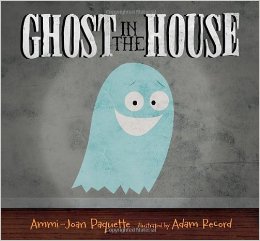
Ghost in the House

ghostGhost in the House

by Ammi-Joan Paquette

illustrated by Adam Record

Candlewick 2013

I love Halloween, and I love things that are creepy…but oddly enough I don’t like to be scared.  Haunted houses?  Forget it!  So it’s no wonder that I’ve fallen in love with Ghost in the House written by Ammi-Joan Paquette and illustrated by Adam Record. This is a haunted house I’d actually like to visit.

The story starts off on a black page with the simple exclamation “Boo!”  On the next page a ghost appears—the most adorable ghost you’ve ever seen (yes, even more than Casper).  This structure continues, enunciating the creepy sounds the house makes and breaking tension with a collection of friendly creatures: a mummy, a monster, a skeleton, and a witch.  Finally the creatures stumble upon something that really frightens them—a human boy.

This book somehow manages to maintain the traditional eeriness we associate with haunted houses, which includes striped wall paper, creaking stairs, and shadows at every turn.  Yet its full of bright and contrasting colors.  The creatures themselves are vibrant, even as they wander down dark and gray hallways.  You might even wonder what this cheery bunch is doing in such a spooky place.

I love how simply and effectively the illustrations reflect the text.  Two eyes on a black background and the ghost’s worried expression reveal the characters’ unease.  Possibly my favorite page features the human boy, with a wide-eyed look that conveys his bafflement.  As the creatures run away, the boy looks straight at the reader and shrugs, as if to say, “What can you do?”

As you’re visiting haunted houses, or perhaps haunting them yourself, “on this dark, spooky night,” it’s always good to remember that there isn’t a creature scarier than a human.  Have a Happy Halloween!

KP

The results are in

As part of the fifth annual Dominican University Caritas Veritas Symposium the Butler Center staged a Book Identity Project through which we solicited from members of the university community a book (or six) from childhood that contributed to their identity. Participants were given an old-school check-out card asking for the book and we lined the front door and window of the center with old-school check-out card pockets to receive them. We had a tremendous response, with 101 books listed on 86 different cards.

identity cardsThe submissions are fascinating, with a surprising variety. To be sure, the collection includes some well-loved, to be expected titles. Where the Wild Things Are gets three mentions, and Dr. Seuss shows up six times, twice for The Cat in the Hat, twice for Green Eggs and Ham, and once each for Oh, the Places You’ll Go! and One Fish, Two Fish, Red Fish, Blue Fish. I’m not surprised to see Louisa May Alcott or A.A. Milne, C.S. Lewis or Lewis Carroll (or Robert Louis Stevenson) in the mix. The single most-cited title is Shel Silverstein’s The Giving Tree, with four mentions, which is something of a surprise, not because it’s a book I don’t care for (indeed, I don’t care for it) but because it seems to have the sort of nostalgic perspective that I never thought spoke strongly to children. Consider me schooled. I was somewhat surprised, too, to find books outside the children’s canon, by the likes of Hemingway and Steinbeck and Dwight D. Eisenhower. We didn’t specify that the book needed to be a book written expressly for children, just that it resonated in the participant’s childhood, so it makes perfect sense that books like these would show up. It’s a great reminder of my own myopia, that I automatically understand young people’s reading through my deep engagement with the body of literature I study. Schooled again!

Quite a few series made the cut, including Nancy Drew, The Boxcar Children, The Chronicles of Narnia, and, of course, Harry Potter (I was 32 when Harry Potter and the Sorcerer’s Stone was published, and it’s just a little sobering to realize how many of our students read it as children). Alexander and the Terrible, Horrible, No Good, Very Bad Day got two mentions (I wonder if those folks saw the movie) as did The Runaway Bunny. Andrew Clements’ Things Not Seen, published in 2004, is the youngest book mentioned, and the oldest is Henry Wadsworth Longfellow’s Song of Hiawatha, first published in 1855.

Here’s the complete list. Check it out. Are you surprised by what you see? And while you’re at it, let us know if you can identify the authors of any of the first few books listed, unfamiliar to us.

stephan and karaHere are Butler Center Student Assistant Kara Pauley and LISSA President Stephan Licitra collecting entires (and passing out candy). It sure is great to have such friendly, diligent assistance.


Oh, and for the record, my choice was Spectacles, by Ellen Raskin. It’s a great book. You should check it out.spectacles

Here is the World: A Year of Jewish Holidays
here is the worldHere is the World: A Year of Jewish Holidays

written by Lesléa Newman

illustrated by Susan Gal

Abrams, 2014

Sometimes I love a book on sight. It’s not fair, I know, or smart, really, to offer up my affection before I have really gotten to know the book a little, but sometimes I can’t help it. I had just such a reaction to this book. And I’m happy to report that deeper study and familiarity prove that my instincts were right. It’s splendid. And this, Rosh Hashanah, the beginning of the Jewish year, seems the perfect day to sing its praises.

My affection began with the images. They are bright and cheerful and immediately arresting, but that basic appeal is just the beginning of their wonder. Susan Gal is a master of composition and shape. Every spread exhibits ordered balance and movement, reinforcing the sense of celebration with steady energy. And her figure work is just exquisite, with impeccable proportion and individual consistency. This seems a small thing, perhaps, but I can think of plenty of illustrators, some of them household names, who don’t approach the skillful grace of this warm, vital portraiture.

The color work enjoys the same sense of energy and balance, with rich, saturated jewel tones humming beside one another, glowing with naturalistic light. Indeed, whether lit by sunlight or stars, every spread elicits a sense of presence, so immediate is the setting.

And Gal employs all of this skill and style to a cumulative visual story that threads the family’s experience through the year. These holidays are not abstract, isolated festivities, but the real and meaningful celebrations of a close family.

For her part, Newman’s rhythmic verse scans beautifully (would that all rhyming text scan this well!), inviting, even imploring to be read aloud. But, just like the pictures, there’s substance behind the style, with family as the central theme.

This wonderful book will find its way to many libraries because of its useful and  accessible treatment of important cultural information, but I sure hope it has a chance to extend beyond its simple utility and has a chance to delight with its profound and handsome charms.

Shanah tovah.

What book from your childhood contributed to your identity?

photoOn September 23rd, Dominican University will be holding its fifth annual Caritas et Veritas Symposium, and the Butler Center will be taking part in the festivities.  We’ve created library date-due cards with space for members of the Dominican Community to answer a single question: what book from your childhood contributed to your identity?  Participants are encouraged to bring their cards to the Butler Center on the second floor of Rebecca Crown Library, room 214, where we will collect your responses.

But for now, a preview: what book contributed to my identity?  To answer this question, I first had to ask myself, how exactly do I identify?  In the most basic terms, I classify myself as a reader, a writer, a geek.  If there was one work really started me down the path to becoming what I am today, it was Kevin J. Anderson’s and Rebecca Moesta’s Young Jedi Knights series.

Prior to reading this series I would not have identified as a reader.  I remember reading being a struggle for me until middle school.  But after reading the Young Jedi Knights series (more commonly known among fans as the YJK books) I suddenly wanted all the Star Wars literature I could get my hands on.  And since LucasFilm continually publishes Star Wars novels, there are always more Star Wars books to read.

The YJK books made me a reader first, but the writer and the geek followed in quick succession.  By the time I reached high school, I was writing and posting Star Wars fan fiction online, which led me to pursue a major in Creative Writing as an undergraduate student.  Eventually, I began writing original stories.  Reading the Star Wars books also steered me toward other science fiction works, such as Ender’s Game1984, and Do Androids Dream of Electric Sheep?  I steadily became indoctrinated in other fandoms, making me the geek I am today.

The YJK also had a specific effect on the way I viewed myself as a young girl.  While it could be argued that although all five main characters were equally important, Jaina Solo (the daughter of Princess Leia and Han Solo) acted as the leader of the group.  She was introduced as an inquisitive, mechanically-minded girl who preferred grease stains to makeup.  She was always the character to stay cool when a situation heated up, and has continues to be my favorite character in the Star Wars universe.  The YJK books also featured Tenel Ka, an athletic, rustic girl from a backwards planet with a no-nonsense attitude.  Like Jaina, she wasn’t worried about her appearance, but rather about developing her abilities.  Four books into the series, however, she lost her left arm in a lightsaber training accident, and as she recovered it was revealed that she has a somewhat secret identity: she was really the princess of a 36-planet cluster.  Both girls were able to become strong characters without losing their their femininity and were displayed in leadership roles more prominently than the three boys who made up the rest main cast.

The YJK was a series filled with great role models, fast pacing, and valuable lessons.  Best of all, it was easy to read.  These were definitely high-interest, low-level books.  Although the characters began at the age of fourteen, the series was really written at a fourth grade reading level, which is just another reason why they were able to pull me in when I was a struggling reader.  Without it, I wouldn’t have become the reader, writer, and geek that I am today.

So what book from your childhood contributed to your identity?  Stop by the Butler Center next Tuesday and let us know, or fill out the form below!

KP

← Back

Thank you for your response. ✨

Warning
Warning
Warning

Warning.