Grandma

grandmaGrandma

by Jessica Shepherd

Child’s Play, 2014

“I’m Oscar and I have the best Grandma in the whole wide world.” So begins this sweet, fragile story about the finite, particular experience of moving an older person into assisted living, and its impact on a young child. Oscar’s direct story offers a linear account of the situation. Grandma is forgetting things and needs more help than the family can provide, so she’s going to live somewhere where there are lots of people to care for her. We will miss her, it will be different, and you can ask questions. Oscar visits Grandma, learns about her new routine, meets her friend Albert, and decides it’s going to be OK.

This kind of purposeful book rarely gets attention beyond its purpose. It may not attract a large audience beyond families sharing the experience it depicts, and probably won’t find its way into regular storytime rotation (though I would be all over it). But there is real art here, and detail that warrants our notice.

Let’s begin with the style of the artwork, fresh and tender and childlike. The images vibrate with the love of family, and reinforce the child’s perspective. Just looking at the book, one feels the sort of security a child might craft for himself. The handwritteny font further establishes this as something experienced directly by a child, not filtered through the wisdom of adulthood.

And within the art are many wonderful details. Right on the cover we see Oscar and Grandma cuddling in a soft, oversized chair upholstered in a particularly cheery floral fabric. We see that fabric, with its bright red, yellow, blue and pink blossoms, over and over, on the opening and closing pages, on the coverlet on Grandma’s bed, as a handkerchief in Grandma’s memory box. And the original chair comes with Grandma and is present in her room after the move. No mention is made of the fabric’s constancy, but the through-line reminds readers that while some things will be different, some things will stay the same. The imagery is not all about particulars, though. Open backgrounds and copious white space leave plenty of room for children to fit themselves into the story, and fully absorb its comforts.

Also worth noting is the candor of the first person address. Oscar, experiencing things genuinely, tells the truth. “Grandma still tells me lots of stories about her life. I know them all by heart, so that I can remind her if she forgets one day” he says, for example. The sweetness here is pure, and does not come from sugar coating. It would be disingenuous to suggest to children that things will be better than they are. Instead, Oscar gives us his own account, focused on the positive, to be sure, but fully acknowledging the reality.

As practitioners we are aware of the need for books like this to help families through situations of stress and change. How wonderful that we have at our disposal books that support and explain, and do so with consummate artfulness.

what i came to tell you

what i came to tell youwhat i came to tell you

by Tommy Hays

Egmont, 2013

Grover and Sudie have recently lost their mother, killed when she was hit by a car, crossing the street. Their father, director of the local Thomas Wolfe House, buries himself in his work. Sudie disintegrates into tears. And Grover retreats to the cane break in the vacant lot beside their home, weaving intricate tapestries of branches and leaves between the wild bamboo shoots growing there. As time passes these tapestries take on meaning for Grover, and for the community, and when a developer threatens to raze them, Grover fears the loss of much more than the pieces of art themselves. Hays is careful and artful as he draws back the curtain, slowly revealing circumstances surrounding the accident and the burdens associated with them. A cast of original, winning characters helps and bumbles and threatens and loves. There is so much sweet spirit here, and it shines just right.

This is a book cut of a standard middle grade cloth. We have seen many books about the death of a parent, wherein a child struggles to make peace and move forward, and this, surely, won’t be the last. But this book is special, if not because of its theme, then because of its approach to it. For in Grover we meet a particular, individual child, the likes of which we don’t see in literature every day. Grover is a sensitive boy.

For decades arms of the children’s literature establishment have fought against female gender expectations, filling shelves with plucky, resolute heroines who defy stereotypes and take no prisoners. By no means do I mean to suggest that we’re done–girls are still bombarded with images and messages that define their lives in unfortunate and dangerous ways–but we can find more and more positive role models on the pages of books, girls who take responsibility for their own lives, ignoring princes and taking on dragons themselves.

But where are the boys who sidestep societal expectations? Have we become so consumed with getting boys to read, chasing their attention with action and adventure and testosterone-fueled explosions, that we are inadvertently doing some stereotyping of our own? I admire what i came to tell you for its warm prose, metaphorical landscape, and astute characterizations. It is, all by itself, a lovely and resonant story. But I am thankful for its contribution to the canon. It offers us a model of a boy who looks to art as a doorway, who processes his pain with nimble fingers and a beating heart, a boy who feels. It shows us that there are lots of different ways to meet the challenges life has in store for us, and that tenderness is not a liability but an asset. It delivers the power of art, in its theme and its execution.

Thanks.

Your Story Matters.

With all of the rich conversation going on right now on the CCBC listserv, I wanted to voice my own vision– both connected to the conversation and entirely separate (… I have come to love blurred lines and paradoxes).

We know that, like Megan Schliesman so beautifully stated, THE ONE answer to problems of representation of race and ethnicity doesn’t exist. If there are plural answers, we are all going to have varying opinions about which are correct, which are valid and valuable.

Here’s one thought, among the many:

Let’s do everything we can to let every human being know that THEIR STORY MATTERS. I think if we shift the conversation a bit– from who is publishing or not publishing certain material, who or who is not represented, and blame (the stem and the leaves of the tree)– to a sense of self-ownership and each of us belonging and being valued (the root of the tree), we might get somewhere.

All people have hard issues, deep sensitivities, and a plethora of identities. Each of us wants to be treated as the multi-dimensional person that we are; I definitely want to be seen as more than my physical appearance, more than my cultural identity, more than my age or religion or gender or sexual orientation or my hobbies. But those things ARE me; I can’t separate them out from my story.

So I should tell my story. You should tell your story. You should convince everyone– your friends, your family, your library patrons, the kids in storytime, the people you meet on the train or at the grocery store– to tell their stories. This doesn’t mean that every story will be published as a book for kids (it’s not easy to publish a kid’s book!). But it DOES mean that more people will BELIEVE that they can do it. They can tell their story orally to their grandchildren, they can journal, they can blog about their experiences, they can share anecdotes with friends and family and strangers and their stories will go into the air and might change something. It could change anything! Maybe your story will convince someone else to write something, maybe your story will give someone confidence to get the education they deserve or ignite them to research the publishing industry and how to develop a manuscript and submit. It may sound spiritual, or “self-esteemy” or “woo woo new age let’s go light some incense,” but so much of the stories we hear now are built on shame (think reality TV, magazines, social media, negative self-talk) that it’s no wonder people think their stories are unimportant!

My point is: If more people believed that their story is important, our literature would be a more accurate representation of our diverse world. Sharing story is HARD. It opens you up to vulnerability, possible rejection (think of how many times authors get rejected before getting published!), and critique.

YOUR STORY MATTERS (tell it).

Paying it forward

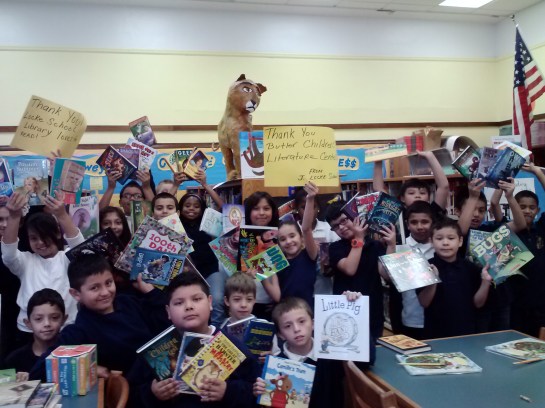
locke kidsThe buzz leading up to the ALA Youth Media Awards announcements Monday morning, full of predictions and premonitions, rightly focuses on the books themselves. The criteria for the big awards are all different, but they share a stalwart dismissal of the definition of popularity as inherently valuable. We look for literary and/or illustrative excellence, knowing that the best way to build a population of curious and voracious readers is to purposefully challenge them with excellent excellence. But it’s too easy to let that focus distract us from the very real work of matching kids and books, which sits at the heart of youth librarianship (at least as far as I’m concerned).

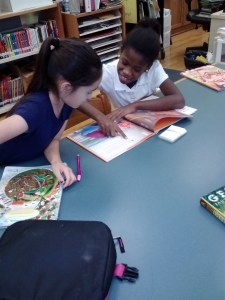
And today I have the great pleasure of having my attention diverted to such happy togetherness of kids and books with these pictures, sent to us from the Josephine Locke School, the most recent recipient of a grant of new books from the Butler Center. The Locke Librarian, Sabrena Wetzel, is a longtime friend of the Butler Center, and we enjoyed working with her to distribute books to the library there.

Each year the Butler Center receives new books from our friends in publishing, and each year we pull the previous year’s books, to make room for the next. We work with local libraries, schools, and other agencies to place those books where they’ll do the most good, and boy, howdy, they appear to be doing some good at Josephine Locke!

If you’d like to be considered for a book grant, drop us a line. We’d love to meet you!

shared reading

kids reading

Mock CaldeNott Results!

This time of year we enjoy handicapping the big children’s and young adult book awards as much as the next literature center. But rather than trying to anticipate the 2014 committees, we decided to go a different way in our own engagement with the process. We used the Caldecott lens to examine some outstanding examples of picture book making from around the world. Yesterday evening a hale and inquisitive group of 22 gathered in the Butler Center to consider extraordinary picture books ineligible for the actual Caldecott Medal due to their international provenance. We pulled out the official Caldecott terms and criteria (leaving behind the bits about the illustrator being American and the book being first published in America) and focused them on a butler’s dozen (that’s 13) of terrific ineligible picture books. It was stimulating and edifying, and, as is always the case with Butler Center book discussions, a real blast. In the end we chose one winner and one honor book. Look at us!

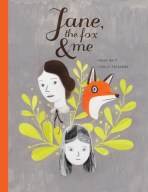
jane the fox and meFor our winner we selected Jane, the Fox & Me by Fanny Britt, illustrated by Isabelle Arsenault (Groundwood Books). A young girl, bullied and friendless, finds strength and comfort in the pages of a favorite novel, buoyed by its familiar message and strengthened enough, eventually, to trust someone and take a chance. We were especially taken with Arsenault’s sophisticated use of color to paint an emotional landscape; the distinct styles she used to differentiate the adolescent world of the protagonist and the imaginary world of Jane Eyre into which she retreats; and the illustrations’ almost childlike essence that really enhanced the raw vulnerability of the first-person voice.

my father's arms are a boatOur honor book is My Father’s Arms Are a Boat by Stein Erik Lunde, illustrated by Øyvind Torseter (Enchanted Lion Books). A boy who recently lost his mother steps into the night with his father to process grief, look for comfort, and reconnect with the world that still holds possibility. Here we appreciated the untethered compositions, expressing the amorphous, rudderless nature of grief; the gradual relief that comes with the return of regular boundaries; and the expression of life’s fragility in the delicate three-dimensional paper-work dioramas.

But this was no easy choice. The debate was spirited, intense, and full of insight. And just look at the other distinguished titles we had on the table!:

The Line by Paula Bossio (Kids Can Press)

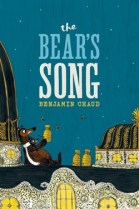
The Bear’s Song by Benjamin Chaud (Chronicle Books)

A Little Book of Sloth by Lucy Cooke (Margaret K. McElderry Books)

Herman and Rosie by Gus Gordon (Roaring Brook Press)

Opposites by Xavier Deneux (Chronicle Books)

Here I Am by Patti Kim, illustrated by Sonya Sanchez (Capstone)

The Big Wet Balloon by Liniers (Toon Books)

The Tiny King by Taro Miura (Candlewick Press)

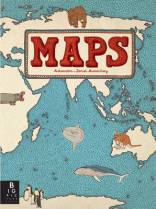
Maps by Aleksandra Mizielinska and Daniel Mizielinski (Big Picture Press)

The Voyage by Veronica Salinas, illustrated by Camilla Engman (Groundwood Books)

Nasreddine by Odile Weulersse, illustrated by Rbecca Dautremer (Eerdmans Books for Young Readers)

It was a lot of fun. You should try it.

Commonalities, Not Competition: Newbery 2014

It gets to be this time of the year in the children’s publishing world and my anxiety starts to bubble to the surface of my being. Blogs are buzzing with reviews of novels, analysis of illustrations, and comparison of genres. Librarians ask each other, “What are your favorites this year?” Patrons ask, “So who do you think is going to win?” And while I love love love the ALSC awards, I want to take a step back and reflect upon what a few of these buzzing books have in common, rather than the spirit of competition that my air bubble is currently filled with. This perfectly fits with The Butler Center’s mission to encourage imagination and wonder through literature.

I generated the following list of books randomly from several sources. This is simply for observation’s sake, so if a book isn’t included, there is no intention or reason behind it (and I have had a chance to READ THESE!) Let’s check out some of the books:

  • Counting by 7s by Holly Goldberg Sloan
  • One Came Home by Amy Timberlake
  • The Thing About Luck by Cynthia Kadohata
  • Flora and Ulysses: The Illuminated Adventures by Kate DiCamillo
  • The Center of Everything by Linda Urban
  •  A Tangle of Knots by Lisa Graff
  • Far Far Away by Tom McNeal

Okay, so let’s the get obvious ones out of the way– most of these authors are women and they are all fiction choices. But this says more about me as a reader than about the Newbery contenders this year.

But let’s look at what’s underneath. When I take a close look, this is what I see:

1) They all ask important questions. Why are we here? How do I discover my own voice? What is the best way to make decisions? Where do I fit in? Can I change my own destiny, or is it just up to luck? Whether it is Georgie who is trying to navigate her own world amidst feelings of loss and coming-of-age discoveries or Flora going on adventures with a magic squirrel, these characters search, seek, and only sometimes find the answer. In other words, they make us think.

2) They are filled with important relationships. I think we know that humans instinctually want to connect with others, but each of these books explores friendship and family relationships with distinguished and dynamic depth. Cady searches for her long-lost parent. Willow loses everything she has and then finds family in a patchwork quilt of interesting human beings. The ghost of Jacob Grimm protects young Jacob Johnson Johnson, forming a kind of intimate bond between male characters. This level of authenticity is, in my opinion, rare in middle grade/YA novels.

3) They leave us with more questions, rather than answers. These books don’t tell us the way to live. There is no black and white, right or wrong. They explore questions along the way, but they leave the answers up to the reader. And isn’t that what great books are all about? Some of the best books I’ve read, I’ve finished the last page and thought, “Hmmm,” or “….huh….?” But then I think. I talk to other readers. I wait for it to sink in. And all of these books have sunk in because they don’t “fix” or “solve” anything. They explore, ignite, and wonder.

What Newbery buzz books are you excited about this year? What do they have in common with each other? How do the books inform each other when you compare them in the aggregate rather than in direct competition with each other?

Mock CaldeNott!

the bear's songOn Thursday, January 16, our regular Butler Center book discussion group, B3, resumes with a bang. This time out we’re conducting a Mock Caldenott Award. Yes, you read that right. CaldeNott. We’ll be using the official Caldecott terms and criteria to evaluate picture books ineligible for the actual award, due to their foreign provenance, and pick a winner.
I am as likely as the next person to get swept up in the drama and intrigue of the ALA Youth Media Awards. I attend the press conference where the winners are announced to the world without fail, and had the great honor of presiding over the festivities in 2010 (the year we announced The Lion and the Mouse as Caldecott winner). And I love all of the handicapping and arm-chair quarterbacking that goes on. But there’s a little part of me (OK, a big part) that feels bad about the incredible books that don’t get their due. We spend so much time searching for the most distinguished American books of the year that books from other countries get lost in the shuffle. And some of those books are fan-freaking-tastic.

mapsSo, we have a short list of a butler’s dozen (that’s 13) extraordinary picture books vying for the Caldenott crown. You can find the titles here. Hey, why don’t you join us?!

As always, we meet on the third Thursday of the month in the Butler Center at 7:00. This time we’re opening up a few hours early. From 5:00-7:00 you’re welcome to drop into the center, enjoy a sandwich and a snack, review the books on the table, and consider the terms and criteria that will guide our discussion. If you can come only be with us for part of the evening, that’s fine. If you haven’t seen any of the books yet, that’s fine. The point is, you should come.

It would be great if you’d RSVP in the form below (but do still please come, even if you don’t get around to it).

the big wet balloonHope to see you there!

← Back

Thank you for your response. ✨

Warning
Warning

Warning.

Girls gone wild

I lived with my sister, now a science education specialist, while she was completing her master’s degree. Her thesis considered students’ perceptions and assumptions of scientists: their work, appearance, and setting. We had a ball examining the teenaged participants’ drawings, through which an overwhelmingly popular archetype emerged: Einsteinian hair, glasses, bow ties, lab coats, Erlenmeyer flasks, boiling liquids, explosive gases. When asked “What does a scientist look like?”, students’ answer is almost unanimously male and inside a laboratory.

The Tapir ScientistI am so pleased to see books for the young adult reader challenging the stereotype. Houghton Mifflin’s excellent Scientists in the Field series solidifies an altogether different image. Take The Tapir Scientist, by children’s nonfiction juggernauts Sy Montgomery and Nic Bishop. While the cover photograph shows the captivating and rarely seen face of a tapir – trunk-like snout, curious eye and nearly smiling mouth – the first title page’s photograph reveals the book’s namesake and star: a woman wearing dirty cargo pants, t-shirt and baseball cap wades through ankle-deep wetlands, holding an instrument in the air and peering towards the horizon. Her name is Patricia Medici, a Brazilian scientist whose work may more closely resemble extreme camping than the conventional image of “doing science.” For days, she and her team (which includes Sy and Nic) make trips around the vast Pantanal Wetlands of Brazil attempting to collar and track the elusive tapirs, whose behavior is largely a mystery. She has to beware pumas, venomous snakes, and the relentless bite of ticks, but the more troublesome battles are that with faulty equipment or inconsistent results. Although the subject of The Tapir Scientist and other books within this series is an animal, the text’s content is all process from the scientist’s point of view. Montgomery and Bishop record Patricia’s frustrations and triumphs as they happen and present their work as a narrative full of suspense, empathy and joy. Yes, the reader learns the traditional creature facts – anatomy, behavior, ecosystem – but all that report fodder is discovered only through the journey the reader makes with the scientist.

PrimatesSimilarly, Jim Ottaviani and Maris Wicks’ graphic novel Primates: The Fearless Science of Jane Goodall, Dian Fossey, and Biruté Galdikas places its readers right in the boots (or bare feet) of the title’s three scientists. Through brilliantly distinct and sometimes overlapping narration, we grow to understand the individuals: Jane’s endless curiosity, Dian’s brusque fierceness, Biruté’s patient hunger. But all are united by their commitment to primate study, more so, to study primates in the wild. Each is recruited by famed anthropologist Louis Leakey, whose targeting of women feels ambiguously both progressive and sexist: he seems to respect these women for their observational intelligence, but Primates also references his womanizing with the young researchers he employs. Nevertheless, for these three women, chimps, gorillas and orangutans are the subject of all attention. The reader, too, is given a front seat to the observations; Wicks devotes pages of panels, with minimal text, just to the sequential movements and expressions of the primates: the chimps’ mysterious rain dance, gorillas’ unique noses “like big fingerprints,” an orangutan’s leisurely journey through the trees. Wicks’ style is not naturalistic; on the contrary, her brightly painted drawings are stylistically playful and simply rendered. Coupled with the type sets used for the texts, which mirror the style of each scientist’s documentation – handwritten script or typed Courier – the reader can imagine these illustrations appearing in these women’s scientific logs, a patient and enthusiastic recording of what they see in the field.

Into That ForestLastly, Louis Nowra’s fictional novel Into That Forest portrays not a willing scientist per se, but a child lost in the woods. Incredibly, young Hannah and her friend Becky survive a storm in the Tasmanian wild, only to be rescued and adopted by two Tasmanian tigers. Initially they are terrified, but as the creatures prove themselves trustworthy guardians – bringing them caught fish, leading them to their den – the girls adapt to their bizarre new family structure. Over four years in the wild, they slowly lose the things that define them as human – their manners, clothes, and eventually, language – but they gain just as much in their careful observations of their new companions. Theiri senses sharpen, words are replaced by growls and eye expressions, and affection for their new foster parents grows:

The tigers stopped being animals to me. They were Corinna and Dave… Corinna showed she liked us by licking us and curling up with us whenever we slept. Though I have to say, if she didn’t like something you did, she’d nip you to let you know.

Nowra’s story, as dense and rich as the Tasmanian forests, not only stands as an imaginative memorial to the thylacine, officially declared extinct in 1936, but as a testament to Piaget’s classic theory of development: that the child is a scientist, learning and constructing her world of knowledge through constant observation and application without any extrinsic motivation, like candy bribes or A+ grades. It is that childlike passion and curiosity that should identify grownup scientists more than the lab coats. Indeed, the women so masterfully presented in these varied stories all possess that drive for understanding the world that seems to exist outside of and above the status quo of our everyday work culture. And perhaps outside is the key: it is hard not to feel awed, inspired and motivated when you’re surrounded by the wonder of the wild.

Annual Butler Booksale – 11/22/13

book-92771_640It’s that time of year again!

Join the Butler Children’s Literature Center for our annual book sale!

On Friday, November 22nd, the Butler Center will be staffed from 9:00am-4:00pm and we want YOU to come join us for cookies, cider, expert recommendations, and BOOKS!

If you’re looking to build your personal book collection, stock up for your school or public library, buy some holiday presents for your loved ones, or just want to check out the best books for kids and teens from 2012, you won’t want to miss this opportunity!

Hardcovers are $7.50 apiece, paperbacks $2.50. Cookies and cider are free! Cash and checks are welcome!

Hope to see you there!

Book Sale
Butler Children’s Literature Center
Rebecca Crown Library, 214
Friday, November 22, 2013
9:00am-4:00pm

God got a dog

godgotadogGod got a dog

by Cynthia Rylant, illlustrated by Marla Frazee

Beach Lane Books, 2013

Cynthia Rylant is a visionary, the sort of author who seems compelled to challenge literary constructs, and herself, ever in pursuit of some deeper truth that she needs to express. At least she has always seemed like a visionary to me, judging by her extraordinarily varied, generally innovative and uniformly personal body of work. Whether it is the Newbery-winning Missing May, with its put-your-head-on-the-desk heartbreak, the bold sweetness of her self-illustrated picture books like Cat Heaven and Dog Heaven, or the inspired, uncommon poetry of Boris or Something Permanent, her work transcends the expected in order to achieve the basic. In 2003 she published God Went to Beauty School, a collection of page-long poetic essays, each about God undertaking some commonplace activity, from opening His own nail salon to cooking spaghetti. These episodes, in their essential combination of the mundane and the sublime, express a rainbow of grace. In this year’s God got a dog a number of these poems is recollected and illustrated by Caldecott-honor illustrator Marla Frazee, who brings her own generous accessibility to the project. Frazee adds to the flavor of the book. Hand-lettering contributes a sense of innocence. Light permeates each tableau. But most striking is her casting of God in each episode. Rylant’s work already used both female and male pronouns to refer to God, but Frazee takes the plurality a step further, diversifying the personifications of God as much as possible: old and young, big and small, country and city, race after race. None of these updates represents a huge departure from the tone and intention of the original work. This new books, like its predecessor, is a soft, welcoming meditation on the sanctity of our daily lives and the reflection of the divine in simple things (even if those reflections are upside-down). But there is whimsy in this new package, a luminous, bubbly sort of warmth that unifies the different experiences and personifications, softening the edges and opening the doors. Rylant’s God is us, and Frazee’s us is God, and there you have it.