As we enter the second week of the federal government shutdown and consider the particularly polarized nature of the DC discourse itself, and the coverage of same, it is hard not to conclude that we have arrived, as a country, at some sort of cultural impasse. Our two-party system seems to have devolved into a he-said-she-said standoff full of bull-headed bravado and empty of reason. And as if the certainty of the politicians wasn’t enough, all of us in the peanut gallery, regardless of which side of the divide we’re spectating from, are equally certain about who’s right and who’s guilty. 100%.
Uh oh.
It seems that the very idea of challenging our own assumptions, wondering about our choices, even changing our minds, is an endangered species.
Part of the reason I do the work I do, in fact, a big part of the reason, has to do with raising up a generation (or 12) of critical thinkers. Kids enter the world with an incredible openness and curiosity, and it is through their cultural “education” that they let go of these possibilities in exchange for a sense of certainty. But those of us who endeavor to connect kids with stories understand the role those connections can play in keeping the wonder gates open. Meeting up with other people (and bears and vampires and cupcakes) in books allows kids to experience things they can’t or don’t experience on their own. Yet. And reading books that expose them to different sides of the same story lets them know that, usually, there is more than one side.
There are, happily, many books for young people that acknowledge, and even celebrate ambiguity. Let’s take a look at a few books about some of our founding fathers. The current debate is fraught with invocations of their fundamental perfection. And yet, there are some books out there, books for children no less, that see them as the people they really were, humanity and all.
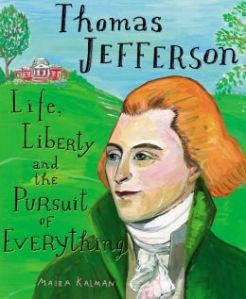 In her upcoming picturebook biography Thomas Jefferson: Life, Liberty and the Pursuit of Everything, Maira Kalman makes the most of her brilliant, quasi-surrealist stlye, painting a portrait of the nation’s third president that expresses the dynamic breadth of his interests and the depth of the passion he brought to them in her wondrous tableaux of electric colors. We learn of diverse pursuits, the art and architecture, science, botany, etc. We learn of the care and generosity with which he ran his house and his infamous Monticello estate. We learn of his public pronouncements about the evils of slavery. And we learn about the slaves he kept himself, including one Sally Hemings, who, it is believed, bore him a number of children. In the mainstream media much has been made of Jefferson’s alleged relationship (so much, in fact, that some would say the allegations are proven) but we do not always see such admissions of guilt in books aimed at young children. But in her direct and unapologetic treatment of the whole man, Kalman ultimately paints a portrait that is more compelling for its inclusion of flaws.
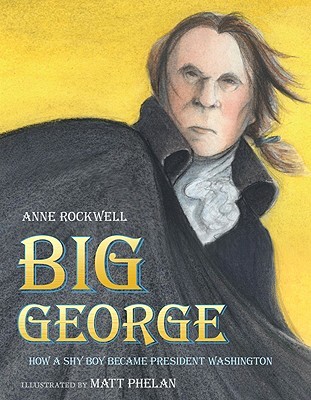
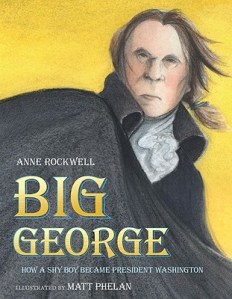 In Big George: How a Shy Boy Became President Washington, author Anne Rockwell and illustrator Matt Phelan paint a similarly human portrait of the first of the founding fathers. Right from the start, before we even open the book, we see a different George Washington than the one we’re accustomed to, younger, sadder, and maybe, even, angry. And then we have a subtitle suggesting that he’s shy, a characterization markedly different from the man pictured. The portrait that follows is just as complex and nuanced as the cover promises. Instead of the iconic truth teller of cherry trees and wooden teeth, we meet a man of soft speech and quiet ways. We meet a man reluctant to assume the responsibilities thrust upon him but resigned to his duties. We meet a man. Throughout the book there are tensions between the text and the illustrations, which positively vibrate with the conflicts Washington experienced throughout his life. This is another portrait of an American “hero” that transcends the ordinary hero worship to offer a bigger picture actually worthy of its subject.
The thing to remember is that kids start out smart. They start out ready to think and learn and grow. They wonder. They change their minds. And the best authors and illustrators making books for them see in them the potential to stretch and grow, and challenge them accordingly. There is an inherent and profound respect in asking a lot of a child audience, setting our standards high and believing in their capacity to meet them. In my experience, kids give you what you expect of them. If you expect little, that’s what you get. If you expect everything, look out. I expect them to think and to change their minds.
Of course, I expect this of my politicians, too, and of late I have been sorely disappointed. But if we stick to our commitment to raising up the next generation with open curiosity, I have every faith that we may yet live up to our sizable ideals as a nation of thinkers.
Thomas Jefferson: Life, Liberty and the Pursuit of Everything, by Maira Kalman, Nancy Paulsen Books, 2014.
Big George: How a Shy Boy Became President Washington, by Anne Rockwell, illustrated by Matt Phelan, Houghton Mifflin Harcourt, 2009.
 It’s that time of year again!
 God got a dog
 Respected children’s book authority Peggy Sharp has been touring the country and delighting audiences with her trademark rapid-fire, how-many-titles-can-you-talk-about-in-a-day booktalk sessions for years. This year marks the final tour (Peggy will retire at the end of 2013) and the last chance you’ll have to see and hear her work her magic. She will be at Dominican on November 1st, 2013, with her program “What’s New in Children’s Literature: A Look at the Latest Children’s Books and How to Use Them in Your Program,” jam-packed with ready-to-use-tomorrow ideas.





 Butler's Pantry