Dynamic Bibliography: Eight Keys and Relish

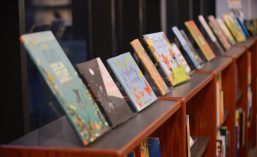
Every month at the Butler Center, we have an open discussion group in which we consider three books with something in common, called Butler Book Banter. The purpose of this meeting—to discuss books in the context of others—resonates with part of Thom Barthelmess’s mission for the Butler Center: what he calls Dynamic Bibliography.

I personally think Dynamic Bibliography should be added to the Oxford English Dictionary. The concept rests in the idea that while it is important to look at an individual book, the real truth, discovery, beauty, essence, and energy of a work resides in intertextuality. How do books talk to each other? What are common themes, or how do themes resist each other or argue? What is between the lines, between the pages, between the covers of a list of books? How does a book change when you discuss it in context with different books? When we put two, or three, or four books next to each other, they certainly say something different than one that stands alone.

What’s fabulous is that what the books say is all up to the reader.

Today, I am going to attempt this concept of discussion through Dynamic Bibliography with two books, both published within the last two years. They are:

Eight Keys by Suzanne LaFleur. Published by Wendy Lamb Books, 2011.

Relish: My Life in the Kitchen by Lucy Knisley. Published by First Second, 2013.

ImageEight Keys tells the story of middle grader Elise, who is struggling between her childhood self and her impending adolescence. With a best friend who she believes to be childish, a locker partner who smashes her lunch, and two parents who died before she was three, Elise doesn’t have it easy. Then, Elise discovers a key that has her name on it in her uncle’s barn, and she enters a mystery that might finally help her come to terms with her past, her situation, and herself.

Relish: My Life in the Kitchen is a graphic novel that is not just about food, but about finding deliciousness in every aspect of life. In this memoir, Lucy tells her life story through interaction of text and illustration, and she tells it in the context of sautéed garlic mushrooms, sushi, gourmet cheese, and much more. She tells of her life as a child of divorce, her travels abroad, her time in college, and her work life, her artistic core, and her relationships. It is refreshing to read a novel about a young woman who loves food, who enjoys it, and who has a healthy relationship with it.


Now, at first glance, these books don’t really have much to do with each other. One is a middle grade piece of fiction, one a graphic novel memoir. One’s focus is on mystery and school life, one is on food. One is written in linear prose, the other through childhood flashbacks and illustration.


But, let’s take a deeper look…what do both of these books say? What do they say to each other?


1.)    Family. Both of these girls’ lives are connected with their families, and both in unconventional ways. Elise is raised by her aunt and uncle, and Lucy spends time going back and forth between her mom’s house in the country and her dad’s city apartment. Yet, both girls cherish their families, get upset with their families, and forgive their families. And they both need their families.


“I walked over to her, climbed into her lap. I’m much too big for that; hadn’t done it in years and years, couldn’t even remember doing it, really. But I sat sideways with my legs on the couch. I put my arms around her neck and rested by head on her shoulder. She slipped her arms around me and held on.”
Eight Keys


“After almost eight years of living in Chicago, I realized: I’m homesick…And I missed my mom’s cooking.”


-Relish


2.)    Friends. Elise’s friendship stories play a more significant role in the plot than Lucy’s, but several of Lucy’s vignettes include friendship as a central piece of her own development. Elise’s best friend Franklin is so kind and giving that when Elise ditches his babyish ways, my goes out to him. The antithesis of friendship—bullying—is also present in Eight Keys. Maybe it’s just the bullied kid in me (I have such white skin; kids called me “Albino” and “Alien” because you could see veins in my arms), but I was surprised that bullying wasn’t part of Lucy’s story. What does the absence of bullying say about Lucy’s story? That it didn’t happen, or that it wasn’t significant?


“Once we got on the bus, it was totally like usual—just me and Franklin on our own, in our own seat, having our own conversation. That was how the whole school day always used to go. We didn’t really need to get to know the other kids because we had each other.”


-Eight Keys


“We ate [sweet corn on a stick] while sitting on the dusty curb, with cold grapefruit soda, making a mess of our clothes and faces.”


-Relish


3.)    Leaving Childhood behind. Adolescence was a hard, sad time for me, which is probably why coming-of-age novels are always my favorite. I see myself in them. Both of these girls struggle with questions—why is middle school so much harder than elementary? Why am I getting bad grades? Why is my dad so dang hard to get along with? Why doesn’t my family understand me? Lucy tells her story as an adult reflecting back on childhood, so her maturity bleeds through, while Elise is right in the middle of her struggle and doesn’t apologize for it. While each of these girls grow in different ways, they both find their way through the muck and become strong along the way.


“No one likes me because I’m friends with that dweebus Franklin. He makes me look like a baby.”


-Eight Keys


“We fought. The truth is, my dad and I are sometimes too similar—too finicky and stubborn and easily wounded—to get along all the time.”


-Relish


4.)    Self-Discovery: This is the big one. Through overcoming obstacles, reconciling the past, and facing the future with an open heart, both of these girls discover who they are. Lucy uses food as a way to illustrate her self-discovery, and this makes sense because food is all about the senses—feeling, seeing, smelling, sensing, wanting, touching, tasting. Isn’t that what adolescence is about? Dipping our fingers into adulthood, trying certain dishes and finding out that some are delicious and some are disgusting? Elise discovers herself through a gift from her father, and sees that instead of waiting to live her life until after she grows up, realizes that she’s already living it, and has been her whole life.  


“It could be whatever I needed it to be, whatever I wanted it to be. And the truth, I suddenly understood, was that so could I.”


-Eight Keys


“Like me, still a young woman, learning about what moves me, what I want. What I love. And doing these things with excitement, curiosity, and relish.”


-Relish


These girls are both lovable, both smart, and both grow into themselves in their respective books. I think if they were to magically appear in front of me, they would be friends. They would argue because they are both strong-headed, and they would both be protective of their own hearts.


But I can also see them planting a garden, Elise telling Lucy the way they do it on her farm, and Lucy returning with memories from her mother’s garden in the country.

And they’d share a tomato.
B3 suspended for April 18, 2013

rain spoiled my bookDue to the extraordinarily excessive and perpetual rainfall, Dominican has closed campus today and suspended all events. So, our last Butler Book Banter of the season will have to wait for another day. Check back soon for dates and titles for our fall B3 series. And don’t be a stranger!

Love, Thom

Maggot Moon

maggot moon

Maggot Moon

by Sally Gardner

Candlewick/Brilliance Audio, 2013

There is so much I want to say about this book. So much. But each and every element or facet or consequence I might mention would rob you of the opportunity to experience it yourself, thereby diminishing your encounter. Even saying that much feels like something of a spoiler.

So I’ll make just these few short comments:

1) Every now and again you read something that feels actually new. This is one of those stories.

2) For a good while you will feel disoriented. Stick it out. It’s worth it.

3) There are some powerful, interactive spot illustrations in the print book that contribute to the mood. The audiobook is sharp and reserved and extraordinary. Take your pick.

4) Please read this book as soon as you can, then find me so we can talk about it.

Such Soft, Snuggly, Sleepy, Sloths

Lucy Cooke celebrates the otherwise underappreciated sloth in her book a little book of SLOTH. Few children’s books begin with an author’s note confessing “I love sloths. I always have.” Of course, to my knowledge, there are just not many books entirely dedicated to the beloved sloth and shame on publishing for that. Books about soft, fuzzy kittens and playful puppies enjoy rampant popularity. To be sure, if mice were paid for their abundance of stories they would have started their own colony on the moon (after all it is made of cheese, right?) far from those mean kittens. Who knows why authors love them so. No offense against rodents but even I jump when one scampers across the living room floor. The world’s largest rodent, the capybara, happens to be my favorite but how many books were published about the capybara last year (seriously, if there were any, let me know)?

slothMy apologies…this is neither about my empathy for the under-sloth as it were nor my anxiety from excessive dog/cat/mouse lit.

Slothville shelters well over a hundred sloths that have been hurt or found parentless in the wild. Founded by Judy Arroyo in Costa Rica, the sanctuary cares for the curious, grinning creatures which are lanky in appearance and leisurely in motion. In reference to a sloth named Mateo who is particularly protective of his stuffed cow Moo, Cooke jests, “If any of the other baby sloths tries to sneak a Moo hug, a fight breaks out – a very, very slow fight, in which the winner is the last sloth to stay awake.” Each page of the colorful photo album contains a single image or multiple images of the animals in cute poses a la Anne Geddes, hanging from tree limbs, or snuggling with stuffed toys, blankets, and fellow sloths. Alongside images the author relays interesting tidbits with clever quips on the animal’s behavior. The sloth’s unique behavior and bizarre characteristics will fascinate parents and children alike while the round eyed, stumpy nosed babies in their hand-crafted onesies are absolutely adorable. Besides, with a little imagination they sort of look like mice, too. Envision a rainy evening, scoop up your little one, and snuggle up to a little book of SLOTH.

A Little Book of Sloth

by Lucy Cooke

Margaret K. McElderry Books, 2013

Summer and Bird

ImageSummer and Bird

by Catherine Catmull

Dutton, 2012

This book is a book to write about.

I first picked it up on Thom Barthelmess’s (curator of The Butler) recommendation, but was also instantly attracted to the beauty of the cover. A cream background contrasted with eerie, sharp bare tree branches echoes the themes of light and dark in the text. A giant swan opens its wings at the top of the cover, inviting you to look at the beautifully embossed, maroon, shiny cursive-like font of the title. The stark white of the back cover seems stripped of feeling, except for the back of two girls walking away, close in physical space but looking in different directions. Ingenious design here.

The text itself is lyrical, insightful, and entirely imaginative. Like Shannon Hale, Catmull pulls you slowly into her world, and in order to follow, you have to surrender your skepticism and let yourself be taken over by the lush phrases and astonishing world building. As with Neil Gaiman or Kathi Appelt, you must relinquish control let the author lead you through a story that will surely be magical, and maybe will even change you.

The plot centers on two very different sisters, Summer and Bird, who wake up one day to find their parents missing in their forest home. Softspoken, warm Summer and the young, spunky, but selfish Bird are overwhelmed with confusion, rejection, and mystery, but decide to follow a cryptic note from their mother and are drawn to the woods in search of their parents. Much like Narnia or The Looking Glass, the sisters enter into the fantasy world of Down, where they take separate, parallel journeys as they try to find their parents. Through their own experiences—Bird falling under the power of The Puppeteer, a manipulative bird who has stolen her mother’s crown, and Summer finding herself stuck in a nest high in the sky with nothing but a small egg—they find that maybe what they were searching for wasn’t necessarily their parents, but themselves. Touching on complex themes of jealousy, desire for power, betrayal, guilt, anger, the dynamic nature of family relationships, courage, inner strength, hope, and freedom, this book is mesmerizing and thought provoking. I admit that as I was reading it, I went through cycles of emotion—anger, fear, irritation, hope, joy, catharsis, and a type of tender sorrow that reaches down deep where I can feel my chest sting a bit with wonder.

Catmull writes in a third-person omniscient perspective, one that is difficult to write in and hard to keep your reader involved in, because the narrator knows every character, and can write from each of their viewpoints. Catmull, however, uses the perspective to add layer and layer upon the story, sometimes jumping in time, sometimes giving the reader secret information that Summer and Bird do not know. Abundant with the mythology of birds and elements of fairy tale, Catmull entwines sections of her story like a skilled weaver, leaving her reader with a one-of-a-kind, extraordinary piece of art.

An eloquent, magical, unsettling, brave debut novel, this is one you want to read.

“All their lives, Bird had been the difficult one, the unmanageable child, and Summer the good girl who could always be relied on. But Summer could see that Bird had always found her own story and chosen to follow it, and Summer envied that. Most of all, she envied the magnetic bird-soul that had told Bird what to do.”

~from the text

Hygiene Hypothesis

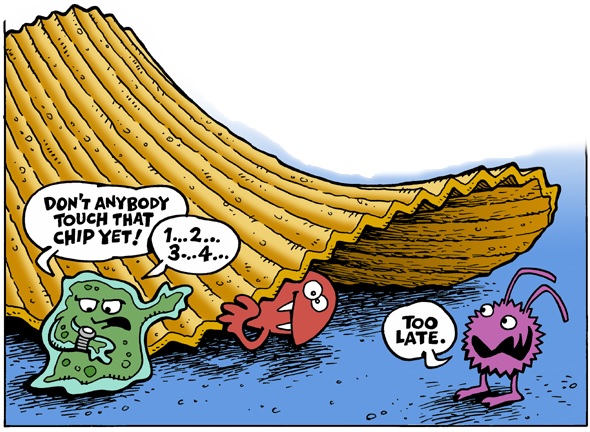
five second ruleLast week my colleague Katie posted about Brave Irene, wondering particularly about situations in the book (neglect, stranger danger) that seemed innocent enough at the time of publication but feel somehow more difficult in a contemporary cultural context. The conversation got me thinking about an article I read recently in the Washington Post about the hygiene hypothesis. Researchers suspect a link between our growing obsession with cleanliness (which we understand as the absence of germs) and a rise in diagnosis for all sorts of immunological problems including everything from allergies to multiple sclerosis. As I understand it, the idea is this: by protecting children from garden variety germs, we remove the opportunity for their bodies to distinguish between everyday irritants and dangerous pathogens. When they are exposed to things (as they inevitably will be) their bodies treat all sorts of microbes as major threats, resulting in an overzealous auto-immune response. It’s an interesting premise, and one that makes common sense to me.

And I wonder if the same could be said for ideas. Are there costs to “protecting” children from exposure to intellectual things they will encounter in their lives? What might those costs be? I have long believed that, collectively, we err on the side of over-protection. If an effort to spare children uncomfortable emotions we fill their environments with primary colors and ebullient music and sunshine and cuddles. And we purge those environments of any references to despairing or struggle. We mean well, of course we do. We don’t want the kids in our lives to be unhappy. But kids despair and they struggle. And should not books be places for kids to make sense of those emotions? Of course they should.

I am not suggesting that we tie kids up and subject them to a literary diet of terror and dismay, any more than I would advocate feeding them decidedly rotten meat. Yuck. But I am suggesting that there is a place in the preschool world for books that acknowledge hurt and sorrow, books that recognize that such emotions exist and tell kids that it’s OK to feel them. Maybe, by inoculating children against the darker shadows the human condition, we prepare them for meeting them head on. And by showing kids that books and stories make really effective tools for managing our emotions, we give them a powerful gift indeed.

image crop from Greg Williams’ WikiWorld.

Mike Mulligan and his Steam Shovel

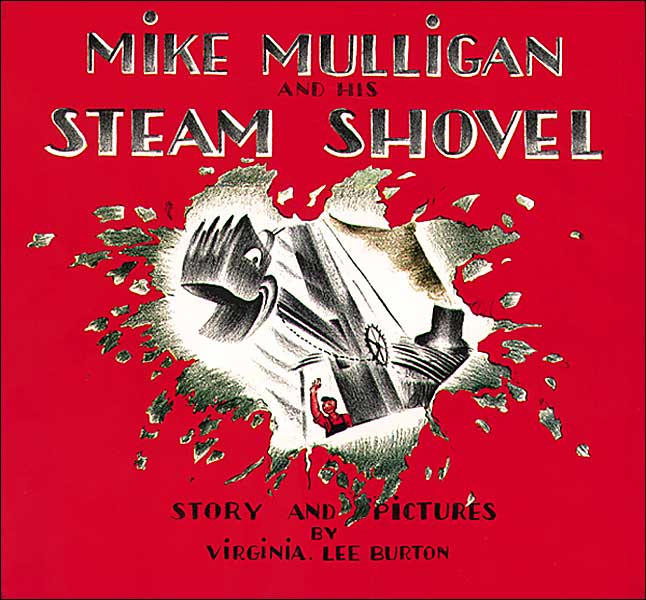
Mike-Mulligan-and-his-Steam-Shovel-Book-CoverRecently, I had a chance to look at Virginia Lee Burton’s classic for the first time since I was a child. My memories of the story, though fond, consisted of fast paced machinery digging stuff. As a 39 year old child, I’ve come to realize much more.Burton begins her story with a proud Mike Mulligan showing off Mary Ann (his steam shovel both named and personified with ever-grinning face – I love it!) on a hilltop, rays of light surrounding her; tah dah! The story follows their rise to stardom as key members in the architectural development of our country and the subsequent takeover of more efficient machines. While other steam shovels find their way to the junkyards, Mike can’t bear to leave Mary Ann to such a dismal end and looks for work outside of the busy city.

Throughout the story, Mike remains confident in Mary Ann and proves her worth with a final dig of Popperville’s town hall cellar. Whereas the new and improved technology is taking over in the cities, the steam shovels are still efficient, viable, and even exciting for folks in rural areas. Mary Ann proves to be the newest and fastest digging machine the townspeople have ever seen. In a sense, the story on its face seems to suggest that newer and faster is better. Mary Ann and Mike are nudged aside by better technology and in turn replace “a hundred men” digging the new town hall cellar. However, Burton proposes a clever quandary when Mary Ann literally digs herself too deep with no way out. An insightful little boy’s suggests building the town hall around the machine and the citizens, as well as Mike and Mary Ann of course, agree. Mary Ann retires with pride as the town hall’s heating system and Mike finds a less strenuous position as the building’s janitor; happily ever after. In the end, the town hall doubles as a museum to the old steam shovel and serves as a nostalgic salute to Mike and his contemporaries.

Today, technological advancement (especially as it relates to speed) is nearly constant. It’s hard to deny the improvements in efficiency and perhaps quality of life for those able to take advantage of new technology. Just as challenging is remembering how we got here and realizing that older and slower still have an important role to play in the world. Mike Mulligan and his Steam Shovel almost seems an answer to a child’s question, “What happens to the older (fill in the blank) when the new ones come along?” Though perhaps somewhat idealistic, Burton’s nod to the past and progress is a wonderful book for children brimming with morality and opportunity for meaningful discussion.

Makankosappo Kamehameha

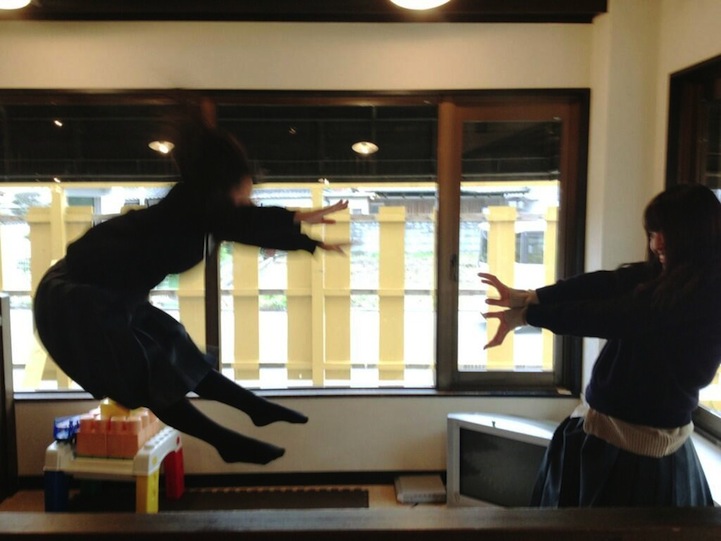
dragonballz6My friend Heath alerted me to this trend of Japanese young people sharing photographic interpretations of manga/anime energy cannons. I love so much about it: the appropriation of the theme and its translation to a new medium, the ironic juxtaposition of prim, restrained school uniforms and dynamic, energetic composition, and the contagious fun. Just look. For all of their serious machinations, they can’t help but grin. It’s no surprise that it’s catching on quick. It’s like planking only interesting.

My favorite thing, though, is its expressive process of story. All of this began with books, books that made a mark on the cultural consciousness that these kids feel the need to explore and share. In 2013, in a world suffused with gadgetry, this is how stories perpetuate themselves. We get so distracted by sensational arguments about the end of publishing and fling ourselves on the funeral pyre of the printed book, and miss the truth staring us in the face. Stories are there. Right in front of us, telling us something about ourselves, just like they always have. We just have to remember to look.

Brave Irene

brave-ireneBrave Irene

by William Steig

Farrar, Straus and Giroux, 1986

A childhood favorite of mine, this book is about one girl’s determination to help her mother in the face of trouble. When Irene’s mother, a seamstress, falls sick, there is no one to take a beautiful gown to the duchess on the day of her big ball. Irene takes on the job, and bounds through whirling snow and bitter wind that taunts Irene, telling her to GO HO—WO—WOME!” After the package flies out of Irene’s arms and the dress blows away, Irene becomes buried in snow and almost gives up. But remembering her mother’s face, she leaps out of the snow and races down the hill to the duchess’s house. She sees the beautiful dress her mom made next to a tree, and is greeted by a glowing fire, a warm meal, and cheerful faces when she knocks on the duchess’s door. William Steig’s classic illustration style—with atmospheric color, bold outlining, and sketch-like detail—shines in this heartwarming story. It is notable that the text is longer than the average picture book, and so I would only use this with a well-behaved preschool storytime group. It is also significant that the story deals with some heavy, questionable circumstances. As I child, I never wondered why Irene’s mother let her go out in the freezing snowstorm, but now I do. I never worried about the implications of young Irene staying overnight in a stranger’s home, but now I do. When Irene gets buried in the snow, she asks herself, “Why not freeze to death, and let all these troubles end?” Of course, the beauty is that she finds hope in the image of her mother’s face and keeps going, but it is definitely intense material for storytime. Yet, the theme of this picture book is hope amidst chaos, and determination in a world that wants you to give up. How can we not share a book with such poignant themes with children?

Bbbbbbbbbbbbbbbbbbb!

elephantMy wife and I recently brought our 22 month old son to his first pajama storytime. Unwise in the ways of toddler aging, I would prefer, “He is almost two year old.” He in his onesie, me in my version of pjs, and Mom the only mature, pajama-less one of us set out for an adventurous evening at our library. I suppose I should mention here my disappointment that adult onesies are not widely fashionable. When they are, as my dreams foretell, I shall forever wear them.

As I was saying, we planned to arrive at the library a bit early so B could explore. Unfortunately, a significant aspect of his exploratory process includes climbing stairs at the speed of molasses. Against his wishes, we decided to carry him up for fear of missing the program entirely. Librarians have organized short, picture book stacks in rows overlooking a play area and glass-walled activity room. My eager little guy scurried through the aisles pointing, oohing, and ahhing almost exactly the way I envisioned he would. For B, nearly every audible thing on earth; cars, elephants, trains, cows, trains with car driving cows and elephants, produce an enthusiastic ‘Bbbbbbbbbbbb!’ sound. Naturally, when he noticed the dozens of stuffed animal characters on top of each book stack, the once quiet library was transformed into a bustling circus train yard. I was smitten.

B has little previous contact with other children beyond our nuclear family. Toddler storytime at the library proved an excellent way to introduce him to other people his age. Although he looked to be the youngest of the bunch, he interacted with other children through play, crafting, and dancing while learning to share, communicate, and listen. Not bad for a 30 minute library program. The theme was spring and although librarian shared only two books (for the life of me, I can’t remember them…I was too busy being a proud father; bad librarian!), the group was ready to graduate to building a paper plate mask with lion and lamb on either side. Afterward, we scurried out to the play area for some block building and car ‘bbbbbb’ing.

As we left the library I reflected on the last hour (should I have said sixty minutes?) feeling happy and eager to enjoy our next visit. Strapping B into his car seat, I realized that the chances of him remembering his first storytime when he was say 96 months old were remote. Fortunately, I knew that I would never forget it.

Image from Microsoft Word Clip Art