Mock CaldeNott!

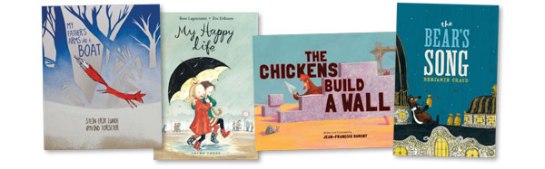
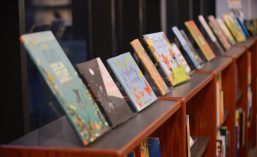
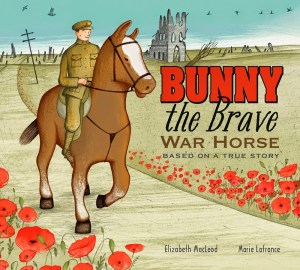
the bear's songOn Thursday, January 16, our regular Butler Center book discussion group, B3, resumes with a bang. This time out we’re conducting a Mock Caldenott Award. Yes, you read that right. CaldeNott. We’ll be using the official Caldecott terms and criteria to evaluate picture books ineligible for the actual award, due to their foreign provenance, and pick a winner.

I am as likely as the next person to get swept up in the drama and intrigue of the ALA Youth Media Awards. I attend the press conference where the winners are announced to the world without fail, and had the great honor of presiding over the festivities in 2010 (the year we announced The Lion and the Mouse as Caldecott winner). And I love all of the handicapping and arm-chair quarterbacking that goes on. But there’s a little part of me (OK, a big part) that feels bad about the incredible books that don’t get their due. We spend so much time searching for the most distinguished American books of the year that books from other countries get lost in the shuffle. And some of those books are fan-freaking-tastic.

mapsSo, we have a short list of a butler’s dozen (that’s 13) extraordinary picture books vying for the Caldenott crown. You can find the titles here. Hey, why don’t you join us?!

As always, we meet on the third Thursday of the month in the Butler Center at 7:00. This time we’re opening up a few hours early. From 5:00-7:00 you’re welcome to drop into the center, enjoy a sandwich and a snack, review the books on the table, and consider the terms and criteria that will guide our discussion. If you can come only be with us for part of the evening, that’s fine. If you haven’t seen any of the books yet, that’s fine. The point is, you should come.

It would be great if you’d RSVP in the form below (but do still please come, even if you don’t get around to it).

the big wet balloonHope to see you there!

← Back

Thank you for your response. ✨

Girls gone wild

I lived with my sister, now a science education specialist, while she was completing her master’s degree. Her thesis considered students’ perceptions and assumptions of scientists: their work, appearance, and setting. We had a ball examining the teenaged participants’ drawings, through which an overwhelmingly popular archetype emerged: Einsteinian hair, glasses, bow ties, lab coats, Erlenmeyer flasks, boiling liquids, explosive gases. When asked “What does a scientist look like?”, students’ answer is almost unanimously male and inside a laboratory.

The Tapir ScientistI am so pleased to see books for the young adult reader challenging the stereotype. Houghton Mifflin’s excellent Scientists in the Field series solidifies an altogether different image. Take The Tapir Scientist, by children’s nonfiction juggernauts Sy Montgomery and Nic Bishop. While the cover photograph shows the captivating and rarely seen face of a tapir – trunk-like snout, curious eye and nearly smiling mouth – the first title page’s photograph reveals the book’s namesake and star: a woman wearing dirty cargo pants, t-shirt and baseball cap wades through ankle-deep wetlands, holding an instrument in the air and peering towards the horizon. Her name is Patricia Medici, a Brazilian scientist whose work may more closely resemble extreme camping than the conventional image of “doing science.” For days, she and her team (which includes Sy and Nic) make trips around the vast Pantanal Wetlands of Brazil attempting to collar and track the elusive tapirs, whose behavior is largely a mystery. She has to beware pumas, venomous snakes, and the relentless bite of ticks, but the more troublesome battles are that with faulty equipment or inconsistent results. Although the subject of The Tapir Scientist and other books within this series is an animal, the text’s content is all process from the scientist’s point of view. Montgomery and Bishop record Patricia’s frustrations and triumphs as they happen and present their work as a narrative full of suspense, empathy and joy. Yes, the reader learns the traditional creature facts – anatomy, behavior, ecosystem – but all that report fodder is discovered only through the journey the reader makes with the scientist.

PrimatesSimilarly, Jim Ottaviani and Maris Wicks’ graphic novel Primates: The Fearless Science of Jane Goodall, Dian Fossey, and Biruté Galdikas places its readers right in the boots (or bare feet) of the title’s three scientists. Through brilliantly distinct and sometimes overlapping narration, we grow to understand the individuals: Jane’s endless curiosity, Dian’s brusque fierceness, Biruté’s patient hunger. But all are united by their commitment to primate study, more so, to study primates in the wild. Each is recruited by famed anthropologist Louis Leakey, whose targeting of women feels ambiguously both progressive and sexist: he seems to respect these women for their observational intelligence, but Primates also references his womanizing with the young researchers he employs. Nevertheless, for these three women, chimps, gorillas and orangutans are the subject of all attention. The reader, too, is given a front seat to the observations; Wicks devotes pages of panels, with minimal text, just to the sequential movements and expressions of the primates: the chimps’ mysterious rain dance, gorillas’ unique noses “like big fingerprints,” an orangutan’s leisurely journey through the trees. Wicks’ style is not naturalistic; on the contrary, her brightly painted drawings are stylistically playful and simply rendered. Coupled with the type sets used for the texts, which mirror the style of each scientist’s documentation – handwritten script or typed Courier – the reader can imagine these illustrations appearing in these women’s scientific logs, a patient and enthusiastic recording of what they see in the field.

Into That ForestLastly, Louis Nowra’s fictional novel Into That Forest portrays not a willing scientist per se, but a child lost in the woods. Incredibly, young Hannah and her friend Becky survive a storm in the Tasmanian wild, only to be rescued and adopted by two Tasmanian tigers. Initially they are terrified, but as the creatures prove themselves trustworthy guardians – bringing them caught fish, leading them to their den – the girls adapt to their bizarre new family structure. Over four years in the wild, they slowly lose the things that define them as human – their manners, clothes, and eventually, language – but they gain just as much in their careful observations of their new companions. Theiri senses sharpen, words are replaced by growls and eye expressions, and affection for their new foster parents grows:

The tigers stopped being animals to me. They were Corinna and Dave… Corinna showed she liked us by licking us and curling up with us whenever we slept. Though I have to say, if she didn’t like something you did, she’d nip you to let you know.

Nowra’s story, as dense and rich as the Tasmanian forests, not only stands as an imaginative memorial to the thylacine, officially declared extinct in 1936, but as a testament to Piaget’s classic theory of development: that the child is a scientist, learning and constructing her world of knowledge through constant observation and application without any extrinsic motivation, like candy bribes or A+ grades. It is that childlike passion and curiosity that should identify grownup scientists more than the lab coats. Indeed, the women so masterfully presented in these varied stories all possess that drive for understanding the world that seems to exist outside of and above the status quo of our everyday work culture. And perhaps outside is the key: it is hard not to feel awed, inspired and motivated when you’re surrounded by the wonder of the wild.

Annual Butler Booksale – 11/22/13

book-92771_640It’s that time of year again!

Join the Butler Children’s Literature Center for our annual book sale!

On Friday, November 22nd, the Butler Center will be staffed from 9:00am-4:00pm and we want YOU to come join us for cookies, cider, expert recommendations, and BOOKS!

If you’re looking to build your personal book collection, stock up for your school or public library, buy some holiday presents for your loved ones, or just want to check out the best books for kids and teens from 2012, you won’t want to miss this opportunity!

Hardcovers are $7.50 apiece, paperbacks $2.50. Cookies and cider are free! Cash and checks are welcome!

Hope to see you there!

Book Sale
Butler Children’s Literature Center
Rebecca Crown Library, 214
Friday, November 22, 2013
9:00am-4:00pm

God got a dog

godgotadogGod got a dog

by Cynthia Rylant, illlustrated by Marla Frazee

Beach Lane Books, 2013

Cynthia Rylant is a visionary, the sort of author who seems compelled to challenge literary constructs, and herself, ever in pursuit of some deeper truth that she needs to express. At least she has always seemed like a visionary to me, judging by her extraordinarily varied, generally innovative and uniformly personal body of work. Whether it is the Newbery-winning Missing May, with its put-your-head-on-the-desk heartbreak, the bold sweetness of her self-illustrated picture books like Cat Heaven and Dog Heaven, or the inspired, uncommon poetry of Boris or Something Permanent, her work transcends the expected in order to achieve the basic. In 2003 she published God Went to Beauty School, a collection of page-long poetic essays, each about God undertaking some commonplace activity, from opening His own nail salon to cooking spaghetti. These episodes, in their essential combination of the mundane and the sublime, express a rainbow of grace. In this year’s God got a dog a number of these poems is recollected and illustrated by Caldecott-honor illustrator Marla Frazee, who brings her own generous accessibility to the project. Frazee adds to the flavor of the book. Hand-lettering contributes a sense of innocence. Light permeates each tableau. But most striking is her casting of God in each episode. Rylant’s work already used both female and male pronouns to refer to God, but Frazee takes the plurality a step further, diversifying the personifications of God as much as possible: old and young, big and small, country and city, race after race. None of these updates represents a huge departure from the tone and intention of the original work. This new books, like its predecessor, is a soft, welcoming meditation on the sanctity of our daily lives and the reflection of the divine in simple things (even if those reflections are upside-down). But there is whimsy in this new package, a luminous, bubbly sort of warmth that unifies the different experiences and personifications, softening the edges and opening the doors. Rylant’s God is us, and Frazee’s us is God, and there you have it.

Have You Seen This Website?

Image

There’s not many things cooler than the International Children’s Digital Library (ICDL). Not only does this website contain free ebooks, but it contains literature for children in multiple languages. Here in Chicago, the school system has over 70 different languages represented in its student population. Wow, right? How can we offer these students access to literature in their first language?

You can search in two ways– simple and advanced search. In the simple, kid-friendly search, users can search by “kid characters” vs. “animal characters,” length, even color of the cover! There are books in Spanish, Danish, German, Japanese, Mongolian, Arabic, Swahili, Polish…the list goes on and on.

You won’t find Diary of a Wimpy Kid here, but you will find gems that are endearing, funny, and accessible to all via the Web. Talk about ACCESS and ADVOCACY for ALL. The website states, “Ultimately, the Foundation aspires to have every culture and language represented so that every child can know and appreciate the riches of children’s literature from the world community.” Way to go, ICDL!

Peggy Sharp comes to GSLIS

peggy sharpRespected children’s book authority Peggy Sharp has been touring the country and delighting audiences with her trademark rapid-fire, how-many-titles-can-you-talk-about-in-a-day booktalk sessions for years. This year marks the final tour (Peggy will retire at the end of 2013) and the last chance you’ll have to see and hear her work her magic. She will be at Dominican on November 1st, 2013, with her program “What’s New in Children’s Literature: A Look at the Latest Children’s Books and How to Use Them in Your Program,” jam-packed with ready-to-use-tomorrow ideas.

Preview the best new children’s books: fiction, nonfiction, picture books.

Learn about the future of children’s books and current hot topics in the world of children’s literature.

Discuss the latest technological developments in the world of children’s literature.

Earn 7 CPDU’s!

All participants will leave with extensive annotated bibliographies in a comprehensive resource handbook full of outstanding ideas.

$130 fee includes lunch, breaks and handouts

For more information and to register, visit http://gslis.dom.edu/newsevents/whatsnew2013

Questions: Call (708) 524-6054

Fifty Shades of Ambiguity

As we enter the second week of the federal government shutdown and consider the particularly polarized nature of the DC discourse itself, and the coverage of same, it is hard not to conclude that we have arrived, as a country, at some sort of cultural impasse. Our two-party system seems to have devolved into a he-said-she-said standoff full of bull-headed bravado and empty of reason. And as if the certainty of the politicians wasn’t enough, all of us in the peanut gallery, regardless of which side of the divide we’re spectating from, are equally certain about who’s right and who’s guilty. 100%.

Uh oh.

It seems that the very idea of challenging our own assumptions, wondering about our choices, even changing our minds, is an endangered species.

Part of the reason I do the work I do, in fact, a big part of the reason, has to do with raising up a generation (or 12) of critical thinkers. Kids enter the world with an incredible openness and curiosity, and it is through their cultural “education” that they let go of these possibilities in exchange for a sense of certainty. But those of us who endeavor to connect kids with stories understand the role those connections can play in keeping the wonder gates open. Meeting up with other people (and bears and vampires and cupcakes) in books allows kids to experience things they can’t or don’t experience on their own. Yet. And reading books that expose them to different sides of the same story lets them know that, usually, there is more than one side.

There are, happily, many books for young people that acknowledge, and even celebrate ambiguity. Let’s take a look at a few books about some of our founding fathers. The current debate is fraught with invocations of their fundamental perfection. And yet, there are some books out there, books for children no less, that see them as the people they really were, humanity and all.

thomas jeffersonIn her upcoming picturebook biography Thomas Jefferson: Life, Liberty and the Pursuit of Everything, Maira Kalman makes the most of her brilliant, quasi-surrealist stlye, painting a portrait of the nation’s third president that expresses the dynamic breadth of his interests and the depth of the passion he brought to them in her wondrous tableaux of electric colors. We learn of diverse pursuits, the art and architecture, science, botany, etc. We learn of the care and generosity with which he ran his house and his infamous Monticello estate. We learn of his public pronouncements about the evils of slavery. And we learn about the slaves he kept himself, including one Sally Hemings, who, it is believed, bore him a number of children. In the mainstream media much has been made of Jefferson’s alleged relationship (so much, in fact, that some would say the allegations are proven) but we do not always see such admissions of guilt in books aimed at young children. But in her direct and unapologetic treatment of the whole man, Kalman ultimately paints a portrait that is more compelling for its inclusion of flaws.

big georgeIn Big George: How a Shy Boy Became President Washington, author Anne Rockwell and illustrator Matt Phelan paint a similarly human portrait of the first of the founding fathers. Right from the start, before we even open the book, we see a different George Washington than the one we’re accustomed to, younger, sadder, and maybe, even, angry. And then we have a subtitle suggesting that he’s shy, a characterization markedly different from the man pictured. The portrait that follows is just as complex and nuanced as the cover promises. Instead of the iconic truth teller of cherry trees and wooden teeth, we meet a man of soft speech and quiet ways. We meet a man reluctant to assume the responsibilities thrust upon him but resigned to his duties. We meet a man. Throughout the book there are tensions between the text and the illustrations, which positively vibrate with the conflicts Washington experienced throughout his life. This is another portrait of an American “hero” that transcends the ordinary hero worship to offer a bigger picture actually worthy of its subject.

The thing to remember is that kids start out smart. They start out ready to think and learn and grow. They wonder. They change their minds. And the best authors and illustrators making books for them see in them the potential to stretch and grow, and challenge them accordingly. There is an inherent and profound respect in asking a lot of a child audience, setting our standards high and believing in their capacity to meet them. In my experience, kids give you what you expect of them. If you expect little, that’s what you get. If you expect everything, look out. I expect them to think and to change their minds.

Of course, I expect this of my politicians, too, and of late I have been sorely disappointed. But if we stick to our commitment to raising up the next generation with open curiosity, I have every faith that we may yet live up to our sizable ideals as a nation of thinkers.

Thomas Jefferson: Life, Liberty and the Pursuit of Everything, by Maira Kalman, Nancy Paulsen Books, 2014.

Big George: How a Shy Boy Became President Washington, by Anne Rockwell, illustrated by Matt Phelan, Houghton Mifflin Harcourt, 2009.

Odd Duck

Odd DuckOdd Duck
by Cecil Castellucci & Sara Varon
First Second, 2013

The phrase feels like a relic from an older generation, like bee’s knees. Indeed, when I occasionally say it, I can feel the echo of my parents’ voices in my lungs. “She’s a bit of an odd duck, isn’t she?” It’s almost – almost – an endearing phrase – not quite as nice as “marches to the beat of a different drummer” but a similar notion. Just enough of a raised-eyebrow judgment to acknowledge a differentness in another.

The title’s slightly nostalgic phrase makes me not at all surprised its artist is the quirky, kooky Sara Varon, whose Bake Sale was a deliciously different cookie of a book as well. In Odd Duck, she brings her signature omnisciently-bemused labeling to the endearing details of Cecil Castellucci’s story and character, including duck-protagonist Theodora’s morning rituals (“Quaking exercises, for perfect pitch and tone”), her occasional unorthodox shopping choices (“Duck food, just like all the other ducks…but also…mango salsa! Huh!”), and her eventual disapproval of the new neighbor Chad (“Feathers ASKEW!” and “Violent dancing!”). Details including rotary phones and Theodora’s lavender cloche-like bonnet (complete with a decorative, metaphorically-foreshadowing bee) insist the story is set in some bygone era. The ducks’ wide-eyed expressions and wiggly, spaghetti-like limbs (again, “Violent dancing!”) call to mind the Steamboat Willie days of early cartooning, or perhaps today’s decidedly-retro hit “Adventure Time” on Cartoon Network.

Early in the story, Theodora wishes on a star “that nothing in her happy life would ever change.” She is clearly as sentimental and vintage as her artist’s style suggests. And of course the new neighbor throws a bit of a wrench (nearly literally, as he is a builder of strange modern sculpture) into her life. She is initially offended by his unrefined mannerisms and disheveled appearance until they find some common ground on the ground: both decide not to fly south for winter. Bonded by this quiet rebellion against the birds-of-a-feather rule – a glimmer of the uncompromising nature of each of their odd-duck-ness to be fully revealed and reveled in by the book’s end – Theodora and Chad become fast not-so-fair-weather friends.

The odd-duck odd-couple’s charm lies in their utter contentment with themselves. Up until a critical plot point in which they overhear a stranger’s comments, it never occurs to either party that he or she holds the title of oddest duck. Their mostly unencumbered sense of self and gentle stubbornness to be anything else is such a delightful match to Castellucci’s story and Varon’s artwork. It’s a reading experience so well done and delightful it’s sure to inspire its readers to embrace the odd in themselves.