Benefits of a Bossy Butler: A Review of Pay Attention, Carter Jones

carter jones

Pay Attention, Carter Jones
Gary D. Schmidt
Clarion Books, February 2019

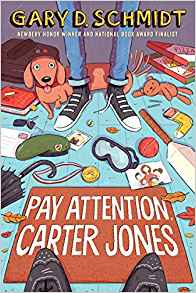
The Butler in Gary Schmidt’s Pay Attention, Carter Jones shows up at the perfect time. Carter’s father is deployed in Germany when Mr. Bowles-Fitzpatrick arrives on the Jones’s family’s front porch, his service an inheritance of sorts from their recently passed grandfather. Carter’s mother, struggling to care for four and mourning the loss of a fifth, is all too happy to accept free help, but Carter doesn’t appreciate Mr. Bowles-Fitzpatrick’s insistence on speaking “the Queen’s English” or his tips on gentlemanly behavior. The two bond, however, when the butler teaches Carter to drive a car that will one day be his own and introduces him to the intricacies of Cricket. When Carter finds out his father is not returning from Germany, he starts to suspects the butler knows more about his family than it seems, and that the butler’s unsolicited guidance may help him sort the fragments of his family currently spinning out of control. The Butler is appropriately irritating and loveable all at once, striking a perfect balance of affection and frustration as his central relationship with Carter blooms. Carter is both stubborn and sympathetic as a middle schooler confronting the loss of a sibling and his father’s abandonment in a touching and realistic way. A hilarious and heartfelt book that will have readers laughing between tears and “remembering who they are.”

Many thanks to local author, SCBWI-IL member, and guest reviewer, Mike Grosso. Mike is an author, musician, and middle school math teacher who always keeps a guitar in his classroom. Mike writes books and records music at his home in Oak Park, Illinois, where he lives with his son and a drum set he plays much too loud. I AM DRUMS is his first novel, and his rock album, SILENT EXPLOSION, was funded via Kickstarter in early 2018. You can find him at mikegrossoauthor.com.


The Wild City: A Review of Animal City

61UGpFi7QrL._SX393_BO1,204,203,200_

Animal City
Joan Negrescolor
Chronicle Books,
November 2018

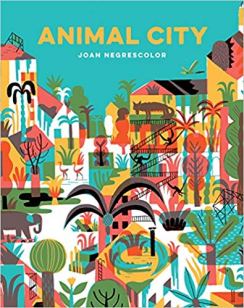
Animal City depicts a place overrun by unrestrained animals and plants, which Nina explores. Each day she returns to tell the animals their favorite stories. Some animals love to hear tales about myths and monsters or traveling to outer space while others prefer poems about sailors. The story shows Nina traveling through the forgotten city, emphasizing themes of curiosity and exploration of nature. Negrescolor’s text is simple, yet conveys a powerful message that stories have the ability to enthrall and capture the attention of anyone or anything. The digitally-created illustrations use vibrant and bold shades of red, blue, yellow, black, and green to create their jungle. By using digital art in this medium, Negrescolor depicts a chaotic wilderness, reflecting the mood of the story. The book simulates our curiosity because it is not clear what happened to humanity. The narrative allows for imagination to fill in the missing pieces here. Since there is not a lot of writing, this gives an opportunity for the pictures to tell the story and fully represent this ruined city.

Duty, Loyalty, Love: A Review of Empress of All Seasons


Empress of All Seasons

Empress of All Seasons
Emiko Jean
Houghton Mifflin Harcourt, November 2018

As per tradition, when the land of Honoku needs a new empress, a competition is held. All eligible women are invited, and the one who survives each of the four enchanted seasonal rooms is deemed worthy of the title of Empress of Honoku and position next to Taro, the prince next in line to be emperor. Mari has trained for this competition since childhood, though as yōkai she is technically ineligible to compete. Yōkai, supernatural beings, are under threat and enslaved by the current emperor. But Mari cares little about the rules or the prince – she competes for the power of being empress, and to bring change to Honoku from within. Taro himself doesn’t enjoy being a prize to be won, and cares little about his power – he would rather spend time in his lab with his mechanical inventions. Akira, another yōkai and friend of Mari, works to overthrow the Emperor from the outside while Mari keeps her true identity hidden to join the competition. Taro may just become their greatest ally, if they can learn to trust each other when their identities and motivations are revealed.

A detailed world and political structure along with multiple perspectives gives this fantasy novel depth and puts the reader at the immediacy of the action. Inspired by her Japanese heritage, Jean has created an escape for readers that questions the sacrifices made for duty and love, and challenges the notion of tradition as a value to be upheld.

Where Do You Fit In? A Review of Click

Click

Click by Kayla Miller
Houghton Mifflin Harcourt, January 2019
Ages 10-13

In Kayla Miller’s Click, the variety show is coming up at school and outgoing Olive has not been asked to join a group. This leaves her feeling outcast and alone when she is unable to find her own “click.” Olive refuses her mom’s help to find a group, instead turning to her Aunt Molly. She decides the best choice is to become a host, the talent show announcer. In her words, “It would be a way that I could help all of my friends with their acts by introducing them” (p.132). This story was heartfelt and cute with bright colored pastel artwork which suggest that the tone is cheerful. The digital medium conveys the lively tone through expressive faces and flat simplistic backgrounds with bold highlight lines. The novel does a wonderful job touching on family relationships, specifically mother and daughter. At first, Olive’s mom oversteps her boundaries in trying to help her. By the end of the novel, a balance is achieved between allowing Olive to be independent and encouraging her to follow through. Olive also learns that, in friendships, growing apart and having different interests is okay. Her friends even encourage her in her choice to become a host. The novel has a solid plot portraying realistic issues for friendship and family. Miller shows these serious middle school themes in a lighthearted way that doesn’t take away from the tension.

Stregas & Strategy: A Review of The Brilliant Death

brilliant deathThe Brilliant Death
Amy Rose Capetta
Viking Books, October 2018

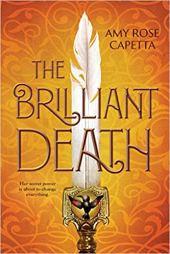
Historical fantasy and romance collide in this captivating tale set in Vinalia, a fictional land inspired by mountain villages of old Italy. Teodora di Sangro is well aware of and versed in the di Sangro way of life, which places loyalty to the family above the self, and the opinions of men above women – but she yearns for more: the power of a di Sangro son, and to use the magic she holds inside of her. With her magic, she changes her family’s enemies into trinkets that decorate her room, but Teo knows she could do more, if only her father trusted the strega way in addition to practicing and teaching political strategy to his sons.

When Teo meets Cielo, a young genderfluid strega who can teach Teo how to use her power to become the di Sangro son she longs to be, Teo realizes there may be a way to be her true self and save her family from the Capo’s plans to weaken each of the Five Families of Vinalia. With challenges to traditional gender roles, exploration of what it means to feel at home and whole in your body, and poetically descriptive language, The Brilliant Death elevates a coming-of-age story into a thoughtful consideration of who we are when we let go of society’s expectations and trust the magic inside of us.

A Sweet Story to Tackle a Tough Topic: A Review of The Remember Balloons

The Remember BalloonsThe Remember Balloons
Jessie Oliveros
Illustrated by Dana Wulfekotte
Simon and Schuster, August 2018
Ages 5-9

James has a handful of colorful balloons, reminders of his most important days. His parents and grandfather have even more balloons. His dog has one! Each bright balloon holds a special memory—birthdays, weddings, fishing trips—a lifetime of extraordinary moments. As Grandpa’s balloons begin to float away, Mom and Dad help James understand memory loss and how he can help keep Grandpa’s stories alive.

A gentle metaphor for aging, memory loss, and dementia to help young readers process what’s happening to a loved one. Oliveros doesn’t shy away from the anxiety, confusion, and anger in James’ reactions; validating those feelings in young and old alike. The black and white pencil drawings of this close-knit, mixed-race family provide an understated counterpoint to the vibrant balloons and the memories within. The subtly in both text and art work well together in handling such an emotional topic and put the focus on the joy of remembering shared experiences.

New Children’s Fiction Alert!: Tight by Torrey Maldonado

Tight by Torrey Maldonado

Tight
Torrey Maldonado
Nancy Paulsen Books, September 2018
Ages 8-12/Grades 3-7

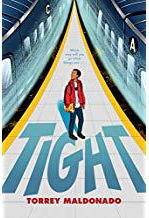
If Bryan could be any superhero, he’d be Batman. Or Black Panther. They’re smart, they think 10 steps ahead, and they’re tough. Bryan’s dad and his older sister, Ava, both say he should be tough: “don’t be soft” they tell him, but his mom keeps him cool and level-headed. She also introduces him to Mike, who is in 7th grade – one year older than him in school – and Bryan thinks he’s pretty tight. Mike loves comics and drawing superheroes just like Bryan, and he doesn’t let school get in the way of having fun.

Slowly, Mike starts asking Bryan to take more and more risks: climbing up to the rooftop of a neighborhood building, ducking the subway turnstiles to take the train for free, skipping school to get the newest Luke Cage comic. Bryan doesn’t feel so good about lying to his parents, especially his mom, but he loves the feeling of freedom that comes with hanging out with Mike.

Bryan’s internal struggle to make the right choices is grounded in Tight’s contemporary Brooklyn setting and in his genuine interactions with strong secondary characters. He genuinely wants to do the right thing, while also wanting to give his friend a chance to choose better as well. Maldonado’s dialogues present a variety of perspectives on peer pressure and the difficulties of navigating friendships as a young person, making it easy to empathize with Bryan.

Women and Wealth Redistribution: A Review of The Forest Queen

The Forest Queen by Betsy CornwellThe Forest Queen
Betsy Cornwell
HMH/Clarion Books, August 2018

“Steal from the rich, give to the poor” gets a fresh take in this gender-swapped retelling of the classic Robin Hood tale. Sylvie, sixteen and lady of Loughsley Abbey, begins to question her family’s treatment of the people of Loughsley – especially now that her brother, John, is the unforgiving sheriff. With her childhood friend, Bird, she runs away and lives in hiding in the nearby woods. Slowly, others from Loughsley join them in their new community, including a young woman named Little Jane, the midwife Mae Tuck, and others who feared otherwise being jailed for their inability to pay egregious taxes. Sylvie must eventually confront her brother, along with her own complicity in the evils done by her family, and she comes to realize that the changes required for economic justice mean she must take “radical action” and put herself in potential danger for the greater good.
Sylvie and her mission to redistribute wealth among the people of Loughsley are easy to root for, but the additional focus on gender roles, womanhood, and the idea of community as family are what set this retelling apart. Strong secondary characters help to challenge Sylvie and force her to take a strong stand against a system that she would otherwise benefit from, and parallels can be drawn from the injustices in the story to those of today’s world. As Little Jane, who becomes a dear friend to Sylvie says, “If someone doesn’t care whether you live or die, then living itself is rebellion” (p 241). This thoughtful narrative of what can happen when the privileged few horde wealth while the majority struggles to make do with less and less shows the power in a united band of concerned citizens.

Back to School with Historical Fiction: A Review of Finding Langston

Finding Langston by Lesa Cline-Ransome

Finding Langston
Lesa Cline-Ransome
Holiday House, August 2018

Langston doesn’t like much about his new life in Chicago – not the small apartment he shares with his father, or the noisy streets and sidewalks, and definitely not his new school, where classmates call him “country boy” and make fun of how he speaks. Langston misses Alabama, where his mother died and where his Grandma still lives, though his father sends her part of his paycheck each week in the hopes of helping her move up north with them. It’s only when Langston discovers George Cleveland Hall Library, open to all Chicago residents, that he starts to feel at home.

In the safety of the library, Langston also discovers his namesake, a poet who seems to have inspired a few of the love letters written by young Langston’s mother to his father. Reading the poetry of Hughes helps Langston work through his grief at losing his mother, but it’s a new friend who recognizes that reading poetry “is a way of putting all the things you feel inside on the outside” (p 99).

Cline-Ransome mixes poetry and history in this slim fiction novel for elementary and middle school children. The post World War II era of the Great Migration is explored through the story of one family, and Langston (the character) also learns a great deal about Langston Hughes and other African American poets and writers of the time. Chicago’s Bronzeville neighborhood and Chicago Public Library’s Hall Branch are both highlighted and given extra detail in an Author’s Note at the end of the book. Told with heart and thoughtfulness, Finding Langston belongs in personal libraries and on classroom shelves alike.

Valuable Reminders: A Review of The Dollar Kids

dollar kids

The Dollar Kids
Jennifer Richard Jacobson
Illustrations by Ryan Andrews
Candlewick (August, 2018)
Ages 10-14

When his family wins the chance to buy a house for just $1, twelve-year-old Lowen sees it as a chance to hit the reset button — Mum can open her own restaurant, Dad can follow his dream of working in a clinic in an underserved community, his brother Clem can finally be the star athlete, and his sister Anneth — well, she’ll need convincing. And sensitive, artistic Lowen can work through his grief over the death of a friend and guilt over believing he caused it. But moving to a small town isn’t easy on any of them, leading everyone to question whether the Dollar House program was such a good idea after all. Dubbed the “Dollar Kids” by hostile new neighbors skeptical of the program and “whether it’s a help or drain on the town” (p. 328), Lowen and the other new kids in town struggle to make a place for themselves, rehab houses, and rebuild community.

The idea of home, be it a building, a community, a family, or a feeling creates a strong backbone for this plot, helping to pull the reader through the slightly slow start to the one year the book covers. By mid-book, the pace picks up in both action and time (the progress noted with each new chapter). While slightly awkward, the change of pacing mirrors the changes Lowen experiences as he processes his grief and settles into life in Millville. Scenes from Lowen’s comic book drawing layer in additional elements of his grieving process, questions of faith, and ultimately his healing.

Diversity (of age, gender, and cultures) among the characters in this story provide a varied range of coping mechanisms for dealing with uncertainty, insecurity, and change by both the new families settling in and Millville residents dealing with the decline of their small, but proud town. The inclusion of parents and other community members as active players in the story is a refreshing change from books that often leave you wondering “What happened to all the adults?” and provides a subtle reminder that communities need all types of diversity to thrive.