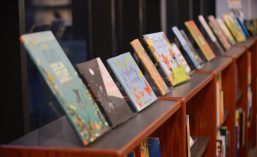
As part of the fifth annual Dominican University Caritas Veritas Symposium the Butler Center staged a Book Identity Project through which we solicited from members of the university community a book (or six) from childhood that contributed to their identity. Participants were given an old-school check-out card asking for the book and we lined the front door and window of the center with old-school check-out card pockets to receive them. We had a tremendous response, with 101 books listed on 86 different cards.
 The submissions are fascinating, with a surprising variety. To be sure, the collection includes some well-loved, to be expected titles. Where the Wild Things Are gets three mentions, and Dr. Seuss shows up six times, twice for The Cat in the Hat, twice for Green Eggs and Ham, and once each for Oh, the Places You’ll Go! and One Fish, Two Fish, Red Fish, Blue Fish. I’m not surprised to see Louisa May Alcott or A.A. Milne, C.S. Lewis or Lewis Carroll (or Robert Louis Stevenson) in the mix. The single most-cited title is Shel Silverstein’s The Giving Tree, with four mentions, which is something of a surprise, not because it’s a book I don’t care for (indeed, I don’t care for it) but because it seems to have the sort of nostalgic perspective that I never thought spoke strongly to children. Consider me schooled. I was somewhat surprised, too, to find books outside the children’s canon, by the likes of Hemingway and Steinbeck and Dwight D. Eisenhower. We didn’t specify that the book needed to be a book written expressly for children, just that it resonated in the participant’s childhood, so it makes perfect sense that books like these would show up. It’s a great reminder of my own myopia, that I automatically understand young people’s reading through my deep engagement with the body of literature I study. Schooled again!
Quite a few series made the cut, including Nancy Drew, The Boxcar Children, The Chronicles of Narnia, and, of course, Harry Potter (I was 32 when Harry Potter and the Sorcerer’s Stone was published, and it’s just a little sobering to realize how many of our students read it as children). Alexander and the Terrible, Horrible, No Good, Very Bad Day got two mentions (I wonder if those folks saw the movie) as did The Runaway Bunny. Andrew Clements’ Things Not Seen, published in 2004, is the youngest book mentioned, and the oldest is Henry Wadsworth Longfellow’s Song of Hiawatha, first published in 1855.
Here’s the complete list. Check it out. Are you surprised by what you see? And while you’re at it, let us know if you can identify the authors of any of the first few books listed, unfamiliar to us.
 Here are Butler Center Student Assistant Kara Pauley and LISSA President Stephan Licitra collecting entires (and passing out candy). It sure is great to have such friendly, diligent assistance.
Oh, and for the record, my choice was Spectacles, by Ellen Raskin. It’s a great book. You should check it out.
 Here is the World: A Year of Jewish Holidays
 On September 23rd, Dominican University will be holding its fifth annual Caritas et Veritas Symposium, and the Butler Center will be taking part in the festivities. We’ve created library date-due cards with space for members of the Dominican Community to answer a single question: what book from your childhood contributed to your identity? Participants are encouraged to bring their cards to the Butler Center on the second floor of Rebecca Crown Library, room 214, where we will collect your responses.

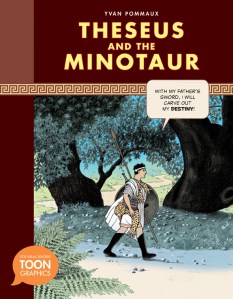 Theseus and the Minotaur
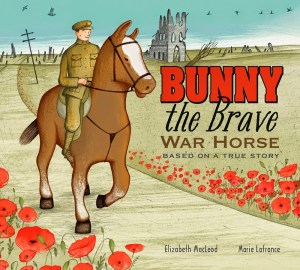 ve War Horse: Based on a True Story
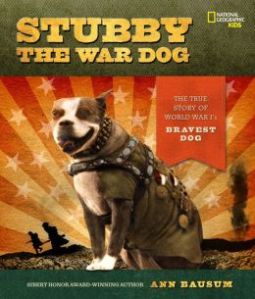 Stubby the War Dog: The True Story of World War I’s Bravest Dog
 3…2…1…Circus and Early Rider
 Wegman’s children’s literature output has been spottier of late, though experiments with a new style, inserting digital images of the dogs into scribbly, painterly paintings, have produced some recent charmers, including two board books out this month. 3…2…1…Circus! sees the dogs in all manner of circus scenarios, beginning with ten and counting down to a literal, lone puppy blast-off. Early Rider sets the puppies to get about in all manner of transportation, from pogo stick to hot-air balloon, described in rhyming couplets. The production values here are pleasantly rough, with sketchy objects on even sketchier backgrounds, offering a pronounced contrast to the digital clarity of the puppy pics. And Wegman’s ability to interpret the puppies’ playful positions, painting them into cockpits and clown suits, adds lots of dynamic energy.
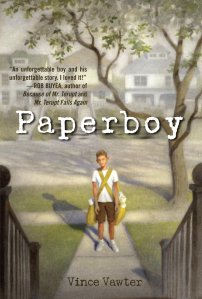 Paperboy
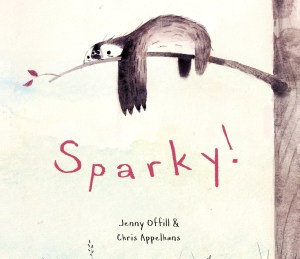 Sparky!
 The Caldecott terms and criteria constitute a particular, prescriptive lens through which to look at picture book illustration. The Caldecott Medal is arguably the most prestigious prize a picture book can win, and as such the specific elements and attributes it recognizes have a particular role to play as we examine and evaluate books in the canon. To be sure, the Caldecott terms and criteria are not the only measure we can apply. Indeed, in our day to day work with children, other things–iconic characterization, accessibility, suitability for a group read aloud–can be much more significant. Still, measuring picture books with the Caldecott measuring stick allows us to delve deeply into the quality of the illustration, and gives us meaningful information about the application and legacy of the Medal itself.






 Butler's Pantry