Welcome to the online presence of the Butler Children's Literature Center, housed in Dominican's SOIS (Crown Library room 214). Here, we celebrate the best in books for youth and those who delight in sharing them. For Summer 2026, BCLC will offer collection access to the Dominican community and general public during posted open hours: Monday 9am-noon, Tuesday through Friday 9am-4pm, and by appointment with the Curator. Contact Jen Clemons at jclemons@dom.edu to make arrangements or you can still reach us at butler@dom.edu.
Here at the Butler Center we’re proud to host the USBBY Outstanding International Books Committee for their year-end deliberations. And, given our recent trip to the Bologna Children’s Book Fair, we’re especially interested in their choices.
Here’s the 2014 list. I see some favorites. How about you? What international books for children and teens are on your radar for next year’s list?
“I’m Oscar and I have the best Grandma in the whole wide world.” So begins this sweet, fragile story about the finite, particular experience of moving an older person into assisted living, and its impact on a young child. Oscar’s direct story offers a linear account of the situation. Grandma is forgetting things and needs more help than the family can provide, so she’s going to live somewhere where there are lots of people to care for her. We will miss her, it will be different, and you can ask questions. Oscar visits Grandma, learns about her new routine, meets her friend Albert, and decides it’s going to be OK.
This kind of purposeful book rarely gets attention beyond its purpose. It may not attract a large audience beyond families sharing the experience it depicts, and probably won’t find its way into regular storytime rotation (though I would be all over it). But there is real art here, and detail that warrants our notice.
Let’s begin with the style of the artwork, fresh and tender and childlike. The images vibrate with the love of family, and reinforce the child’s perspective. Just looking at the book, one feels the sort of security a child might craft for himself. The handwritteny font further establishes this as something experienced directly by a child, not filtered through the wisdom of adulthood.
And within the art are many wonderful details. Right on the cover we see Oscar and Grandma cuddling in a soft, oversized chair upholstered in a particularly cheery floral fabric. We see that fabric, with its bright red, yellow, blue and pink blossoms, over and over, on the opening and closing pages, on the coverlet on Grandma’s bed, as a handkerchief in Grandma’s memory box. And the original chair comes with Grandma and is present in her room after the move. No mention is made of the fabric’s constancy, but the through-line reminds readers that while some things will be different, some things will stay the same. The imagery is not all about particulars, though. Open backgrounds and copious white space leave plenty of room for children to fit themselves into the story, and fully absorb its comforts.
Also worth noting is the candor of the first person address. Oscar, experiencing things genuinely, tells the truth. “Grandma still tells me lots of stories about her life. I know them all by heart, so that I can remind her if she forgets one day” he says, for example. The sweetness here is pure, and does not come from sugar coating. It would be disingenuous to suggest to children that things will be better than they are. Instead, Oscar gives us his own account, focused on the positive, to be sure, but fully acknowledging the reality.
As practitioners we are aware of the need for books like this to help families through situations of stress and change. How wonderful that we have at our disposal books that support and explain, and do so with consummate artfulness.
This time of year we enjoy handicapping the big children’s and young adult book awards as much as the next literature center. But rather than trying to anticipate the 2014 committees, we decided to go a different way in our own engagement with the process. We used the Caldecott lens to examine some outstanding examples of picture book making from around the world. Yesterday evening a hale and inquisitive group of 22 gathered in the Butler Center to consider extraordinary picture books ineligible for the actual Caldecott Medal due to their international provenance. We pulled out the official Caldecott terms and criteria (leaving behind the bits about the illustrator being American and the book being first published in America) and focused them on a butler’s dozen (that’s 13) of terrific ineligible picture books. It was stimulating and edifying, and, as is always the case with Butler Center book discussions, a real blast. In the end we chose one winner and one honor book. Look at us!
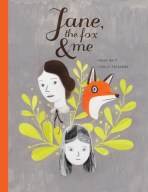
For our winner we selectedJane, the Fox & Me by Fanny Britt, illustrated by Isabelle Arsenault (Groundwood Books). A young girl, bullied and friendless, finds strength and comfort in the pages of a favorite novel, buoyed by its familiar message and strengthened enough, eventually, to trust someone and take a chance. We were especially taken with Arsenault’s sophisticated use of color to paint an emotional landscape; the distinct styles she used to differentiate the adolescent world of the protagonist and the imaginary world of Jane Eyre into which she retreats; and the illustrations’ almost childlike essence that really enhanced the raw vulnerability of the first-person voice.
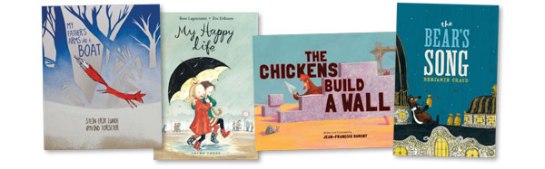
Our honor book is My Father’s Arms Are a Boat by Stein Erik Lunde, illustrated by Øyvind Torseter (Enchanted Lion Books). A boy who recently lost his mother steps into the night with his father to process grief, look for comfort, and reconnect with the world that still holds possibility. Here we appreciated the untethered compositions, expressing the amorphous, rudderless nature of grief; the gradual relief that comes with the return of regular boundaries; and the expression of life’s fragility in the delicate three-dimensional paper-work dioramas.
But this was no easy choice. The debate was spirited, intense, and full of insight. And just look at the other distinguished titles we had on the table!:
The Line by Paula Bossio (Kids Can Press)
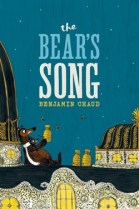
The Bear’s Song by Benjamin Chaud (Chronicle Books)
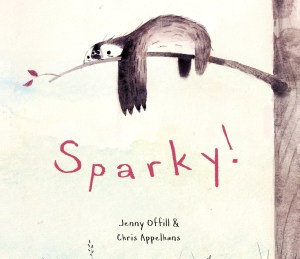
A Little Book of Sloth by Lucy Cooke (Margaret K. McElderry Books)
Herman and Rosie by Gus Gordon (Roaring Brook Press)
Opposites by Xavier Deneux (Chronicle Books)
Here I Am by Patti Kim, illustrated by Sonya Sanchez (Capstone)
The Big Wet Balloon by Liniers (Toon Books)
The Tiny King by Taro Miura (Candlewick Press)
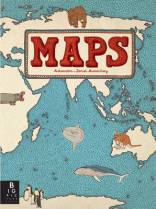
Maps by Aleksandra Mizielinska and Daniel Mizielinski (Big Picture Press)
The Voyage by Veronica Salinas, illustrated by Camilla Engman (Groundwood Books)
Nasreddine by Odile Weulersse, illustrated by Rbecca Dautremer (Eerdmans Books for Young Readers)
On Thursday, January 16, our regular Butler Center book discussion group, B3, resumes with a bang. This time out we’re conducting a Mock Caldenott Award. Yes, you read that right. CaldeNott. We’ll be using the official Caldecott terms and criteria to evaluate picture books ineligible for the actual award, due to their foreign provenance, and pick a winner.
I am as likely as the next person to get swept up in the drama and intrigue of the ALA Youth Media Awards. I attend the press conference where the winners are announced to the world without fail, and had the great honor of presiding over the festivities in 2010 (the year we announced The Lion and the Mouse as Caldecott winner). And I love all of the handicapping and arm-chair quarterbacking that goes on. But there’s a little part of me (OK, a big part) that feels bad about the incredible books that don’t get their due. We spend so much time searching for the most distinguished American books of the year that books from other countries get lost in the shuffle. And some of those books are fan-freaking-tastic.
So, we have a short list of a butler’s dozen (that’s 13) extraordinary picture books vying for the Caldenott crown. You can find the titles here. Hey, why don’t you join us?!
As always, we meet on the third Thursday of the month in the Butler Center at 7:00. This time we’re opening up a few hours early. From 5:00-7:00 you’re welcome to drop into the center, enjoy a sandwich and a snack, review the books on the table, and consider the terms and criteria that will guide our discussion. If you can come only be with us for part of the evening, that’s fine. If you haven’t seen any of the books yet, that’s fine. The point is, you should come.
It would be great if you’d RSVP in the form below (but do still please come, even if you don’t get around to it).
The Butler Center opened in its permanent space two years ago today on September 11th, 2011, the tenth anniversary of that infamous day in world history. To commemorate that occasion we curated an exhibit called the Kinship Project, a collection of books for children and teens that speak to our human kinship. We created a catalog with notes that speak to each of the 29 books connection to the idea of kinship. I link here to the online version. We have some print copies as well (beautiful, actually) and I’d be happy to send some along to you, too. Just fill out the form below with your name and address and I’ll get them in the mail.
How about you? What do you remember of that day? What do your memories have to say to your work with books and young people? Where do you see kinship among the collections we keep?
Written by Julie Fogliano, illustrated by Erin E. Stead.
A Neal Porter Book, Roaring Brook Press, 2013. ISBN 978-1-59643-731-9
Quiet and lyrical, this picturebook (created by the same team as And Then It’s Spring) celebrates childhood in its playful energy and its deep contemplation. Fogliano’s minimalist poetry flows off the page like maple syrup; yet, the text is not without structure. Fogliano uses assonance and alliteration effectively and intelligently throughout the story, using fun phrases such as “whales won’t wait for watching” and delicate ones such as “ship that is sailing” and “flag that is flapping.” Stead’s signature illustration style of muted pastels and purposeful negative space compliment and extend Fogliano’s artful text. As I experienced this story, I couldn’t help but put myself into the young character’s shoes, imagining, remembering and creating images in my head about my own childhood journeys.
I was left with many thoughts and feelings after I finished this book, but the most significant was a personal meditation on patience and discovery. After a first read, it might be easy to think that seeing a whale is the most important thing for this young boy. After all, it is the title of the book. Yet, I think the text and image are purposefully juxtaposed here. Yes, the text states, “You’ll have to just ignore the roses,” and “Don’t look way out and over there to the ship that is sailing.” But, the boy doesn’t ignore the roses, and he does look way out and over there. During the majority of the book, the boy isn’t seeing a whale. Rather, he is exercising patience for the future and truly experiencing the beautiful things of every day. Most days aren’t monumental, right? Most days, we don’t have promotions, our babies aren’t born, our books aren’t published, and the love of our life doesn’t knock on our door with 1,000 yellow daises. Rather, we write emails and cook dinner and help with homework and come home to chaos or maybe empty apartments. The days of actually “seeing the whale” are fabulous and memorable and obviously grand. But we have to be patient to discover them. Maybe Fogliano and Stead are saying that the whale has always been there all along, hanging out in our minds and hearts. We just have to open our eyes to the every day to finally see it.
On a side note, I adore the dog in this picturebook. I love the tilt of its head, the way its back arches when it smells roses, and the way it follows the boy around in every spread, just like dogs do.
“If you are lost, stay in one place. Hug a tree. Think of me.”
On paper everything about this sounds didactic and cloying, in the sort of way that might give one a headache and a toothache at the same time. A sniffing school graduate offers help to would-be lost children to keep them safe and get them found. Her first person (first canine?) exposition outlines specific procedures to be undertaken by a lost toddler matched to the dog’s skills and knowledge.
And it is sweet, make no mistake, and not without purpose.
But it is so much more than that. The language is warm and clear, presenting the instructions in an easy, friendly way, studded with details of particular meaning to a child. It is lilting and confident and happy on the tongue, broken like verse to reinforce its poetic rhythms to the reader-alouder. The toddler in question is shown in the rescue dog’s imagination, doing toddlery things that leave an indelible olfactory trail. The pictures themselves, soft and unapologetically accessible, establish a tone of security and success. And so children understand being lost in terms of the dog’s expertise, not the danger the dfficulty represents. In a final spread the roles are switched, as the child, now safe home in bed, dreams of her rescuer in a dream bubble of her own.
Above all, though, this is a story. I wouldn’t hesitate for a moment reading this aloud to a group of children, not because it contains important information that all children need to hear, but because it is purely delightful. Would that more books built on a message could be so.
Beach Lane Books, 2012. There is no denying that Marla Frazee has made her mark on children’s literature. Her signature illustration style has delighted children and award committees with titles such as Stars, All the World, and A Couple of Boys Have the Best Week Ever.
Boot & Shoe, Frazee’s 2012 gem, stands out for me among her work. I know this is partially because I’m a dog person—I even have two dogs who are brother and sister, similar to Boot and Shoe. But this book is much more for me than just being part of a target audience. It is rich with humor, artistry, and honesty.
Boot and Shoe come from the same litter, and they do everything together—eat, sleep, and even pee. But, Boot likes the back porch and Shoe likes the front porch. Frazee uses soft lines of black Primsacolor pencil and textures and details every page with gouche paint to bring out a wide variety of moods. Significant white space is used throughout the book to highlight vignettes, half-page spreads, and energetic scenes. The crisis of the book—when the dogs can’t find each other—instantly changes Frazee’s artistic style. In nighttime, sad scenes, Frazee uses harsher, straighter lines and deep colors of black and blue pencil. One of my favorite spreads is when the sun comes up, and both Boot and Shoe begin to cry.
So, the book changes. I read this book in a storytime, and kids were laughing and giggling and pointing at the beginning. But when the dogs couldn’t find each other, there was real fear in the room. When Boot and Shoe cried, the room was silent. While I was reading, I kept thinking, “Wow, this is a dynamic book.” Yes, it’s about dogs and friendship. But it’s also about loss; it’s telling children that it’s okay to cry when you feel sad, and it’s doing it with an honest intention and a comforting approach. Rather than books that are only charming and funny (which are great at times, too), Boot and Shoe really spans a variety of moods and emotions, just like we all feel every day. How great to have such authentic, conscientious storytelling for children.
And I gotta say it: If you have dogs or love dogs, this is a book for you. I grew up with one dog, and when she passed away my parents decided to get two—a brother and sister, Jem and Scout. Since getting to know these cuddly dudes, I’m telling you, I’ve never seen such friendship. Besides the fact that Jem would eat all of Scout’s food if he could and Scout bites Jem’s ears constantly, these two dogs are BFFs. Just like Boot and Shoe, they sleep together, eat together, play together. But they are individuals, too. Seeing how much they love each other just makes me want to love more, and to treat each person I meet the way they treat each other—with an open heart, a forgiving soul, and always a shoulder (or back or stomach) to lie on.
Thanks, Marla Frazee. You rule.
Check out Scout and Jem’s friendship throughout their lives below.
Davies employs her considerable zoological chops in service to very young children in this ingenious, elegant and especially attractive lift-the-flap matching-game. The author introduces a series of five habitats (warm, steamy jungle; still, cool pond; dry, sunny grassland; warm, clear, salty ocean; and snowy, frozen Arctic) in two two-page spreads. In the first spread, on the left is the habitat itself, with various forms of wildlife hidden about, and on the right are four quadrants, each with a flap decorated with an abstracted image representing a different habitat. Lifting each flap reveals a different animal who says where it lives, with the final (bottom right) flap exposing one animal who lives in the habitat in question. The subsequent spread shows an expanded image of the habitat, with clearer views of its many inhabitants and a few details about the one animal hidden beneath the flap on the previous page. A final spread identifies all 20 animals and invites us to match them, using their background colors as a guide.
Boutavant’s deliciously cute images, with big eyes and softened, rounded edges, recall an earlier age of children’s book illustration. Indeed, they would look right at home in the 1950s. But beyond their obvious appeal to the target audience (and to me), they conform to careful and deliberate book design pattern, adding lots of value to the entire outing. For example:
Each of the flaps attaches on a different axis, the first at the bottom, the second on the left, the third on the right, and the fourth at the top.
Each habitat image hides four animals. One of them appears under the matching habitat flap on the next page. The other three appear under the flaps for that habitat on the other pages.
The flaps are affixed to quadrants of contrasting colors, and the color behind the “correct” flap matches the background color of the particular habitat.
Text on the back of each flap offers further information about the habitat it represents and the particular animal beneath it.
And all of this pattern means that there’s lots and lots to learn from a book like this. Wildlife ecology is just the beginning. For here are lessons about how books work, and what we can and should look for as we consume them. In lots of ways, this is a book about books and reading as much as it is a book about habitat.
There are two more spring books that have caught my Caldecotty attention:
Round is a Tortilla: A Book of Shapes
written by Roseanne Greenfield Thong
illustrated by John Parra
Chronicle, 2013
To begin with, this book is supremely lovely. Of course, lots of books are lovely, and loveliness is not a particular criterion for Caldecott consideration. But let’s just put that out there. Parra’s figure work is warm and personal, simultaneously accessible and specific. His largely symmetrical composition affords the imagery some organizational clarity, making it especially easy on the eye (and enhancing the shape identification, to boot). But there is much to admire beyond the simple beauty. The color work is extraordinary. Parra sets vibrant reds and oranges against grayed-out blues and greens. The unexpected result, with its dramatic sense of light and shadow, enhances the sense of place. It feels like a hot day in the Mexican shade. The treatment of shapes is suitably sophisticated. Rhyming verse calls attention to one shape at a time, and while many of the shape in question are present for searching and finding, there are other shapes represented, too.
And if ever there was a book jacket optimized to accept a golden circle sticker, this is it. I mean, really.
Henri’s Scissors
written and illustrated by Jeanette Winter
Simon and Schuster, 2013
Illustrating a picture book about a famous artist is no small thing. How does the illustrator capture the essence of the artist’s style without resorting to mimicry, expressing without copying? Jeanette Winter makes it look easy. In this simple picture book biography of Henri Matisse she employs color to set Matisse’s artwork apart from its contextual environs, replicating the vibrant artwork with rich, saturated color and using a more reserved, pastel palette for the artist and his surroundings. She structures the story carefully, covering the first 70 years of his life in the first few pages and dedicating the balance of the book to the paper-cutting for which he is most celebrated today. Matisse made the technical discovery while recovering from a severe, debilitating illness, and Winter reflects its transformational power with a major compositional shift. The exposition unfolds with images in small, tight squares on a clean, buff ground. At the pivotal moment of discovery, when the artist finds his way to creation again, the images break across the entire spread, reaching beyond the edge of the page in expressive freedom. Most picture books contribute to the storytelling with representative imagery. Using the art itself to tell the story, in its structural design, adds layers of meaning to an already illuminating story. I’d call that excellence of pictorial interpretation of story, theme, or concept.
Anyone out there excited about any 2013 American picture books?