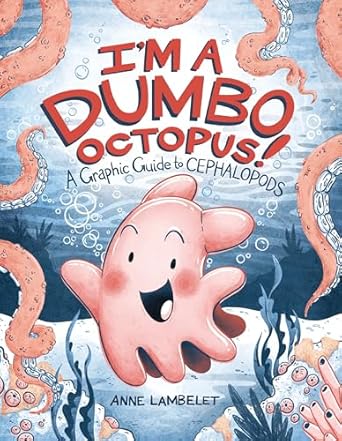
What Makes Me Special?: A Review of I’m a Dumbo Octopus!: A Graphic Guide to Cephalopods 

I’m a Dumbo Octopus!: A Graphic Guide to Cephalopods 
Written and illustrated by Anne Lambelet 
Published by Lerner Publishing Group/Graphic Universe 
Ages 8-12 
Available March 4, 2025 

Have you ever wondered what it’s like to have nine brains or be able to shoot ink to escape dire situations? In this graphic guide, Grimpy, short for Grimpoteuthis, the scientific name for dumbo octopuses, teaches readers about his cephalopod friends and shows all the things that make them different. He introduces individual species within the cephalopod class, such as cuttlefish and coconut octopuses, showing off their fascinating characteristics and abilities, like using color to communicate and making tools out of the environment. Meanwhile, Grimpy becomes increasingly disheartened when he can’t figure out what makes dumbo octopuses special. In the end, his friends come together to share cool facts about dumbo octopuses that make them unique. Grimpy realizes that he is just as unique as his other cephalopod friends.  

By creating an amusing “tour guide” with Grimpy the dumbo octopus, Anne Lambelet successfully creates a fun and personable way to learn about cephalopods in this graphic nonfiction book. Jam-packed with interesting facts, readers will gain a thorough understanding of this class of animals without feeling overwhelmed with information. Lambelet also adds a touching storyline of celebrating each other’s differences through Grimpy and the other cephalopods sharing their unique skills. At the end, Lambelet includes a glossary with illustrations reviewing each important term introduced in the book, as well as a photograph of a dumbo octopus. Although Lambelet doesn’t have a background in marine biology or ocean science, she includes a selected bibliography of her research and a reading list for readers who want to learn more about cephalopods. Lambelet’s cartoon-style illustrations balance her informative text by bringing more humorous personality to the facts she shares. However, the red, pink, and blue color palette limits her depiction of some of the more colorful capabilities of cephalopods, like camouflage and communication. A charming adventure through the fascinating animal class of cephalopods, I’m a Dumbo Octopus! is an entertaining addition to ocean-themed lessons or programs.  

Do you READ LOCAL?

Sarah Aronson Do you shop at your local farmers market? Support local arts organizations? How about adding “Read local authors” to the list?

Join us on Thursday, Sept 20th when we host Evanston author Sarah Aronson for a chat about local authors and creative ways to incorporate their books into your programming.

Made in Illinois: New Books by Illinois Authors and How to Use Them in the Classroom (and Library)

When: Thursday, September 20th– program starts at 6:15pm

Where: Butler Children’s Literature Center– Crown Library Room 214

RSVP: By September 17th to butler@dom.edu

You can find out more about Sarah, her books, and her love of exclamation points at www.saraharonson.com

Sir Quentin Blake

quentin blakeAfter a long and storied career, British illustrator Quentin Blake was knighted by the Prince of Wales today. From Mrs. Armitage to Matilda, he has deposited lots and lots (and lots) of indelible characters, human and otherwise, into our collective consciousness, where they will stay in perpetuity. He is also responsible for the wonderful wallpaper on the display wall right here in the Butler Center. On this side of the pond he is best known for his spot illustrations for the Roald Dahl oeuvre, but in his 64 year career (and 64 is my favorite number) he has crafted a remarkable variety of really exquisite books, as author and as illustrator. Here are a few standouts:

CockatoosCockatoos

by Quentin Blake

Little, Brown 1992

Professor Dupont is a slave to his routine, and it is driving his cockatoos crazy! They decide to teach him a lesson, and distribute themselves about the conservatory, never to be seen again. Or not.  This clever, infectious book turns the familiar counting book on its head, with the ever diminishing items-to-be-counted hidden (in plain, polychrome sight), to the delight of observant children everywhere.

tell me a picture

Tell Me A Picture

by Quentin Blake

Millbook Press, 2003

Quentin Blake curated a collection of 26 paintings and children’s book illustrations and employs his trademark figures to interpret them with us. Each work of art enjoys four pages, two for uncluttered presentation, followed by two more where the sketchy individuals respond, with genuine curiosity, puzzlement, and affection. As much about looking at art as it is about art itself, it offers children a safe and stable place from which to begin their own inquisitions.

michael rosens sad bookMichael Rosen’s Sad Book

by Michael Rosen

illustrated by Quentin Blake

Candlewick, 2005

Michael Rosen tells the story of his own experience losing his adult son, and explores the fundamental nature of grief. Blake’s sketchy, chaotic images, in drab greys and blues, express grief’s uncontrollable disquiet in a profound and deeply affecting way. The world will continue to debate whether or not it is a book for children (it is), but it’s artistic power is undeniable.

“Rubberized” book covers?!

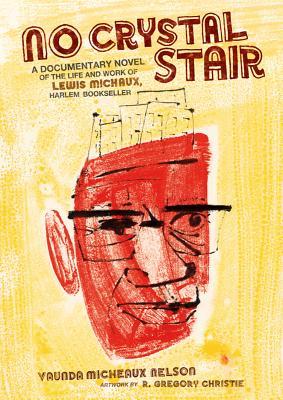
Is it just me? It seems that publishers have become really enamored of some new dust jacket treatment that adds an almost sticky texture to the paper. It feels sort of like a neoprene wetsuity material. I was on the Boston Globe Horn Book Award jury for 2012 and we recognized three pieces of fiction: No Crystal Stair by Vaunda Michaux Nelson (winner), Life: An Exploded Diagram by Mal Peet (honor book), and Code Name Verity by Elizabeth Wein (honor book). And all three have been subjected to these rubbery covers. Two of the three have dark, black backgrounds and I will admit that the matte finish of the texture adds some depth to it. But it also shows fingerprints something awful. And it’s a little tacky (duct-tape-adhesive tacky, not white-pants-after-labor-day tacky). Most libraries will put mylar covers over the jacket, simultaneously solving the problem of the unpleasant feel and compromising the benefits of the matte finish. And, really, at the end of the day, it doesn’t much matter. At all. But, still, someone is going to a lot of trouble (it must be some trouble) to take what might be perfectly fine dust jackets and make them stick.

What do you think?

no crystal stairlife an exploded diagramverity