Where She Started: A Review of Janie Writes a Play 

Janie Writes a Play: Jane Yolen’s First Great Story 
Written by Heidi E. Y. Stemple 
Illustrated by Madelyn Goodnight 
Published by Charlesbridge 
Ages 5-8 
Available February 11, 2025 

Janie loves great stories of all forms. Constantly creating stories in her head, she loves writing down her ideas. With rehearsals about to start for her class play, Janie can’t wait to learn the story and get her part. Unfortunately, when she reads the script, she’s disappointed by its lack of a “rising plot or big moment” (p. 21), and she finds the ending unsatisfying. Later, in ballet class, Janie is disheartened by the lackluster story, but the satisfying ending of her class’s dance routine inspires her to write her own script. After a long night of writing and rewriting, Janie turns in her story to her teacher, Mrs. Jiler. She agrees to use the new play and hands out new roles. In the end, the success of her play inspires Janie to keep writing and ultimately become the beloved children’s author, Jane Yolen. 

In this imaginative picture book, Heidi E. Y. Stemple, Jane Yolen’s daughter, pays loving tribute to the story of her mother’s first story. Writing about young Janie’s constantly soaring imagination, Stemple shows an appreciation for Yolen’s artistry in a manner that encourages readers to foster their own creativity. Stemple shares some insight into Yolen’s creative process, like how she would learn new words by reading books that were above her reading level. At the end, Stemple includes a brief passage about her mother’s life and work, as well as photographs of Yolen and her family growing up. Madelyn Goodnight’s bright, full-color illustrations bring whimsy to Janie’s world by showcasing her strong imagination. One side of a spread shows a regular scene at the park, with people picnicking and flying kites. On the opposite side, Goodnight illustrates what Janie sees: swashbuckling pirates and tutu-clad dinosaurs throwing tantrums. Many of the illustrations are touching references to Yolen’s large body of work. Janie Writes a Play is a delightfully fun story that encourages creativity and curiosity and serves as an amusing resource for information on a beloved children’s author that can aid in a lesson about storytelling or a program featuring Yolen’s books. 
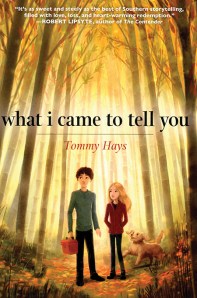
what i came to tell you

what i came to tell youwhat i came to tell you

by Tommy Hays

Egmont, 2013

Grover and Sudie have recently lost their mother, killed when she was hit by a car, crossing the street. Their father, director of the local Thomas Wolfe House, buries himself in his work. Sudie disintegrates into tears. And Grover retreats to the cane break in the vacant lot beside their home, weaving intricate tapestries of branches and leaves between the wild bamboo shoots growing there. As time passes these tapestries take on meaning for Grover, and for the community, and when a developer threatens to raze them, Grover fears the loss of much more than the pieces of art themselves. Hays is careful and artful as he draws back the curtain, slowly revealing circumstances surrounding the accident and the burdens associated with them. A cast of original, winning characters helps and bumbles and threatens and loves. There is so much sweet spirit here, and it shines just right.

This is a book cut of a standard middle grade cloth. We have seen many books about the death of a parent, wherein a child struggles to make peace and move forward, and this, surely, won’t be the last. But this book is special, if not because of its theme, then because of its approach to it. For in Grover we meet a particular, individual child, the likes of which we don’t see in literature every day. Grover is a sensitive boy.

For decades arms of the children’s literature establishment have fought against female gender expectations, filling shelves with plucky, resolute heroines who defy stereotypes and take no prisoners. By no means do I mean to suggest that we’re done–girls are still bombarded with images and messages that define their lives in unfortunate and dangerous ways–but we can find more and more positive role models on the pages of books, girls who take responsibility for their own lives, ignoring princes and taking on dragons themselves.

But where are the boys who sidestep societal expectations? Have we become so consumed with getting boys to read, chasing their attention with action and adventure and testosterone-fueled explosions, that we are inadvertently doing some stereotyping of our own? I admire what i came to tell you for its warm prose, metaphorical landscape, and astute characterizations. It is, all by itself, a lovely and resonant story. But I am thankful for its contribution to the canon. It offers us a model of a boy who looks to art as a doorway, who processes his pain with nimble fingers and a beating heart, a boy who feels. It shows us that there are lots of different ways to meet the challenges life has in store for us, and that tenderness is not a liability but an asset. It delivers the power of art, in its theme and its execution.

Thanks.