The Strength in Being Seen: A Review of Deer Run Home by Ann Clare LeZotte 

Deer Run Home 
Written by Ann Clare LeZotte 
Scholastic Inc/Scholastic Press 
Ages 10-14 
Available October 1, 2024  

Effie Pappas is Deaf and linguistically isolated from her family, who don’t speak American Sign Language. Effie and her sister, Deja, are sent to live with their father at the end of the summer. When school starts, Effie’s ASL interpreter, Miss Kathy, begins to suspect that something is wrong with Effie’s home life. After Miss Kathy visits Effie’s home and sees the neglect, she is awarded temporary custody of Effie. Now that she finally has a safe home and a budding friendship with a new girl at school named Cait, Effie starts to open up about her experiences with her family. Miss Kathy eventually petitions for and wins permanent custody of Effie, giving her the security and family she never had. 

Ann Clare LeZotte’s Deer Run Home is a touching story that exposes the reality that d/Deaf children can experience growing up in hearing families without ASL. LeZotte draws on the real-life court case this novel is inspired by to thoughtfully depict the neglect that Effie experiences because her family won’t learn her language, as well as the difficulty Effie has with speaking up about the sexual abuse she endures at the hands of her stepfather. The sexual abuse happens before the novel begins and is thoughtfully described only once, but it serves as one of the obstacles Effie is able to overcome when she finds kindness and support from Miss Kathy and other adults at school. LeZotte takes advantage of the verse format to mirror ASL grammar and storytelling styles at some points. The verse is poignant and moving, and every word is intentional. Readers are drawn to Effie’s character, feeling every bit of her joy, sadness, fear, and loneliness. LeZotte also ties in a plotline of habitat loss for the local deer population, drawing parallels between the displaced deer and Effie’s feelings of loneliness and being lost. At once heartbreaking and empowering, Deer Run Home shows the healing and growth that comes with discovering your voice. 

Butler Bookshelf

Now that school has started, so has the lesson planning! Whether you want to keep the lessons going at home or you’re looking for books to add to your classroom, we have a lot of new nonfiction books to share, including Wild Brunch: Poems About How Creatures Eat by David L. Harrison and illustrated by Giles Laroche. Harrison uses fun poems to explain how different animals across the world eat their food every day. He covers a wide range of animal species, from sea creatures, like narwhals, to land animals, like aardvarks; he also features a variety of flying animals, like turkey vultures, Mexican free-tailed bats, and houseflies. Harrison even includes a poem about mayflies, who only live for one day and don’t eat at all! Harrison includes a back matter that goes into more detail about each animal he writes about and their eating habits, sharing sources for where readers can learn more. Accompanied by Laroche’s detailed collages, Wild Brunch is sure to delight and educate any animal enthusiast!

Check out more of our nonfiction collection below!

50 True Tales From Our Great National Parks
Written by Stephanie Pearson
Illustrated by Madeline Kloepper
Published by Wide Eyed Editions
Available now

Evidence!: How Dr. John Snow Solved the Mystery of Cholera
Written by Deborah Hopkinson
Illustrated by Nik Henderson
Published by Knopf Books for Young Readers
Available now

Radar and the Raft: A True Story About a Scientific Marvel, the Lives it Saved, and the World it Changed
Written by Jeff Lantos
Published by Charlesbridge
Available September 24th, 2024

The Shape of Things: How Mapmakers Picture Our World
Written by Dean Robbins
Illustrated by Matt Tavares
Published by Knopf Books for Young Readers
Available now

Wild Brunch: Poems About How Creatures Eat
Written by David L. Harrison
Illustrated by Giles Laroche
Published by Charlesbridge
Available now

Follow the Clues: A Review of A Strange Thing Happened in Cherry Hall

A Strange Thing Happened in Cherry Hall
Jasmine Warga
HarperCollins Childrens
Age 8-12
September 10, 2024

Stolen art, a floating girl, and a mystery-solving turtle make for a quirky and suspenseful whodunit. Introverted and outcast, Rami spends more time than he’d like at the Penelope L. Brooks Museum where his mom oversees the cleaning crew. When a painting is stolen from the Cherry Hall gallery, and he and his mom become suspects, Rami begins seeing a ghost girl hovering in that same gallery. And she looks an awful lot like the girl in the missing painting. With the help of a Veda, a clever classmate and aspiring detective, and an observant turtle named Agatha, he will unravel the story of the girl, the painting, and the theft at the Penelope.

In a story about the importance of being seen, Jasmine Warga explores the connection between art, understanding, and truth. As a child of Lebanese immigrants, Rami is an outcast at school, and too timid to make trouble. Veda, however, is a bold and quirky personality, willing to challenge him to be daring in an attempt to solve the mystery. Their tentative new friendship is drawn with thoughtful attentions to the changeable emotions and growing pains of middle school. Themes of friendship and the desire to be seen (by Rami and Veda, by the girl, and by Agatha) provide subtlety to balance the heavier aspects of loneliness and the immigrant experience. This gentle, yet thrilling early elementary school mystery combines brief chapters, a fast pace, and multiple narrators to appeal to a young audience without being entirely childish. Warga breaks the fourth wall in chapters narrated by Agatha to add context, and a touch of magical realism, for young readers. The best combination of a warm-hearted friendship and clue-laced mystery.

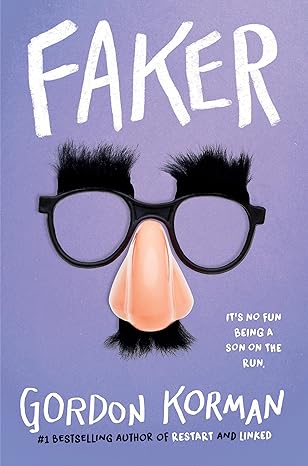
The Big Score: A Review of Faker

Faker
Gordon Korman
Scholastic
Age 8-12
July 2, 2024


Is Trey really defined by what his family does? Confidence man, liar, criminal… Faker? Living a high-end life funded by his father’s career as a con artist, Trey and his little sister are in on the game, to reel in families in a series of prep schools and wealthy communities. Settling into what could be their biggest score yet—the big kahuna—a fictional electric car start-up looking for investors, he begins to question it all. An influential middle school ethics teacher and his activist daughter open Trey’s eyes to the morality of the “family business” and a growing disillusionment with how it affects those around him.

In the authentically conflicted voice of an adolescent boy, Korman gives this realistic fiction tale a twist. What if this boy was a con trying to go straight? Then he adds all the middle school conflict that comes with friendships, family drama, and questioning parental authority. Is Dad right that no one is hurt when you take from the rich? Brisk plotting and snappy dialog mirror the pace of Trey’s quickly developing conscience. “I can’t believe I ever thought it was anything more than stealing” (p. 170). Trey matures throughout the narrative, getting involved to rehab a local park and discovering that a new friend is also part of a con artist family, efficiently driving the final action. In a conveniently tidy conclusion, he makes a dramatic decision—they all go straight, return the money, and build the stable home life Trey always wanted. A funny and fast-paced coming of age story for middle schooler readers that want a side of crime with their family drama.

Guest Reviewer Edition: A Review of Kindling

Kindling
Chee, Traci
HarperCollins
February 27, 2024
Grades 9-up

Magical elite soldiers must confront their own traumas and identities while banding together to defend a town besieged by raiders. Inspired by Seven Samurai, Chee weaves together the stories of seven kindlings who are desperate for stability and purpose in a world that no longer needs them. Raised from the age of six to be elite weapons in a war of expansion, these kindlings now wander the countryside, but are soon gathered for a mission by one of their own. Initially, each kindling views the defense of Camas—the mountain village terrorized by raiders—as just a job. But as time passes and the soldiers’ lives and pasts show their impact, the group finds solace in one another and grows close. “That’s what home is. The people you love. The people you fight for.” (p. 417) Despite coming from similar backgrounds, each character has their own unique voice, characteristics, vices, fears and desires. One character is nonbinary; the rest are female. Even if they don’t bear the same scars, every kindling recognizes a bit of themselves in their comrades. Though all seven kindlings have point-of-view chapters, the book is written in second-person, which forces the reader to empathize with their harsh reality. These vignettes of grief, trauma and the effects of war are devastating and intensely realistic; Chee paints an unflinching depiction of violence and its effect on children. Interweaving these moments with lighter ones like romance and village camaraderie keeps the book from being bogged down by heavy topics. Action scenes towards the climax of the story are fast-paced and thrilling, but easy to follow. Despite a macabre tone throughout and bittersweet climax, the story ends on a note of newfound hope and optimism. Kindling puts the desperation of existing without guidance, and the challenge of living one’s life for oneself, on display in a way any reader can empathize with.


Guest reviewer Katie Steffensen, is a Dominican University MLIS candidate and works in youth services at a library in the North Chicago suburbs. She loves working with tweens and teens.

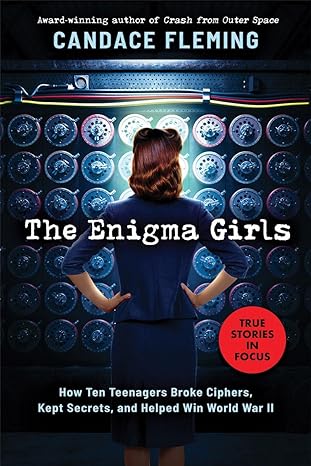
Can You Keep a Secret?: A Review of The Enigma Girls

The Enigma Girls: How Ten Teenagers Broke Ciphers, Kept Secrets, and Helped Win World War II
Candace Fleming
Scholastic
March 5, 2024
Age 8-12

It wasn’t just the boys doing their bit for the war effort during the harrowing years of World War II. Sibert Award-winner Candace Fleming follows The Enigma Girls, ten young women working with the British government, cracking ciphers and codes to help win the war. Based out of Station X at Bletchley Park, a once top secret center of the British intelligence, thousands of people (nearly ¾ of them young women, p. 237) worked night and day intercepting, decoding, transcribing, translating, and cataloging secret communications from German, Italian, and Japanese government and military leaders. Walking chronologically through the war years (1939-1945), Fleming introduces each woman as she’s recruited into the sphere of Bletchley Park, snippets of her life before, during, and after the conflict, and her often emotional reactions to the exhaustion, secrecy, and triumph of the work.

The brisk pace and simple, yet engaging prose of this narrative nonfiction title pull readers into the frantic feelings and tense atmosphere of Station X. Fleming balances that emotion with well-explained vocabulary and intra-chapter information about codes and code breaking. Extensive photo documentation of Europe at war and Bletchley Park in particular bring the horrors of war and high stakes of the work to vivid life. Due to the clandestine role that the women and Bletchley played in the war, primary source material from the time is limited. Fleming’s source notes show extensive research into the biographies and autobiographies of the women (most of them wrote of their wartime experiences once they were allowed), and archives in Britain and beyond. Other backmatter includes thorough source notes, photography credits, and author’s note, and an index to come (not included in the reviewed ARC).

A deftly crafted tribute to the unsung young women whose efforts often turned the tides of battle, saving the lives of allied servicemen.

Forgive Me?: A Review of The Dubious Pranks of Shaindy Goodman

The Dubious Pranks of Shaindy Goodman
By Mari Lowe
Levine Querdio
Published November 7, 2023
Age 10-14

Awkward and excluded, 12-year-old Shaindy Goodman just wants to fit in with the girls at Bais Yaakov Middle School. When she’s invited by Gayil, the queen bee next door, to help with a series of pranks, she shrugs off her misgivings in favor of acceptance. Helping out with some harmless jokes, even if it means breaking into school, may be her chance to find friendship. Shaindy quickly realizes the pranks are more mean-spirited than high-spirited, and that only certain classmates are being targeted. Naïve to Gayil’s manipulation, she feels guilty but hopes for the best until the mischief and hard feelings are all pinned on her. As she finally understands Gayil’s acts of revenge for an unintended slight, she lets go of her own anger for lessons of penance, forgiveness, and taking responsibility for her actions.

Lowe uses the period of the Jewish High Holidays of Rosh Hashanah and Yom Kippur, as well as their lessons, as a frame for this middle grade drama of judgement and atonement. She crafts a well-rounded and sympathetic character in Shaindy, expressing a universal need for friendship and belonging, and the way tweens and teens often make poor decisions in search of them. The plot and pace of the title move quickly through the season, mirroring the way bad choices can often lead to snowballing consequences. Moments of lightness, Shaindy’s struggle with roller blades, and final closeness with her sister help temper more serious content and lead to a satisfying conclusion. In the penultimate scene, a classroom of girls offers each other silent acknowledgment of wrongs and forgiveness for them. The wise words of a teacher, “The hardest thing many of you will do in your lives… is admit you were wrong,” (p 155) is a life lesson for those of all ages and religious backgrounds.

Elementary!: A review of The Improbable Tales of Baskerville Hall

The Improbable Tales of Baskerville Hall
Ali Standish
Harper Collins Children’s Books
Age 8-12
Available September 12, 2023

In a middle-grade twist on the Sherlock Holmes stories, a brilliant young Arthur Conan Doyle accepts a full scholarship to a mysterious school for exceptional students. In the hopes of providing a better life for his family, Arthur devotes himself to school, including the friendships, mysteries, and mayhem that one would expect of a 19th century English boarding school—eccentric students and professors, secret societies, magical clocks, and even a baby dinosaur. But when it comes time to submit to the questionable ethics of the secret society, and their promises of wealth and power, or do the right thing at the possible expense of his future, Arthur shows integrity to the end.

Standish borrows liberally from the Holmes novels with characters, like Dr. Watson, Jamie Moriarty, and Sherlock Holmes himself, named for many of the original Doyle’s most famous characters. Arthur himself is drawn as one would imagine a young Sherlock. These details, however, may be lost on young readers. The swiftly plotted and intricately detailed mystery can stand alone though, using its quirky characters and darkly atmospheric setting to draw the reader into its world and to rooting for the cast of diverse and well-crafted characters. Themes of friendship, integrity, and problem-solving run heavily through the novel and help to ground some of the more outlandish plot devices, like time travel and dinosaur hatching. And with a parting “the game is afoot” (p. 310), Standish sets the stage for a series of future adventures that junior sleuths will be sure to love.

Claiming Her Place: A Review of We Still Belong

We Still Belong
Christine Day
HarperCollins Children’s Books
Age 8-12
August 1, 2023

Excitement, anxiety, disappointment, and hope—over the course of one emotional day, Wesley Wilder explores all the feeling middle school has to offer. As the early riser in her close-knit, multi-generational, indigenous household, Wesley battles nerves over the big day she’s planned. She’s written a heartfelt poem for the school newspaper in celebration of Indigenous People’s Day. She’s planning to use the same newspaper issue to ask her kind, funny, gamer-boy, crush to the school dance. And will cap off the day celebrating at the intertribal powwow planned in her Seattle area community.

As the title implies, themes of belonging, community, family, and friendship drive the fast-paced plot of this middle grade novel. Wesley is a thoroughly sympathetic character, full of all the uncertainty, eagerness, and budding confidence of adolescence, while exhibiting a strong connection to her single mother, grandfather, and extended family (a well-crafted network of supportive adult characters). Her thoughtful voice, and desire for community, come through in care for her best friend, Hanan, and her efforts to reach out to those around her in need of a friend. And even when things around Wesley seem to unravel, like her crush already having a date or her aunt’s family’s potential move, she grounds herself in gratefulness, showing a mindfulness uncommon to most middle grade characters. Day (Upper Skagit) handles incidences of discrimination toward indigenous people and causes with a gentle touch, weaving them into the narrative in a way that explains and exemplifies Wesley’s kindness. A day in the life of a soft-hearted girl growing into her voice.