YMA thoughts

There were lots of surprises at the ALA Youth Media Awards this past Monday morning (you can read about all of the winners here) and they have already been much celebrated, dissected, and critiqued. I have my own thoughts (don’t we all) which I offer as a list, because I fear if I started writing something long form I’d be here until April. And I have some snow to shovel.

So, in no particular order, here’s what I think:

1) Diversity won the day. Everywhere. The Newbery medal and both honor books. The Wilder (ALSC lifetime contribution) and Edwards (YALSA lifetime contribution) awards. The Caldecott medal and three of the six honor books. The Arbuthnot lecturer. Three of the five Sibert honor books. The Geisel award author. Not to mention the slates from the Belpré, the Coretta Scott King, the Schneider Family, and the Stonewall, all of which are diverse by nature. Everywhere!

2) Back in December, in a comment on the Calling Caldecott blog, I suggested that it was entirely possible for This One Summer be recognized by both the Caldecott and Printz committees. Nobody was buying it. This is me, gloating.

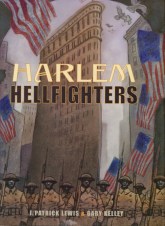
3) Some of my favorites were overlooked. Harlem Hellfighters, The Misadventures of the Family Fletcher, The Turtle of Oman. But I still get to love and champion those books, and now I get to (re)acquaint myself with other books that other folks find to be extraordinary. It’s hard to think of that as a problem, really.

4) Some things I really don’t like were recognized, too. And that’s a terrific opportunity to remember that people see books differently from how I do, and people see the awards differently from how I do. And, ultimately, that the greater the variety of taste and appreciation we have among our ranks, the better able we are to meet the many different literary needs of the young people we serve. Win win, as it were.

5) What did you think?

harlem hellfighters Levy_Front_final 91xfx6cxaRL._SL1500_


PCP Two of Clubs: Denied Detained Deported

denied detained deportedDenied Detained Deported: Stories from the Dark Side of American Immigration

by Ann Bausum

National Geographic, 2009

Negative space is an artistic construct that looks at the visual space around or between subjects as a place in an image where meaning can exist and communicate itself: objects can be defined by their own outlines, or by the outlines of adjacent objects. The construct has application in the study of literature, too, as we consider how an idea is shaped not only by its own definition but also by the definitions of related concepts. As we seek to understand “belonging” in books for young people, then, let us look not only at books that celebrate someone’s place in a particular community, but books that consider the refusal of such membership, too.

Ann Bausum applies such an approach to American history in Denied Detained Deported: Stories from the Dark Side of American Immigration, seeking to understand how people came to this country, by looking deeply and carefully at a number of situations where that arrival was thwarted. She begins with the familiar Emma Lazurus poem that appears on the plaque at the base of the Statue of Liberty, followed by a contemporary poem by Naomi Shihab Nye that offers a decidedly less welcoming vision of the US border. From there Bausum investigates a number of historical events, each titled with a different form of alienation. “Excluded” looks at the Chinese Exclusion Act of 1882 which left Chinese immigrants ineligible for citizenship until 1943. “Denied” tells the story of the St. Louis, a ship carrying hundreds of German Jewish refugees that the US turned away in 1939. The author captures the events with arresting clarity, engaging the reader’s empathy and outrage with her precise language and documentary research. And on top of the harrowing stories Bausum posits questions about our contemporary treatment of those newest to our country, often subjected to xenophobic mistreatment and persecution.

By exacting the nature of fearsome, systematized alienation, Denied Detained Deported delivers a powerful picture of how important it is to belong.

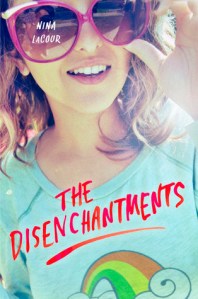
PCP Ace of Spades: The Disenchantments

11699055The Disenchantments

by Nina LaCour

Dutton, 2012

Colby and Bev have been saving for years (and years) for their year-long-backpack-around-Europe-before-college-trip. It’s going to be the best. They’re best friends, after all, and, well, Colby is pretty much in love with Bev. Except Bev isn’t going. She’s going to college instead. She applied ages ago. Sorry.

To make matters worse (or not quite so bad), Colby will be spending the summer before he’s not going to college traveling around with Bev and Meg and Alexa, The Disenchantments, managing their Pacific Northwest tour from his Uncle Pete’s VW van. There is some road-trip revelry here, and a goodly amount of deep adolescent angst, that keep things moving and give us plenty to think about along the way. But the novel’s real genius comes from profound clarity and resonance with which LaCour paints Colby’s circumstances. To be sure, not many of us have experienced this particular turn of events, but she makes something universal of the skittish confusion and achy disorientation that come when the dependability of high school gives way to the unknown of what comes next. It’s no easy path to tread, and Colby’s way through is thrilling and sad and powerfully affecting. By getting the trauma just right, LaCour makes the resultant growth immediately recognizable and especially gratifying.

Mock Newbery Results

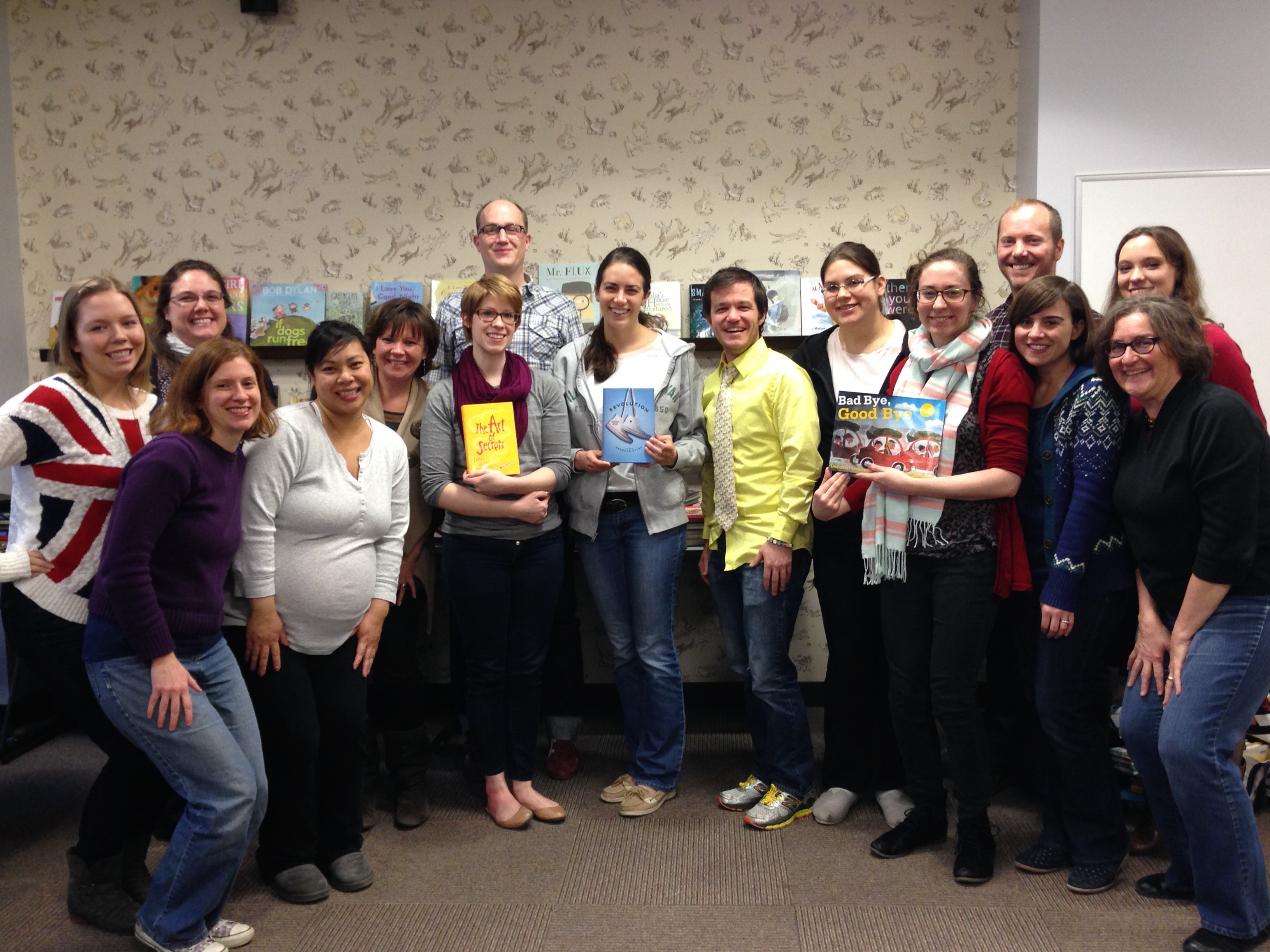
I spent this past weekend immersed in deep, insightful book discussion with fourteen other astute, committed individuals, in search of “the most distinguished contribution to American literature for children” published in 2014. This was the culmination of a semester’s worth of reading, nominating, and more reading. By dedicating the time and energy of an entire course to the endeavor we were able to really dig into the Newbery process, replicating not just the book discussion, but the nominations, introductions, and balloting. In the end we spent 15 hours over two days discussing and voting on a list of 29 titles, arriving at a winner and two honor books. I’ll talk a bit more about our lists in a bit, but let me now get to our results:

The committee chose two honor books:
the art of secretsThe Art of Secrets by James Klise, published by Algonquin Young Readers, 2014

When arsonists torch Saba Khan’s apartment, tensions are high. Is this a hate crime, targeting Saba’s Pakistani immigrant family? Was is staged? Who is responsible? The community at her independent school steps up, raising funds to help the family, but when one of the items collected for auction turns out to be the work of Chicago outsider artist Henry Darger, valued at half a million dollars, things get bona fide complicated. Klise exposes the truths, and misdirections, through a series of blindered e-mails, texts, journal entries, phone conversations, and other exchanges between a diverse cast of players, threading the compelling mystery with obfuscation and intrigue. Taut plotting, masterful characterization, and nuanced exposition combine in a satisfying, surprising novel.

bad bye good bye

Bad Bye, Good Bye by Deborah Underwood, illustrated by Jonathan Bean, published by HMH Books for Young Readers, 2014

A little boy travels with his family from their old home to their new one, lamenting their losses, considering their transitions, and hoping for their future. Underwood composes 57 discrete single-syllable words into forty rhyming couplets, with every couplet being an adjective/noun pairing (with the exception of one critical turning point). Within this structured framework she achieves a staggering range of emotion and experience, equally resonant to the lap-based toddler, the emerging reader, or budding poet. Simple words take on layers of meaning that shift and grow in their careful sequence, drawing the reader or listener along the journey’s immediate, indelible arc. While Bean’s energetic, substantial images add atmosphere to the outing, establishing meaningful context and reinforcing the emotional tug, Underwood’s spare, rhythmic, verse has its own unmistakable, dramatic power.

And the committee chose, as winner of our 2015 Mock Newbery:
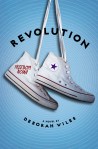
RevolutionRevolution by Deborah Wiles, published by Scholastic Press, 2014.

The town of Greenwood, Mississippi becomes the battleground for a nation in turmoil during the freedom summer of 1964. “Agitators” from the north descend to establish and protect black voters’ rights while the local communities erupt at the challenge to the status quo. Wiles tells the story in two first-person narratives, of twelve-year-old Sunny, whose eyes are opening to habituated racism she couldn’t see, and fourteen-year-old Raymond, who experiences that racism first-hand. Wiles embellishes and interrupts those two distinct voices with a jarring battery of primary documents, submerging the reader in a cultural context that includes everything from frothy invocations of pop-culture to noxious expressions of hatred, all of them documented and real. The resulting combination makes for a piercing, illuminating, and especially human exploration of a tumultuous episode in our country’s history.

A note about our lists:

We began our reading with a list of 15 titles selected by me (as instructor for the course) in July, which included both published and anticipated books. Unlike the “real” committee, that short list was curated to represent a wide range of style, tone, format, and reading level, as well as a balance of cultural diversity. In addition to those titles we all read widely from an ever-growing list of suggested titles from which each student nominated one. And in the end we arrived at our final 29. We can never know how well our final list might compare to the books the “real” committee is looking at this year. Indeed, in many ways our purposes are different. But we have great confidence in the depth and precision of the investigation we undertook, and great pride in the results.
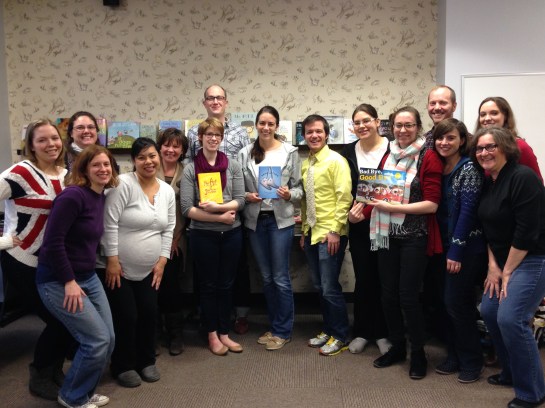
mock newbery committee

The results are in

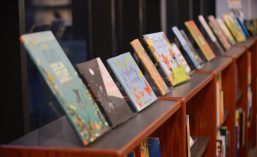
As part of the fifth annual Dominican University Caritas Veritas Symposium the Butler Center staged a Book Identity Project through which we solicited from members of the university community a book (or six) from childhood that contributed to their identity. Participants were given an old-school check-out card asking for the book and we lined the front door and window of the center with old-school check-out card pockets to receive them. We had a tremendous response, with 101 books listed on 86 different cards.

identity cardsThe submissions are fascinating, with a surprising variety. To be sure, the collection includes some well-loved, to be expected titles. Where the Wild Things Are gets three mentions, and Dr. Seuss shows up six times, twice for The Cat in the Hat, twice for Green Eggs and Ham, and once each for Oh, the Places You’ll Go! and One Fish, Two Fish, Red Fish, Blue Fish. I’m not surprised to see Louisa May Alcott or A.A. Milne, C.S. Lewis or Lewis Carroll (or Robert Louis Stevenson) in the mix. The single most-cited title is Shel Silverstein’s The Giving Tree, with four mentions, which is something of a surprise, not because it’s a book I don’t care for (indeed, I don’t care for it) but because it seems to have the sort of nostalgic perspective that I never thought spoke strongly to children. Consider me schooled. I was somewhat surprised, too, to find books outside the children’s canon, by the likes of Hemingway and Steinbeck and Dwight D. Eisenhower. We didn’t specify that the book needed to be a book written expressly for children, just that it resonated in the participant’s childhood, so it makes perfect sense that books like these would show up. It’s a great reminder of my own myopia, that I automatically understand young people’s reading through my deep engagement with the body of literature I study. Schooled again!

Quite a few series made the cut, including Nancy Drew, The Boxcar Children, The Chronicles of Narnia, and, of course, Harry Potter (I was 32 when Harry Potter and the Sorcerer’s Stone was published, and it’s just a little sobering to realize how many of our students read it as children). Alexander and the Terrible, Horrible, No Good, Very Bad Day got two mentions (I wonder if those folks saw the movie) as did The Runaway Bunny. Andrew Clements’ Things Not Seen, published in 2004, is the youngest book mentioned, and the oldest is Henry Wadsworth Longfellow’s Song of Hiawatha, first published in 1855.

Here’s the complete list. Check it out. Are you surprised by what you see? And while you’re at it, let us know if you can identify the authors of any of the first few books listed, unfamiliar to us.

stephan and karaHere are Butler Center Student Assistant Kara Pauley and LISSA President Stephan Licitra collecting entires (and passing out candy). It sure is great to have such friendly, diligent assistance.


Oh, and for the record, my choice was Spectacles, by Ellen Raskin. It’s a great book. You should check it out.spectacles

Animals at war

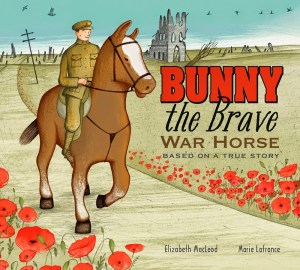
Bunny the BraBunny the Brave War Horseve War Horse: Based on a True Story

by Elizabeth McLeod, illustrated by Marie Lafrance

Kids Can Press, 2014

Bunny, a magnificent horse, and two brothers, Bud and Tom, ship out to Europe in 1914 among a group of police horses and officers sent to fight on the battlefields of WWI. Bunny is initially assigned to Bud, and when he is killed he becomes Tom’s horse. The two form a close bond, and survive the conflict together, performing acts of heroism and sacrifice along the way. At war’s end, however, the two are separated; Tom returns to Canada, and Bunny is sold to a Flemish farmer. McLeod tells Bunny’s story with a combination of poetic license and narrative restraint. Her straightforward prose tells Bunny’s story simply, without drama or sentiment. We experience the hardships of war–the hunger and danger and death–but the matter-of-fact tone with which they are expressed establishes Bunny’s and Tom’s resolute, impenetrable bravery. Lafrance’s folk-like illustrations reinforce this sense of plain strength. Spread across double pages, the images are a bleak amalgam of murky greens and greys, setting a desperate tone broken only by the brilliant poppies immortalized in Dr. John McCrae’s poem “In Flanders Fields.” McLeod includes an author’s note in which she explains just how much isn’t known about Bunny’s story (even “Bud,” the name given Tom’s brother, is an invention), and confirms the heartbreaking conclusion. The Library and Archives Canada Cataloguing in Publication assigns fiction subject headings to this title, and I’m inclined to agree. This is a fiction with roots in fact. But it is no less a powerful and touching evocation of the perpetual price of waging war.

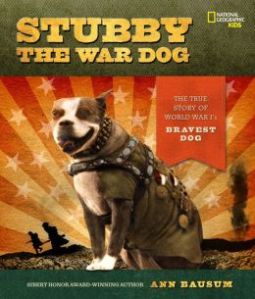
stubby the war dogStubby the War Dog: The True Story of World War I’s Bravest Dog
by Ann Bausum

National Geographic, 2014

In stark contrast to Bunny, Stubby the War Dog is a presentation of a bodacious collection of scrupulously documented facts surrounding one formidable dog. Sergeant Stubby, as he was known, was a dog with a personality as outsized as his antics. He presented himself as a stray to the 102nd Infantry, training at Yale University in 1917, and so endeared himself to the soldiers that one Corporal Robert Conroy smuggled him onto their ship bound for the theater in Europe. From there Stubby’s infamy grew and grew. Bausum offers a series of almost unbelievable anecdotes–Stubby saluting the officer who discovers him as a stowaway, Stubby rescuing a French toddler from oncoming traffic, Stubby recovering from grievous injury sustained on the battlefield–which establish his irrepressible persona. She also surrounds Stubby’s own story with rich and extensive context, offering lots of information about the greater war and its impact on everyone it touched. The narrative follows Stubby back to the United States after the war, where he travels, parades, and generally contributes to the post-war effort, and even chronicles his story after death, and the eventual inclusion of his remains at the Smithsonian Institution. What is most striking about this masterful exposition, to me, is the journalistic integrity of Bausum’s language. She makes it crystal clear, at every juncture, what she knows and what she wonders, and how she knows the difference. At no time does the reader question the veracity of the facts being presented, yet the narrative’s careful precision never intrudes on the accessible flow of the story. It’s easy to imagine kids enthralled with Stubby’s bigger-than-life life. And it’s just as easy to imagine them fascinated by the curiosity that prompted the investigation and the research that followed. I consumed the story through the Recorded Books audiobook version, narrated by Andrea Gallo, and even the experience without a single image was riveting.

These two books differ from one another in interesting ways. One uses snippets of history as a foundation for a largely fictionalized story while the other offers a detailed account sourced from the (admittedly much more plentiful) historical record. Yet, almost counterintuitively, it is Stubby’s “true” story that brims with outlandish, colorful flourishes, while Bunny’s “imagined” account offers a much more reserved and stoic vision of the animals-at-war experience. And this juxtaposition, in a nutshell, is what I love so much about the work of librarianship for the young. It is not ours to determine which is the better, truer, more legitimate approach, We get to put these books on the self, together, and invite kids (metaphorically, or directly, too, if we want) to ponder them both.

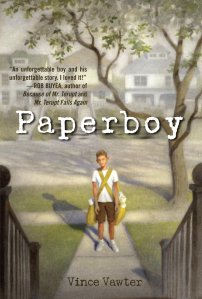
Paperboy

the paperboyPaperboy

by Vince Vawter

Delacorte, 2013

audiobook by Listening Library, narrated by Lincoln Hoppe and Vince Vawter

As 2014 ALA Annual approaches I find myself, as ever, catching up with the award-winning books of the year, in anticipation of the upcoming conference’s many festivities. I just finished listening to the affecting recording of Newbery Honor-winning Paperboy by Vince Vawter, a semi-autobiographical story of a boy with a stutter coming of age in Memphis, TN in 1959.

The entire novel takes place over the course of a few weeks in the summer before 7th grade. Our protagonist, whom we come to know as Vince at the end of the book, takes over his friend Rat’s paper route and though his interactions with the people he meets as a consequence learns about himself and his place in the world. I will leave the details to you (if you’ve read the book you already know them, and if you haven’t, I don’t want to spoil them) but I do want to look at a pivotal scene where Vince and his guardian find themselves in grave peril, due, to some degree, to Vince’s disobedience. There is risk of real bodily harm, death even, and yet in the moment of danger there is no guilt and no reproach, only devotion and commitment. I credit the author for his keen characterization and careful plotting. He telegraphs none of these feelings, focusing instead on the circumstances and allowing the emotions to course underneath, organically. It’s a beautiful piece of writing, successful for its simple clarity and for the well-crafted build-up before it.

The scene has been much with me of late. Beyond its own literary resonance, it speaks to my understanding of the news of the day, specifically the aggressive scrutiny of prisoner of war Sgt. Bowe Bergdahl negotiated release. There are some who proclaim Sgt. Bergdahl a deserter who besmirched his homeland’s good name. They see his exchange for five Guantanamo-detained members of the Taliban as an abominable expense of geopolitical capital. They call him a traitor and thereby invalidate any claim he might have for American support. But my recent experience with Paperboy reminds me that our relationships have value expressly because they are not dependent upon our perfect behavior. We are allowed mistakes. Those who love us and assume responsibility for us take care of us. No matter what. I would hope that a soldier putting himself or herself in harm’s way could expect no less of his or her government, regardless of whether or not that soldier had stepped afoul of the line. I imagine that the circumstances surrounding Sgt. Berghadl’s initial disappearance will be investigated, and that strikes me as wholly appropriate. But I’m thankful and proud that the United States Government negotiated his release based upon his citizenship, not his conduct.

We all make mistakes, and none of us would want to be defined by our worst ones. Life is so very complicated, and how lucky we are that we have fine books like Paperboy to help us make sense of it.

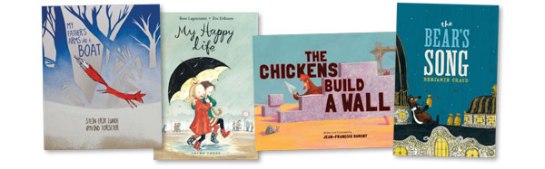
USBBY’s 2014 Outstanding International Books List

Here at the Butler Center we’re proud to host the USBBY Outstanding International Books Committee for their year-end deliberations. And, given our recent trip to the Bologna Children’s Book Fair, we’re especially interested in their choices.

Here’s the 2014 list. I see some favorites. How about you? What international books for children and teens are on your radar for next year’s list?

SLJ1402w_FT-USSBY_Image1

what i came to tell you

what i came to tell youwhat i came to tell you

by Tommy Hays

Egmont, 2013

Grover and Sudie have recently lost their mother, killed when she was hit by a car, crossing the street. Their father, director of the local Thomas Wolfe House, buries himself in his work. Sudie disintegrates into tears. And Grover retreats to the cane break in the vacant lot beside their home, weaving intricate tapestries of branches and leaves between the wild bamboo shoots growing there. As time passes these tapestries take on meaning for Grover, and for the community, and when a developer threatens to raze them, Grover fears the loss of much more than the pieces of art themselves. Hays is careful and artful as he draws back the curtain, slowly revealing circumstances surrounding the accident and the burdens associated with them. A cast of original, winning characters helps and bumbles and threatens and loves. There is so much sweet spirit here, and it shines just right.

This is a book cut of a standard middle grade cloth. We have seen many books about the death of a parent, wherein a child struggles to make peace and move forward, and this, surely, won’t be the last. But this book is special, if not because of its theme, then because of its approach to it. For in Grover we meet a particular, individual child, the likes of which we don’t see in literature every day. Grover is a sensitive boy.

For decades arms of the children’s literature establishment have fought against female gender expectations, filling shelves with plucky, resolute heroines who defy stereotypes and take no prisoners. By no means do I mean to suggest that we’re done–girls are still bombarded with images and messages that define their lives in unfortunate and dangerous ways–but we can find more and more positive role models on the pages of books, girls who take responsibility for their own lives, ignoring princes and taking on dragons themselves.

But where are the boys who sidestep societal expectations? Have we become so consumed with getting boys to read, chasing their attention with action and adventure and testosterone-fueled explosions, that we are inadvertently doing some stereotyping of our own? I admire what i came to tell you for its warm prose, metaphorical landscape, and astute characterizations. It is, all by itself, a lovely and resonant story. But I am thankful for its contribution to the canon. It offers us a model of a boy who looks to art as a doorway, who processes his pain with nimble fingers and a beating heart, a boy who feels. It shows us that there are lots of different ways to meet the challenges life has in store for us, and that tenderness is not a liability but an asset. It delivers the power of art, in its theme and its execution.

Thanks.