The results are in

As part of the fifth annual Dominican University Caritas Veritas Symposium the Butler Center staged a Book Identity Project through which we solicited from members of the university community a book (or six) from childhood that contributed to their identity. Participants were given an old-school check-out card asking for the book and we lined the front door and window of the center with old-school check-out card pockets to receive them. We had a tremendous response, with 101 books listed on 86 different cards.

identity cardsThe submissions are fascinating, with a surprising variety. To be sure, the collection includes some well-loved, to be expected titles. Where the Wild Things Are gets three mentions, and Dr. Seuss shows up six times, twice for The Cat in the Hat, twice for Green Eggs and Ham, and once each for Oh, the Places You’ll Go! and One Fish, Two Fish, Red Fish, Blue Fish. I’m not surprised to see Louisa May Alcott or A.A. Milne, C.S. Lewis or Lewis Carroll (or Robert Louis Stevenson) in the mix. The single most-cited title is Shel Silverstein’s The Giving Tree, with four mentions, which is something of a surprise, not because it’s a book I don’t care for (indeed, I don’t care for it) but because it seems to have the sort of nostalgic perspective that I never thought spoke strongly to children. Consider me schooled. I was somewhat surprised, too, to find books outside the children’s canon, by the likes of Hemingway and Steinbeck and Dwight D. Eisenhower. We didn’t specify that the book needed to be a book written expressly for children, just that it resonated in the participant’s childhood, so it makes perfect sense that books like these would show up. It’s a great reminder of my own myopia, that I automatically understand young people’s reading through my deep engagement with the body of literature I study. Schooled again!

Quite a few series made the cut, including Nancy Drew, The Boxcar Children, The Chronicles of Narnia, and, of course, Harry Potter (I was 32 when Harry Potter and the Sorcerer’s Stone was published, and it’s just a little sobering to realize how many of our students read it as children). Alexander and the Terrible, Horrible, No Good, Very Bad Day got two mentions (I wonder if those folks saw the movie) as did The Runaway Bunny. Andrew Clements’ Things Not Seen, published in 2004, is the youngest book mentioned, and the oldest is Henry Wadsworth Longfellow’s Song of Hiawatha, first published in 1855.

Here’s the complete list. Check it out. Are you surprised by what you see? And while you’re at it, let us know if you can identify the authors of any of the first few books listed, unfamiliar to us.

stephan and karaHere are Butler Center Student Assistant Kara Pauley and LISSA President Stephan Licitra collecting entires (and passing out candy). It sure is great to have such friendly, diligent assistance.


Oh, and for the record, my choice was Spectacles, by Ellen Raskin. It’s a great book. You should check it out.spectacles

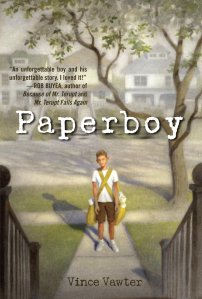
Paperboy

the paperboyPaperboy

by Vince Vawter

Delacorte, 2013

audiobook by Listening Library, narrated by Lincoln Hoppe and Vince Vawter

As 2014 ALA Annual approaches I find myself, as ever, catching up with the award-winning books of the year, in anticipation of the upcoming conference’s many festivities. I just finished listening to the affecting recording of Newbery Honor-winning Paperboy by Vince Vawter, a semi-autobiographical story of a boy with a stutter coming of age in Memphis, TN in 1959.

The entire novel takes place over the course of a few weeks in the summer before 7th grade. Our protagonist, whom we come to know as Vince at the end of the book, takes over his friend Rat’s paper route and though his interactions with the people he meets as a consequence learns about himself and his place in the world. I will leave the details to you (if you’ve read the book you already know them, and if you haven’t, I don’t want to spoil them) but I do want to look at a pivotal scene where Vince and his guardian find themselves in grave peril, due, to some degree, to Vince’s disobedience. There is risk of real bodily harm, death even, and yet in the moment of danger there is no guilt and no reproach, only devotion and commitment. I credit the author for his keen characterization and careful plotting. He telegraphs none of these feelings, focusing instead on the circumstances and allowing the emotions to course underneath, organically. It’s a beautiful piece of writing, successful for its simple clarity and for the well-crafted build-up before it.

The scene has been much with me of late. Beyond its own literary resonance, it speaks to my understanding of the news of the day, specifically the aggressive scrutiny of prisoner of war Sgt. Bowe Bergdahl negotiated release. There are some who proclaim Sgt. Bergdahl a deserter who besmirched his homeland’s good name. They see his exchange for five Guantanamo-detained members of the Taliban as an abominable expense of geopolitical capital. They call him a traitor and thereby invalidate any claim he might have for American support. But my recent experience with Paperboy reminds me that our relationships have value expressly because they are not dependent upon our perfect behavior. We are allowed mistakes. Those who love us and assume responsibility for us take care of us. No matter what. I would hope that a soldier putting himself or herself in harm’s way could expect no less of his or her government, regardless of whether or not that soldier had stepped afoul of the line. I imagine that the circumstances surrounding Sgt. Berghadl’s initial disappearance will be investigated, and that strikes me as wholly appropriate. But I’m thankful and proud that the United States Government negotiated his release based upon his citizenship, not his conduct.

We all make mistakes, and none of us would want to be defined by our worst ones. Life is so very complicated, and how lucky we are that we have fine books like Paperboy to help us make sense of it.

USBBY’s 2014 Outstanding International Books List

Here at the Butler Center we’re proud to host the USBBY Outstanding International Books Committee for their year-end deliberations. And, given our recent trip to the Bologna Children’s Book Fair, we’re especially interested in their choices.

Here’s the 2014 list. I see some favorites. How about you? What international books for children and teens are on your radar for next year’s list?

SLJ1402w_FT-USSBY_Image1

Girls gone wild

I lived with my sister, now a science education specialist, while she was completing her master’s degree. Her thesis considered students’ perceptions and assumptions of scientists: their work, appearance, and setting. We had a ball examining the teenaged participants’ drawings, through which an overwhelmingly popular archetype emerged: Einsteinian hair, glasses, bow ties, lab coats, Erlenmeyer flasks, boiling liquids, explosive gases. When asked “What does a scientist look like?”, students’ answer is almost unanimously male and inside a laboratory.

The Tapir ScientistI am so pleased to see books for the young adult reader challenging the stereotype. Houghton Mifflin’s excellent Scientists in the Field series solidifies an altogether different image. Take The Tapir Scientist, by children’s nonfiction juggernauts Sy Montgomery and Nic Bishop. While the cover photograph shows the captivating and rarely seen face of a tapir – trunk-like snout, curious eye and nearly smiling mouth – the first title page’s photograph reveals the book’s namesake and star: a woman wearing dirty cargo pants, t-shirt and baseball cap wades through ankle-deep wetlands, holding an instrument in the air and peering towards the horizon. Her name is Patricia Medici, a Brazilian scientist whose work may more closely resemble extreme camping than the conventional image of “doing science.” For days, she and her team (which includes Sy and Nic) make trips around the vast Pantanal Wetlands of Brazil attempting to collar and track the elusive tapirs, whose behavior is largely a mystery. She has to beware pumas, venomous snakes, and the relentless bite of ticks, but the more troublesome battles are that with faulty equipment or inconsistent results. Although the subject of The Tapir Scientist and other books within this series is an animal, the text’s content is all process from the scientist’s point of view. Montgomery and Bishop record Patricia’s frustrations and triumphs as they happen and present their work as a narrative full of suspense, empathy and joy. Yes, the reader learns the traditional creature facts – anatomy, behavior, ecosystem – but all that report fodder is discovered only through the journey the reader makes with the scientist.

PrimatesSimilarly, Jim Ottaviani and Maris Wicks’ graphic novel Primates: The Fearless Science of Jane Goodall, Dian Fossey, and Biruté Galdikas places its readers right in the boots (or bare feet) of the title’s three scientists. Through brilliantly distinct and sometimes overlapping narration, we grow to understand the individuals: Jane’s endless curiosity, Dian’s brusque fierceness, Biruté’s patient hunger. But all are united by their commitment to primate study, more so, to study primates in the wild. Each is recruited by famed anthropologist Louis Leakey, whose targeting of women feels ambiguously both progressive and sexist: he seems to respect these women for their observational intelligence, but Primates also references his womanizing with the young researchers he employs. Nevertheless, for these three women, chimps, gorillas and orangutans are the subject of all attention. The reader, too, is given a front seat to the observations; Wicks devotes pages of panels, with minimal text, just to the sequential movements and expressions of the primates: the chimps’ mysterious rain dance, gorillas’ unique noses “like big fingerprints,” an orangutan’s leisurely journey through the trees. Wicks’ style is not naturalistic; on the contrary, her brightly painted drawings are stylistically playful and simply rendered. Coupled with the type sets used for the texts, which mirror the style of each scientist’s documentation – handwritten script or typed Courier – the reader can imagine these illustrations appearing in these women’s scientific logs, a patient and enthusiastic recording of what they see in the field.

Into That ForestLastly, Louis Nowra’s fictional novel Into That Forest portrays not a willing scientist per se, but a child lost in the woods. Incredibly, young Hannah and her friend Becky survive a storm in the Tasmanian wild, only to be rescued and adopted by two Tasmanian tigers. Initially they are terrified, but as the creatures prove themselves trustworthy guardians – bringing them caught fish, leading them to their den – the girls adapt to their bizarre new family structure. Over four years in the wild, they slowly lose the things that define them as human – their manners, clothes, and eventually, language – but they gain just as much in their careful observations of their new companions. Theiri senses sharpen, words are replaced by growls and eye expressions, and affection for their new foster parents grows:

The tigers stopped being animals to me. They were Corinna and Dave… Corinna showed she liked us by licking us and curling up with us whenever we slept. Though I have to say, if she didn’t like something you did, she’d nip you to let you know.

Nowra’s story, as dense and rich as the Tasmanian forests, not only stands as an imaginative memorial to the thylacine, officially declared extinct in 1936, but as a testament to Piaget’s classic theory of development: that the child is a scientist, learning and constructing her world of knowledge through constant observation and application without any extrinsic motivation, like candy bribes or A+ grades. It is that childlike passion and curiosity that should identify grownup scientists more than the lab coats. Indeed, the women so masterfully presented in these varied stories all possess that drive for understanding the world that seems to exist outside of and above the status quo of our everyday work culture. And perhaps outside is the key: it is hard not to feel awed, inspired and motivated when you’re surrounded by the wonder of the wild.

God got a dog

godgotadogGod got a dog

by Cynthia Rylant, illlustrated by Marla Frazee

Beach Lane Books, 2013

Cynthia Rylant is a visionary, the sort of author who seems compelled to challenge literary constructs, and herself, ever in pursuit of some deeper truth that she needs to express. At least she has always seemed like a visionary to me, judging by her extraordinarily varied, generally innovative and uniformly personal body of work. Whether it is the Newbery-winning Missing May, with its put-your-head-on-the-desk heartbreak, the bold sweetness of her self-illustrated picture books like Cat Heaven and Dog Heaven, or the inspired, uncommon poetry of Boris or Something Permanent, her work transcends the expected in order to achieve the basic. In 2003 she published God Went to Beauty School, a collection of page-long poetic essays, each about God undertaking some commonplace activity, from opening His own nail salon to cooking spaghetti. These episodes, in their essential combination of the mundane and the sublime, express a rainbow of grace. In this year’s God got a dog a number of these poems is recollected and illustrated by Caldecott-honor illustrator Marla Frazee, who brings her own generous accessibility to the project. Frazee adds to the flavor of the book. Hand-lettering contributes a sense of innocence. Light permeates each tableau. But most striking is her casting of God in each episode. Rylant’s work already used both female and male pronouns to refer to God, but Frazee takes the plurality a step further, diversifying the personifications of God as much as possible: old and young, big and small, country and city, race after race. None of these updates represents a huge departure from the tone and intention of the original work. This new books, like its predecessor, is a soft, welcoming meditation on the sanctity of our daily lives and the reflection of the divine in simple things (even if those reflections are upside-down). But there is whimsy in this new package, a luminous, bubbly sort of warmth that unifies the different experiences and personifications, softening the edges and opening the doors. Rylant’s God is us, and Frazee’s us is God, and there you have it.

Adrenaline Fix

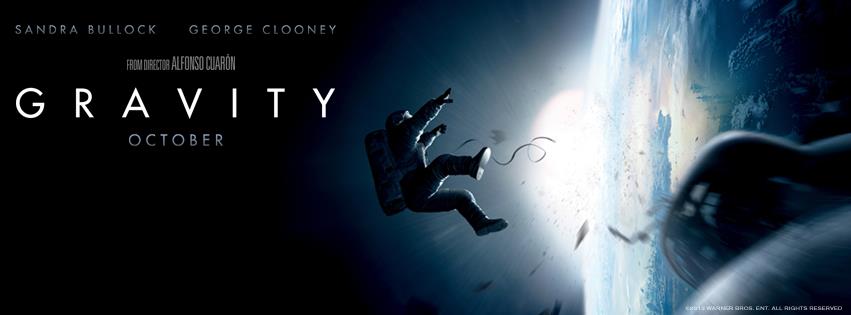
gravityI’m really not much of an adrenaline junky. Sure, I like a roller coaster as much as the next person (though I am now, sadly, too tall to ride most of them) and I’d follow Jason Bourne anywhere. But friends will tell you that all I catch of a screen thriller is what I can see between the fingers pressed firmly over my eyes. I hear even less (my thumbs are blocking my ears). And it takes a good nine hours to watch one from the comfort of my couch, what with all the pausing and walking around the living room shaking out my hands. And yet I find myself strangely addicted to the trailer for the new Alfonso Cuarón film Gravity. The first time I saw it in a theater the hair on my arms was standing up for a good five minutes, and I have worn out the various views on the YouTube (like this one and this one).

And it all has me wondering about a corollary interest in take-your-breath-away books. What are the reads that have left me gasping?

the white darkness The first thing that came to my mind is Geraldine McCaughrean’s Printz-winning The White Darkness which, quite frankly, scared the bejeezus out of me. This story of a shy girl with a hearing impairment and an historically accurate imaginary friend who accompanies her uncle on a mysterious trip to Antarctica compounds the menace of an unhinged villain with all of the terror mother nature can muster. Good night that book is scary.

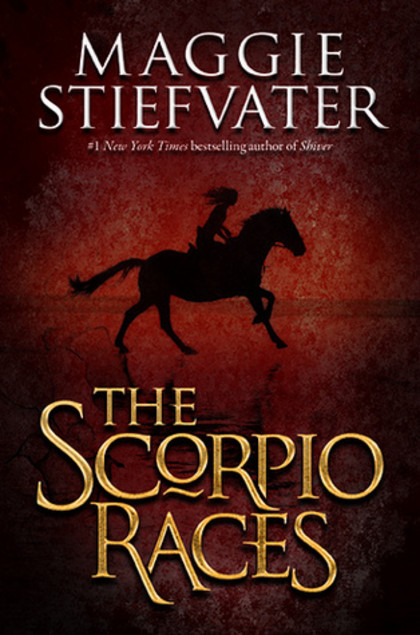
the scorpio racesThe Scorpio Races by Maggie Stiefvater raises hairs in an entirely different way. This is the story of the deadly races that happen every autumn along the shores of a Celtic Island where men capture and train capaill uisce, fierce, carnivorous horses that rise from the sea. And this time, for the first time, young Puck will be the first woman in the race. Much hangs in the balance in this taut drama, but it is Stiefvater’s evocation of the fearsome horses themselves, all teeth and muscle and blood and bone, that is so spine-chilling.

The_Great_Wide_SeaAnd then we’ve got something like The Great Wide Sea by M.H. Herlong that delivers its fright straight through the realm of possibility. Three boys set out on a year-long sail around the world with their father, broken by the recent death of their mother and clearly spinning outside the reach of responsibility. Tensions on the little craft are bad enough, but when the boys awake one morning to find the deck empty and their father gone, fear sets in. Slowly the boys’ resilience weakens as life becomes increasingly precarious and survival starts to slip from their grasp.

And what about you? What are your favorite tales of terror? Hit us up!

Kinship Project

voice from afarThe Butler Center opened in its permanent space two years ago today on September 11th, 2011, the tenth anniversary of that infamous day in world history. To commemorate that occasion we curated an exhibit called the Kinship Project, a collection of books for children and teens that speak to our human kinship. We created a catalog with notes that speak to each of the 29 books connection to the idea of kinship. I link here to the online version. We have some print copies as well (beautiful, actually) and I’d be happy to send some along to you, too. Just fill out the form below with your name and address and I’ll get them in the mail.

← Back

Thank you for your response. ✨

How about you? What do you remember of that day? What do your memories have to say to your work with books and young people? Where do you see kinship among the collections we keep?

“The President Has Been Shot!” vs. Kennedy’s Last Days

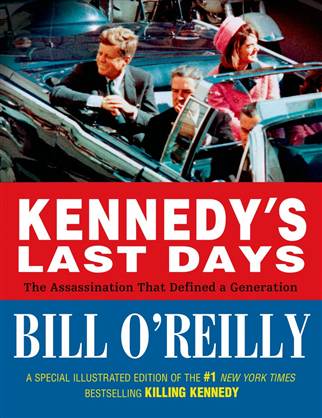
When I discovered that two different accounts of Kennedy’s assassination had arrived at the Butler Center, I immediately grabbed them and started reading. Like so many people, I have a fascination with the Kennedys. I can’t pinpoint why exactly, but I’m guessing it’s a combination of my enchantment with mystery, glamour, politics, unexplainable tragedy, and story. Kennedy’s life—and death—are captivating stories, and two versions of Kennedy’s story are newly published for young adults in 2013: “The President Has Been Shot!”: The Assassination of John F. Kennedy by James L. Swanson, and Kennedy’s Last Days: The Assassination that Defined a Generation by Bill O’Reilly. Before I compare and contrast, I want to make a note about audience. Scholastic suggests that the Swanson book be for ages 12 and up, noted on the book jacket. O’Reilly’s book cover does not indicate an intended age, but after further research I discovered that Henry Holt and Co. notes on their website that the book “will captivate adults and young readers alike” (http://us.macmillan.com/kennedyslastdays/BillOReilly). Of course, librarians can choose where to shelve this book, on what bibliographies to include this book, and what ages to steer this book to in reader’s advisory conversations. Finding out the publisher’s intended age was important to me though, for one reason: As I was reading, I wondered, Why is there no mention of Kennedy’s affairs? Both of these titles are not picturebooks or nonfiction titles intended for early elementary children. They are written for older kids—tweens and teens. Of course, many might argue that Kennedy’s philandering might not be appropriate for tweens, but then I beg the inevitable question. Why are we okay with telling them about extreme violence? Both books have large pictures of rifles and handguns. Of the assassination, Swanson’s book states, “[The third bullet] cut a neat hole through [the president’s] scalp and perforated his skull. The velocity, the pressure, and the physics of death did the rest. The right rear side of the president’s skull blew out—exploded really—tearing open his scalp, and spewing skull fragments, blood, and brains several feet into the air where it hung for a few seconds, suspended in a pink cloud” (113). Similarly, O’Reilly states, “The next bullet explodes his skull…it slices through the tender gray brain matter before exploding out the front of his head” (207). It is bothersome to me that both authors consciously eliminated sexual content for a young adult audience, but were perfectly fine with descriptive violence. I understand the importance of preserving JFK’s legendary status and historical importance, but this is a book of nonfiction, and kids deserve to know the whole story. The intended elimination reminds me of Ingri & Edgar Parin d’Aulaire’s Caldecott winning book Abraham Lincoln, in which there is no mention of Lincoln’s assassination. Do we think we are protecting young adults by eliminating facts? Do we think they won’t find out? What is it that is so much more terrifying about sex than exploding brains, spewing skull fragments, and revolvers?

president bookSwanson’s book establishes a strong narrative flow immediately. His writing is detailed, jargon-free, and action-packed. He is always able to put his reader right inside the story while using a third-person point of view. Swanson knows how to paint a picture, and emphasizes significant things that are not just arbitrary. I’ve read so much about the Kennedys and I never had read this: When Jackie got off the plane in Dallas, she was given red roses EVEN THOUGH the state flower was the yellow rose. Apparently, “so many of them had been ordered for the various events the Kennedys would attend in Texas that local florists had run out of them” (87-8). Pretty eerie that Jackie would be given red roses in the city that her husband would be assassinated in only minutes later. Never-before seen photographs are released in this book, and Swason’s charts and graphs are descriptive and compelling. Swanson details Oswald’s every move through text and picture, even recreating his view of Elm Street from the 6th floor of the Texas School Book Depository. Several photographs of the seconds after the violent shots are shown from varied angles, displaying Clint Hill covering the president and Jackie with his own body. Swanson’s biggest accomplishment is his ability to keep the tension high while keeping facts straight; I didn’t want to put the book down.

kennedy bookWhile I’m not normally a fan of O’Reilly’s politics, I went into this book with a distinct conviction to be unbiased. O’Reilly starts his book off with a personal touch, describing where he was and how he felt on November 22, 1963. He outlines his book into four parts—The Making of a Hero, The Making of a Leader, Dallas, Texas—November 1963, and The Making of a Legend. The chapters alternate perspectives, recounting the parallel time frames of the lives of Kennedy and Oswald. It is an interesting approach the illuminates personality traits of both men. Using present tense, O’Reilly attempts to place his reader directly into the narrative, as if it is happening right now. The thing is, Swanson does that with past tense and it makes much more sense. One does not need to write in present tense in order to make a story come alive. In fact, because the book often needs to use past tense for historical background and context, it is strange to jump back and forth between tenses. Yet, O’Reilly writes with respect towards JFK and loyalty to his country. I was bothered by some of the assumptions made, specifically about people feeling certain things. For example, O’Reilly states , “Jackie Kennedy likes to think of herself as a traditional wife, focusing most of her attention on her husband and children” (55-6). First of all, how do we know what Jackie Kennedy felt about her role as a wife? Secondly, I have read the contrary. Rather than focusing on her family and children, Jackie took several trips abroad without her children, and very rarely had to do the things that many “traditional mothers” have to do—change dirty diapers, cook breakfast, do the dishes, clean the laundry. While I’m not doubting Jackie’s loyalty to her family, I do doubt O’Reilly’s statement that she was a traditional wife. In the memoir Mrs. Kennedy and Me, by Clint Hill (Jackie’s personal secret service agent), Hill describes Mrs. Kennedy in a way you’ve never known her before. It’s definitely a book to read if you like all things Kennedy.

It is difficult to be an author that follows up a fabulous year of narrative nonfiction, and let’s face it—2012 rocked. These two authors do a good job with building and maintaining a tense, politically-charged, mysterious story about a piece of contemporary history. When I grew up, history was just history to me. It all seemed the same, and numbers never had much significance for me, because I just had to MEMORIZE them. I probably became fascinated with the Kennedys because my parents constantly told me about that time period—it’s when they grew up. I remember the realization of “Woah. Civil Rights wasn’t long ago. This assassination (and Bobby Kennedy’s and Martin Luther King’s) was one lifetime away from me.” Kids in middle school and high school now don’t have as many parents that remember this time. It’s up to great nonfiction writers to preserve the past and keep the story alive. Swanson’s book available in October; O’Reilly’s in stores now.

The 39 Deaths of Adam Strand

adam-strandThe 39 Deaths of Adam Strand
Gregory Calloway
Dutton Juvenile, 2013

Teens looking for answers will not find them in Gregory Galloway’s The 39 Deaths of Adam Strand.

Although this is a book about suicide and depression, it is not a classic “problem novel.” Adam Strand has not been persecuted for his beliefs or sexuality. His parents are not abusive or uncaring. He has no body image issues or drug addictions. He’s just inexplicably drawn to the act of killing himself.

But in a sisyphean twist, Adam can never complete this act. Every time, no matter what method he chooses, Adam is fantastically returned to life. 

Galloway is very much aware that he is writing a kind of teen introduction to The Nausea. He even creates a concerned teacher who constantly recommends Kafka and explains Camus. Like any existential protagonist, Adam is unmoved. But the dialogue serves as a nice supplementary reading list for teens that are drawn to the philosophical issues the novel raises. 

Like Adam’s teacher in the novel, I must admit that I often have ulterior motives when I recommend a book. I recognize his hope, his deeply-rooted faith that one of these works will resonate with the troubled teen and inspire him to turn his life around.

There is no such transcendent moment for Adam. And most of the time there’s none for the teens I work with either.

Still, in the life of a transparent nerd and sentimental optimist there are little victories. Books like this one can be the spark of curiosity that have the potential, at least, to open up an entire world of literature.  When you hand a strange, complicated novel like this one to a teen, how can you not secretly hope that he or she will come back and ask who this Kafka guy is?

Openly Straight

Openly StraightOpenly Straight

by Bill Konigsberg

Arthur A. Levine Books, 2013.

In the hilarious comedy Anger Management, Jack Nicholson’s character (a therapist) asks Adam Sandler’s character (an average Joe businessman) who he is (see video below). Adam Sandler answers with thoughts about his job, his personality, and his “likes.” Jack Nicholson pushes, and says “No, those are things ABOUT you. I want to know WHO YOU ARE.” An entertaining dialogue pursues, and the movie goes on.

Who are you?

Quite the question, huh? Often times, when I get asked this question when meeting someone new, my stomach feels like someone forced Robitussin cough syrup down my throat (the worst thing I can remember tasting in my life). Who am I? A graduate student. A dog lover. A dancer. A musician. A writer. I work at a library and I’m a middle child and in my spare time I do aerial acrobatics and play piano. My favorite candy is Laffy Taffy.

All of this is true. But is it really who I am? WHAT DOES THAT QUESTION MEAN?

Part of the problem is that we aren’t defined just by our own labels. Other people have labeled me, and in ways I don’t always like. Blonde. Overly Sensitive. A Pushover. Sometimes, I believe or become those things because someone else labeled me that way. Labeling is a scary, slippery slope, and it happens every day to everyone.

In Bill Konigsberg’s new YA novel, Openly Straight, seventeen-year-old Rafe is sick of his label. He’s been “the gay boy” since he came out in eighth grade, and it has become exhausting. He knows he’s got it lucky—he lives in Boulder, Colorado, where he isn’t bullied in school, his parents fully accept his sexuality, and he has good friends. But he’s been defined by this one label for so long that he feels like his other parts have disappeared. So he takes a risk and transfers to an all-boys’ boarding school in New England to try out a new method of self-expression—being “openly straight.”

For a while, life is fabulous. Rafe discovers his love of sports, hones his gift of creative writing, and fulfills his desire to be seen as Rafe, not Gay Rafe. But of course, there is another boy in this book—a boy that Rafe falls for, and complication ensues. Konignsberg writes his first-person narrative with a quirky grace and his dialogue with honesty and intelligence. His ability to build relationships between characters and willingness to ask thought-provoking, challenging questions to his reader is exceptional.

There’s still more to this book that I’m not including; something that is very hard to put into words. Alas, I will try.

We all want to be taken for the entire, deeply layered, multi-dimensional person that we are. I know I don’t want one of my labels to define me, but I do want the sum of my PARTS to define me. There is a type of psychotherapy called “Parts therapy,” which is based on the concept that we are complex human beings that have many different parts within us. I have a sensitive Part, but I also have a bold Part. I am a creative artist, but I am also a researcher and scholar. I don’t want to get stuck in one Part, and I don’t want to get hidden beneath a Part so no one sees any of the other Parts. Is my sexuality important? Of course. Does it define WHO I AM? No, it’s a Part. There is no Me without every Part that exists within me, and if I deny a Part of me, I’m not really Me either. Parts are fluid. They are not static; they change as we change. Openly Straight is poignant and powerful because it both asks and challenges the question: WHO ARE YOU?

Rafe would have to answer that question for himself, but I’m guessing he would say that he’s many, many things, but most of all he’s human. I would tell him that I’m the same, and that I’m a system of Parts that all work together to create the one—and only—me.

Just like you.