Tell Me a Bedtime Story

By Alena Rivers

This week we spotlight two picture books in the Butler Center sure to help slow down busy nights and provide a comforting bedtime story. Both books feature animals and a familiar bedtime experience where children can watch a young bear cub deny sleepiness or speculate about what animals dream.

Goodnight Everyone by Chris Haughton (Candlewick, 2016)

Nighttime approaches in the forest. All of the forest animals are ready for sleep with their eyes drooping or completely closed; all except for a small bear cub whose eyes are wide awake. Little Bear wanders the forest home looking for a playmate asking the sleepy mice, hares and deer if they will play. They each yawn and reply they are too sleepy to play. As the story progresses, Little Bear grows more and more sleepy. Little eyes begin to droop until Great Big Bear carries Little Bear off with a kiss and a snuggle where sleeps finally catches up with the small bear cub.

Characteristic of Haughton’s earlier books, Little Owl Lost and Oh No, George!, one color palette is emphasized in the digitally created images which are saturated in shades of blue, pink and purple. Oranges and greens punctuate some of the images depicting an approaching evening glow as the sun begins to set. The text repeats throughout the book creating a predictable and gentle tone. Preschoolers will enjoy following Little Bear’s quest to find a playmate and will notice how Little Bear’s eyes gradually move from wide open to completely closed, signifying the final surrender to slumber.

When the World Is Dreaming by Rita Gray, illus. by Kenard Pak (Houghton Mifflin Harcourt, 2016)

What do little woodland creatures like snakes, newts, deer and mice dream? Young readers are asked this question for each woodland animal featured in the story. Amusing images of each animal’s dream follow, from a snake that becomes a flying kite tail to a bunny flying over a tree with wings of cabbage. The final Little Dreamer is a young child in bed dreaming of all the woodland creatures visiting her bedroom while she sleeps and they approach the gifts from nature that she has collected for each them.

Recalling a similar style as Pak’s recent Goodbye Summer, Hello Autumn, the images are done in a combination of digital media and watercolor. The color palette features soft pastels and alternates between spreads with plenty of white space and spreads filled with watercolor images. Rhyming text is repeated throughout the story to allow young readers to anticipate upcoming lines. Preschoolers will delight in the gentle rhymes and the whimsical dreams of each woodland creature.

Twists on Myth

By Hal Patnott and Alena Rivers

This week we decided to take a look at two books that share a tie-in with Greek Mythology. Check out our advanced reading copies of Bull by David Elliott and The Icarus Show by Sally Christie at the Butler Center.

Bull by David Elliott (Houghton Mifflin Harcourt, 2017)

Most stories remember Asterion the Minotaur as a monster, the terror of the labyrinth. They never tell us that he was a boy, half-human and half-bull, rejected by his family, unable to fit in anywhere. Bull, in verse, reimagines the famous Greek myth of the minotaur as a tragedy about a lonely boy struggling with his identity. While the structure of the myth remains in tact, Elliott fleshes out Asterion’s youth and explores his relationship with his half-sister Ariadne. In the backmatter Elliott explains how he altered the myth and the choices he made for poetic form. Poseidon, Minos, Pasiphae, Asterion, Daedalus, and Ariadne share control of the narrative. Each character speaks with their own poetic style. Playful use of modern slang and swearing bring the story into the present and defy the notion that myth should be highfalutin. As Poseidon says, “You think a god should be more refined…[Never bawdy, raunchy, racy, rude]? News Flash: You don’t want a god. You want a prude.” Elliott’s retelling of the myth of the minotaur is part tragedy, part dark comedy, and entirely engaging.

The Icarus Show by Sally Christie (Scholastic, 2017)

Do you believe a boy can fly? Students in Alex Meadow’s Year 7 class at Lambourn Secondary School are suspicious but no less curious when they start receiving mysterious messages in their school bags leading to an invitation to see the Icarus show. While the other students speculate about who is behind the messages, Alex discovers that the showman orchestrating all of this is closer than he would have imagined. Despite the distraction of the upcoming show, Alex must continually work hard to steer clear of the taunting and bullying doled out by Alan Tydman and his “Battalion” of boys who lord over his classmates. Alex has developed rules to help him survive his secondary school years; stay in control, “Don’t React”, “Trust No One.”

Over the course of the weeks leading up to the Icarus show, Alex cautiously befriends a classmate, David “Bogsy” Marsh who, since the start of secondary school, has been a target of Alan Tydman and his Battalion. Together Alex and Bogsy share a secret that eventually allows them to trust one another.

Christie identifies how trust and patience are required to overcome loneliness and how courage is required to confront that which makes us feel different. Issues of bullying and suicide are handled in a subtle manner that allows youth to reflect on these issues while challenging them to explore the big and small ways they can have a positive impact on others.

We Are Okay by Nina LaCour

by Hal Patnott

we-are-okay

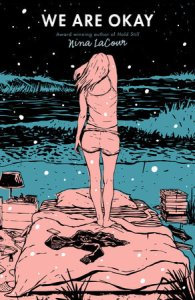
We Are Okay by Nina LaCour (Penguin Random/Dutton, 2017)

The day after her grandfather disappears into the ocean forever, Marin boards a plane from San Francisco to New York determined to disappear too, even if it means leaving behind the people who care about her. At her college in the city, far away from her old life, she can become someone new, pretend her phone is secondhand and that the girl named Mabel sending her messages is a complete stranger. However, some relationships mean too much to end. As Marin’s grandfather once tells her, “[Sometimes] two people have a deep connection. It makes romance seem trivial. It isn’t about anything carnal. It’s about souls. About the deepest part of who you are as a person.” Neither Marin or Mabel can forget about their bond. After months of silence from Marin, Mabel still refuses to give up on her best friend, the girl she fell in love with during the summer of their senior year. She’s willing to fly three thousand miles to learn the truth and convince Marin to come home to the people who want to support her.

We Are Okay by Nina LaCour is a haunting coming-of-age story about love and moving on after betrayal. The novel is written in first-person from Marin’s perspective. Chapters alternate between the present and flashbacks to her senior year of high school. LaCour’s lyrical prose and her sparing use of dialogue beautifully convey Marin’s loneliness and longing. Despite the heavy sorrow that fills the pages,the book ends on a note of hope. Grab a box of tissues. We Are Okay is a must-read of 2017.

Check out our advanced reading copy of We Are Okay at the Butler Center!

Midnight Without a Moon by Linda Williams Jackson

By Alena Rivers

midnight

Midnight Without a Moon by Linda Williams Jackson (Houghton Mifflin Harcourt, 2017)

Rose Lee Carter is thirteen years old and learning to navigate the uncertainties of her daily life. Rose Lee is African American and lives in a small town in Mississippi where Jim Crow laws rule. Her story takes place in 1955 over the weeks surrounding the death of Emmett Till, a fourteen year-old African American boy brutally murdered for allegedly whistling at a white woman. Told in first-person narration, each chapter represents a day of Rose Lee’s observations of her family and her community. Rose Lee lives with her grandparents, Papa and Ma Pearl, her 12 year-old brother, Fred Lee and their 15 year-old cousin, Queen. Although she lives with her grandparents, brother and cousin, Rose Lee rarely sees her mother, who left after marrying into a new family.

Along with her mother’s absence, Rose Lee must contend with the lack of nurturing care from grandmother, Ma Pearl, who treats Rose Lee with contempt and indignation. Her situation is further troubled by the constant verbal berating she receives from cousin Queen who receives extreme special treatment from Ma Pearl, likely because of her very light skin color. Ma Pearl and Queen make no secret of their contempt for Rose Lee’s midnight black skin color as they seemingly regard Rose Lee with a Cinderella-like status in their family.

In the end, Rose Lee must make a tough decision to either stay in Mississippi or go north with her aunt and her aunt’s fiancé who want to give Rose Lee the opportunity to find another life for herself. Rose Lee makes her decision in the final page of the story, however, the decision seemed abrupt and the story could have benefitted from more attention to Rose Lee’s rationale for her choice. Rose Lee’s life is rife with influences that negatively impact her and readers may not easily make a connection to the positive influences that affect her final decision to stay in Mississippi. Still, the story lends a unique perspective on the impact of a horrific event on a family and their relationship to a pivotal moment in civil rights history.

The Art of Being Normal by Lisa Williamson

by Hal Patnott

the-art-of-being-normal

The Art of Being Normal by Lisa Williamson (Macmillan/Farrar Straus Giroux 2016)

David’s classmates call her a “freak.” It started when she was eight and shared with the class what she wanted to be when she grew up. Other kids wanted to be sports stars, actresses, or the prime minister, but not David. She wanted to be a girl. Aside from her two best friends, Essie and Felix, she is isolated in her posh high school, where no secrets stay hidden for long. Although she longs to tell her parents the truth and start her life as Kate, fear of rejection keeps her feelings locked inside her.

Leo Denton is desperate to escape Cloverdale. His acceptance into the elite Eden Park High School is his best chance to leave behind the bad memories at his old school and his unstable relationship with his mother. He dreams of finding his father who left when he was a baby. All Leo has to do is keep his head down and stay out of trouble so no one will learn about his past as Megan. However, when he finds himself falling for the popular and artistic Alicia Baker, his secrets get harder to hide in the spotlight.

Set in the suburbs outside of London, The Art of Being Normal is a coming-of-age story that explores gender identity, socioeconomic differences, and what it means to fit in. Written in first-person narration, the chapters alternate between the points-of-view of Kate and Leo. Both characters show growth throughout the book. Through their friendship, Kate finds the courage to claim her identity and Leo learns to let in the people who love him. Despite the acceptance that the characters find in their friends and family by the end of the book, they both face violence and transphobic language from their peers. The otherwise engaging story of self-acceptance suffers from a fixation with the achievement of cisnormative standards of gender presentation. Leo “passes” and never once is denied masculine pronouns except in overt instances of bullying. Kate, on the other hand, gets misgendered until the end, even by her allies. No one calls her Kate or uses her preferred pronoun until she starts wearing dresses. The chapter markers designate her as “David” as well. While The Art of Being Normal provides visibility for transgender teens and a message of self-acceptance, it fails to break out of the binary.


Banned Books Week at Butler

By Alena Rivers and Hal Patnott

As graduate assistants in the Butler Children’s Literature Center and current students of the Master of Library and Information Science program at Dominican University, we are continuously exposed to new and classic children’s and young adult literature. We are challenged to read with our eyes wide open to the impact that a story can have on its young readers who, intuitively, look for books that relate to their own interests and experiences and shed light on their developing personalities. As librarians-in-training, we are learning how important it is to share books that encourage our readers to think beyond their experiences in order to build a bigger picture of the world around them.  Books with diverse characters benefit more than the populations they represent.

This week, we will be participating in a Mock Book Challenge as part of our LIS 777 : Issues of Access, Advocacy, and Policy course. The subject of our book challenge is Speak by Laurie Halse Anderson. This exercise is serving as excellent preparation for what may be an inevitable experience for us during our library careers. Within this course and others, we have discussed intellectual freedom, the ALA’s position on censorship, and how censorship differs from selection. We have discussed how librarians can use their library’s collection development policy to support their stand on book challenges, and how crucial it is to have a clear and comprehensive policy to follow. Our discussions have been insightful but they have also generated questions that go beyond what happens when a book is challenged or banned.

Over the course of our first year in the GSLIS program, we have witnessed the critical reviews of several children’s and young adult books including A Birthday Cake for George Washington, A Fine Dessert, and more recently When We Was Fierce, There Is a Tribe of Kids and Ghost. In these cases, books have been pulled before publication, published but not recommended by reviewers, or recommended by mainstream review sources but not by others in the children’s/young adult literature community. How does censorship play a role in these early stages of a book’s introduction to its readers? How is communication about a book’s content impacted by censorship, which, in effect, tries to silence communication?

Nearly every one of these books has arrived in the Butler Center and their presence has generated discussion about the process that comes well before a book is challenged or banned in our school and public libraries. We see books before they are published and there is a whole conversation that happens before the books end up in, or get weeded from, a library based on outdated content. We wonder about the occasions, though, when a contemporary book, as opposed to one published in a long-ago, less-enlightened era, misrepresents an oppressed group of people. Books like those mentioned above are new and coming under fire, rightfully so, because of misrepresentations of characters and their experiences.

In our quest to delve deeper into these topics and to write our own reviews with a critical and informed eye on the content of the books we have found that more and more, what others in children’s and young adult literature already know; there is a great absence in the number of authors/illustrators, publishers and reviewers from diverse backgrounds who can create and evaluate stories dominated by diverse characters. The incident at VOYA this last week is a prime example of the thoughtless and hurtful errors that can occur because of a lack of diversity and understanding.

Another issue arises when we put authors on a pedestal because of their previous acclaim. Ghosts by Raina Telgemeier received starred reviews in Booklist, SLJ, Publishers Weekly, and Kirkus. Her work was praised in these reviews for its diversity, but as Debbie Reese pointed out in her review, the diversity was superficial. We expect better of authors like Telgemeier, but ultimately they aren’t perfect. They make mistakes. As Diane Foote commented last year on the Coretta Scott King Book Award electronic discussion list, “We expect a crappy book to be, well, crappy, and if its crappiness is also evident in poor cultural competency, well, that’s just to be expected, and we dismiss such a book. But in an otherwise high-quality production, the failure of even the most basic historical accuracy or cultural competency insults all of our high expectations, and insults young readers most of all.” If we stop reading with a critical eye because the author is someone whose past work we love, then we will miss opportunities for much needed conversations. Those conversations are an important part of intellectual freedom.

What conversations are you having this Banned Books Week?

Picture Books Featuring the Caring Nature of Children

By Alena Rivers

Acts of kindness can be simple gestures or complex, thoughtful ones. Either way, the effects on the recipients can be heartwarming. Stories that express the multiple ways that children show their concern for others help young readers explore how they can positively interact with individuals and the world around them.

The stories featured today each demonstrate the ways children share their compassionate sides. The books present a quiet simplicity in style but they reveal a clear message; our kind gestures have a strong impact on those with whom we come in contact.

The Day I Became a Bird by Ingrid Chabbert, illustrated by Guridi (Kids Can, 2016)

A young boy falls in love with his classmate, Sylvia, on their first day of school. He discovers that Sylvia is in love with birds but she does not seem to notice him. In order to win her attention, the young boy builds a bird costume to wear to school. Becoming a bird is not easy. Not only must he endure the stares and giggles from his classmates, but navigating the bathroom and the soccer field in a large bird costume has its challenges. Still the boy’s determination to connect with Sylvia makes him indifferent to these obstacles. Wearing a bird costume during school for several days may seem like a grand gesture for the attention of another, but the protagonist’s efforts pay off in a satisfying and sweet ending.

Originally published in Spain, this book gently portrays the story of a young child’s admiration for his classmate. Illustrator Guridi  uses pencil drawings and photoshop to create both realistic images and the costumed version of the birds that are central to this story. The Day I Became a Bird is an inspiring story that demonstrates how taking risks to show you care can be worth the effort.

Look Up! By Jung Jin-Ho (Holiday, 2016)

Look Up! takes on the perspective of a young child in a wheelchair peering over a balcony above a busy neighborhood street. Like the child, the reader can only see the tops of people’s heads as they walk along the street without noticing the child above, who only wants them to “Look Up!”. Finally, a young boy looks up and notices the child on the balcony. He lays on the ground so the child can see him. This act starts a chain of pedestrians who stop to see what he is doing and, in turn, lie down so they, too, can look up.

Jung Jin-Ho’s black-and-white sketches give readers a unique perspective beyond the bustle of daily life to remind us that through our busiest moments, we can stop to see someone who may otherwise be overlooked.

Lucy by Randy Cecil (Candlewick, 2016)

As though in a theater production, Lucy is told in four acts. Each act starts the same as the previous one but builds on the story of a tenacious stray dog who visits the front door of an apartment building.  It is here that he is greeted each morning by a young girl who dangles her leftover food by a string from her bedroom window to provide breakfast to the little stray. The young girl lives with her father who is a store stock-person by day and an aspiring vaudeville performer with stage fright by night. The story comes full circle when we learn how the small dog became a stray and how she finds a place to call home.

Randy Cecil’s black-and-white oil textured illustrations strongly support the text that, in turn, nicely frames and punctuates the images. As if through a telescope, the reader gets a glimpse of the small dog’s day through images rendered in a circular frame in the center of each page. Lucy is a charming story that young children will enjoy watching unfold.

The Big Read Bibliography

The Butler Children’s Literature Center has partnered with Dominican’s Crown Library, the Oak Park Public Library and several other local libraries for the Big Read program to create a bibliography of books for elementary and middle school readers inspired by this year’s Big Read, Into the Beautiful North by Luis Alberto Urrea. The bibliography contains fiction books published between 2014-2016 that explores the multiple aspects of the immigrant experience. You can find The Big Read Bibliography on the Butler’s Pantry blog under Bibliographies.

B3 Butler Book Banter

Wednesday, September 21, 2016, 6-7 p.m.

Exploring Farms and Food

From classic picture books such as Lois Ehlert’s Eating the Alphabet (Harcourt, 1989) and Growing Vegetable Soup (Harcourt, 1987) and Elisha Cooper’s Farm (Orchard, 2010) to more contemporary middle-grade fiction such as Return to Sender by Julia Alvarez (Knopf, 2009) and informational books including the young readers’ edition of The Omnivore’s Dilemma by Michael Pollan (Dial, 2015), food and where it comes from has been a perennial topic in children’s lit.

Fall season is harvest time, and for our first B3 of the year we’ll focus on food, farms, and farmers’ markets. There is a full crop of newly-published foodie books this year, and we’ll focus on these:

Board books: Edible Colors and Edible Numbers, both by Jennifer Vogel Bass (Roaring Brook, 2016)
Picture books: Grow! Raise! Catch! How We Get Our Food by Shelly Rotner (Holiday House, 2016); On the Farm, at the Market by G. Brian Karas (Holt, 2016); and Sleep Tight Farm by Eugenie Doyle, illus. by Becca Stadtlander (Chronicle, 2016)
Informational: The Story of Seeds by Nancy F. Castaldo (Houghton Mifflin Harcourt, 2016)

Whether you’ve read all, some, or none, please join us in the Butler Center to talk about kids books about food, and enjoy some farmers’ market treats. We’ll have the food and, um, books out at 5:30 for perusal and partaking.

A Review of It Looks Like This

By Hal Patnott

It Looks Like This

Stop by the Butler Center to take a look at our copy of It Looks Like This by Rafi Mittlefehldt.

It Looks Like This by Rafi Mittlefehldt (Candlewick 2016)

When the sun rose at Mill Point Beach, they listened to the waves “surrounded by an eruption of colors.” That sunrise is what Mike wants to remember when he lets himself think about Sean, not all the bad things that came after. The summer before Mike’s freshman year of high school, his family moves from Sheboygan Falls, Wisconsin to Somerdale, Virginia, a small, oceanside town with mild winters. Unlike his little sister Toby, Mike doesn’t mind the move or the megachurch their father insists they attend. Although one of his classmates, Victor, accuses him of staring and bullies him for no reason, Mike doesn’t completely hate his new school. He loves French class–that’s where he meets Sean. When Mike and Sean decide to partner for a class project, they start to explore their feelings for one another. Their attraction is a huge secret that Mike must hide from his conservative parents and Victor, who will jump at any chance to make his life hell.

 
It Looks Like This is a far-from-uplifting coming-of-age story. No one knows about Mike’s doomed relationship with Sean until Victor films them kissing on the beach on New Year’s Eve and calls their parents. Even Mike’s friends–who eventually stand by him at the end of the book–casually throw around homophobic slurs. Sean’s father responds with violence when he learns about his son’s relationship. Mike’s parents coerce him into attending conversion therapy camp, where he learns all the “negatives” of being a “practicing homosexual,” such as “depression, drug use, and relationship instability.” His roommate tells their discussion group, “There are all these obstacles to being a homosexual already, and that’s before you consider that it goes against the obvious purpose of sex. I’m just saying that maybe the natural world is trying to tell you something.” While Mike does escape the camp, he returns home to learn that Sean got drunk and died in an all too familiar car crash. It takes Sean’s death for Mike’s parents to start trying to support him. Decades after Annie on My Mind by Nancy Garden (Farrar, Straus, Giroux, 1982) broke the mold of books about gay and lesbian youth by offering a happy ending, It Looks Like This feels a bit like a return to the bad old days. Certainly, It Looks Like This offers a realistic portrayal of the isolation of being an LGBTQ teen in a small, conservative town, but the progress Mike makes toward self-acceptance in the resolution doesn’t fully overcome the overwhelming sense of hopelessness present throughout the novel.