Finding Perseverance Through Friendship: A Review of Dasia (Forever)

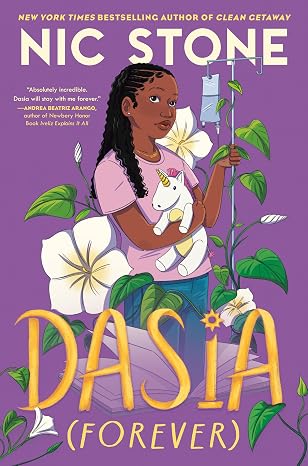
Dasia (Forever) 
Nic Stone 
Illustrated by Simone Douglas 
Crown Books for Young Readers, an imprint of Random House Children’s Books
Ages: 10+ 
Available: October 6, 2026  

13-year-old Dasia Monae Riley is not supposed to have visitors while undergoing bone cancer treatment. This doesn’t stop 14-year-old fellow cancer patient Jameson “Jimmy” Jeffs from entering her room, unnoticed by the doctors and nurses, and having a conversation with her on a lonely July night. As the two girls talk, Dasia realizes she has more in common with Jimmy than she first thought. Little does she know that one night in spectral Jimmy’s company will change her life forever.

This magical realistic middle grade fiction novel, a spin-off of Stone’s the Dear Martin series, is part prose and part verso libre poetry in the form of Dasia’s unsent letters to her incarcerated older brother, LaQuan. The letters give readers a glimpse of Dasia’s life prior to induction chemo, feelings and experiences that she’s rarely shared with others except for Jimmy. Simone Douglas’s black-and-white illustrations, mainly seen as margin doodles in Dasia’s letters, accurately capture her sometimes-extreme emotional state. Stone gives the intense topic of childhood cancer gravitas and is not shy in including the isolation and pain associated with it, while Jimmy’s encouragement for Dasia to keep going and Dasia’s resolve to still fight her cancer, even at her lowest point, provide the reader hope. Extensive prior knowledge of the Dear Martin series isn’t required to understand Dasia’s narrative. Its powerful message of optimism in the face of illness is strong enough to stand alone. In short, Dasia (Forever) is an emotionally charged tale that will tug a reader’s heartstrings. 
Living in Agony and Remorse: A Review of Find My Way Down to You

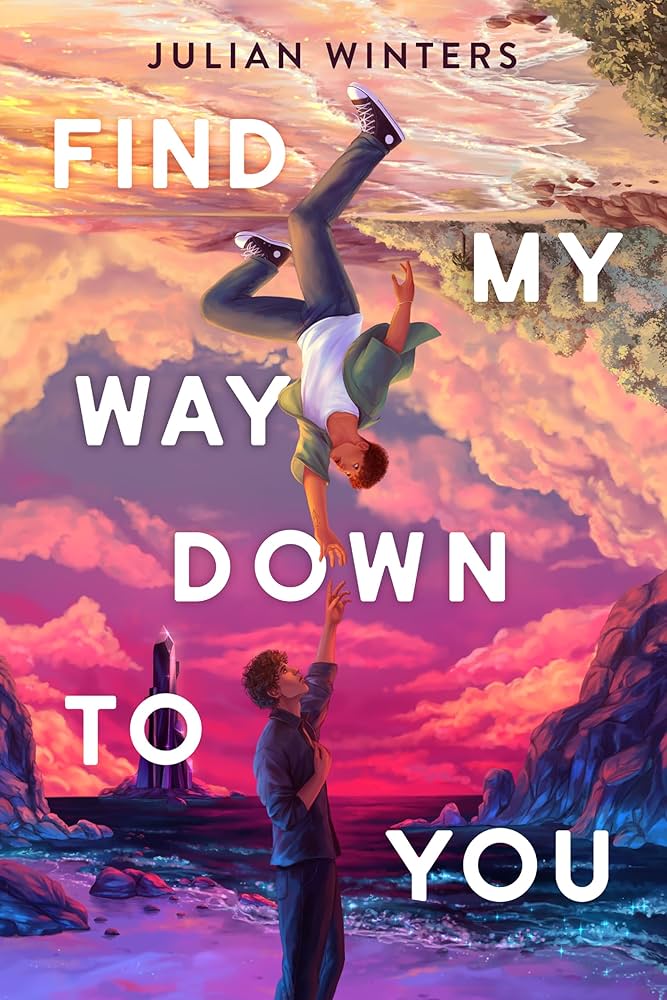
Find My Way Down to You
Julian Winters
Viking, an Imprint of Penguin Random House
Ages: 13+
Available Now

For the first time since the untimely death of his boyfriend, London, 18-year-old August’s life turns upside down when he meets a mysterious “ferrier of souls” named Cary, whom August follows into a forbidden place: Aides, the Underworld, where mortal souls spend eternity after they die. Seeing an opportunity to find London, August frequently visits the extravagant Aides looking for his lost love, with Cary as his reluctant guide. After five visits to Aides, August is presented with a choice, as per the rules: choose a lonely life without his old boyfriend or pursue his budding feelings for the moody Cary.  

Julian Winters’s contemporary prose emphasizes how grief impacts August’s life. Its omnipresence is evident when August oversleeps, is late to his work shift, mentions blaming himself for his boyfriend’s death in several chapters, and seeing an old photo of him and London leaves him in emotional turmoil. It’s heartbreak at its bleakest. However, this plot doesn’t just have doom and gloom. August’s interactions with Cary and other Aides characters breathe fresh air and excitement into an otherwise depressing story. Same-sex relationships and attractions are included without value-judgement, giving both the characters and readers room to explore their own feelings. Readers don’t need to be extremely fluent in afterlife mythos, especially Greek mythology, to follow the narrative. Even Henri, one of the other soul ferriers, mentions that everything found in Wikipedia about the underworld gets things “wrong.” Emotionally raw and rife with dramatic intrigue, Find My Way Down to You is a weighty rainy-day YA romantasy that is guaranteed to make readers cry.  

Faults and Aftershocks: A Review of Odessa

odessa-9781620107898_lg.jpgOdessa
Written and illustrated by Jonathan Hill
Published by Oni Press
Available November 10, 2020
Ages 13+

Eight years ago, Vietnamese-American Ginny Crane’s earth shattered—and not just because an earthquake ripped the West Coast apart, tearing apart the land and communities. No, Ginny’s world was shaken when her mother left her family, taking off without a word. In the years that followed, Ginny and her dad took care of her two kid brothers, acclimating to a new way of life. Now, on her eighteenth birthday, Ginny receives a package from her mother, Odessa. Ginny knows this is her chance to find her mother. Ginny takes off in the middle of the night, leaving her family behind. Her brothers, Harry and Wes, however, tag along on her journey; they miss their mother, too. As the trio bushwhack their way through a post-apocalyptic America, they struggle with who they can and cannot trust. They encounter rival gangs—all bent on keeping their territory intact—and join forces with an enigmatic man called Four Dollars. Jonathan Hill’s images in Odessa are salmon-saturated and filled with exquisite detail. The landscape is decimated, and the population is weary. Hill’s drawings capture the fatigue and manic energy that is integral to their survival. The Crane family is full of love and secrets: the mysterious Four Dollars is actually the siblings’ long-lost Uncle Hank. Uncle Hank, in turn, is deeply connected to the warring factions that plague the Crane’s journey. As family mysteries are unearthed, the Cranes encounter violence and death. Hill ends the story with a new beginning: the remaining Cranes must set forth into Middle America to find the truth. This new #OwnVoices graphic novel from Oni Press is a taut and exciting exploration of perseverance, truth, and unbreakable bonds.

Poetry is My Superpower: A Review of Isaiah Dunn is My Hero

41TdgcCewtL._SY346_Isaiah Dunn is My Hero
Written by Kelly J. Baptist
Published by Crown Books for Young Readers
Available August 18, 2020
Ages 8-10

Ten-year-old Isaiah Dunn loves to write poetry. He doesn’t anymore, though, not since his father passed away. Everything is different now that his father is gone. His mother, Lisa, stopped going to work and barely talks, and his little sister Charlie keeps calling their motel room “home.” The only thing Isaiah wants to do is spend time with his best pal, Sneaky, or read his dad’s journals. They are filled with stories about Isaiah Dunn, Superhero, who gets his special powers from eating rice and beans. He feels connected to his father when reading the stories and wishes he could be a superhero himself. Things are getting more complicated, though. Isaiah keeps getting in trouble at school for reacting to his classmate Angel’s name-calling. When he and Angel get paired up for a class project, it could not get any worse. Things start to improve when a school counselor mediates between Angel and Isaiah; Angel reveals that Isaiah hurt her feelings when he made fun of her hair. Angel and Isaiah discover they have a lot in common and create a poetry business together. After losing her job, Isaiah’s mom enters a rehabilitation program; while she is away Isaiah and his sister stay at a family friend’s home.  Isaiah spends more time at the library. He comes up with an idea to have a writing room in an old storage space, and the library approves the idea. Isaiah’s mother returns home and the family celebrates the Fourth of July all together. Kelly J. Baptist’s novel explores Isaiah as a budding young poet while struggling with the loss of a parent and home insecurity. Baptist breaks up the story by days, as if writing in a journal, and populates the middle-grade novel with poetry and snippets of short stories. Baptist depicts Isaiah’s and his family’s grief as the complex entity it is. Lisa’s grief-induced alcoholism and depression are layered and multi-dimensional. Sneaky and Angel are complicated individual characters who go beyond their supporting role. While this is a book about grief, this is a hopeful novel—and a great addition to a middle-grade collection.

A Sea of Memories: A Review of When Life Gives You Mangos

cover190381-medium.pngWhen Life Gives You Mangos
Written by Kereen Getten
Published by Delacorte Books for Young Readers
Ages 10-14
Available September 15, 2020

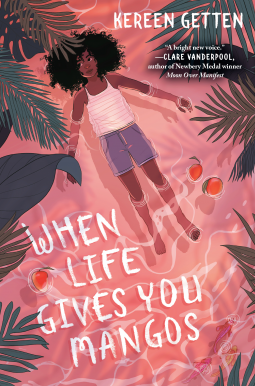
Clara lives in a small village on a tourist-destination Caribbean island, but to Clara, it’s not a destination—it’s just home. This summer, she is twelve, and she’s struggling. Her former best friend Gaynah does not want to play in their secret dugout anymore; she is more interested in Calvin and being grown up. Also, Gaynah teases her about last summer. Even though Clara tries, she cannot remember what happened. All she knows is that her parents will not let her surf anymore, and she can never go into the water alone. Sometimes she has nightmares that she does not understand. Her parents explain the imagery, but they tell her not to worry. Clara finds that she angers and frustrates easily, but she does not understand why. Now, a mysterious new girl named Rudy is living on the island and wants to be friends with Clara. But Rudy does not know the rules of the island, and what spots are off-limits. Clara does not want to lose another friend, so she follows along, even though she could get in trouble. Kereen Getten’s When Life Gives You Mangos begins slowly, unfolding the story of Clara’s memory loss. The calm pace and beautiful landscape exacerbate the scary and obscure reason behind the amnesia. The book takes time to reveal what happened, and the grief behind the loss is significant. Newcomer Rudy serves as a stand-in for the reader at times, as she is learning how the village of Sycamore operates. Religion is an important factor in how Clara’s memory loss is dealt with by the community; ultimately Getten reveals that pastors and bishops, no matter how well-intentioned they are, are ultimately human and can make mistakes. The reveal behind Clara’s amnesia involves grief, but also reconciliation as her family makes room for members that have been long shunned in the village. This read emphasizes the power of love and community.

Beyond the Ice and Snow: A Review of The Barren Grounds

51ptXY7Wl5L._SX327_BO1,204,203,200_The Barren Grounds
Written by David A. Robertson
Published by Penguin Random House Canada
Available September 8, 2020
Ages 8-12

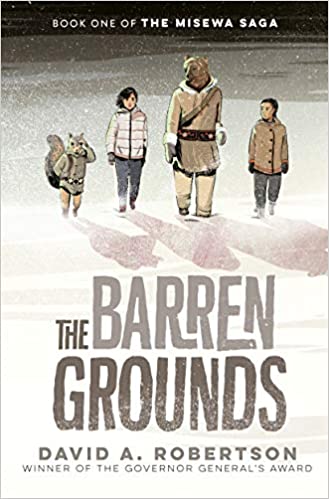
Morgan’s latest foster family isn’t so bad, even Eli, the new foster kid is okay. He’s indigenous, like her, but he never raises his voice or gets angry like Morgan. In fact, he hasn’t said much since he arrived at the foster home in Winnipeg, and he stays quiet at their middle school, too. The only thing he does is draw in his giant artist notebook. But at least Eli shows her his drawings—they’re layered and mysterious and incredible. But when one of his drawings opens up a portal in their attic, the children find themselves transported to Misewa. There they meet creatures, like Ochek, a talking fisher, who introduce them to traditional ways to survive. The community of Misewa, Ochek explains, has been locked in a forever winter following an encounter with a duplicitous man. The community is struggling, and soon food supplies will run out. As conditions worsen, the children and Ochek set off to save Misewa from perpetual ice.

Author David A. Robertson connects Morgan, and the reader, with her Cree heritage, blending difficult truths about First Nations history with middle-grade fantasy. Morgan and Eli, like so many other First Nations children, have been separated from their biological parents and placed in the foster care system. Morgan’s struggles and mistrust of her foster parents come with good reason; she’s been neglected and discarded before. Despite this trauma, Morgan is able to connect with Ochek and Eli. And as her trust in them grows, so do her snappy comebacks. Robertson’s depiction of Morgan’s emotional and cultural journey is compelling, with occasional humorous outbursts. Whether it’s her skepticism with new friends or with her white foster mom’s cringeworthy cross-cultural attempts to make her feel at home, Morgan’s reactions are captivating. Readers do not uncover the whole mystery behind Morgan’s and Eli’s backgrounds, but there will be plenty of opportunities to learn more: The Barren Grounds is Book 1 of Robertson’s Misewa Saga.

Don’t Trust Your Cravings: A Review of When We Vanished

WhenWeVanished3DPhotoTransp-1.png

When We Vanished (Call of the Crow Quartet, Book One)
Written by Alanna Peterson
Published by Rootcity Press
Available June 2, 2020

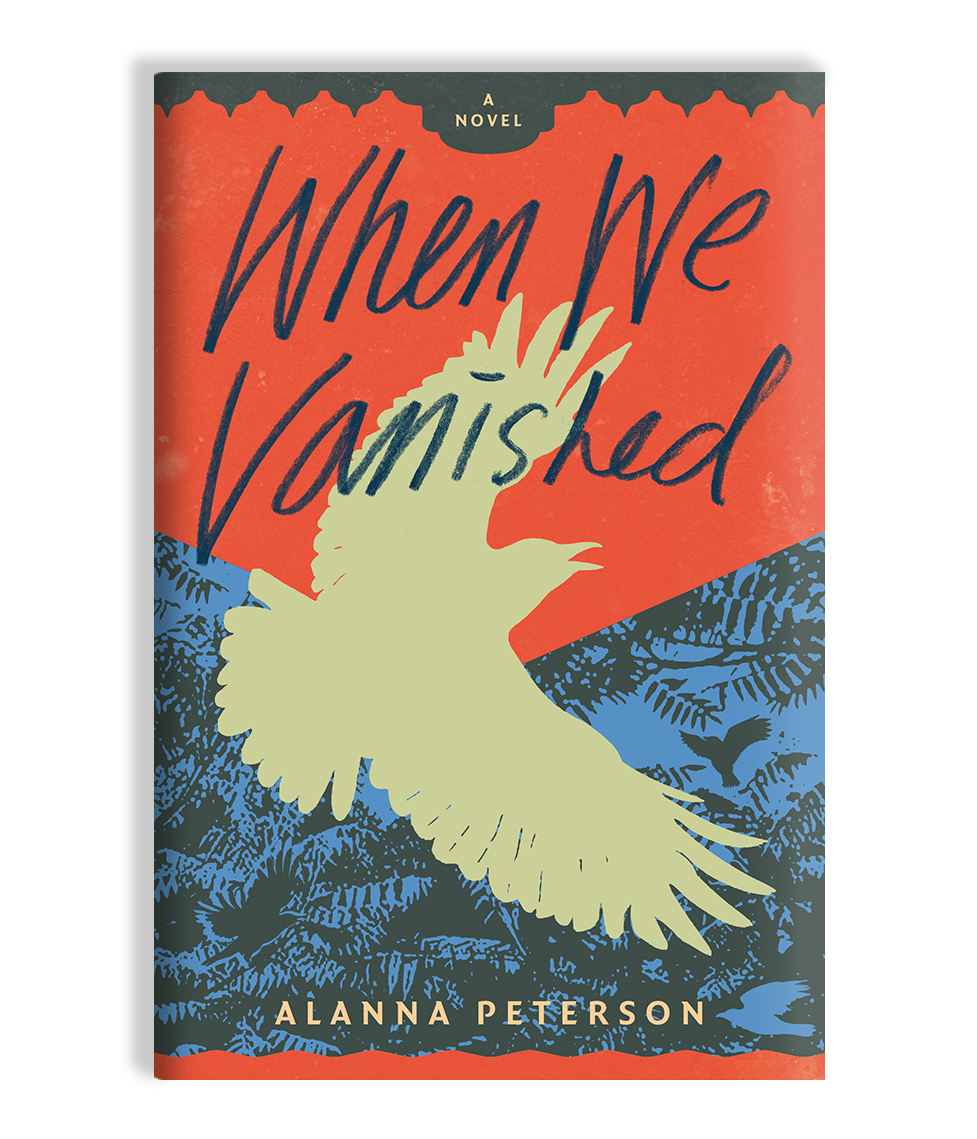
After Andi Lin’s family record store goes bust, her dad enlists in a clinical trial run by food corporation Nutrexo that promises big bucks. But when Andi cannot get in touch with him, she starts to worry—especially when she learns that Nutrexo’s involved in a harmful research study. Andi’s next-door neighbor Cyrus is also wary of Nutrexo; his mom worked for them years ago, and he knows she’s keeping secrets from her family.

Alanna Peterson writes a complex and compelling mystery that indicts the U.S. food industry. Even the most innocent-seeming things take on a scary new meaning in When We Vanished. Take Blazin Bitz, that delectable chip from Nutrexo: no one can resist them! And soon enough Andi, Cyrus, and Cyrus’ siblings know why when the break into SILO, Nutrexo’s  top-secret research facility. What they discover there is not for the squeamish. These instances of violence, medical experimentation, and animal cruelty—while crucial to the plot—may upset readers. But there is also plenty for readers to enjoy: wonderful recipes and food imagery, teenage crushes, and unyielding family bonds. These enjoyable parts don’t play second fiddle to the action—the relationships and personalities that make up the characters’ world drive this thriller into unexpected places. With so many overlapping plots, even one concerning the main villain’s background, you’d think the reader would lose track. Not so—every single story sucks you in. Good thing When We Vanished is the only the first installment of the Call of the Crow Quartet. There is plenty of material here for a series.


Butler Bookshelf

What do you get when you cross Mean Girls and the supernatural? You get Mintie Das’ debut novel, Brown Girl Ghosted. It’s a high school thriller about cheerleaders, race, and the #metoo movement – all set in a small Illinois town. Check out more great reads below, in the latest Butler Bookshelf!

Winterborne Home for Vengeance and Valor
Written by Ally Carter
Published by HMH Books for Young Readers
Available now!

Brown Girl Ghosted
Written by Mintie Das
Published by Versify
Available now!

Prairie Lotus
Written by Linda Sue Park
Published by Clarion Books
Available now!

Jasmine Green Rescues: A Duckling Called Button
Written by Helen Peters and illustrated by Ellie Snowdon
Published by Walker Books
Available now!

You Call This Democracy?: How to Fix Our Government and Deliver Power to the People
Written by Elizabeth Rusch
Published by HMH Books for Young Readers
Available now!


Danger in the Water: A Review of Mayhem

cover179111-mediumMayhem
Written by Estelle Laure
Published by Wednesday Books / St. Martin’s Press
Ages 14 +
Available July 14, 2020

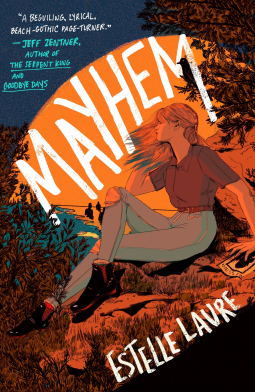
Mayhem Brayburn knows her mother never wanted to go back to Santa Maria, a small coastal California town. But when her stepfather goes too far, she and her mom take off for home. Mayhem was only a baby when she was last in Santa Maria, and it’s nothing like Mayhem expected. For one thing, there’s been a spate of girls gone missing—vanished from the beach without a trace. For another, the townspeople seem to think the Brayburns have mystical powers, something Mayhem’s mom and her estranged aunt don’t discourage. And finally, Mayhem’s aunt has taken in several wayward youngsters, around Mayhem’s own age, and they seem dangerous.

Mayhem is a wild story full of supernatural twists and lore, and everyday all-too-common horror (abuse, murder, addiction, sexual assault). Our title character’s name may mean chaos and anarchy, but Mayhem sees clearly through the turmoil that rages around her and her mother. Things go fuzzy for Mayhem when others take control. But what control does Mayhem have if all Brayburns follow the same destiny? Author Estelle Laure hooks readers with a story of magic passed down generation to generation. A journal from the Brayburn women’s lineage interspersed between the present day and illuminates much of the novel’s mystery. Readers should take note: this is an adrenaline-filled book, filled with edgy material and language.


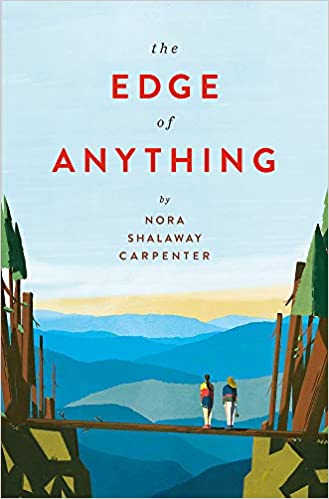
Mind Over Matter? A Review of The Edge of Anything

41ijEI30ipL._SX327_BO1,204,203,200_.jpgThe Edge of Anything
Written by Nora Shalaway Carpenter
Published by Running Press Kids
Available March 24, 2020
Ages 13+

Sage is going places: she’s a varsity senior on her school volleyball squad, scouted by Penn State and UNC. But when a court accident leads to a medical disqualification, she’s sent reeling. Her family isn’t helping, and her teammates just don’t get it. But then she meets high school loner Len. Len isn’t going places: Len’s stuck. Ever since a family tragedy, her photography has lacked life and Len has been picking up strange fears: most recently, dirt and the diseases it holds—even though she used to hike the Asheville mountains every day. As Sage and Len’s friendship grows, so does their willingness to face their inner turmoil.

In some ways, this is a tough read. Len, a gifted artist, struggles with grief and Obsessive-Compulsive Disorder amidst a troubling family backdrop—a family of free thinkers who believe the mind is enough to cure what ails. Sage, faced with devastating and scary news of a genetic medical condition, also struggles and shuts out her family and friends. Both teenage girls exhibit scary signs that something is wrong, but families, teachers, coaches, and teammates are unable to get through to either girl. Despite the serious topics (mental health, grief, genetic conditions), both Sage and Len are fully realized teenagers—and their big deal topics are imbued with adolescent attitude. Sage doesn’t mean to ice out her teammates, but she thinks that they should be able to intuit what kind of support she needs. Len does not want anyone to feel pity for her family, so she doesn’t seek help or confide in anyone about their financial circumstances. Author Nora Shalaway Carpenter writes the girls’ stories with great care. Her author’s note details her own experience with trauma-induced Obsessive-Compulsive Disorder. In addition to her own story, she spotlights mental health resources at the close of the book.