Happy Hispanic Heritage Month

September 15th-October 15th is Hispanic Heritage Month! The Hispanic experience is vast, with different cultures, languages, and races all falling under the Hispanic umbrella—therefore, no one book can define what the experience is like for any one person. With the political climate and rhetoric often disparaging Hispanic people and pushing forward policies that deny Hispanic people rights, it can be comforting to read books that extol the Hispanic experience. To celebrate Hispanic Heritage Month, we would like to share with you some of our favorite 2019 books about the Hispanic experience. This is by no means a comprehensive list of all the Hispanic books that have come out this year, but it is a start for those who wish to read more books where Hispanic culture and people are the focus.

Happy reading everyone!

other sideThe Other Side: Stories of Central American Teen Refugees Who Dream of Crossing the Border
Juan Pablo Villalobos
Translated by Rosalind Harvey
Farrar Straus Giroux, September 10, 2019
Ages 12-18
This is a non-fiction novel that depicts the experiences of ten Central American teens who crossed the border. To protect their identities, the names of the teens have been changed. Each experience is written in a narrative format that highlights the struggles that the teens had to endure in their home countries, traveling across the border, and in immigration detention centers. Reading about the challenges that these teens faced is heartbreaking. The back matter provides further details about what happened to each teen after crossing the border, as well as a list of resources and readings for those who want to learn more about the migrant crisis.

moon withinThe Moon Within
Aida Salazar
Arthur A. Levine, February 26, 2019
Ages 8-13
Celi is an eleven-year-old Afro-Latina living in Oakland who is dreading the day that she gets her first period. Her mother wants her to have a traditional ‘moon ceremony’ when Celi finally starts to menstruate to celebrate her transition from childhood into womanhood. If that wasn’t enough, the boy she has a crush on, Ivan, has been cruel to her best friend Mar who recently came out as genderfluid. Celi is forced to navigate the emotional waters of puberty, what it means to be a good friend, and who she wants to be. The back matter contains an author’s note discussing the cultural traditions of Mesoamerican peoples and a poem entitled “A Flower Song for Maidens Coming of Age” written in 1440. It is the only Mesoamerican precolonial document written about a moon ceremony. To accompany the poem, there is a moon calendar for those who are interested in tracking their menstrual cycles with the moon.

juana y lucas big problemasJuan & Lucas: Big Problemas
Juana Medina
Candlewick, May 14, 2019
Ages 5-8
Juana lives in Bogota, Colombia with her Mami and her dog (and best friend) Lucas. Juana grows worried as she begins to notice that her Mami is changing. She’s wearing makeup, perfume, changing her hair, and going out more often. Then one day, Juana meets Mami’s new friend Luis. Is Luis going to take Mami away from Juana? The illustrations are simple and vibrant, showing the things that are the most important to Juana. The book contains some Spanish words throughout the text, making it feel more like Juana herself is speaking.

a new homeA New Home
Tania de Regil
Candlewick, April 9, 2019
Ages Pre K-6
A little boy and a little girl are moving to a new city. The little boy is moving to Mexico City while the little girl is moving to New York. Each of them reflects on the things that they will miss about their city, each hoping that they will enjoy their new homes. The illustrations are phenomenal. The colors and details showcase the differences and similarities between the two cities. The last two pages of the book describe some of the locations within the book, explaining their significance to their respective cities.

vamos¡Vamos! Let’s Go to the Market
Raul the Third
Houghton Mifflin Harcourt, April 2, 2019
Ages 4-8
Little Lobo and Bernabe have to deliver supplies to the people at the market. At the market, Little Lobo and Bernabe run into many different people, each new person more interesting than the last. The illustrations are reminiscent of a comic, with the color palette evocative of the desert. Spanish is used throughout the text, with a glossary at the end of the book that translates Spanish words into English. Mexican culture is prevalent throughout the book, not just in the foreground but in the background as well.

 

Woman on the Mountain: A Review of At the Mountain’s Base

download

At the Mountain’s Base
By Traci Sorell
Illustrated by Weshoyot Alvitre
Kokila September 17, 2019
Ages Pre K-8

In At the Mountain’s Base, Traci Sorell shares the story of a Cherokee family tucked in a cozy cabin, preparing a daily meal as grandmother weaves nearby. As the family works, they sing, focusing their thoughts on a loved one, a US Air Force pilot “protecting and defending” far away. The family’s love and worries unfold in this simple, lyrical poem. Every sentence in the poem starts with a prepositional phrase, “On that stove,” “Around that grandmother,” “Within their song.” This consistent, cohesive pattern draws the reader in and pulls them gently through the family’s actions, those centered around a warm stove and those performed far off in the sky. Weshoyot Alvitre’s realistic illustrations clearly capture the different family members’ emotions, showing their love, worry, and pride. The Cherokee family highlighted in the poem is fictional. However, Sorell’s author’s note provides factual notes on the role of women from American Indian and Alaska Native Nations within the US Armed Forces. She specifically details the role of Ola Mildred “Millie” Rexroat, the only Native woman to serve as a Women Airforce Service Pilot during World War II. As a registered citizen of the Cherokee Nation, Traci Sorell reveals the American Indian experience in a voice as authentic and respectful as in her previous picture book, We Are Grateful: Otsaliheliga (Charlesbridge, 2018). At the Mountain’s Base is a wonderful homage to Native veterans everywhere.

Many thanks to local author, SCBWI-IL member, and guest reviewer, Michelle Schaub. Schaub is a children’s poet and teacher from Downers Grove, Illinois. Her second poetry collection, FINDING TREASURE: A COLLECTION OF COLLECTIONS (Charlesbridge, 2019), shares a release date with AT THE MOUNTAIN’S BASE on September 17th. Learn more about Michelle and her books at http://www.michelleschaub.com

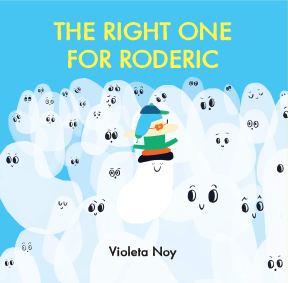
Apples and Ectoplasm: A Review of The Right One for Roderic

81dqpmXCxML

The Right One for Roderic
By Violeta Noy
July 9, 2019
Pre-K to 2nd Grade

Roderic is the smallest ghost in his family and longs to stand out. He often feels like his family doesn’t notice him, which makes him feel smaller than he already is. Everyone in Roderic’s family wears white sheets which makes them all look the same.  Reflecting on what he can do to make himself more noticeable to the other members of his family, Roderic decides to change how he looks. He tries wearing hats, scarves, and even taking off his white sheet and changing his wardrobe entirely, but his family does not approve of his fashion choices. Thinking that people in the city will appreciate his fashion sense, Roderic leaves to the city only to find that they don’t notice him either. When he returns home his family is relieved to see him and cover him in a white sheet. Not wanting to settle, Roderic finally finds the perfect outfit—a white sheet with apples on it. Roderic announces to his family that he does not care if his family wants to wear white sheets, he is going to be different. Roderic is not only accepted by his family, but his family follows his lead and starts to experiment with their fashion too.

The digital illustrations are simple and the use of color helps to highlight the loneliness that Roderic feels in the beginning of the story, and later the acceptance he feels at the end of the story. While the message itself is nothing new, the book is quite touching, once again reminding  readers that is okay to be yourself.

Moving Forward: A Review of I Don’t Want To Be Crazy

download (1)
I Don’t Want To Be Crazy 
by Samantha Schultz
Scholastic Inc.
March 29, 2019
Grades 9 and up

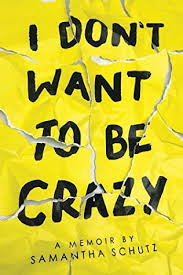
In the memoir I Don’t Want To Be Crazy, Samantha Schultz describes her journey with anxiety disorder. The memoir is written in verse and split into five sections. In the book, Schultz begins with her senior year in high school and continues one year beyond college. She describes her relationships with family, friends, and romantic partners. During this period of transition, she begins to identify that she is having panic attacks and to understand what her anxiety disorder entails. At the end of the book, Schultz includes an Author’s Note explaining why she wrote the memoir, noting that she was motivated to “provide comfort for others” by sharing her story and that others have opened up to her about their experiences with mental illness after reading the book. She also includes backup resources on how to talk to one’s family about mental illness and offers steps that readers can take to address mental illness. With clear and believable descriptions, Schultz provides the reader with insight into what her panic attacks feel like and how she manages her anxiety. Furthermore, she also involves family members’ reactions to her mental illness, which include questioning her about it. She writes, “My mother must think I’m blaming them, / but that’s not what I tried to say…./ We have given you everything/ you ever needed, ever wanted…./ What could possibly be so wrong with your life?” (62-63). She internalizes this questioning and feels guilty about her anxiety. Because Schultz speaks directly about mental health in this book, she provides a valuable perspective, letting the readers know that it’s okay to be mentally ill. While she is talking about her personal experience with mental illness, she also provides her readers with a way of moving forward.

A Burning Sky of Pain–A Review of The Weight of our Sky

the weight of our sky

The Weight of Our Sky
By Hanna Alkaf
Simon & Schuster
February 5, 2019
Grades:  9 and up

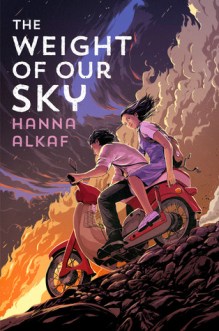
Melati Ahmad is a sixteen-year-old Malaysian girl of Malay descent who suffers from Obsessive Compulsive Disorder (OCD)—however, Melati believes that her OCD is actually the work of a djinn. Since the death of her father, Melati’s greatest fear has been the death of her mother. She counts by threes—her compulsive behavior—to appease the djinn and save her mother, along with everyone else she loves, from dying. On May 13, 1969, Melati is thrown into a world of chaos when the race riots between the Chinese and Malays begin. While at the movies with her best friend Saf, men with weapons break into the theater. Although Melati is saved by a Chinese-Malaysian stranger, she is forced to leave Saf behind if she wants to survive. Overcome with guilt, Mel teams up with Auntie Bee’s son Vince to try and find her mother who see she has not seen since the beginning of the riots. Melati is forced to confront her djinn and find her inner strength in order to stand up for what she believes in, find her mother, and protect the people she loves.

Alkaf is unafraid to make a book that is completely and utterly of her homeland. Alkaf’s note at the beginning of the book is spot on, letting readers know of the many possible triggers within the book and lets readers know that it is okay if they are not ready to read the book at this time. This is a powerful and brutally honest book that provides a very real look at what OCD looks like in a high-stress situation, which help builds the tension within the book.  It is thoughtfully and beautifully written, vividly capturing a time of terror from the eyes of a teenaged girl who just wants her mother.

Sharks Find Their Way Home: A Review of The Line Tender

the line tenderThe Line Tender
By Kate Allen, Illustrated by Xingye Jin
Penguin
April 2019
Grades: 5 and up

 Lucy and Fred are lifelong friends, and as they work on their animal field guide over the summer, it looks like they may become something more. When local fisherman and family friend Sookie catches a great white shark, Fred and Lucy set out to learn more about great white sharks by reading an old research proposal written by Lucy’s mother—an accomplished shark biologist before her untimely death when Lucy was 7 years old. Tragedy strikes when, after sharing her first kiss with Fred, he drowns in a quarry accident. Lucy is then left trying to find meaning in her friendship to Fred and wondering what could have been, while still struggling with the grief of her mother’s passing. By dedicating herself to her mother’s shark research and Fred’s field guide, and with the help of her Father, Sookie, and neighbor Mr. Patterson, Lucy is eventually able to come to terms with the deaths of her mother and Fred.
The Line Tender by Kate Allen is an emotional coming-of-age story that follows Lucy Everhart as she grapples with the loss of her mother and her best friend Fred. Allen thoughtfully ties Lucy’s attempts to find meaning in her friendship with Fred to her attempts to better understand the sharks her mother and Fred loved so much. The Line Tender is beautifully written and is both heartfelt and heartbreaking in the ways that it deals with community, friendship, and tragedy. Xingye Jin’s shark illustrations for each chapter title are stunning, adding yet another layer to the book as it shows Lucy slowly learning how to draw sharks as she learns more about them.

Chicken Killer: A Review of Bone Hollow

91gp8+kYlxLBone Hollow
Kim Ventrella
Scholastic, January 2019
Grades: 5-8

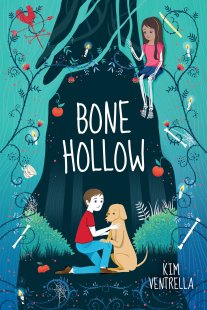
Did you ever think you’d die trying to save a chicken? Yeah, well, neither did sixth-grader Gabe, in Kim Ventrella’s forthcoming Bone Hollow. Except Gabe is only half dead–and he discovers this when he shows up at the town candlelight service for him. Gabe is on the run from the town, when he meets Wynne, the embodiment of Death. Wynne helps people pass into the light, and she wants Gabe to take over this job. Over the course of the novel, she and Gabe become friends, and, under Wynne’s mentorship, Gabe eventually accepts the responsibility of helping people cross over. Gabe is a lonely and humorous kid, and his voice is authentic, for a sixth grader which makes his processing of dying and death compelling to the reader. The narrator describes Gabe’s new perspective on Death: “Sad, sure, but also happy and kind and vast, like the ocean he and Gramps used to imagine. A deep, endless ocean, with rushing waves and a surface that reflected back each and every star” (222). Ultimately, this book might help adolescent readers recognize that death is inevitable, but it doesn’t have to be painful. Like Gabe, the readers might understand that Death is more of a transition than an ending.   


The Wild City: A Review of Animal City

61UGpFi7QrL._SX393_BO1,204,203,200_

Animal City
Joan Negrescolor
Chronicle Books,
November 2018

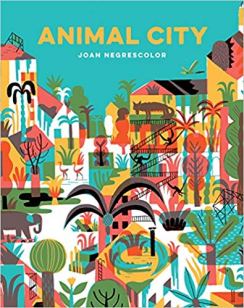
Animal City depicts a place overrun by unrestrained animals and plants, which Nina explores. Each day she returns to tell the animals their favorite stories. Some animals love to hear tales about myths and monsters or traveling to outer space while others prefer poems about sailors. The story shows Nina traveling through the forgotten city, emphasizing themes of curiosity and exploration of nature. Negrescolor’s text is simple, yet conveys a powerful message that stories have the ability to enthrall and capture the attention of anyone or anything. The digitally-created illustrations use vibrant and bold shades of red, blue, yellow, black, and green to create their jungle. By using digital art in this medium, Negrescolor depicts a chaotic wilderness, reflecting the mood of the story. The book simulates our curiosity because it is not clear what happened to humanity. The narrative allows for imagination to fill in the missing pieces here. Since there is not a lot of writing, this gives an opportunity for the pictures to tell the story and fully represent this ruined city.

Duty, Loyalty, Love: A Review of Empress of All Seasons


Empress of All Seasons

Empress of All Seasons
Emiko Jean
Houghton Mifflin Harcourt, November 2018

As per tradition, when the land of Honoku needs a new empress, a competition is held. All eligible women are invited, and the one who survives each of the four enchanted seasonal rooms is deemed worthy of the title of Empress of Honoku and position next to Taro, the prince next in line to be emperor. Mari has trained for this competition since childhood, though as yōkai she is technically ineligible to compete. Yōkai, supernatural beings, are under threat and enslaved by the current emperor. But Mari cares little about the rules or the prince – she competes for the power of being empress, and to bring change to Honoku from within. Taro himself doesn’t enjoy being a prize to be won, and cares little about his power – he would rather spend time in his lab with his mechanical inventions. Akira, another yōkai and friend of Mari, works to overthrow the Emperor from the outside while Mari keeps her true identity hidden to join the competition. Taro may just become their greatest ally, if they can learn to trust each other when their identities and motivations are revealed.

A detailed world and political structure along with multiple perspectives gives this fantasy novel depth and puts the reader at the immediacy of the action. Inspired by her Japanese heritage, Jean has created an escape for readers that questions the sacrifices made for duty and love, and challenges the notion of tradition as a value to be upheld.

“Made in Illinois”: Connecting Readers with Creators in YOUR Classrooms and Libraries

Sarah Aronson

The Butler Children’s Literature Center was pleased to host local author Sarah Aronson last week Thursday, September 20th, for her “Made in Illinois” presentation. Aronson, who has written several books for children and teens, including the Wish List series for middle grade readers and an upcoming Rube Goldberg picture book biography, is originally from Pennsylvania, but now calls Evanston home. She shared with our audience various ways teachers and librarians can incorporate local authors and illustrators into their programming, from brief but impactful Skype conversations, to writing or illustrating workshops, or as enhancements to various STEAM curricula. Aronson also suggested collaborating with authors and illustrators to introduce more difficult conversations. “Books are a safe place to have a bigger discussion,” she said, whether that be about “bullying, the loss of a loved one, or talks about community and empathy.”

However educators want to work with authors and illustrators, the important thing, Aronson reminded everyone, was that the kids and their interests and imaginations be at the forefront, and that it be a collaborative effort between all parties: “When kids meet authors and illustrators, something happens. The book comes alive.” All it takes to make this magic happen is reaching out. Many authors have contact information on their websites, and there is an online resource launching this fall that will help connect local creators with local educators (look for announcements here and on our social media!).

Thanks again to Sarah, and happy collaborating to all!