Welcome to the online presence of the Butler Children's Literature Center, housed in Dominican's SOIS (Crown Library room 214). Here, we celebrate the best in books for youth and those who delight in sharing them. For Summer 2025, BCLC will offer collection access to the Dominican community and general public during posted open hours: Tuesday and Thursday 9am to 4pm, Wednesday noon-4pm, Friday 9am-5pm and by appointment with the Curator. Contact Jen Clemons at jclemons@dom.edu to make arrangements or you can still reach us at butler@dom.edu.
These days, it’s more important than ever for us to share stories about immigration with the young readers we serve; both for the sake of immigrant kids in our communities, and to encourage understanding among others of these kids’ experiences.
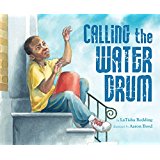
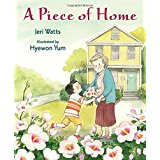
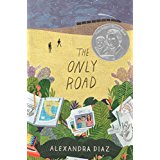
Join us on April 5, 2017 in the Butler Center from 5:30-7:00 (books & snacks out at 5:30; discussion from 6-7) to discuss the following list of recently published books with an immigration theme, from picture books to children’s fiction to teen fiction. We’re focusing on fiction this time; we know there are lots of excellent informational books too. You may remember the Butler Center’s “Big Read” bibliography from last year; this month’s list complements the selections recommended there.
It gets to be this time of the year in the children’s publishing world and my anxiety starts to bubble to the surface of my being. Blogs are buzzing with reviews of novels, analysis of illustrations, and comparison of genres. Librarians ask each other, “What are your favorites this year?” Patrons ask, “So who do you think is going to win?” And while I love love love the ALSC awards, I want to take a step back and reflect upon what a few of these buzzing books have in common, rather than the spirit of competition that my air bubble is currently filled with. This perfectly fits with The Butler Center’s mission to encourage imagination and wonder through literature.
I generated the following list of books randomly from several sources. This is simply for observation’s sake, so if a book isn’t included, there is no intention or reason behind it (and I have had a chance to READ THESE!) Let’s check out some of the books:
Counting by 7s by Holly Goldberg Sloan
One Came Home by Amy Timberlake
The Thing About Luck by Cynthia Kadohata
Flora and Ulysses: The Illuminated Adventures by Kate DiCamillo
The Center of Everything by Linda Urban
A Tangle of Knots by Lisa Graff
Far Far Away by Tom McNeal
Okay, so let’s the get obvious ones out of the way– most of these authors are women and they are all fiction choices. But this says more about me as a reader than about the Newbery contenders this year.
But let’s look at what’s underneath. When I take a close look, this is what I see:
1) They all ask important questions. Why are we here? How do I discover my own voice? What is the best way to make decisions? Where do I fit in? Can I change my own destiny, or is it just up to luck? Whether it is Georgie who is trying to navigate her own world amidst feelings of loss and coming-of-age discoveries or Flora going on adventures with a magic squirrel, these characters search, seek, and only sometimes find the answer. In other words, they make us think.
2) They are filled with important relationships. I think we know that humans instinctually want to connect with others, but each of these books explores friendship and family relationships with distinguished and dynamic depth. Cady searches for her long-lost parent. Willow loses everything she has and then finds family in a patchwork quilt of interesting human beings. The ghost of Jacob Grimm protects young Jacob Johnson Johnson, forming a kind of intimate bond between male characters. This level of authenticity is, in my opinion, rare in middle grade/YA novels.
3) They leave us with more questions, rather than answers. These books don’t tell us the way to live. There is no black and white, right or wrong. They explore questions along the way, but they leave the answers up to the reader. And isn’t that what great books are all about? Some of the best books I’ve read, I’ve finished the last page and thought, “Hmmm,” or “….huh….?” But then I think. I talk to other readers. I wait for it to sink in. And all of these books have sunk in because they don’t “fix” or “solve” anything. They explore, ignite, and wonder.
What Newbery buzz books are you excited about this year? What do they have in common with each other? How do the books inform each other when you compare them in the aggregate rather than in direct competition with each other?
I lived with my sister, now a science education specialist, while she was completing her master’s degree. Her thesis considered students’ perceptions and assumptions of scientists: their work, appearance, and setting. We had a ball examining the teenaged participants’ drawings, through which an overwhelmingly popular archetype emerged: Einsteinian hair, glasses, bow ties, lab coats, Erlenmeyer flasks, boiling liquids, explosive gases. When asked “What does a scientist look like?”, students’ answer is almost unanimously male and inside a laboratory.
I am so pleased to see books for the young adult reader challenging the stereotype. Houghton Mifflin’s excellent Scientists in the Field series solidifies an altogether different image. Take The Tapir Scientist, by children’s nonfiction juggernauts Sy Montgomery and Nic Bishop. While the cover photograph shows the captivating and rarely seen face of a tapir – trunk-like snout, curious eye and nearly smiling mouth – the first title page’s photograph reveals the book’s namesake and star: a woman wearing dirty cargo pants, t-shirt and baseball cap wades through ankle-deep wetlands, holding an instrument in the air and peering towards the horizon. Her name is Patricia Medici, a Brazilian scientist whose work may more closely resemble extreme camping than the conventional image of “doing science.” For days, she and her team (which includes Sy and Nic) make trips around the vast Pantanal Wetlands of Brazil attempting to collar and track the elusive tapirs, whose behavior is largely a mystery. She has to beware pumas, venomous snakes, and the relentless bite of ticks, but the more troublesome battles are that with faulty equipment or inconsistent results. Although the subject of The Tapir Scientist and other books within this series is an animal, the text’s content is all process from the scientist’s point of view. Montgomery and Bishop record Patricia’s frustrations and triumphs as they happen and present their work as a narrative full of suspense, empathy and joy. Yes, the reader learns the traditional creature facts – anatomy, behavior, ecosystem – but all that report fodder is discovered only through the journey the reader makes with the scientist.
Similarly, Jim Ottaviani and Maris Wicks’ graphic novel Primates: The Fearless Science of Jane Goodall, Dian Fossey, and Biruté Galdikas places its readers right in the boots (or bare feet) of the title’s three scientists. Through brilliantly distinct and sometimes overlapping narration, we grow to understand the individuals: Jane’s endless curiosity, Dian’s brusque fierceness, Biruté’s patient hunger. But all are united by their commitment to primate study, more so, to study primates in the wild. Each is recruited by famed anthropologist Louis Leakey, whose targeting of women feels ambiguously both progressive and sexist: he seems to respect these women for their observational intelligence, but Primates also references his womanizing with the young researchers he employs. Nevertheless, for these three women, chimps, gorillas and orangutans are the subject of all attention. The reader, too, is given a front seat to the observations; Wicks devotes pages of panels, with minimal text, just to the sequential movements and expressions of the primates: the chimps’ mysterious rain dance, gorillas’ unique noses “like big fingerprints,” an orangutan’s leisurely journey through the trees. Wicks’ style is not naturalistic; on the contrary, her brightly painted drawings are stylistically playful and simply rendered. Coupled with the type sets used for the texts, which mirror the style of each scientist’s documentation – handwritten script or typed Courier – the reader can imagine these illustrations appearing in these women’s scientific logs, a patient and enthusiastic recording of what they see in the field.
Lastly, Louis Nowra’s fictional novel Into That Forest portrays not a willing scientist per se, but a child lost in the woods. Incredibly, young Hannah and her friend Becky survive a storm in the Tasmanian wild, only to be rescued and adopted by two Tasmanian tigers. Initially they are terrified, but as the creatures prove themselves trustworthy guardians – bringing them caught fish, leading them to their den – the girls adapt to their bizarre new family structure. Over four years in the wild, they slowly lose the things that define them as human – their manners, clothes, and eventually, language – but they gain just as much in their careful observations of their new companions. Theiri senses sharpen, words are replaced by growls and eye expressions, and affection for their new foster parents grows:
The tigers stopped being animals to me. They were Corinna and Dave… Corinna showed she liked us by licking us and curling up with us whenever we slept. Though I have to say, if she didn’t like something you did, she’d nip you to let you know.
Nowra’s story, as dense and rich as the Tasmanian forests, not only stands as an imaginative memorial to the thylacine, officially declared extinct in 1936, but as a testament to Piaget’s classic theory of development: that the child is a scientist, learning and constructing her world of knowledge through constant observation and application without any extrinsic motivation, like candy bribes or A+ grades. It is that childlike passion and curiosity that should identify grownup scientists more than the lab coats. Indeed, the women so masterfully presented in these varied stories all possess that drive for understanding the world that seems to exist outside of and above the status quo of our everyday work culture. And perhaps outside is the key: it is hard not to feel awed, inspired and motivated when you’re surrounded by the wonder of the wild.
Odd Duck
by Cecil Castellucci & Sara Varon
First Second, 2013
The phrase feels like a relic from an older generation, like bee’s knees. Indeed, when I occasionally say it, I can feel the echo of my parents’ voices in my lungs. “She’s a bit of an odd duck, isn’t she?” It’s almost – almost – an endearing phrase – not quite as nice as “marches to the beat of a different drummer” but a similar notion. Just enough of a raised-eyebrow judgment to acknowledge a differentness in another.
The title’s slightly nostalgic phrase makes me not at all surprised its artist is the quirky, kooky Sara Varon, whose Bake Sale was a deliciously different cookie of a book as well. In Odd Duck, she brings her signature omnisciently-bemused labeling to the endearing details of Cecil Castellucci’s story and character, including duck-protagonist Theodora’s morning rituals (“Quaking exercises, for perfect pitch and tone”), her occasional unorthodox shopping choices (“Duck food, just like all the other ducks…but also…mango salsa! Huh!”), and her eventual disapproval of the new neighbor Chad (“Feathers ASKEW!” and “Violent dancing!”). Details including rotary phones and Theodora’s lavender cloche-like bonnet (complete with a decorative, metaphorically-foreshadowing bee) insist the story is set in some bygone era. The ducks’ wide-eyed expressions and wiggly, spaghetti-like limbs (again, “Violent dancing!”) call to mind the Steamboat Willie days of early cartooning, or perhaps today’s decidedly-retro hit “Adventure Time” on Cartoon Network.
Early in the story, Theodora wishes on a star “that nothing in her happy life would ever change.” She is clearly as sentimental and vintage as her artist’s style suggests. And of course the new neighbor throws a bit of a wrench (nearly literally, as he is a builder of strange modern sculpture) into her life. She is initially offended by his unrefined mannerisms and disheveled appearance until they find some common ground on the ground: both decide not to fly south for winter. Bonded by this quiet rebellion against the birds-of-a-feather rule – a glimmer of the uncompromising nature of each of their odd-duck-ness to be fully revealed and reveled in by the book’s end – Theodora and Chad become fast not-so-fair-weather friends.
The odd-duck odd-couple’s charm lies in their utter contentment with themselves. Up until a critical plot point in which they overhear a stranger’s comments, it never occurs to either party that he or she holds the title of oddest duck. Their mostly unencumbered sense of self and gentle stubbornness to be anything else is such a delightful match to Castellucci’s story and Varon’s artwork. It’s a reading experience so well done and delightful it’s sure to inspire its readers to embrace the odd in themselves.
Written by Julie Fogliano, illustrated by Erin E. Stead.
A Neal Porter Book, Roaring Brook Press, 2013. ISBN 978-1-59643-731-9
Quiet and lyrical, this picturebook (created by the same team as And Then It’s Spring) celebrates childhood in its playful energy and its deep contemplation. Fogliano’s minimalist poetry flows off the page like maple syrup; yet, the text is not without structure. Fogliano uses assonance and alliteration effectively and intelligently throughout the story, using fun phrases such as “whales won’t wait for watching” and delicate ones such as “ship that is sailing” and “flag that is flapping.” Stead’s signature illustration style of muted pastels and purposeful negative space compliment and extend Fogliano’s artful text. As I experienced this story, I couldn’t help but put myself into the young character’s shoes, imagining, remembering and creating images in my head about my own childhood journeys.
I was left with many thoughts and feelings after I finished this book, but the most significant was a personal meditation on patience and discovery. After a first read, it might be easy to think that seeing a whale is the most important thing for this young boy. After all, it is the title of the book. Yet, I think the text and image are purposefully juxtaposed here. Yes, the text states, “You’ll have to just ignore the roses,” and “Don’t look way out and over there to the ship that is sailing.” But, the boy doesn’t ignore the roses, and he does look way out and over there. During the majority of the book, the boy isn’t seeing a whale. Rather, he is exercising patience for the future and truly experiencing the beautiful things of every day. Most days aren’t monumental, right? Most days, we don’t have promotions, our babies aren’t born, our books aren’t published, and the love of our life doesn’t knock on our door with 1,000 yellow daises. Rather, we write emails and cook dinner and help with homework and come home to chaos or maybe empty apartments. The days of actually “seeing the whale” are fabulous and memorable and obviously grand. But we have to be patient to discover them. Maybe Fogliano and Stead are saying that the whale has always been there all along, hanging out in our minds and hearts. We just have to open our eyes to the every day to finally see it.
On a side note, I adore the dog in this picturebook. I love the tilt of its head, the way its back arches when it smells roses, and the way it follows the boy around in every spread, just like dogs do.
Opening the pages of one of Doug TenNapel’s book is a bit like pressing play for a David Lynch film: you feel the certainty in your gut that it’s going to be a surprising and unique experience, an hour or two of bizarre, sometimes even disturbing images you’ll never forget seeing. The difference is, with Lynch’s work, I’d usually prefer to look away; with TenNapel, I can’t tear my eyes from the page.
Before the warped worlds of Bad Island and Ghostopolis, before the philosophical minefield of Cardboard, Doug TenNapel wrote Tommysaurus Rex, now beautifully republished in full color (contributed by Katherine Garner). In this middle grade graphic novel, a boy named Ely loses a pet dog and gains a pet dinosaur. Ely knows in his heart that the tyrannosaurus – playful, good-natured, and in need of training – is some manifestation of his old dog Tommy, despite its also having memories of Cretaceous life (and death). The mechanisms for the dinosaur’s rebirth and reincarnation are largely unstated, and blissfully so; TenNapel’s masterful storytelling presents a confident, fantastical logic that shrugs off the dull necessities of reality. The reader is happy to shrug them off, too.
In Tommysaurus Rex, TenNapel nods to fellow monster creators: Ray Harryhausen, visual effects artist who innovated new stop-motion animation techniques in the 1950s and ‘60s, makes a cameo appearance in Ely’s story. Bill Watterson was a clear influence on the artist; like Calvin and Hobbes, Ely and his fellow humans are drawn with occasionally zany stylistic expressions, while Tommysaurus is almost frighteningly realistic. Yet despite its allusions and tributes, the style and story stand alone. Calvin and Hobbes cuts with wit and cynicism, but through its perfectly messy imagery and fantastical conceit, Tommysaurus Rex rings loudly and truly with heart. One moment you might recoil from the image of a tyrannosaurus digging into a bloody feast of a cow carcass; the next, you’re holding back tears as a bully expresses regret or a friend says good-bye forever. TenNapel always surprises me somehow, except I always know I need to hold on for dear life (and keep the tissues within reach).
One for the Murphys
by Lynda Mullaly Hunt
Nancy Paulsen Books, 2012
For a dog owner, it’s always a fascinating exercise to see what your pet notices. You pick up the house keys and she’s at the door; simply raise your eyebrows and her ears are pricked up in anticipation. A dog’s job is above all observing her humans, and we’re amazed by what she notices.
Yet nothing tops our own species as the reigning champions of observation. When we’re paying attention, we see everything: the slight tightness in a boss’s face, or the averted eyes of a suspicious stranger. The key is the paying attention part. In psychology experiments, a subject might be “primed” for a test by viewing significant words or images. In life, our past experiences teach us what to look out for.
One for the Murphys is a story about seeing. Twelve-year-old Carley Connors keeps much to herself, but the reader sees she’s a pro at observation, especially of her foster family:
“Michael Eric comes in with his hand tucked into his armpit. His mother drops to the floor like someone has kicked her behind the knees, but she lands gently, holding out her arms, and he melts into them.”
From smiling photos, neatly arranged pantry supplies, and especially the warm gestures and touches exchanged between the Murphys, Carley sees she doesn’t belong. She sees other things, too: moments of tension, worry, and anger. To another’s eyes, these might be normal moments of stress for a family, especially a new foster family. But to Carley, every frown is evidence that she is unwanted. Every hand reaching out is a potential slap, and she reflexively flinches. Although she has a keen eye for observation, her perception is skewed.
Through fragments of memory, the reader starts to see why: the last thing Carley saw before she woke up in the hospital was her stepfather raising his fists to beat her, and her mother holding her down. Carley, believing strength and emotion are mutually exclusive, doesn’t share this information readily with the people she encounters. Without all the facts, these other characters make their own judgments: a police officer sees her as an instigator; a classmate, seeing only the new clothes Mrs. Murphy has purchase for Carley, thinks she’s a mindless clone of any other kid. But the reader is granted the most accurate view. In seeing each person’s mistakes in perception, including Carley’s, we start to wonder about the people we see and the judgments we make. There’s almost always more to the story – in One for the Murphys and in life – and it isn’t always something that we great observers can clearly see.
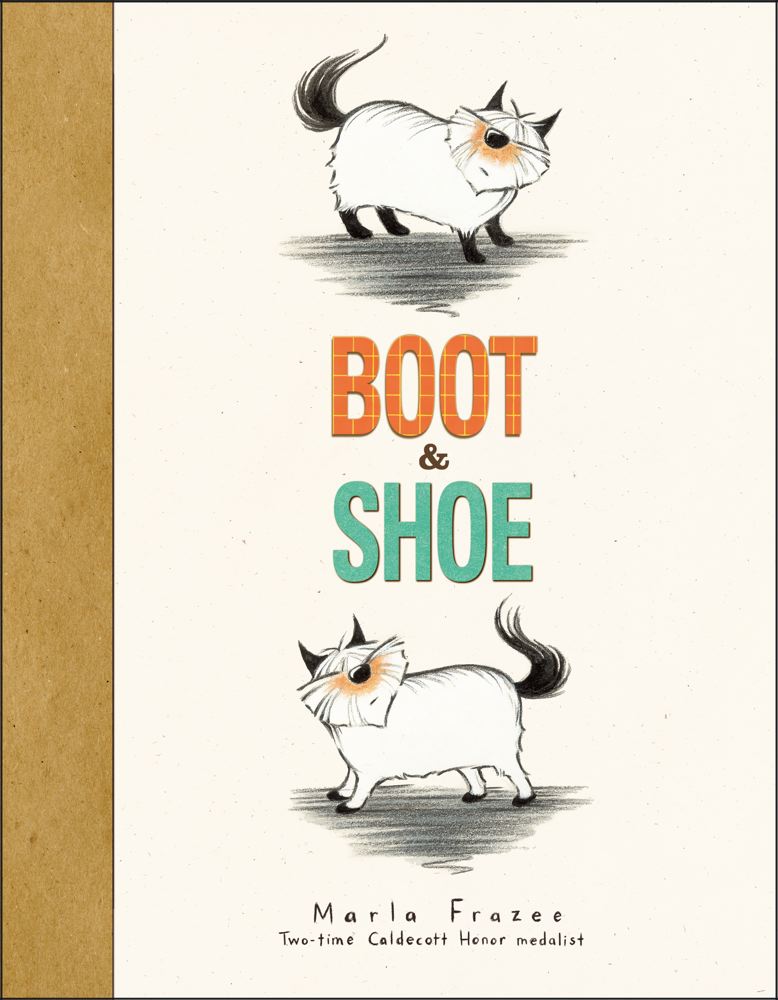
Beach Lane Books, 2012. There is no denying that Marla Frazee has made her mark on children’s literature. Her signature illustration style has delighted children and award committees with titles such as Stars, All the World, and A Couple of Boys Have the Best Week Ever.
Boot & Shoe, Frazee’s 2012 gem, stands out for me among her work. I know this is partially because I’m a dog person—I even have two dogs who are brother and sister, similar to Boot and Shoe. But this book is much more for me than just being part of a target audience. It is rich with humor, artistry, and honesty.
Boot and Shoe come from the same litter, and they do everything together—eat, sleep, and even pee. But, Boot likes the back porch and Shoe likes the front porch. Frazee uses soft lines of black Primsacolor pencil and textures and details every page with gouche paint to bring out a wide variety of moods. Significant white space is used throughout the book to highlight vignettes, half-page spreads, and energetic scenes. The crisis of the book—when the dogs can’t find each other—instantly changes Frazee’s artistic style. In nighttime, sad scenes, Frazee uses harsher, straighter lines and deep colors of black and blue pencil. One of my favorite spreads is when the sun comes up, and both Boot and Shoe begin to cry.
So, the book changes. I read this book in a storytime, and kids were laughing and giggling and pointing at the beginning. But when the dogs couldn’t find each other, there was real fear in the room. When Boot and Shoe cried, the room was silent. While I was reading, I kept thinking, “Wow, this is a dynamic book.” Yes, it’s about dogs and friendship. But it’s also about loss; it’s telling children that it’s okay to cry when you feel sad, and it’s doing it with an honest intention and a comforting approach. Rather than books that are only charming and funny (which are great at times, too), Boot and Shoe really spans a variety of moods and emotions, just like we all feel every day. How great to have such authentic, conscientious storytelling for children.
And I gotta say it: If you have dogs or love dogs, this is a book for you. I grew up with one dog, and when she passed away my parents decided to get two—a brother and sister, Jem and Scout. Since getting to know these cuddly dudes, I’m telling you, I’ve never seen such friendship. Besides the fact that Jem would eat all of Scout’s food if he could and Scout bites Jem’s ears constantly, these two dogs are BFFs. Just like Boot and Shoe, they sleep together, eat together, play together. But they are individuals, too. Seeing how much they love each other just makes me want to love more, and to treat each person I meet the way they treat each other—with an open heart, a forgiving soul, and always a shoulder (or back or stomach) to lie on.
Thanks, Marla Frazee. You rule.
Check out Scout and Jem’s friendship throughout their lives below.
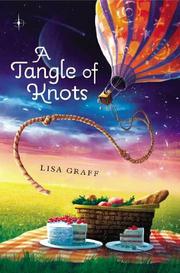
I pick up a book for a number of reasons—good reviews, a fabulous cover, or because a friend or colleague gives a recommendation. Rarely does a book’s title encourage me to dive in. Even though A Tangle of Knots has all of the aforementioned things, its title is what really struck me.
Tangles and knots both suggest tension, complexity, and stress. I don’t know about anyone else out there, but the world has seemed to be a tangle of knots lately. I’m not sure when the tangle of knots began for me—maybe 9/11 was the first time I truly comprehended catastrophe. Since then, and very recently, it feels like they just keep coming– the shootings in Aurora, Colorado and Newtown, Connecticut. The Boston Marathon bombings. The tornado. The daily violence here in Chicago.
That’s just the United States. If I start thinking about the terrorism in Mogadishu or the violence in Syria, the knots get thicker and the tangles more snarly.
So what does this difficult stuff have to do with a middle grade novel? Well, I picked up this book in the middle of one of those really tangly, knotty weeks. I had read first-person accounts from the families affected by the Newtown, CT shootings at my doctor’s appointment. The Boston Marathon bombings happened. Then the tornado came. Yet, as I read Graff’s novel, a number of things changed for me. First of all, I let myself sink into the world of the novel and was distracted from my sensitivity for little while. Graff’s eloquent, imaginative story weaving and her sophisticated, third-person writer’s voice made it impossible not to be encapsulated by the book. Secondly, I laughed, probably for the first time that week. Lastly, the book was a window and a mirror. I thought about the book’s tangle of knots, my own tangle of knots, and the world’s tangle of knots, and I accepted them all.
This acceptance probably has to do with the fact that the book is all about cake, and there is no way I can be in a bad mood when I am reading about cake. The protagonist, Cady, is an orphan searching for her place in the world. She has her own special Talent—she can meet someone and instantly know his or her favorite cake. I love Cady. The novel is rich with a puzzle of characters, but what I love about Cady is that she has lost almost everything, and she is not bitter. By the end of the book, I realized that Cady’s magic had nothing to do with her cake making—it is all about her heart. Add in a whimsical family, an old woman who has lost her ability to speak, a boy who has a Talent for spitting, a thief, several real cake recipes, and some blue suitcases–we’ve got a winner.
As I turned the last page, I stopped thinking about the horrific parts of past tragedies and turned toward the small miracles. The police workers on 9/11. The Boston marathoners who crossed the finish line and ran to the local hospitals to give blood. The interview with the woman who had lost her dog in the rubble of Oklahoma’s tornado (see attached video). I know people talk about the small stuff, but it truly is everywhere. And it’s written all over Graff’s novel. A ferret. Peanut butter cake. A missing dinosaur bone.
And then I thought: tangles and knots. Yes, both suggest tension. But put in a different light, they suggest stability, support, strength. We tie knots when we want something to stay together. When my hair tangles, it comes together in clumps, and each individual hair is indistinguishable. Maybe sometimes we need to be individuals, to be untangled and free. But other times, especially hard times, we need to tie knots with each other, and learn to lean on each other for support and strength. Cady does.
Graff writes, “Cady was one of the biggest-hearted people Marigold had ever met—she tried harder than anybody else to make others happy…If Marigold had learned anything that week, it was that trying hard and being a good person didn’t always mean that good things would happen to you.”
We all know that bad things happen. But that fact doesn’t make Cady lose her sensitive heart or her willingness to stay positive, so it won’t make me lose mine, either.
I think my favorite cake would be a chocolate one; almost brownie-like, with a really rich, dense texture and chocolate frosting, warmed up with ice cream on the side.
“Emily Dickinson is the perfect thing to hand to a 16-year old girl,” advised fellow blogger lynchlibrarian recently. What is it about Emily? Indeed, I was 16 when I purchased my paperback copy of her complete works (at the local Borders bookstore, my idea of the cool hangout spot), and I vividly remember discussing “Success is counted sweetest” in my high school’s U.S. Literature class. Certainly I considered her words earlier and later in life, though not by much: an eager seventh grade teacher chalked “I never saw a moor” on the board for the daily quote; in my second year of college, fellow English majors and I spent the better part of a class dissecting the differences between her 1859 and 1861 versions of “Safe in their Alabaster Chambers” (the power — of a dash!).
So what is it about Emily that resonates during young adulthood? While increasingly introspective teens may be intrigued by her famously reclusive habits, it’s her words that truly inspire. At a time when teenagers feel pulled between their past and future selves, her voice simultaneously offers innocence and wisdom. As they encounter the terribly great problems of the world and personal decisions to make, her subject matter rings with the impossible brightness and darkness of life’s great questions. Through succinct, tender verses, Emily provides young people with a “nugget of pure truth” to grasp in their hands and hearts. (My Virginia Woolf obsession came later in life.)
If young people miss out on enthusiastic teachers reading Emily’s poetry aloud, I’m happy to know they may also discover her in the pages of fiction. Jacqueline Woodson’s beloved Feathers (Putnam, 2007) perfectly pairs “‘Hope’ is the thing with feathers” with a story that examines the power of friendship over divisions and discrimination during the 1970s, a fragile, precariously hopeful time in our nation’s history. What a perfect story for a 12-year-old.
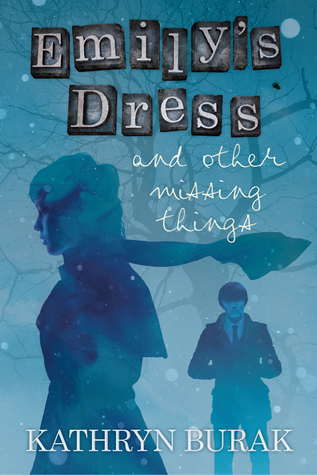
For older readers, Kathryn Burak’s novel Emily’s Dress and Other Missing Things (Roaring Book Press, 2012) explores Emily’s darker side. After experiencing personal tragedy, Claire and her father attempt to start fresh by moving to Amherst, Massachusetts, the home of Emily Dickinson. Claire is a poet herself and finds herself drawn to Emily’s words, rich with poignant examinations of death, and to Emily’s house, now of course a museum where Emily’s personal belongings are artfully arranged for tourists to view. As if in a creative trance, she breaks in, night after night, to write while wearing Emily’s white dress — until the day the college-aged student teacher Tate discovers her. Instantly linked by this strangely intimate crime, they run, stealing the dress in the process. Burak’s poetry is the star of this novel, both in the actual verses Claire writes — the portals by which she gradually shares the tragic details of her past — and in the crisp, shimmering prose of Claire’s narration:
The smell of snow on the winter air fades. I take a deep breath. I smell paper. Here I have the cool, clean feeling of paper, too.
I am so glad to get away. To be in Emily Dickinson’s house.
With a frigate like this book, the reader will certainly agree.





 Butler's Pantry