Welcome to the online presence of the Butler Children's Literature Center, housed in Dominican's SOIS (Crown Library room 214). Here, we celebrate the best in books for youth and those who delight in sharing them. For Summer 2025, BCLC will offer collection access to the Dominican community and general public during posted open hours: Tuesday and Thursday 9am to 4pm, Wednesday noon-4pm, Friday 9am-5pm and by appointment with the Curator. Contact Jen Clemons at jclemons@dom.edu to make arrangements or you can still reach us at butler@dom.edu.
The Butler Children’s Literature Center was pleased to host local author Sarah Aronson last week Thursday, September 20th, for her “Made in Illinois” presentation. Aronson, who has written several books for children and teens, including the Wish List series for middle grade readers and an upcoming Rube Goldberg picture book biography, is originally from Pennsylvania, but now calls Evanston home. She shared with our audience various ways teachers and librarians can incorporate local authors and illustrators into their programming, from brief but impactful Skype conversations, to writing or illustrating workshops, or as enhancements to various STEAM curricula. Aronson also suggested collaborating with authors and illustrators to introduce more difficult conversations. “Books are a safe place to have a bigger discussion,” she said, whether that be about “bullying, the loss of a loved one, or talks about community and empathy.”
However educators want to work with authors and illustrators, the important thing, Aronson reminded everyone, was that the kids and their interests and imaginations be at the forefront, and that it be a collaborative effort between all parties: “When kids meet authors and illustrators, something happens. The book comes alive.” All it takes to make this magic happen is reaching out. Many authors have contact information on their websites, and there is an online resource launching this fall that will help connect local creators with local educators (look for announcements here and on our social media!).
Thanks again to Sarah, and happy collaborating to all!
The Forest Queen Betsy Cornwell HMH/Clarion Books, August 2018
“Steal from the rich, give to the poor” gets a fresh take in this gender-swapped retelling of the classic Robin Hood tale. Sylvie, sixteen and lady of Loughsley Abbey, begins to question her family’s treatment of the people of Loughsley – especially now that her brother, John, is the unforgiving sheriff. With her childhood friend, Bird, she runs away and lives in hiding in the nearby woods. Slowly, others from Loughsley join them in their new community, including a young woman named Little Jane, the midwife Mae Tuck, and others who feared otherwise being jailed for their inability to pay egregious taxes. Sylvie must eventually confront her brother, along with her own complicity in the evils done by her family, and she comes to realize that the changes required for economic justice mean she must take “radical action” and put herself in potential danger for the greater good. Sylvie and her mission to redistribute wealth among the people of Loughsley are easy to root for, but the additional focus on gender roles, womanhood, and the idea of community as family are what set this retelling apart. Strong secondary characters help to challenge Sylvie and force her to take a strong stand against a system that she would otherwise benefit from, and parallels can be drawn from the injustices in the story to those of today’s world. As Little Jane, who becomes a dear friend to Sylvie says, “If someone doesn’t care whether you live or die, then living itself is rebellion” (p 241). This thoughtful narrative of what can happen when the privileged few horde wealth while the majority struggles to make do with less and less shows the power in a united band of concerned citizens.
The Dollar Kids
Jennifer Richard Jacobson
Illustrations by Ryan Andrews
Candlewick (August, 2018)
Ages 10-14
When his family wins the chance to buy a house for just $1, twelve-year-old Lowen sees it as a chance to hit the reset button — Mum can open her own restaurant, Dad can follow his dream of working in a clinic in an underserved community, his brother Clem can finally be the star athlete, and his sister Anneth — well, she’ll need convincing. And sensitive, artistic Lowen can work through his grief over the death of a friend and guilt over believing he caused it. But moving to a small town isn’t easy on any of them, leading everyone to question whether the Dollar House program was such a good idea after all. Dubbed the “Dollar Kids” by hostile new neighbors skeptical of the program and “whether it’s a help or drain on the town” (p. 328), Lowen and the other new kids in town struggle to make a place for themselves, rehab houses, and rebuild community.
The idea of home, be it a building, a community, a family, or a feeling creates a strong backbone for this plot, helping to pull the reader through the slightly slow start to the one year the book covers. By mid-book, the pace picks up in both action and time (the progress noted with each new chapter). While slightly awkward, the change of pacing mirrors the changes Lowen experiences as he processes his grief and settles into life in Millville. Scenes from Lowen’s comic book drawing layer in additional elements of his grieving process, questions of faith, and ultimately his healing.
Diversity (of age, gender, and cultures) among the characters in this story provide a varied range of coping mechanisms for dealing with uncertainty, insecurity, and change by both the new families settling in and Millville residents dealing with the decline of their small, but proud town. The inclusion of parents and other community members as active players in the story is a refreshing change from books that often leave you wondering “What happened to all the adults?” and provides a subtle reminder that communities need all types of diversity to thrive.
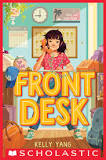
Front Desk by Kelly Yang Scholastic/Arthur A. Levine Books May, 2018
Mia and her parents, recent immigrants from China, are managing a California motel in the early 1990s. It’s a family affair, as ten-year-old Mia finds herself responsible for checking in motel guests while her parents tend to the rooms and motel maintenance – though it sometimes feels like it’s Mia against the world. After a rough start including washing machine mishaps, bad grades, and arguments with her mother (who wants Mia to stick to math, something she considers Mia to be a “native” in), Mia hits her stride when she realizes the power of using her ever-improving English to help others, especially the motel guests she considers family.
Adventurous subplots and dynamic secondary characters add to the appeal of this compelling middle grade novel. Mia believes in herself and wants what is best for her friends and family, and though her quick thinking sometimes gets her in trouble, at the end of the day she is a force for good in her community. This book is fun, yet thoughtful, and shows that there’s no age requirement for taking action against injustice.
Told in three separate yet connected stories, Refugee is a novel of perseverance and commitment to who you are in the face of persecution.
Josef is fleeing from 1930s Nazi Germany and the threat of concentration camps with his parents and sister. Isabel, her parents, and her neighbors use a makeshift raft to escape Cuba in 1994, during the unrest of Castro’s regime. Mahmoud, along with his parents and younger siblings, leave the violence of war in Syria in 2015, traveling through Europe as they search for a safer place to live. Though the details of their stories are unique, Josef, Isabel, and Mahmoud share more similarities than just their situations.
The attention given to creating characters with heart and conviction is engaging, while the conflicts each protagonist faces ensure none of their individual stories get stuck in the emotion of the book as a whole. Refugee tells an important story, and does so without preaching or sensationalizing the experiences of refugees past and present. Maps and an author’s note highlight the reality of Josef, Isabel, and Mahmoud’s stories and show the readers how they can help with relief efforts.
These days, it’s more important than ever for us to share stories about immigration with the young readers we serve; both for the sake of immigrant kids in our communities, and to encourage understanding among others of these kids’ experiences.
Join us on April 5, 2017 in the Butler Center from 5:30-7:00 (books & snacks out at 5:30; discussion from 6-7) to discuss the following list of recently published books with an immigration theme, from picture books to children’s fiction to teen fiction. We’re focusing on fiction this time; we know there are lots of excellent informational books too. You may remember the Butler Center’s “Big Read” bibliography from last year; this month’s list complements the selections recommended there.
It gets to be this time of the year in the children’s publishing world and my anxiety starts to bubble to the surface of my being. Blogs are buzzing with reviews of novels, analysis of illustrations, and comparison of genres. Librarians ask each other, “What are your favorites this year?” Patrons ask, “So who do you think is going to win?” And while I love love love the ALSC awards, I want to take a step back and reflect upon what a few of these buzzing books have in common, rather than the spirit of competition that my air bubble is currently filled with. This perfectly fits with The Butler Center’s mission to encourage imagination and wonder through literature.
I generated the following list of books randomly from several sources. This is simply for observation’s sake, so if a book isn’t included, there is no intention or reason behind it (and I have had a chance to READ THESE!) Let’s check out some of the books:
Counting by 7s by Holly Goldberg Sloan
One Came Home by Amy Timberlake
The Thing About Luck by Cynthia Kadohata
Flora and Ulysses: The Illuminated Adventures by Kate DiCamillo
The Center of Everything by Linda Urban
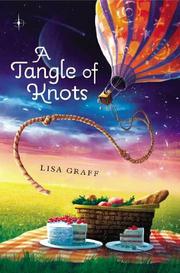
A Tangle of Knots by Lisa Graff
Far Far Away by Tom McNeal
Okay, so let’s the get obvious ones out of the way– most of these authors are women and they are all fiction choices. But this says more about me as a reader than about the Newbery contenders this year.
But let’s look at what’s underneath. When I take a close look, this is what I see:
1) They all ask important questions. Why are we here? How do I discover my own voice? What is the best way to make decisions? Where do I fit in? Can I change my own destiny, or is it just up to luck? Whether it is Georgie who is trying to navigate her own world amidst feelings of loss and coming-of-age discoveries or Flora going on adventures with a magic squirrel, these characters search, seek, and only sometimes find the answer. In other words, they make us think.
2) They are filled with important relationships. I think we know that humans instinctually want to connect with others, but each of these books explores friendship and family relationships with distinguished and dynamic depth. Cady searches for her long-lost parent. Willow loses everything she has and then finds family in a patchwork quilt of interesting human beings. The ghost of Jacob Grimm protects young Jacob Johnson Johnson, forming a kind of intimate bond between male characters. This level of authenticity is, in my opinion, rare in middle grade/YA novels.
3) They leave us with more questions, rather than answers. These books don’t tell us the way to live. There is no black and white, right or wrong. They explore questions along the way, but they leave the answers up to the reader. And isn’t that what great books are all about? Some of the best books I’ve read, I’ve finished the last page and thought, “Hmmm,” or “….huh….?” But then I think. I talk to other readers. I wait for it to sink in. And all of these books have sunk in because they don’t “fix” or “solve” anything. They explore, ignite, and wonder.
What Newbery buzz books are you excited about this year? What do they have in common with each other? How do the books inform each other when you compare them in the aggregate rather than in direct competition with each other?
Odd Duck
by Cecil Castellucci & Sara Varon
First Second, 2013
The phrase feels like a relic from an older generation, like bee’s knees. Indeed, when I occasionally say it, I can feel the echo of my parents’ voices in my lungs. “She’s a bit of an odd duck, isn’t she?” It’s almost – almost – an endearing phrase – not quite as nice as “marches to the beat of a different drummer” but a similar notion. Just enough of a raised-eyebrow judgment to acknowledge a differentness in another.
The title’s slightly nostalgic phrase makes me not at all surprised its artist is the quirky, kooky Sara Varon, whose Bake Sale was a deliciously different cookie of a book as well. In Odd Duck, she brings her signature omnisciently-bemused labeling to the endearing details of Cecil Castellucci’s story and character, including duck-protagonist Theodora’s morning rituals (“Quaking exercises, for perfect pitch and tone”), her occasional unorthodox shopping choices (“Duck food, just like all the other ducks…but also…mango salsa! Huh!”), and her eventual disapproval of the new neighbor Chad (“Feathers ASKEW!” and “Violent dancing!”). Details including rotary phones and Theodora’s lavender cloche-like bonnet (complete with a decorative, metaphorically-foreshadowing bee) insist the story is set in some bygone era. The ducks’ wide-eyed expressions and wiggly, spaghetti-like limbs (again, “Violent dancing!”) call to mind the Steamboat Willie days of early cartooning, or perhaps today’s decidedly-retro hit “Adventure Time” on Cartoon Network.
Early in the story, Theodora wishes on a star “that nothing in her happy life would ever change.” She is clearly as sentimental and vintage as her artist’s style suggests. And of course the new neighbor throws a bit of a wrench (nearly literally, as he is a builder of strange modern sculpture) into her life. She is initially offended by his unrefined mannerisms and disheveled appearance until they find some common ground on the ground: both decide not to fly south for winter. Bonded by this quiet rebellion against the birds-of-a-feather rule – a glimmer of the uncompromising nature of each of their odd-duck-ness to be fully revealed and reveled in by the book’s end – Theodora and Chad become fast not-so-fair-weather friends.
The odd-duck odd-couple’s charm lies in their utter contentment with themselves. Up until a critical plot point in which they overhear a stranger’s comments, it never occurs to either party that he or she holds the title of oddest duck. Their mostly unencumbered sense of self and gentle stubbornness to be anything else is such a delightful match to Castellucci’s story and Varon’s artwork. It’s a reading experience so well done and delightful it’s sure to inspire its readers to embrace the odd in themselves.
I pick up a book for a number of reasons—good reviews, a fabulous cover, or because a friend or colleague gives a recommendation. Rarely does a book’s title encourage me to dive in. Even though A Tangle of Knots has all of the aforementioned things, its title is what really struck me.
Tangles and knots both suggest tension, complexity, and stress. I don’t know about anyone else out there, but the world has seemed to be a tangle of knots lately. I’m not sure when the tangle of knots began for me—maybe 9/11 was the first time I truly comprehended catastrophe. Since then, and very recently, it feels like they just keep coming– the shootings in Aurora, Colorado and Newtown, Connecticut. The Boston Marathon bombings. The tornado. The daily violence here in Chicago.
That’s just the United States. If I start thinking about the terrorism in Mogadishu or the violence in Syria, the knots get thicker and the tangles more snarly.
So what does this difficult stuff have to do with a middle grade novel? Well, I picked up this book in the middle of one of those really tangly, knotty weeks. I had read first-person accounts from the families affected by the Newtown, CT shootings at my doctor’s appointment. The Boston Marathon bombings happened. Then the tornado came. Yet, as I read Graff’s novel, a number of things changed for me. First of all, I let myself sink into the world of the novel and was distracted from my sensitivity for little while. Graff’s eloquent, imaginative story weaving and her sophisticated, third-person writer’s voice made it impossible not to be encapsulated by the book. Secondly, I laughed, probably for the first time that week. Lastly, the book was a window and a mirror. I thought about the book’s tangle of knots, my own tangle of knots, and the world’s tangle of knots, and I accepted them all.
This acceptance probably has to do with the fact that the book is all about cake, and there is no way I can be in a bad mood when I am reading about cake. The protagonist, Cady, is an orphan searching for her place in the world. She has her own special Talent—she can meet someone and instantly know his or her favorite cake. I love Cady. The novel is rich with a puzzle of characters, but what I love about Cady is that she has lost almost everything, and she is not bitter. By the end of the book, I realized that Cady’s magic had nothing to do with her cake making—it is all about her heart. Add in a whimsical family, an old woman who has lost her ability to speak, a boy who has a Talent for spitting, a thief, several real cake recipes, and some blue suitcases–we’ve got a winner.
As I turned the last page, I stopped thinking about the horrific parts of past tragedies and turned toward the small miracles. The police workers on 9/11. The Boston marathoners who crossed the finish line and ran to the local hospitals to give blood. The interview with the woman who had lost her dog in the rubble of Oklahoma’s tornado (see attached video). I know people talk about the small stuff, but it truly is everywhere. And it’s written all over Graff’s novel. A ferret. Peanut butter cake. A missing dinosaur bone.
And then I thought: tangles and knots. Yes, both suggest tension. But put in a different light, they suggest stability, support, strength. We tie knots when we want something to stay together. When my hair tangles, it comes together in clumps, and each individual hair is indistinguishable. Maybe sometimes we need to be individuals, to be untangled and free. But other times, especially hard times, we need to tie knots with each other, and learn to lean on each other for support and strength. Cady does.
Graff writes, “Cady was one of the biggest-hearted people Marigold had ever met—she tried harder than anybody else to make others happy…If Marigold had learned anything that week, it was that trying hard and being a good person didn’t always mean that good things would happen to you.”
We all know that bad things happen. But that fact doesn’t make Cady lose her sensitive heart or her willingness to stay positive, so it won’t make me lose mine, either.
I think my favorite cake would be a chocolate one; almost brownie-like, with a really rich, dense texture and chocolate frosting, warmed up with ice cream on the side.
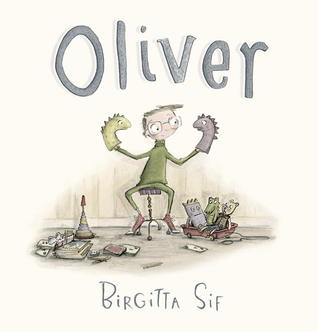
From Ferdinand to Frederick, children have wonderful (often animal) picture book role models who express the value in accepting yourself. And of course that message is all well and good. Yet in reality, the self satisfaction found in cherishing your uniqueness sometimes fails to eclipse the loneliness that so often accompanies it. Take Oliver. Here’s a young person who doesn’t seem particularly plagued by the burden of his differentness. He’s not cursing a defect or suffering from taunts; he’s not asking a parent why he is the way he is. He rather enjoys his quiet, imaginative life. His playmates are his toys, plush animals whom he carts around the library and yard. Even surrounded by his boisterous family, Oliver prefers to retreat into his own world with these soft-hearted friends.
And with these playful illustrations, the reader may retreat with him. Notice the subtle glances of otherwise button eyes, the teasing suggestion of life from what reason would inform are inanimate objects: a tiny glimpse for us into the everyday magic Oliver experiences.
Until one day, it’s not enough for Oliver. His animal friends, heaped in a pile, don’t respond like they used to. Yes, Oliver likes the way he is, and isn’t purposefully ostracized for it. There’s no doubting of self here. What Oliver lacks is someone who sees the world like he sees it; someone who can appreciate him and share his fantastical world and adventures. By the book’s end and through a fateful moment, Oliver finds his someone: a someone who’s more than plush stuffing and button eyes. And as the reader turns back to pore over the warmly detailed illustrations, she discovers that Oliver’s new friend has been with him all along, present but unseen. More magic lives on these pages, and in Oliver’s world, than first meets the eye. And as Oliver discovers, magic begs to be shared.

 The Forest Queen
 Front Desk by Kelly Yang
 Josef is fleeing from 1930s Nazi Germany and the threat of concentration camps with his parents and s



 Butler's Pantry